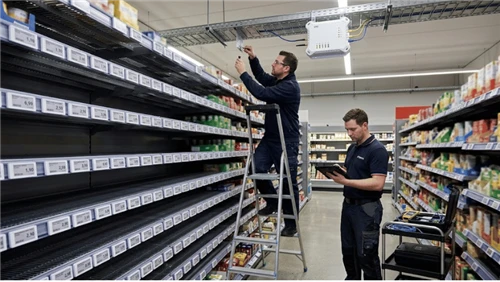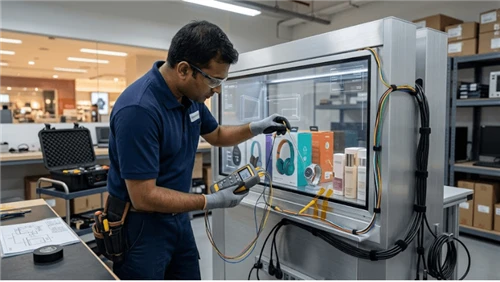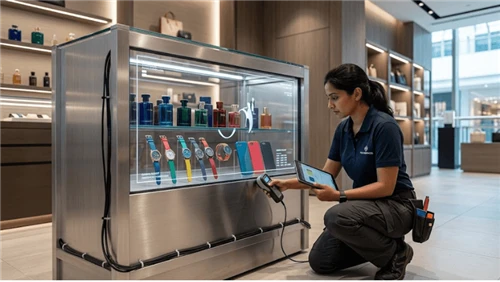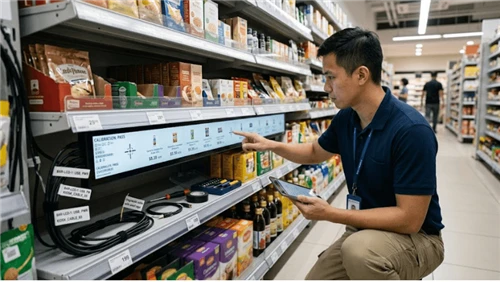
Electronic Shelf Labels for Grocery Stores: Fresh Food, Promotions, and Price Accuracy addresses a practical problem: how to apply ESLs to department-specific grocery workflows. The subject is easy to oversimplify because an electronic shelf label is visible, while the pricing data, software, wireless network, fixtures, operating roles, and exception controls behind it are not. A retailer can buy capable labels and still create a weak outcome if the product master is inconsistent, update confirmation is ignored, store ownership is unclear, or the business case counts benefits that were never measured.
The source page, "Electronic Shelf Labels for Grocery Stores," is used as a starting signal for search demand rather than as text to rewrite. This article independently organizes the topic around the reader's decision chain. It states what must be measured, what evidence is credible, which conditions can change the answer, and what output a team should produce before moving forward. Commercial claims are separated from standards, government guidance, retailer announcements, and transparent analytical assumptions.
The scope is deliberate: Fresh, center store, promotion, cold areas, accuracy, and controls; not a general vendor comparison. Adjacent topics such as medical labeling, algorithmic pricing strategy and generic market forecast are kept outside the core answer. Readers who need product options can review electronic shelf label solutions; readers who need an adjacent technical or operational topic will find internal links near the relevant section rather than a generic block of links.
Use Electronic Shelf Labels for Grocery Stores: Fresh Food, Promotions, and Price Accuracy as a working document, not as a substitute for store evidence. Record assumptions, retain test results, and update its model when store format, label quantity, wage rates, software scope, or service terms change. The outputs for this specific reader task-apply ESLs to department-specific grocery workflows-are designed so finance, operations, IT, procurement, and store teams can review the same evidence without using different definitions.
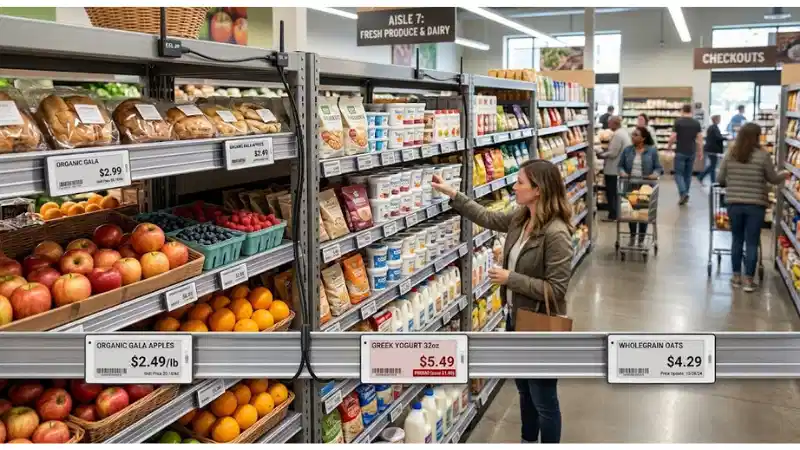
Why grocery needs department-level requirements
The strongest way to examine why grocery needs department-level requirements is to work backward from a retail consequence. Here, the conclusion is that why grocery needs department-level requirements should be converted into a measurable decision for electronic shelf labels for grocery stores, not left as a broad aspiration. The supporting fact is that the operational value of electronic shelf labels for grocery stores depends on data, people, fixtures, network behavior, and lifecycle support working together. This framing prevents a feature checklist from becoming a substitute for analysis. A feature has value only when it changes a named task, reduces a measured risk, improves a controlled information flow, or creates an option the retailer is prepared to operate. In this article, the why grocery needs department-level requirements checkpoint is evaluated specifically for electronic shelf labels for grocery stores, so the conclusion should not be transferred to a different scope without retesting.
Execution depends on evidence collected in the actual store environment rather than a showroom demonstration. FMI's digital shelf label fact discussion supports the distinction between label capability and grocery pricing practice, although its stated limitation must remain visible in the decision. The source does not remove the need for store evidence. Procurement should request configuration details, test logs, architecture boundaries, support processes, and examples of exception behavior. Operations should then verify those claims with its own data and fixtures. The result is a layered evidence model rather than trust in either a brochure or a single demonstration. For why grocery needs department-level requirements, the evidence record should remain traceable to the stated boundary of Electronic Shelf Labels for Grocery Stores: Fresh Food, Promotions, and Price Accuracy.
Do not ignore unclean master data, unconfirmed updates, fixture incompatibility and network dead zones. They determine whether the result remains valid outside the demonstration. The analysis should specify a supported range and a review trigger. It should also distinguish recoverable exceptions from conditions that require a different design. A short retry may solve a temporary transmission problem; it will not fix a wrong product mapping or a promotion rule that was approved with the wrong effective date. These conditions are recorded for the why grocery needs department-level requirements decision in electronic shelf labels for grocery stores, which makes this checkpoint distinct from the other sections of the analysis.
The section's deliverable is a rollout gate with objective evidence. Pair store-level adoption readiness with an error measure, a recovery measure, and a cost measure. A balanced set avoids local optimization. For example, faster updates are not an improvement if they produce more mismatches, create more associate interventions, or require an expensive support model that was excluded from the business case. The named deliverable for why grocery needs department-level requirements must therefore be reviewed against the article-specific objective: apply ESLs to department-specific grocery workflows.
Center-store price and promotion execution
The decision behind Center-store price and promotion execution is narrower than the headline suggests. For Supermarket operations, fresh-category managers, pricing teams, and store IT, the useful question is whether a useful cost decision compares lifecycle cash flows, not the sticker price of one label. The article therefore treats hardware size, display color, gateway density, software scope, integration, mounting, spares, cold-zone requirements, and support can move total cost independently. That distinction prevents a common failure: purchasing or planning around a capability statement while leaving the operational condition undefined. The working unit should be a store, department, workflow, or forecast assumption that can be observed and changed, not an abstract promise about digital transformation. In this article, the center-store price and promotion execution checkpoint is evaluated specifically for electronic shelf labels for grocery stores, so the conclusion should not be transferred to a different scope without retesting.
The mechanism is building a cost stack with common quantities, a common lifecycle, explicit exclusions, and sensitivity ranges. In practice, the team should name the authoritative input, record the event that starts the process, confirm the system response, and define the exception path. FMI's grocery shelf digitization article supports the grocery operating rationale for shelf digitization, although its stated limitation must remain visible in the decision. Evidence is strongest when the same definition is used in the baseline, pilot, supplier test, and business case; otherwise each group can report a different version of success. For center-store price and promotion execution, the evidence record should remain traceable to the stated boundary of Electronic Shelf Labels for Grocery Stores: Fresh Food, Promotions, and Price Accuracy.
Conditions can reverse the conclusion. Relevant variables include store size, SKU count, duplicate facings, promotion frequency, legacy system quality, installation windows, and expected service life. A result that works in one store format or one department should not be generalized until these variables are tested. The team should also separate a technical limit from a policy choice. A system may permit frequent updates, for example, while governance intentionally restricts who can approve them, when they become effective, and how shoppers are protected during partial failure. These conditions are recorded for the center-store price and promotion execution decision in electronic shelf labels for grocery stores, which makes this checkpoint distinct from the other sections of the analysis.
The practical output is a normalized total-cost worksheet and a list of quote clarifications. It should include an owner, evidence source, threshold, review date, and residual risk. One useful metric is update success rate, but it needs a denominator and a time window. A rate without the number of attempted updates, affected labels, or trading hours can hide the operational consequence. The output becomes decision-ready only when a reviewer can reproduce the calculation and trace the result to store evidence. The named deliverable for center-store price and promotion execution must therefore be reviewed against the article-specific objective: apply ESLs to department-specific grocery workflows.
Department requirement matrix
| Decision element | Required input | Evidence or test | Pass condition |
|---|---|---|---|
| Scope | Define the store, department, geography, or revenue layer for electronic shelf labels for grocery stores | Approved source list and boundary statement | No material category is silently added or removed |
| Baseline | Record the current time, error, cost, or adoption measure | Timestamped operational sample using a stated denominator | A reviewer can reproduce the baseline |
| System behavior | Specify data, display, network, and user response | Store test under normal and peak conditions | Target result is achieved and failures are visible |
| Lifecycle | Include software, support, spares, fixtures, and replacement work | Contract schedule and seven-year cash-flow model | No major recurring or end-of-life cost is excluded |
| Decision | Name the owner of the department requirement matrix | Signed decision record with residual risks | Go, revise, or stop is tied to evidence |
The department requirement matrix is a control surface for electronic shelf labels for grocery stores, not proof that the project will succeed. Its value is that it exposes missing inputs and prevents teams from comparing unlike scopes. Change its rows when the article's conditions change, retain the evidence behind each cell, and record why the pass threshold for this specific decision tool was selected.
Fresh-category markdown and waste workflows
Retail teams often begin fresh-category markdown and waste workflows with a product discussion. A better starting point is the business decision: fresh-category markdown and waste workflows should be converted into a measurable decision for electronic shelf labels for grocery stores, not left as a broad aspiration. That reframing matters because the operational value of electronic shelf labels for grocery stores depends on data, people, fixtures, network behavior, and lifecycle support working together. It also keeps the scope aligned with the article's boundary. The goal is not to describe every possible feature; it is to identify the few inputs that determine whether the intended retail outcome is plausible, measurable, and supportable over the system life. In this article, the fresh-category markdown and waste workflows checkpoint is evaluated specifically for electronic shelf labels for grocery stores, so the conclusion should not be transferred to a different scope without retesting.
A sound design uses a measured baseline followed by a limited change and an explicit acceptance threshold. The sequence should be visible in a process map, not buried in vendor configuration. GS1's retail 2D implementation guidance supports the link between data, automation, recalls, and stock processes, although its stated limitation must remain visible in the decision. The source establishes a useful boundary, but the retailer still has to translate it into local requirements, data fields, operating roles, test cases, and escalation rules. This translation step is where a general technology claim becomes a store control. For fresh-category markdown and waste workflows, the evidence record should remain traceable to the stated boundary of Electronic Shelf Labels for Grocery Stores: Fresh Food, Promotions, and Price Accuracy.
Several conditions deserve explicit treatment: fixture incompatibility, network dead zones, unclear ownership and overstated savings. Each should be written as an assumption that can be verified. If an assumption is unknown, the pilot must expose it rather than quietly replacing it with a favorable estimate. Teams should also identify who bears the consequence of failure: a shopper, an associate, the pricing desk, IT support, or a supplier. Consequence determines the necessary control strength. These conditions are recorded for the fresh-category markdown and waste workflows decision in electronic shelf labels for grocery stores, which makes this checkpoint distinct from the other sections of the analysis.
The section should leave the reader with a named owner and escalation path. Track price mismatch incidents alongside one quality measure and one recovery measure. This prevents an efficiency metric from rewarding speed while hiding errors or rework. A useful review asks what changed, what did not change, whether the result persisted outside the test window, and whether the operating team can sustain it without project specialists. The named deliverable for fresh-category markdown and waste workflows must therefore be reviewed against the article-specific objective: apply ESLs to department-specific grocery workflows.
A final control for this part of the decision is to connect the evidence to the next operating document. The related fresh-category markdown and waste workflows resource can hold the adjacent depth, while the current article retains the boundary defined above. This prevents duplicate explanations and gives the owner a clear place to maintain specifications, calculations, or troubleshooting steps as the system changes.
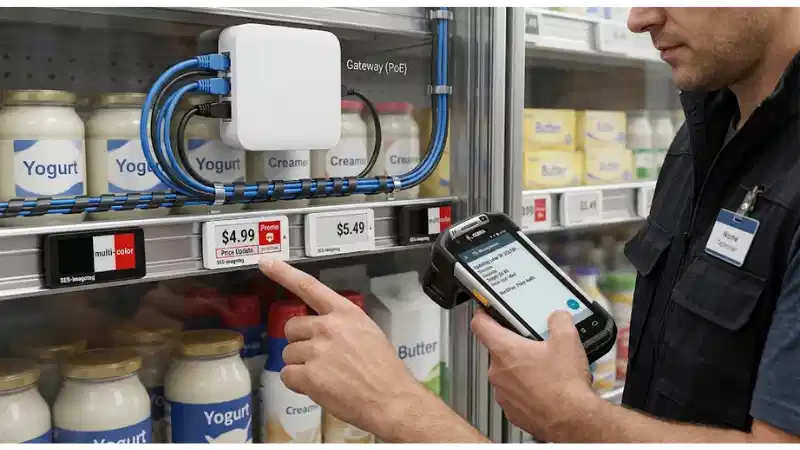
Chillers, freezers, and environmental testing
Chillers, freezers, and environmental testing becomes actionable when the team states the conclusion it is trying to prove: a pilot is valuable only when it tests the conditions that could stop scale and produces pre-agreed evidence for a decision. The reason is straightforward: large retail rollouts connect labels to pricing, inventory, fulfillment, and associate workflows, making organizational repeatability as important as device performance. Without that statement, suppliers can answer with attractive specifications that do not resolve the buyer's actual uncertainty. A decision document should therefore begin with the expected store behavior, the evidence required, and the condition that would cause the team to reject or redesign the idea. In this article, the chillers, freezers, and environmental testing checkpoint is evaluated specifically for electronic shelf labels for grocery stores, so the conclusion should not be transferred to a different scope without retesting.
The operating logic is baseline measurement, representative store selection, staged installation, acceptance thresholds, control comparison, defect closure, and rollout gates. the NIST Office of Weights and Measures supports the importance of transparent and fair retail transactions, although its stated limitation must remain visible in the decision. Use the source to define a credible starting point, then test the translation into the retailer's architecture. The evidence chain should connect source data, transformation rules, transmission, endpoint state, and human response. Missing one link creates a blind spot where a technically successful update can still deliver the wrong information or arrive too late to support the workflow. For chillers, freezers, and environmental testing, the evidence record should remain traceable to the stated boundary of Electronic Shelf Labels for Grocery Stores: Fresh Food, Promotions, and Price Accuracy.
The main exceptions are store archetype, legacy systems, fixture mix, network density, field capacity, training, and support coverage. These are not footnotes; they are variables that determine scope, cost, and risk. A design should show which conditions are supported, which require modification, and which are outside the approved use case. When the condition changes, the team should know whether the answer changes because of physics, software, data quality, staffing, policy, or commercial terms. These conditions are recorded for the chillers, freezers, and environmental testing decision in electronic shelf labels for grocery stores, which makes this checkpoint distinct from the other sections of the analysis.
End the analysis with a go, revise, or stop decision supported by measured results. The record should also define labor minutes per change batch, the sampling method, and the escalation threshold. Evidence should be collected during normal trading, high-load periods, and at least one controlled failure. That combination shows not only whether the system can work, but whether the organization can detect, diagnose, and recover when it does not. The named deliverable for chillers, freezers, and environmental testing must therefore be reviewed against the article-specific objective: apply ESLs to department-specific grocery workflows.
Fresh markdown workflow
- Define the exact decision and boundary for electronic shelf labels for grocery stores.
- Capture the current-state baseline with a denominator and time window.
- Prepare source data, roles, test fixtures, and escalation paths.
- Run the change in a representative store or controlled scenario.
- Confirm endpoint results and route every exception to an owner.
- Compare the result with pass thresholds and lifecycle economics.
- Record a go, revise, or stop decision and schedule the next review.
The fresh markdown workflow sequence for electronic shelf labels for grocery stores is intentionally evidence-led. Skipping its baseline makes benefit claims unverifiable; skipping endpoint confirmation hides partial failure; skipping the decision record allows activity to drift into rollout without approval. Add local controls where price law, pharmacy procedure, cybersecurity, or store trading risk requires them.
Unit pricing and shopper readability
The strongest way to examine unit pricing and shopper readability is to work backward from a retail consequence. Here, the conclusion is that shopper trust depends on consistent prices, understandable information, visible remedies, and disciplined policy rather than on the display medium alone. The supporting fact is that industry and retailer sources describe accuracy and information benefits, while consumer concern often focuses on how quickly retailers could change prices. This framing prevents a feature checklist from becoming a substitute for analysis. A feature has value only when it changes a named task, reduces a measured risk, improves a controlled information flow, or creates an option the retailer is prepared to operate. In this article, the unit pricing and shopper readability checkpoint is evaluated specifically for electronic shelf labels for grocery stores, so the conclusion should not be transferred to a different scope without retesting.
Execution depends on one authoritative price, effective-time controls, endpoint confirmation, exception handling, audit logs, and plain-language communication. FMI's grocery shelf digitization article supports the grocery operating rationale for shelf digitization, although its stated limitation must remain visible in the decision. The source does not remove the need for store evidence. Procurement should request configuration details, test logs, architecture boundaries, support processes, and examples of exception behavior. Operations should then verify those claims with its own data and fixtures. The result is a layered evidence model rather than trust in either a brochure or a single demonstration. For unit pricing and shopper readability, the evidence record should remain traceable to the stated boundary of Electronic Shelf Labels for Grocery Stores: Fresh Food, Promotions, and Price Accuracy.
Do not ignore unit pricing, promotions, loyalty prices, local rules, accessibility, app synchronization, and partial system outages. They determine whether the result remains valid outside the demonstration. The analysis should specify a supported range and a review trigger. It should also distinguish recoverable exceptions from conditions that require a different design. A short retry may solve a temporary transmission problem; it will not fix a wrong product mapping or a promotion rule that was approved with the wrong effective date. These conditions are recorded for the unit pricing and shopper readability decision in electronic shelf labels for grocery stores, which makes this checkpoint distinct from the other sections of the analysis.
The section's deliverable is a trust control loop and a shopper-facing exception response. Pair offline-label count with an error measure, a recovery measure, and a cost measure. A balanced set avoids local optimization. For example, faster updates are not an improvement if they produce more mismatches, create more associate interventions, or require an expensive support model that was excluded from the business case. The named deliverable for unit pricing and shopper readability must therefore be reviewed against the article-specific objective: apply ESLs to department-specific grocery workflows.
Online-to-shelf price consistency
The decision behind Online-to-shelf price consistency is narrower than the headline suggests. For Supermarket operations, fresh-category managers, pricing teams, and store IT, the useful question is whether a useful cost decision compares lifecycle cash flows, not the sticker price of one label. The article therefore treats hardware size, display color, gateway density, software scope, integration, mounting, spares, cold-zone requirements, and support can move total cost independently. That distinction prevents a common failure: purchasing or planning around a capability statement while leaving the operational condition undefined. The working unit should be a store, department, workflow, or forecast assumption that can be observed and changed, not an abstract promise about digital transformation. In this article, the online-to-shelf price consistency checkpoint is evaluated specifically for electronic shelf labels for grocery stores, so the conclusion should not be transferred to a different scope without retesting.
The mechanism is building a cost stack with common quantities, a common lifecycle, explicit exclusions, and sensitivity ranges. In practice, the team should name the authoritative input, record the event that starts the process, confirm the system response, and define the exception path. the NIST Office of Weights and Measures supports the importance of transparent and fair retail transactions, although its stated limitation must remain visible in the decision. Evidence is strongest when the same definition is used in the baseline, pilot, supplier test, and business case; otherwise each group can report a different version of success. For online-to-shelf price consistency, the evidence record should remain traceable to the stated boundary of Electronic Shelf Labels for Grocery Stores: Fresh Food, Promotions, and Price Accuracy.
Conditions can reverse the conclusion. Relevant variables include store size, SKU count, duplicate facings, promotion frequency, legacy system quality, installation windows, and expected service life. A result that works in one store format or one department should not be generalized until these variables are tested. The team should also separate a technical limit from a policy choice. A system may permit frequent updates, for example, while governance intentionally restricts who can approve them, when they become effective, and how shoppers are protected during partial failure. These conditions are recorded for the online-to-shelf price consistency decision in electronic shelf labels for grocery stores, which makes this checkpoint distinct from the other sections of the analysis.
The practical output is a normalized total-cost worksheet and a list of quote clarifications. It should include an owner, evidence source, threshold, review date, and residual risk. One useful metric is time to resolve exceptions, but it needs a denominator and a time window. A rate without the number of attempted updates, affected labels, or trading hours can hide the operational consequence. The output becomes decision-ready only when a reviewer can reproduce the calculation and trace the result to store evidence. The named deliverable for online-to-shelf price consistency must therefore be reviewed against the article-specific objective: apply ESLs to department-specific grocery workflows.
A final control for this part of the decision is to connect the evidence to the next operating document. The related online-to-shelf price consistency resource can hold the adjacent depth, while the current article retains the boundary defined above. This prevents duplicate explanations and gives the owner a clear place to maintain specifications, calculations, or troubleshooting steps as the system changes.
Cold-zone test plan
- Define the exact decision and boundary for electronic shelf labels for grocery stores.
- Capture the current-state baseline with a denominator and time window.
- Prepare source data, roles, test fixtures, and escalation paths.
- Run the change in a representative store or controlled scenario.
- Confirm endpoint results and route every exception to an owner.
- Compare the result with pass thresholds and lifecycle economics.
- Record a go, revise, or stop decision and schedule the next review.
The cold-zone test plan sequence for electronic shelf labels for grocery stores is intentionally evidence-led. Skipping its baseline makes benefit claims unverifiable; skipping endpoint confirmation hides partial failure; skipping the decision record allows activity to drift into rollout without approval. Add local controls where price law, pharmacy procedure, cybersecurity, or store trading risk requires them.
Exception handling during high-volume changes
Retail teams often begin exception handling during high-volume changes with a product discussion. A better starting point is the business decision: exception handling during high-volume changes should be converted into a measurable decision for electronic shelf labels for grocery stores, not left as a broad aspiration. That reframing matters because the operational value of electronic shelf labels for grocery stores depends on data, people, fixtures, network behavior, and lifecycle support working together. It also keeps the scope aligned with the article's boundary. The goal is not to describe every possible feature; it is to identify the few inputs that determine whether the intended retail outcome is plausible, measurable, and supportable over the system life. In this article, the exception handling during high-volume changes checkpoint is evaluated specifically for electronic shelf labels for grocery stores, so the conclusion should not be transferred to a different scope without retesting.
A sound design uses lifecycle planning that includes software, support, spares, batteries, fixtures, and replacement labor. The sequence should be visible in a process map, not buried in vendor configuration. FMI's digital shelf label fact discussion supports the distinction between label capability and grocery pricing practice, although its stated limitation must remain visible in the decision. The source establishes a useful boundary, but the retailer still has to translate it into local requirements, data fields, operating roles, test cases, and escalation rules. This translation step is where a general technology claim becomes a store control. For exception handling during high-volume changes, the evidence record should remain traceable to the stated boundary of Electronic Shelf Labels for Grocery Stores: Fresh Food, Promotions, and Price Accuracy.
Several conditions deserve explicit treatment: inconsistent effective times, support obligations that end too early, unclean master data and unconfirmed updates. Each should be written as an assumption that can be verified. If an assumption is unknown, the pilot must expose it rather than quietly replacing it with a favorable estimate. Teams should also identify who bears the consequence of failure: a shopper, an associate, the pricing desk, IT support, or a supplier. Consequence determines the necessary control strength. These conditions are recorded for the exception handling during high-volume changes decision in electronic shelf labels for grocery stores, which makes this checkpoint distinct from the other sections of the analysis.
The section should leave the reader with a documented residual-risk register. Track promotion execution accuracy alongside one quality measure and one recovery measure. This prevents an efficiency metric from rewarding speed while hiding errors or rework. A useful review asks what changed, what did not change, whether the result persisted outside the test window, and whether the operating team can sustain it without project specialists. The named deliverable for exception handling during high-volume changes must therefore be reviewed against the article-specific objective: apply ESLs to department-specific grocery workflows.
A grocery rollout sequence that protects trading
A grocery rollout sequence that protects trading becomes actionable when the team states the conclusion it is trying to prove: a pilot is valuable only when it tests the conditions that could stop scale and produces pre-agreed evidence for a decision. The reason is straightforward: large retail rollouts connect labels to pricing, inventory, fulfillment, and associate workflows, making organizational repeatability as important as device performance. Without that statement, suppliers can answer with attractive specifications that do not resolve the buyer's actual uncertainty. A decision document should therefore begin with the expected store behavior, the evidence required, and the condition that would cause the team to reject or redesign the idea. In this article, the a grocery rollout sequence that protects trading checkpoint is evaluated specifically for electronic shelf labels for grocery stores, so the conclusion should not be transferred to a different scope without retesting.
The operating logic is baseline measurement, representative store selection, staged installation, acceptance thresholds, control comparison, defect closure, and rollout gates. Walmart's 2024 rollout announcement supports the operational breadth of a large retailer rollout, although its stated limitation must remain visible in the decision. Use the source to define a credible starting point, then test the translation into the retailer's architecture. The evidence chain should connect source data, transformation rules, transmission, endpoint state, and human response. Missing one link creates a blind spot where a technically successful update can still deliver the wrong information or arrive too late to support the workflow. For a grocery rollout sequence that protects trading, the evidence record should remain traceable to the stated boundary of Electronic Shelf Labels for Grocery Stores: Fresh Food, Promotions, and Price Accuracy.
The main exceptions are store archetype, legacy systems, fixture mix, network density, field capacity, training, and support coverage. These are not footnotes; they are variables that determine scope, cost, and risk. A design should show which conditions are supported, which require modification, and which are outside the approved use case. When the condition changes, the team should know whether the answer changes because of physics, software, data quality, staffing, policy, or commercial terms. These conditions are recorded for the a grocery rollout sequence that protects trading decision in electronic shelf labels for grocery stores, which makes this checkpoint distinct from the other sections of the analysis.
End the analysis with a go, revise, or stop decision supported by measured results. The record should also define battery-health exceptions, the sampling method, and the escalation threshold. Evidence should be collected during normal trading, high-load periods, and at least one controlled failure. That combination shows not only whether the system can work, but whether the organization can detect, diagnose, and recover when it does not. The named deliverable for a grocery rollout sequence that protects trading must therefore be reviewed against the article-specific objective: apply ESLs to department-specific grocery workflows.
Price accuracy audit
- The scope and excluded adjacent topics are written down.
- The source of product, price, promotion, and location data is named.
- The success metric includes a denominator, sampling method, and time window.
- Store fixtures, temperature, lighting, and radio conditions are represented.
- Failed or delayed updates create an observable exception.
- Security, support, software, spares, and end-of-life work are included.
- A named person can approve, pause, roll back, and close the decision.
- Claims presented to executives or shoppers remain within the evidence.
For the price accuracy audit in this electronic shelf labels for grocery stores decision, a checked box means the evidence exists and has been reviewed; it does not mean the item was merely discussed. Attach the relevant report, contract clause, screenshot, data extract, or signed test result. Items that cannot be evidenced belong in this article's risk register or the next pilot cycle.
Decision-ready next step
The central judgment in Electronic Shelf Labels for Grocery Stores: Fresh Food, Promotions, and Price Accuracy is not whether electronic labels are modern or popular. It is whether the proposed system can produce the article-specific outcome-apply ESLs to department-specific grocery workflows-under the store's real data, fixture, network, staffing, policy, and lifecycle conditions. The strongest decision starts with a bounded task, converts claims into tests, separates direct savings from uncertain benefits, and records the exceptions that could reverse the conclusion.
For Electronic Shelf Labels for Grocery Stores: Fresh Food, Promotions, and Price Accuracy, build the next action around one named artifact from this article: Department requirement matrix, Fresh markdown workflow, Cold-zone test plan, or Price accuracy audit. Assign an owner and a review date. For adjacent depth, use the related electronic shelf label resource rather than expanding the current scope until it loses its decision focus. A supplier conversation is productive when both sides can point to the same requirements, evidence, and pass conditions.