Switching from paper price tags to electronic shelf labels sounds like a smart move - but how do you know it actually pays off? That is the question every retail manager, procurement lead, or store owner asks before signing off on an ESL deployment. The answer starts with a proper ROI calculation.
This guide walks you through a practical ESL ROI calculator framework. No vague promises, just real numbers you can plug in for your own store. By the end, you will know exactly what to measure, how to calculate your payback period, and where the biggest savings come from.
Why You Need an ESL ROI Calculator Before You Buy
Electronic shelf labels are not cheap. A full-store deployment can cost anywhere from $15,000 for a small specialty shop to over $100,000 for a large supermarket, depending on store size, label count, and the mix of E-ink price tags and LCD digital signage displays you choose.
Without a clear ROI picture, ESL projects stall in the approval stage. Finance teams want to see payback timelines, not marketing brochures. An ESL ROI calculator gives you the hard numbers - annual savings, cost reduction per store, and the month your investment turns positive.
Step-by-Step: Build Your Own ESL ROI Calculation
You do not need a fancy spreadsheet. Here is a straightforward four-step process any retailer can follow.
Step 1: Calculate Your Current Paper Label Costs
Start by adding up what you actually spend on manual pricing today. Most retailers underestimate this number because the costs are spread across multiple budget lines.
Labor cost: How many hours per week does your staff spend printing, cutting, sorting, and placing paper labels? Multiply that by your average hourly wage, then annualize it. A mid-sized grocery store typically dedicates 10 to 15 hours per week to price tag changes - that translates to $12,000–$18,000 per year in labor alone.
Material cost: Paper, ink cartridges, label stock, printer maintenance. This typically runs $1,500–$3,000 per year per store.
Error cost: Pricing errors cause two kinds of losses. First, underpriced items that sell below the intended margin. Second, overpriced items that trigger customer complaints and potential compliance fines. Industry data suggests pricing inaccuracies cost retailers 0.5%–1% of revenue annually.
Add these three together. That is your annual paper labeling cost - the baseline your electronic shelf label system needs to beat.
Step 2: Estimate Your ESL System Investment
Your total ESL cost has several components:
Hardware: The digital price tags themselves - from compact 2.66-inch E-ink labels for standard shelf edges to larger 7.3-inch electronic price tags for endcaps and featured products. Stores with high-value categories like electronics or wine may also deploy 10.1-inch LCD digital price screens for richer product storytelling.
Infrastructure: Communication gateways or access points that push price updates to the labels wirelessly. Most systems use one gateway per 500–1,000 square meters of retail space.
Software: The cloud-based or on-premise management platform that syncs your POS/ERP system with the labels. Some vendors include this in the hardware price; others charge an annual license.
Installation: Professional setup, label mounting, and system commissioning. Budget 10%–15% of hardware cost for installation.
Step 3: Quantify Your Annual Savings and Revenue Gains
This is where the ESL ROI calculator gets interesting. The savings come from multiple streams:
Labor savings (the big one): Electronic shelf labels reduce pricing update time by 80%–90%. If you were spending $15,000 per year on manual label changes, you save $12,000–$13,500 annually. Your staff can be redeployed to customer service, restocking, or merchandising - activities that directly drive sales.
Material elimination: No more paper, ink, or printer maintenance. That is $1,500–$3,000 saved every year.
Pricing accuracy gains: With 100% price compliance between POS and shelf, you stop losing margin on underpriced items and avoid the customer trust issues that come with overcharges. Conservative estimate: 0.3%–0.5% revenue recovery.
Dynamic pricing uplift: This is the benefit many retailers overlook. With digital price tags, you can run flash promotions, time-based markdowns for perishable goods, or competitor price matching - all instantly. Even a modest 1%–2% sales lift from dynamic pricing can add thousands in annual revenue. For a store doing $2 million per year, a 1% lift equals $20,000.
Step 4: Run the Numbers
Now apply the standard ROI formula:
Annual ROI = (Total Annual Savings − Annual ESL Cost) ÷ Total ESL Investment × 100%
Here is a real-world example for a mid-sized retail store with 5,000 SKUs:
Total ESL investment: $50,000 (including hardware, infrastructure, installation)
Annual software fee: $2,000
Annual labor savings: $13,000
Annual material savings: $2,500
Pricing accuracy recovery: $6,000
Dynamic pricing lift: $10,000
Total annual benefit: $31,500
First-year ROI: ($31,500 − $2,000) ÷ $50,000 = 59%
Payback period: $50,000 ÷ $29,500 = approximately 20 months
After the system pays for itself, you keep the full $29,500 in annual savings - and that number grows as you scale to additional locations.
ROI Factors That Vary by Retail Sector
Not all stores see the same return. Here is what drives differences across verticals:
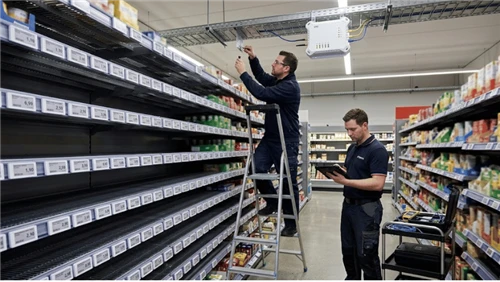
Grocery and supermarkets see the fastest payback because they have the highest frequency of price changes - often thousands per week due to promotions, fresh produce markdowns, and competitive adjustments. E-ink electronic shelf labels in the 4–6 inch range are the workhorse here.
Electronics and appliance stores benefit most from the dynamic pricing and enhanced product information angle. A 15.6-inch LCD electronic price screen next to a high-margin product can loop product demos, display comparison specs, and show real-time promotions - that is not just a label, it is a point-of-sale marketing tool.
Pharmacies gain on accuracy and compliance. Drug pricing regulations mean errors carry outsized risk. Mid-sized E-ink tags handle the dense SKU environment well, and the compliance savings alone can justify the investment.
Hardware and home improvement stores manage tens of thousands of SKUs with infrequent but labor-intensive price changes. The labor savings per update are high because staff physically walk large floor areas to swap tags.
Hidden ROI Drivers Most Calculators Miss
Beyond the direct cost savings, a few often-overlooked factors improve your real-world return:
Reduced employee turnover. Staff hate tedious label-changing work. Removing it improves job satisfaction and retention, which cuts recruitment and training costs.
Faster planogram resets. When a product moves shelves, its digital label updates automatically. No one needs to reprint, sort, and rehang paper tags during a layout change.
Sustainability and brand image. Eliminating thousands of paper labels per year supports your environmental goals. For retailers with ESG commitments, this has tangible brand value.
Omnichannel price consistency. When your shelf price matches your online price in real time, you eliminate one of the biggest friction points in the modern retail experience.
How to Choose the Right ESL Hardware for Maximum ROI
Your ROI depends heavily on matching the right label type to each use case. Overspending on large screens where a small tag suffices - or underinvesting in key promotional spots - can skew your numbers.
For standard shelf pricing with high SKU counts, compact 2.66-inch or 4.2-inch E-ink digital price tags deliver the best cost-per-label. For endcaps, feature walls, and high-value categories, 7.3-inch E-ink labels or LCD electronic price screens justify their higher unit cost through increased shopper engagement and conversion.
Retailers looking for a complete in-store digital transformation can combine ESL with LCD bar display screens for aisle-level signage and self-service kiosk displays for interactive customer touchpoints - all managed through a unified digital retail solution.
Start Your ESL ROI Calculation Today
The formula is straightforward. The data is already in your POS reports and payroll records. Once you plug in your actual labor hours, material costs, and error rates, the ROI story typically writes itself - most retailers see a full payback in 18 to 24 months, with savings compounding every year after.
If you are evaluating electronic shelf label options and want to discuss which product mix delivers the best return for your store format, request a quote and our team will help you build a customized deployment plan.