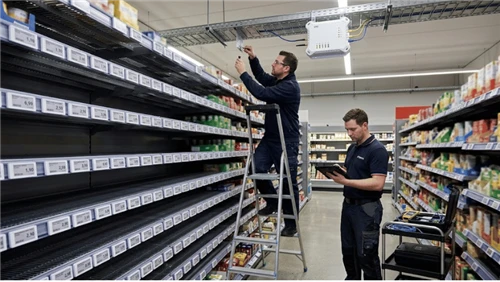
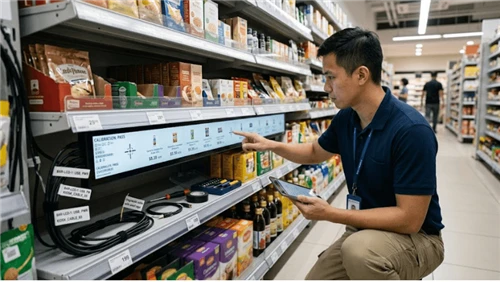
Supermarket electronic price tags - also called electronic shelf labels (ESLs) - replace paper shelf tags with wirelessly updated e-ink or LCD displays. In high-SKU grocery environments, they cut pricing-related labor substantially (independent retailer accounts and vendor-commissioned studies report reductions in the 60–80% range), eliminate shelf-to-checkout price discrepancies, and typically pay back deployment cost within 12 to 24 months. Walmart has rolled them out across roughly 2,300 U.S. stores, with European chains running adoption above 80%. The technology is now mainstream enough that retailers still on paper are increasingly working at a structural disadvantage.
Walk the dairy aisle at a Whole Foods or Amazon Fresh location today and the small screens mounted at shelf edge look almost identical to paper tags - until you watch a promotion go live and every affected label updates simultaneously, with no associate touching a thing. That shift from physical to digital at the shelf edge is not cosmetic. It restructures one of the most labor-intensive and error-prone workflows in grocery retail, across every department, every SKU, every operating hour.
The global market for electronic shelf labels was valued at approximately $1.85 billion in 2024 and is projected to reach $7.54 billion by 2033, according to Grand View Research's electronic shelf label market report. That growth reflects a technology hitting an inflection point rather than emerging novelty. The question for supermarket operators evaluating an investment today is no longer whether ESLs work - it's whether they work for a specific store format, at what cost, and what operational changes are required to actually deliver on the promise.
This guide draws on Legoyo's deployment experience across more than 10,000 retail display projects in over 40 countries. It covers how modern supermarket electronic price tags function, where ROI actually comes from, which store formats benefit most, the technology stack as it stands in 2026, and what to evaluate before signing with a vendor.
How Electronic Shelf Label Systems Work in a Supermarket Environment
An electronic shelf label is not a single product. It's a four-layer system: the display unit on the shelf rail, wireless gateways that push updates to those displays, a management platform that controls pricing and content, and backend integrations with the retailer's point-of-sale and inventory systems.
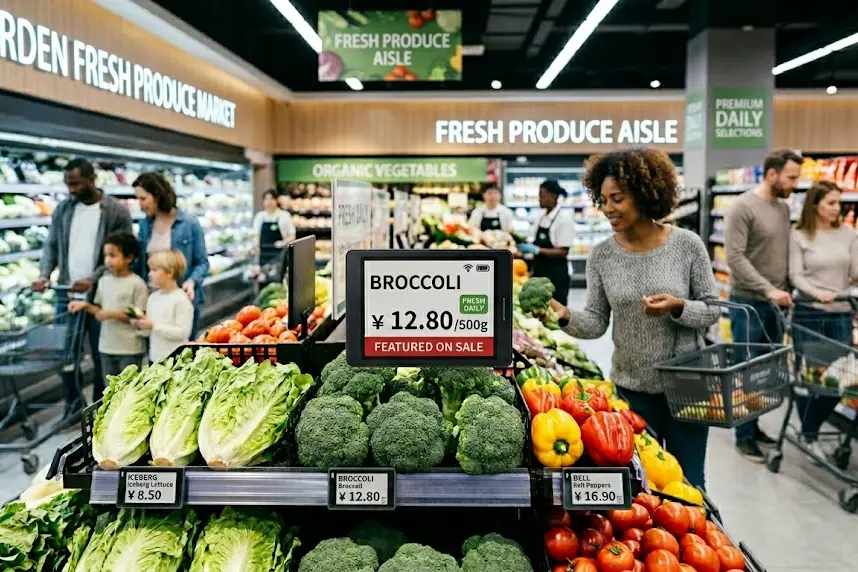
The display technology dominating grocery deployments is e-ink - the same electrophoretic display used in e-readers. E-ink draws power only when the image changes, which is why battery life on current-generation labels typically runs five to seven years without replacement. The display reads cleanly under store lighting at any angle, and the absence of a backlight keeps the visual environment calm in a way LCD screens often don't.
For grocery operators evaluating hardware specifically, Legoyo's ESL hardware lineup covers both standard e-ink configurations and higher-brightness LCD options for fresh food, wine, and promotional zones where color rendering matters more than energy efficiency.
Updates move through the system in a predictable chain. A pricing manager changes a price in the central software - or the change is triggered automatically by a rule tied to inventory level, time of day, or a promotional schedule. The platform pushes that update to the relevant gateway, which transmits it wirelessly to every affected label in coverage. For a store with 10,000 SKUs, a complete price update cycle finishes in under two minutes on current systems. The same task under a paper workflow takes three to four hours of associate time.
Retailers wanting a more granular look at the system architecture - gateway placement, software integration, deployment pitfalls - can work through the technical breakdown of ESL system layers for the implementation-level detail this article doesn't cover.
The Real ROI Drivers Behind ESL Deployments
Labor savings on pricing tasks are the most immediate and measurable return. In a mid-size grocery store running a weekly promotional cycle, the cumulative hours spent printing, sorting by aisle, walking, and swapping paper tags consume a significant share of available staff time - and unlike customer service or restocking, none of that work creates revenue or improves the shopping experience.
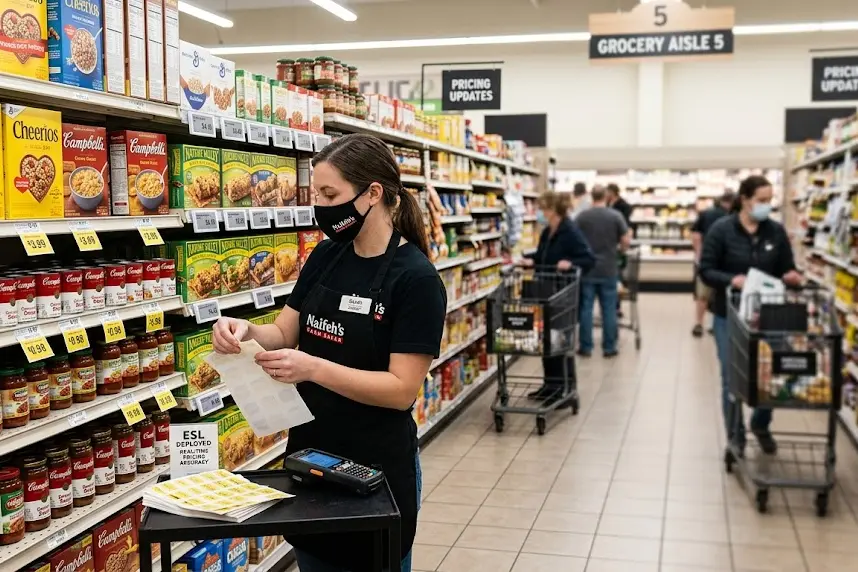
The case that's been most widely documented is Naifeh's Cash Saver, an independent grocer in Covington, Tennessee. As reported by NPR, the store was processing up to 2,000 price changes per week under its paper system, consuming roughly 50 labor hours. After deploying ESLs, that same task collapsed to under three minutes. The hours moved to floor service and order fulfillment.
A vendor-commissioned study by Pricer - one of the major ESL platform providers, so the data should be read with that disclosure in mind - found retailers implementing ESLs saw an average 20% reduction in total in-store labor costs. The pricing-specific effect is more concentrated: in stores with high price-change volumes, the pricing task essentially disappears as a staffing line item. Payback for most mid-size grocery deployments lands in the 12 to 24 month range when labor savings, error reduction, and paper elimination are summed.
Pricing accuracy is the second major driver. Shelf-to-checkout discrepancies - where a tag shows one price and the register rings another - generate customer complaints, regulatory exposure in states with unit pricing laws, and direct markdown losses when the lower price has to be honored at checkout. ESLs eliminate the lag that creates those discrepancies because shelf and POS draw from the same live data source. European chains including Auchan and Carrefour have reported measurable reductions in checkout disputes after rollout.
The third ROI dimension takes longer to materialize but compounds over time: paper and consumables elimination. A store running frequent promotional cycles spends continuously on label stock, printer maintenance, and the labor to manage the print-and-sort workflow. After deployment that line item disappears, and the savings accrue across the label's full hardware life.
For retailers wanting to model these numbers against their own paper system, the cost-side comparison of paper versus electronic labels walks through the variables at each store size.
Beyond Pricing: What Modern Supermarket Electronic Price Tags Can Display
Early ESL deployments used the labels for one thing: showing a price. Current systems are substantially more capable, and the expanded functionality is often what tips the ROI math for mid-size operators who would otherwise find the per-unit hardware cost hard to justify against labor savings alone.
The features that see regular production use include:
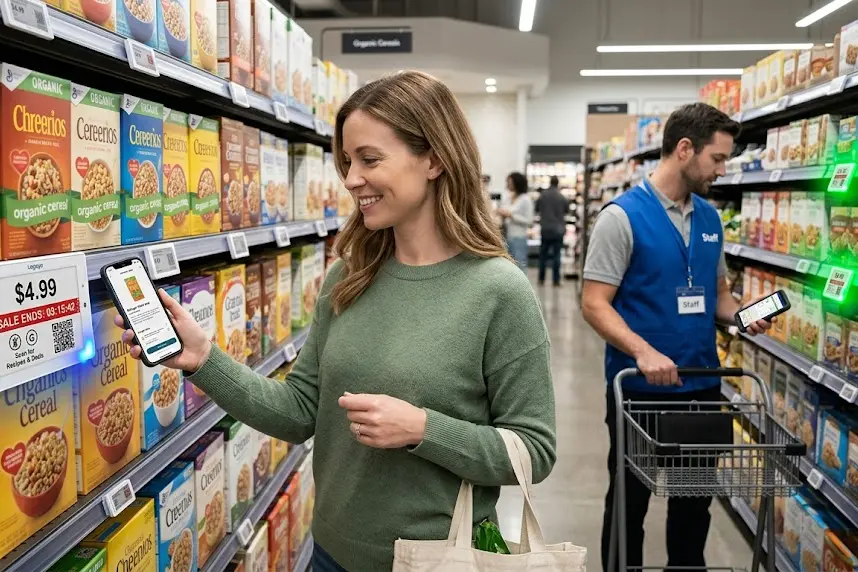
- Promotional pricing and countdown timers - flash sales and time-limited offers run on a schedule, with no associate involvement at shelf level.
- Allergen declarations and country-of-origin labeling - compliance information that updates centrally across all affected SKUs, which matters significantly in jurisdictions with specific shelf disclosure requirements.
- QR codes - linking shoppers to manufacturer pages, recipes, reviews, or loyalty offers pulled up on their own phones, bridging shelf and digital research behavior.
- LED flash signals - triggered remotely by an associate's mobile app, guiding staff to the exact shelf location of a product for restocking or online order picking. Walmart calls this "pick to light" and has cited it as a primary adoption driver alongside pricing labor savings, according to the company's 2024 announcement of its chain-wide rollout.
- Stock-level alerts - displayed on the label itself, flagging low facings to floor staff without a manual scan or radio call.
- NFC tap interaction - on equipped models, letting a shopper's phone pull up extended product content with a single tap of the label surface.
The pick-to-light function has become particularly important as click-and-collect orders take a growing share of grocery revenue. Routing a picker accurately and quickly through a large-format store has shifted from a convenience to an operational necessity. Legoyo's electronic price screen digital signage models cover the multi-function configurations built specifically for these hybrid pricing-and-fulfillment use cases.
Which Supermarket Formats Get the Strongest Returns from ESL
Electronic price tags deliver uneven returns depending on store format, SKU count, and pricing frequency. Setting realistic expectations on this point before deployment matters more than most retailers initially appreciate.
Large-format grocery stores - full-service supermarkets above 25,000 square feet with 10,000 or more SKUs - represent the strongest use case. The combination of high weekly price-change volume, complex promotional cycles, and large physical footprint creates conditions where labor savings are largest and fastest to materialize. This is why the major chains deploying ESLs are disproportionately large-format: Walmart, Kroger, Whole Foods, and their European counterparts Lidl, Carrefour, and Auchan all operate at scales where the math works clearly.
Specialty food retailers - wine shops, cheese counters, organic grocers - make a different but compelling case. These formats often carry high-value products where additional shelf-edge information (origin, tasting notes, pairing suggestions) meaningfully influences purchase decisions. Color ESLs that can render rich content and link to deeper information pages often produce measurable lift in average transaction value, independent of any labor savings argument.
Convenience stores and small-format operators sit in the harder zone. With lower SKU counts and less frequent price changes, labor savings weaken and the per-label capital cost gets harder to amortize. ESLs still pay back in these formats, but the timeline stretches and the case rests more on accuracy and dynamic promotion capability than on labor reduction.
The 2026 ESL Technology Stack: E-Ink, Wireless Protocols, and Software
The ESL market has consolidated significantly over the past three years. The dominant display technology is e-ink - specifically second and third-generation e-paper supporting full four-color rendering, not just the black-and-white displays that defined early deployments. Color capability matters because it enables promotional content, origin branding, and category-level visual differentiation that monochrome can't deliver without sacrificing readability.
Wireless communication has stratified by use case. Most current deployments run on 2.4GHz proprietary protocols or 868/915MHz radio frequency bands, chosen for reliability in the dense metal-shelf environments where Wi-Fi degrades. Some enterprise platforms have moved to NB-IoT (Narrowband IoT) for large-campus or multi-building deployments. Gateway infrastructure has gotten simpler - current units typically cover 1,000 to 1,500 labels each depending on label update frequency and the store's RF environment, requiring fewer access points than earlier generations.
The software layer has arguably changed more than the hardware. Modern ESL management platforms function less like label controllers and more like shelf-edge content management systems: scheduling, rule-based automation, API connections to ERP and inventory, analytics dashboards surfacing pricing compliance data and update confirmation logs. Retailers evaluating vendors should scrutinize the software platform with the same rigor as the hardware specs. The integration quality and update confirmation reliability are what determine whether operational gains actually show up in practice.
The vendor landscape has consolidated around a handful of platform providers - SES-imagotag (now VusionGroup), Pricer, Hanshow, and SoluM dominate global volume, with a growing tier of regional and specialist suppliers serving formats the majors don't prioritize. Hardware-focused suppliers like Legoyo work alongside these platforms to deliver display configurations matched to specific retail environments, particularly for retailers wanting more control over hardware sourcing than the major platforms typically allow.
For retailers comparing specifications, display technologies, and connectivity protocols before narrowing down a shortlist, a vendor evaluation framework with real cost benchmarks lays out the decision variables in detail.
ESL Integration with POS and ERP: Where Most Deployments Stumble
The most common failure mode in ESL deployments isn't hardware. It's integration. Specifically, it's the gap between what the central pricing database actually contains and what the retailer assumed it contained.
ESLs display exactly what's in the source data. When that data is clean and well-structured, the system works as advertised. When it isn't - and item master data in grocery operations is notoriously inconsistent - those issues surface immediately on the labels and become highly visible. Inconsistent product descriptions, missing weight or unit fields, non-standardized promotional pricing codes, duplicate SKUs that resolve to different items in different systems: any of these will produce wrong labels at scale on day one.
The integration architecture itself has matured. Pre-built connectors to common retail ERP systems - SAP for Retail, Oracle Retail Merchandising, Lightspeed, Microsoft Dynamics 365 Commerce - are available from most major platform providers and remove a significant chunk of integration risk. Retailers running custom or older POS systems should expect to budget for middleware development or a longer integration cycle. The piece worth pressure-testing during vendor evaluation is the update confirmation flow: when a price changes in the source system, the platform needs to confirm definitively which labels updated, which didn't, and why. Reliable logging on this dimension is a regulatory requirement in many jurisdictions and an operational necessity for managing a large-format store at scale.
The reverse direction matters too. Mature deployments push data back from the ESL platform into business intelligence layers - pricing compliance rates, label-level update success metrics, dynamic promotion performance - turning what was a passive display layer into an active source of operational data.
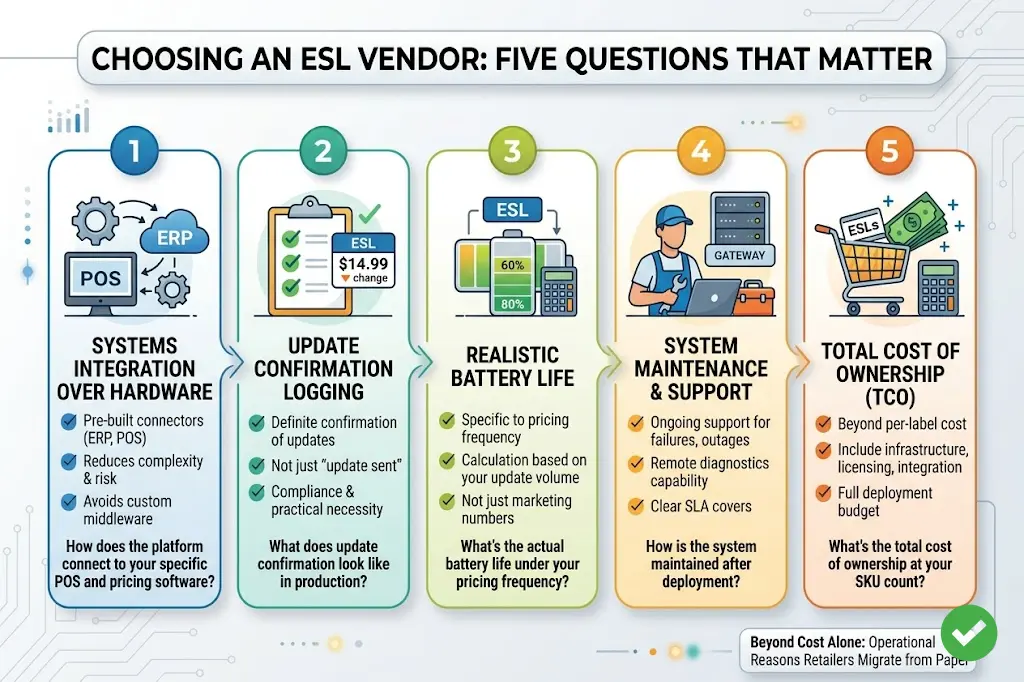
Choosing an ESL Vendor: Five Questions That Matter
Retailers who see the strongest returns share a common pattern: they treated implementation as a systems integration project, not a hardware purchase. The labels are the visible part. The operational value lives in how cleanly the platform connects to existing pricing and inventory systems, and in how well staff are trained on the new workflows.
The five questions worth pressure-testing before committing:
- How does the platform connect to your specific POS and pricing software? Pre-built connectors to your ERP dramatically reduce integration complexity and risk. A system that requires custom middleware adds cost, time, and ongoing maintenance burden.
- What does update confirmation look like in production? Enterprise deployments need to know definitively which labels updated and which didn't - not just that an update was sent. Confirmation logging is a compliance requirement in many jurisdictions and a practical necessity for stores running frequent scheduled changes.
- What's the actual battery life under your pricing frequency? Manufacturers quote battery life under standard-use assumptions. A store running six price changes per day per label drains batteries materially faster than one running two. Get the calculation specific to your update volume rather than the marketing number.
- How is the system maintained after deployment? Label failures, gateway outages, software updates - all of these require ongoing support. Evaluate remote diagnostics capability, hardware replacement process, and what the SLA actually covers in writing.
- What's the total cost of ownership at your SKU count? Per-label hardware cost is the starting point, not the full number. Add gateway infrastructure, installation labor, software licensing, integration work, and ongoing support to get a realistic deployment budget before comparing vendor quotes head-to-head.
For retailers wanting a more comprehensive view of the operational case beyond cost alone, the operational reasons retailers are migrating away from paper covers the broader argument independent of any specific vendor framework.
The Sustainability Case for Supermarket Electronic Price Tags
The environmental argument has gained traction as retailers face ESG reporting requirements and consumer pressure on sustainability commitments. A single mid-size supermarket running weekly promotional cycles can generate tens of thousands of paper label changes per year - paper printed, handled, and discarded within days. At chain level, the volume becomes material.
E-ink labels consume power only when the display content changes; between updates, draw is zero. Hardware is built for multi-year operational life before end-of-life disposal becomes relevant, and most current-generation labels are designed with recyclability in mind. Dynamic pricing enabled by ESLs also reduces food waste: a University of California, San Diego Rady School of Management study found that automated markdown pricing on perishables approaching expiration reduced food waste by up to 21% - a result with direct financial and sustainability implications for grocery operators.
For retailers building a sustainability case alongside the operational efficiency argument, paper elimination, energy efficiency, and waste reduction together produce a credible measurable contribution that quantifies cleanly in carbon accounting frameworks.
A Phased Deployment Framework That Actually Works
Most successful supermarket ESL deployments follow a phased approach rather than a single store-wide rollout. Starting with one or two high-velocity departments - typically the perimeter (deli, bakery, produce) or center-store categories with the highest weekly price-change volume - gives the implementation team time to validate POS integration, establish staff workflows, and identify data quality gaps before expanding system-wide.
Three patterns separate deployments that go well from ones that don't:
Run a data audit before deployment, not during. The retailers who treat data cleanup as a precondition consistently avoid the most common cause of go-live delays. Walking the SKU master, checking unit and weight consistency, standardizing promotional code structures - none of this is glamorous work, and all of it pays off the moment labels go live.
Plan for staff role redefinition, not just training. The associates who managed the print-and-swap workflow now operate on an exception-based model: their work shifts from executing every price change to monitoring update success and handling the small percentage that fail. Stores that frame the change as redefinition rather than just learning new buttons report faster adoption and higher staff satisfaction with the system.
Don't underestimate the gateway placement walk. RF environments in supermarkets are unforgiving - metal shelving, refrigerated cases, and overhead infrastructure all degrade signal in ways that don't show up in coverage modeling. Deployments that include a physical site survey before gateway placement consistently avoid the dead-zone problems that surface a month after go-live and require expensive rework. How ESL hardware, gateways, and software fit together covers the placement variables in more depth than most vendor documentation provides.
The retailers who get this right treat the first 30 days post go-live as a calibration window rather than a finish line. Update success rates, battery drain telemetry, and staff feedback all need active attention during that window. The deployments that go quiet after rollout are the ones that surface problems six months later as compounded operational debt.
Key Benefits at a Glance
- Labor reduction: Pricing-related associate hours cut substantially in high-SKU grocery environments, with documented cases reducing 50-hour weekly tasks to under three minutes.
- Pricing accuracy: Shelf and POS synchronized from a single live data source, eliminating checkout discrepancy disputes.
- Promotional agility: Flash sales, time-limited markdowns, and chain-wide rollouts execute automatically on schedule.
- Paper and print elimination: Ongoing consumables cost removed; savings compound over the hardware lifecycle.
- Operational data: Update confirmation logs, battery telemetry, and pricing compliance tracking built into the platform.
- Sustainability: Paper waste eliminated; e-ink draws zero power between updates; automated perishable markdowns reduce food waste up to 21%.
- Expanded shelf-edge functionality: Allergen info, QR codes, LED pick-to-light, NFC interaction - all centrally managed.
- Multi-location consistency: A single update propagates across all stores in the network simultaneously.
Frequently Asked Questions
How long do electronic price tag batteries last in a supermarket environment?
Most current-generation e-ink shelf labels run five to seven years under typical supermarket conditions - defined as roughly two to four price updates per day per label. Stores with significantly higher update frequency (daily perishable markdowns across thousands of SKUs, for instance) should request a battery life calculation specific to their expected update volume from any vendor they evaluate. Battery life is one of the most commonly misquoted specs in vendor materials, and the difference between "up to 7 years" and "7 years at your pricing frequency" can be substantial.
What happens to shelf prices if the ESL system goes offline?
Electronic shelf labels retain their last displayed content indefinitely without power - the e-ink image is static and requires no energy to maintain. If the central management system or gateway goes offline, existing labels keep showing the last updated price. The operational risk isn't blank displays; it's the inability to push new updates during the outage. Enterprise deployments mitigate this with gateway redundancy, local update buffering, and SLA-backed uptime guarantees from the platform vendor - material factors to evaluate during vendor selection, particularly for stores with frequent scheduled promotional changes.
Do electronic price tags support dynamic pricing - and what are the regulatory considerations?
ESLs technically enable dynamic pricing in the sense that prices can be changed at any frequency without manual intervention. Whether a retailer uses that capability for genuine surge pricing is a separate business and regulatory question. In 2024, Senators Elizabeth Warren and Bob Casey raised formal concerns about ESLs enabling grocery price gouging, and both Walmart and Kroger have publicly stated they don't use the technology for demand-based price increases. In practice, most supermarket operators use the dynamic pricing capability for scheduled promotions, perishable markdowns, and competitive price matching - not real-time demand adjustments. Retailers implementing ESLs should review applicable state price-posting laws and unit pricing requirements; compliance obligations differ by jurisdiction.
What is the typical deployment cost for a mid-size supermarket?
For a mid-size supermarket with roughly 10,000 SKUs, hardware costs for the labels themselves typically range from $15 to $25 per unit at current market pricing. Gateway infrastructure, software licensing, and installation bring the total deployment meaningfully higher - full-store implementation at that scale commonly lands in the $150,000 to $250,000 range before integration work, depending heavily on the existing POS architecture. The labor savings case at that SKU count, combined with paper and consumables elimination, typically produces a payback period of 18 to 24 months. Stores with higher price-change frequencies recover costs faster; lower-velocity formats take longer. Retailers wanting to model their own numbers can work through the per-store math comparing paper and ESL systems at varying scales.
Which display technology is better for supermarkets - e-ink or LCD?
E-ink is the dominant choice for general grocery shelving because of battery efficiency, readability under varied lighting, and long hardware life. LCD shelf labels offer higher brightness and full-motion content capability, making them better suited to promotional endcaps, wine and specialty sections, and high-visibility positions where color vibrancy and video content justify the higher power consumption and more frequent battery management. Most large-format supermarket deployments use e-ink for the majority of shelf positions and selectively place LCD or larger-format screens at high-impact promotional locations. Legoyo's full electronic shelf label range covers both technologies across standard grocery sizing and specialty configurations.
What's the biggest mistake retailers make when deploying ESLs?
Underestimating data quality requirements. Hardware almost never causes deployment failures; integration with messy item master data does. The retailers who run a thorough SKU data audit before go-live - checking unit consistency, weight fields, duplicate codes, and promotional pricing structure - consistently get to a clean rollout. The ones who treat data cleanup as something to handle during deployment end up with labels showing wrong information at scale on day one, and the recovery is far more expensive than the upfront audit would have cost. The second-most-common mistake is skipping the gateway placement walk and relying entirely on coverage modeling, which never accounts for how much grocery RF environments degrade signal in ways software predictions miss.
How do ESLs integrate with multi-store chains running different POS systems?
Most enterprise ESL platforms handle this through abstraction layers - pricing data flows from each store's POS into a normalized format the ESL platform consumes, regardless of the underlying source system. Pre-built connectors exist for SAP, Oracle Retail, Microsoft Dynamics, and most major regional retail ERP systems. Chains running mixed environments (legacy systems alongside modern cloud platforms) typically need a phased integration approach, prioritizing stores on standardized POS platforms first and bringing legacy stores in once middleware is validated. Multi-function shelf-edge displays compatible with multiple platform standards help reduce hardware dependency on any single ESL software vendor, which matters for chains protecting against future platform consolidation.