Primary keyword: electronic shelf label gateway capacity planning | Audience: Retail IT, store systems teams, integrators, procurement engineers
electronic shelf label gateway capacity planning becomes important when a retail display or self-service project moves from a controlled demo into a repeatable store rollout. The visible device is only one part of the outcome. Installation conditions, upstream systems, operating procedures, maintenance access, failure recovery, and evidence from commissioning all shape whether the deployment remains predictable after launch.
This guide is written for Retail IT, store systems teams, integrators, procurement engineers. Its purpose is practical: Treat gateway sizing as a workload, RF coverage, redundancy, and acceptance-test problem rather than a label-count specification. It avoids universal product claims and instead shows what to document, what to test, which failure modes to anticipate, and which evidence should be retained before a rollout decision is made.
The most useful way to read the article is as an engineering and operations framework. Exact limits, supported interfaces, environmental ratings, replacement procedures, and control commands must always be checked against the documentation for the specific model being purchased. Where a supplier exposes a feature, the project still needs an acceptance test that proves the feature works in the intended store, enclosure, network, content workflow, and service model.
Why gateway capacity is not a single label-count number
Separate addressable device count from update concurrency, payload size, retry behavior, store geometry, interference, and failover assumptions. This distinction matters because teams often compress several independent variables into one purchasing question. A useful design review separates the capability of the selected hardware from the conditions required to use that capability reliably. The result is a testable requirement instead of a vague expectation.
Start by writing the normal operating state and at least one stressed state. Record the equipment revision, software or content version, physical installation condition, upstream dependencies, and the operator action that triggers the workflow. That baseline makes later troubleshooting far faster: engineers can compare a failing site with an approved state rather than relying on photographs, memory, or "it worked in the lab."
A common failure pattern is Sizing from a vendor maximum label count alone. Another is Ignoring simultaneous promotion updates. Neither should be accepted as an unavoidable characteristic until the team has isolated the relevant layer. Change one variable at a time, repeat the same test, and retain the before/after evidence. When multiple variables change together, a successful retest may still leave the actual cause unknown.
For acceptance, include Peak batch completion time and Retry rate by zone. The project team should also state who reviews the evidence, what constitutes a pass, and what action follows a marginal result. A commissioning checklist is useful only when it creates a decision, not when it merely confirms that somebody looked at the equipment.
What to document
For this stage, the minimum project record should include: Create a store label and update inventory; Walk the floor and mark RF-risk zones; the hardware and software identity; the test condition; the observed result; any exception; and the person or team responsible for the next action. Keep the record concise enough to use in the field, but specific enough to support later root-cause analysis.
Build an update workload model before choosing infrastructure
Inventory routine price changes, promotion bursts, overnight template pushes, exception corrections, firmware windows, and new-label onboarding. The procurement implication is that specification comparison should follow the intended workflow. Two products can advertise a similar headline feature while creating very different integration, service, or recovery work once they are installed. A buyer therefore needs both product documentation and a site-specific verification plan.
Translate the requirement into observable states. What should the user or operator see? What should the management system report? Which physical component should remain accessible? Which dependency must recover automatically, and which requires a technician? Write those answers before the pilot. This prevents the team from moving the acceptance threshold after a problem appears.
Watch specifically for Testing RF coverage before fixtures and refrigerators are installed and Allowing retry traffic to hide in averages. These are valuable test cases because they reveal whether the architecture has a hidden dependency or whether the operating procedure assumes perfect conditions. Failure injection is often more informative than another hour of normal playback or idle operation.
Use Percentage of labels acknowledging within the agreed window and Offline-label count before and after the test as evidence points. Combine measurements with a short photo, video, log extract, or annotated floor/fixture record when visual context affects the result. Evidence should be detailed enough that another engineer can reproduce the test without asking the original installer what they meant.
What to document
For this stage, the minimum project record should include: Model normal and peak update windows; Install a conservative pilot topology; the hardware and software identity; the test condition; the observed result; any exception; and the person or team responsible for the next action. Keep the record concise enough to use in the field, but specific enough to support later root-cause analysis.
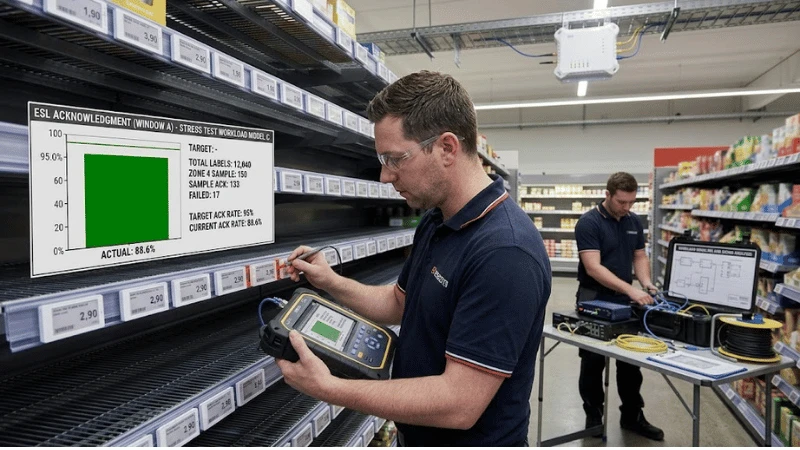
Map RF coverage around the real store
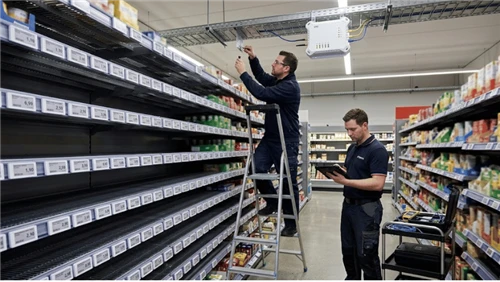
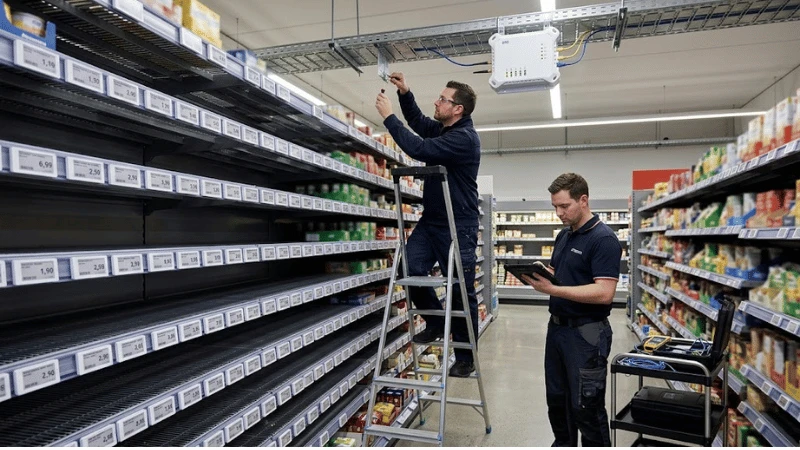
Validate aisles, back rooms, metal shelving, refrigerators, checkout zones, mezzanines, and temporary merchandising rather than relying on open-space assumptions. In practice, the difficult part is rarely identifying the feature in a datasheet. The difficult part is keeping the complete system inside an approved operating envelope after store layout, content, networking, staffing, and service conditions begin to change.
Use a baseline-and-change method. First confirm a known-good configuration. Then introduce the planned change-new hardware, a different location, a content revision, an altered network path, or a service action-and rerun the same acceptance sequence. If performance changes, the team has a bounded investigation rather than an open-ended fault report.
Two avoidable causes are Ignoring simultaneous promotion updates and Placing every gateway on the same power or network failure domain. They are especially costly in multi-site deployments because a small uncontrolled decision can be replicated hundreds of times. Standard drawings, configuration records, model-specific service notes, and change approval are therefore part of reliability engineering, not administrative overhead.
Record Retry rate by zone and Gateway CPU/network utilization if exposed. Where a value has no universal industry pass/fail threshold, the project should define its own limit from vendor documentation, pilot evidence, visual/business requirements, and risk. This is safer than copying a number from a different product or installation.
What to document
For this stage, the minimum project record should include: Walk the floor and mark RF-risk zones; Run routine and burst tests; the hardware and software identity; the test condition; the observed result; any exception; and the person or team responsible for the next action. Keep the record concise enough to use in the field, but specific enough to support later root-cause analysis.
Design for burst throughput and retries
Measure completion distribution, not just average latency; include retry storms, disconnected labels, and backend queues. This distinction matters because teams often compress several independent variables into one purchasing question. A useful design review separates the capability of the selected hardware from the conditions required to use that capability reliably. The result is a testable requirement instead of a vague expectation.
Start by writing the normal operating state and at least one stressed state. Record the equipment revision, software or content version, physical installation condition, upstream dependencies, and the operator action that triggers the workflow. That baseline makes later troubleshooting far faster: engineers can compare a failing site with an approved state rather than relying on photographs, memory, or "it worked in the lab."
A common failure pattern is Allowing retry traffic to hide in averages. Another is Adding labels later without revisiting capacity assumptions. Neither should be accepted as an unavoidable characteristic until the team has isolated the relevant layer. Change one variable at a time, repeat the same test, and retain the before/after evidence. When multiple variables change together, a successful retest may still leave the actual cause unknown.
For acceptance, include Offline-label count before and after the test and Recovery behavior after a controlled gateway or network interruption. The project team should also state who reviews the evidence, what constitutes a pass, and what action follows a marginal result. A commissioning checklist is useful only when it creates a decision, not when it merely confirms that somebody looked at the equipment.
What to document
For this stage, the minimum project record should include: Install a conservative pilot topology; Inject one failure at a time; the hardware and software identity; the test condition; the observed result; any exception; and the person or team responsible for the next action. Keep the record concise enough to use in the field, but specific enough to support later root-cause analysis.
Plan redundancy and failure domains
Define what happens when a gateway, switch port, power source, network path, or management service is unavailable. The procurement implication is that specification comparison should follow the intended workflow. Two products can advertise a similar headline feature while creating very different integration, service, or recovery work once they are installed. A buyer therefore needs both product documentation and a site-specific verification plan.
Translate the requirement into observable states. What should the user or operator see? What should the management system report? Which physical component should remain accessible? Which dependency must recover automatically, and which requires a technician? Write those answers before the pilot. This prevents the team from moving the acceptance threshold after a problem appears.
Watch specifically for Placing every gateway on the same power or network failure domain and Sizing from a vendor maximum label count alone. These are valuable test cases because they reveal whether the architecture has a hidden dependency or whether the operating procedure assumes perfect conditions. Failure injection is often more informative than another hour of normal playback or idle operation.
Use Gateway CPU/network utilization if exposed and Peak batch completion time as evidence points. Combine measurements with a short photo, video, log extract, or annotated floor/fixture record when visual context affects the result. Evidence should be detailed enough that another engineer can reproduce the test without asking the original installer what they meant.
What to document
For this stage, the minimum project record should include: Run routine and burst tests; Document pass criteria and expansion triggers; the hardware and software identity; the test condition; the observed result; any exception; and the person or team responsible for the next action. Keep the record concise enough to use in the field, but specific enough to support later root-cause analysis.
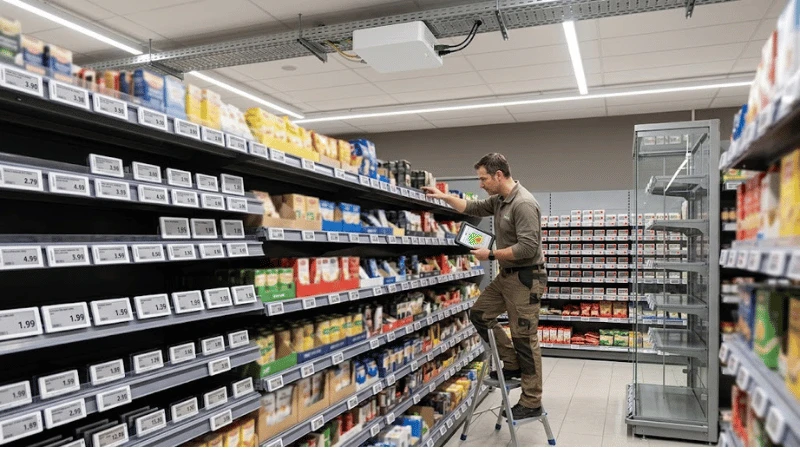
Run a pilot acceptance test that resembles peak operations
Use representative label density and update bursts, record acknowledgements, outliers, retries, and recovery after faults. In practice, the difficult part is rarely identifying the feature in a datasheet. The difficult part is keeping the complete system inside an approved operating envelope after store layout, content, networking, staffing, and service conditions begin to change.
Use a baseline-and-change method. First confirm a known-good configuration. Then introduce the planned change-new hardware, a different location, a content revision, an altered network path, or a service action-and rerun the same acceptance sequence. If performance changes, the team has a bounded investigation rather than an open-ended fault report.
Two avoidable causes are Adding labels later without revisiting capacity assumptions and Testing RF coverage before fixtures and refrigerators are installed. They are especially costly in multi-site deployments because a small uncontrolled decision can be replicated hundreds of times. Standard drawings, configuration records, model-specific service notes, and change approval are therefore part of reliability engineering, not administrative overhead.
Record Recovery behavior after a controlled gateway or network interruption and Percentage of labels acknowledging within the agreed window. Where a value has no universal industry pass/fail threshold, the project should define its own limit from vendor documentation, pilot evidence, visual/business requirements, and risk. This is safer than copying a number from a different product or installation.
What to document
For this stage, the minimum project record should include: Inject one failure at a time; Create a store label and update inventory; the hardware and software identity; the test condition; the observed result; any exception; and the person or team responsible for the next action. Keep the record concise enough to use in the field, but specific enough to support later root-cause analysis.
Turn pilot evidence into a store rollout standard
Freeze assumptions, floor-plan rules, monitoring thresholds, spare policy, documentation, and change-control triggers. This distinction matters because teams often compress several independent variables into one purchasing question. A useful design review separates the capability of the selected hardware from the conditions required to use that capability reliably. The result is a testable requirement instead of a vague expectation.
Start by writing the normal operating state and at least one stressed state. Record the equipment revision, software or content version, physical installation condition, upstream dependencies, and the operator action that triggers the workflow. That baseline makes later troubleshooting far faster: engineers can compare a failing site with an approved state rather than relying on photographs, memory, or "it worked in the lab."
A common failure pattern is Sizing from a vendor maximum label count alone. Another is Ignoring simultaneous promotion updates. Neither should be accepted as an unavoidable characteristic until the team has isolated the relevant layer. Change one variable at a time, repeat the same test, and retain the before/after evidence. When multiple variables change together, a successful retest may still leave the actual cause unknown.
For acceptance, include Peak batch completion time and Retry rate by zone. The project team should also state who reviews the evidence, what constitutes a pass, and what action follows a marginal result. A commissioning checklist is useful only when it creates a decision, not when it merely confirms that somebody looked at the equipment.
What to document
For this stage, the minimum project record should include: Document pass criteria and expansion triggers; Model normal and peak update windows; the hardware and software identity; the test condition; the observed result; any exception; and the person or team responsible for the next action. Keep the record concise enough to use in the field, but specific enough to support later root-cause analysis.
Commissioning and acceptance matrix
A strong acceptance plan connects each activity to evidence and a known failure mode. The table below is intentionally vendor-neutral. Replace generic checks with model-specific limits from the approved hardware documentation and project specification.
| Activity | Evidence to capture | Failure to challenge | Decision record |
|---|---|---|---|
| Create a store label and update inventory | Peak batch completion time | Sizing from a vendor maximum label count alone | Record pass, exception, evidence, owner, and retest decision. |
| Model normal and peak update windows | Percentage of labels acknowledging within the agreed window | Testing RF coverage before fixtures and refrigerators are installed | Record pass, exception, evidence, owner, and retest decision. |
| Walk the floor and mark RF-risk zones | Retry rate by zone | Ignoring simultaneous promotion updates | Record pass, exception, evidence, owner, and retest decision. |
| Install a conservative pilot topology | Offline-label count before and after the test | Allowing retry traffic to hide in averages | Record pass, exception, evidence, owner, and retest decision. |
| Run routine and burst tests | Gateway CPU/network utilization if exposed | Placing every gateway on the same power or network failure domain | Record pass, exception, evidence, owner, and retest decision. |
| Inject one failure at a time | Recovery behavior after a controlled gateway or network interruption | Adding labels later without revisiting capacity assumptions | Record pass, exception, evidence, owner, and retest decision. |
Do not turn this matrix into a one-time factory form. Reuse the same logic after a meaningful hardware substitution, firmware or player change, store remodel, network redesign, enclosure modification, or repeated field incident. Repeating a known acceptance test is faster than inventing a new troubleshooting method at every site.

Common failure modes and how to investigate them
Problems become expensive when symptoms are described without a failure model. Instead of writing "screen unreliable," "labels slow," or "kiosk down," identify the layer, trigger, scope, duration, and recovery. The following failure modes are useful starting points for this topic.
- Sizing from a vendor maximum label count alone. Treat this as a test hypothesis. Reproduce it under controlled conditions, capture the affected layer, and define the recovery or preventive control before rollout.
- Testing RF coverage before fixtures and refrigerators are installed. Treat this as a test hypothesis. Reproduce it under controlled conditions, capture the affected layer, and define the recovery or preventive control before rollout.
- Ignoring simultaneous promotion updates. Treat this as a test hypothesis. Reproduce it under controlled conditions, capture the affected layer, and define the recovery or preventive control before rollout.
- Allowing retry traffic to hide in averages. Treat this as a test hypothesis. Reproduce it under controlled conditions, capture the affected layer, and define the recovery or preventive control before rollout.
- Placing every gateway on the same power or network failure domain. Treat this as a test hypothesis. Reproduce it under controlled conditions, capture the affected layer, and define the recovery or preventive control before rollout.
- Adding labels later without revisiting capacity assumptions. Treat this as a test hypothesis. Reproduce it under controlled conditions, capture the affected layer, and define the recovery or preventive control before rollout.
A useful incident record answers five questions: What changed immediately before the symptom? Which devices or zones were affected? Which layers stayed healthy? What action restored service? Did the same action work on a second unit? Those questions prevent premature component replacement and help distinguish isolated defects from design-level issues.
Recommended implementation workflow
- Step 1: Create a store label and update inventory. Define the expected outcome, the evidence to retain, and the condition that would stop the rollout or require a retest.
- Step 2: Model normal and peak update windows. Define the expected outcome, the evidence to retain, and the condition that would stop the rollout or require a retest.
- Step 3: Walk the floor and mark RF-risk zones. Define the expected outcome, the evidence to retain, and the condition that would stop the rollout or require a retest.
- Step 4: Install a conservative pilot topology. Define the expected outcome, the evidence to retain, and the condition that would stop the rollout or require a retest.
- Step 5: Run routine and burst tests. Define the expected outcome, the evidence to retain, and the condition that would stop the rollout or require a retest.
- Step 6: Inject one failure at a time. Define the expected outcome, the evidence to retain, and the condition that would stop the rollout or require a retest.
- Step 7: Document pass criteria and expansion triggers. Define the expected outcome, the evidence to retain, and the condition that would stop the rollout or require a retest.
This sequence is deliberately conservative. It gives procurement, engineering, operations, and field service a shared record before scale multiplies a small design assumption. Projects can compress individual steps when risk is low, but they should not remove the logic of baseline, representative test, failure challenge, evidence, and controlled change.
Buyer and integrator questions to ask before rollout
Use these questions to move a vendor discussion from headline features to deployable evidence.
- Which exact product models, revisions, accessories, and software versions are included in the proposed configuration?
- Which claims relevant to electronic shelf label gateway capacity planning are documented by the manufacturer, and which depend on site conditions?
- What can be demonstrated in a representative pilot before a purchase or rollout commitment?
- Which parts of the workflow can store staff perform safely, and which require trained service personnel?
- What logs, telemetry, diagnostic interfaces, or service documentation remain available after installation?
- What happens when the primary component, network path, player, power source, or operator workflow fails?
- Which replacement parts or successor models are approved, and how is compatibility validated?
- What changes require re-commissioning rather than being treated as routine maintenance?
For answers that include exact ratings, capacities, wireless behavior, environmental limits, certifications, or maintenance instructions, request the current model-specific source document. A good proposal should make it easy to distinguish verified product capability from a project assumption that still needs validation.
Frequently asked questions
How many ESL labels can one gateway support?
Use the vendor model limit only as a starting boundary. Real sizing must also include update concurrency, RF conditions, retries, store layout, network design, and the completion window the business requires.
Should every store use the same gateway count?
Not automatically. Similar stores can still differ in floor area, metal density, refrigeration, label count, update patterns, and network architecture.
What should a gateway pilot prove?
It should prove coverage, burst completion, retry behavior, failure recovery, monitoring visibility, and a repeatable method for adding capacity.
Final takeaway
Electronic shelf label gateway capacity planning should be managed as a measurable operating requirement, not a line item that disappears after procurement. The safest projects connect model-specific documentation with a representative pilot, explicit failure tests, repeatable evidence, and a service/change-control process that survives beyond the original installation team.
For a new retail display or kiosk project, prepare the intended use case, store or enclosure context, expected operating workflow, integration dependencies, and the evidence you need from a pilot. Legoyo can then discuss the relevant product family and project configuration without relying on assumptions that belong to a different site or device model. Request a project quote with the deployment context and acceptance priorities.