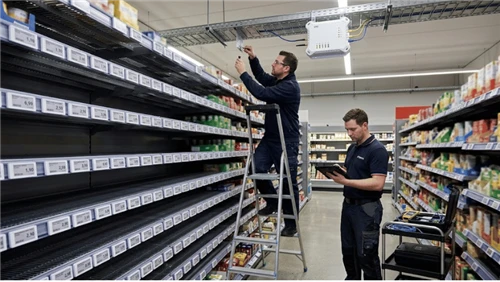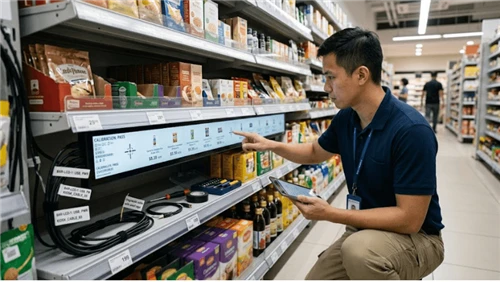
Firmware is easy to ignore during electronic shelf label procurement because it is invisible during normal shelf operation. Yet a large ESL estate is a fleet of managed endpoints, gateways, and software components whose behavior can change over time. Firmware updates may introduce fixes, compatibility changes, security improvements, or device behavior changes. Without a controlled rollout process, a routine update can become a store-operations risk.
This guide explains how retailers and system integrators can design an over-the-air firmware change process for an electronic shelf label deployment. It focuses on governance: inventory, release review, pilot rings, maintenance windows, monitoring, rollback planning, evidence, and supplier responsibilities. Exact firmware functions vary by platform, so the project should verify every procedure against the selected system rather than assume that all ESL vendors behave the same way.

Firmware Management Is a Retail Change-Control Problem
The technical act of sending firmware is only one part of the task. Retailers also need to know which devices are eligible, which version they are running, which stores are in the rollout group, whether the update changes battery or refresh behavior, how failures are reported, and who can stop the deployment.
A change can affect labels, gateways, or other edge components differently. It may also have dependencies on management software or integration versions. The change plan should therefore treat the ESL estate as a set of controlled configuration items rather than a collection of isolated price tags.
Teams new to ESL can review the broader electronic shelf label technology architecture first, then map firmware ownership to each component in their actual deployment.
Create an Accurate Device and Version Inventory
You cannot control a rollout if you do not know what is installed. The management process should be able to identify device model, hardware generation where relevant, firmware version, store, logical group, operational status, and last successful communication or synchronization event. The exact fields depend on the platform, but the inventory must support a question such as: "Which devices are still on the previous approved version?"
Keep inventory tied to lifecycle status. Devices in a lab, pilot, active store, spare pool, repair process, or decommissioned state should not be treated the same. A spare device that enters a store months later should be checked for approved firmware before binding it into production.
For projects that also manage label commissioning, the inventory discipline should align with the retailer's electronic shelf labeling operating procedure so the device identity, product binding, and software state do not drift apart.
Require Release Information Before Approval
A retailer should not approve an OTA change based only on a version number. Ask the supplier or platform owner for release information describing the purpose of the update, affected models, prerequisites, known limitations, compatibility requirements, and any expected operational effect.
The review team should ask whether the release changes communication behavior, display refresh, power management, template rendering, security settings, diagnostic logs, or API behavior. Even when the answer is "no," recording the assessment creates a traceable change history.
- What problem or requirement does the release address?
- Which label and gateway models are in scope?
- Are software, server, or cloud versions prerequisites?
- Does the release change update timing or device power behavior?
- Are there known incompatibilities or downgrade restrictions?
- What evidence shows the release has been validated by the provider?
Use Rollout Rings Instead of an Estate-Wide Push
A staged deployment reduces the blast radius of an unexpected problem. The exact number of rings is flexible, but the logic should move from controlled environments to representative stores and only then to the wider estate.
| Ring | Typical purpose | What to learn |
|---|---|---|
| Lab / staging | Basic compatibility and functional check | Does the update install and preserve core label behavior? |
| Pilot store | Real network, shelves, and workflows | Are there store-specific communication or operational effects? |
| Representative group | Different store sizes, regions, label models | Does performance remain stable across the deployment mix? |
| Broad rollout | Controlled production deployment | Can the estate update within the planned windows and exception process? |
Do not choose the pilot only because it is convenient. Include stores and device models that represent real diversity. A successful head-office lab test does not prove performance in a large store with different radio conditions, network policies, shelf density, or operating hours.
Define Success Criteria Before the Pilot
If success is defined after the update, teams tend to accept ambiguous results. Write the acceptance criteria in advance. They can include successful installation rate, absence of new communication exceptions, correct price and template rendering, expected refresh behavior, stable gateway operation, unchanged integration flow, and no unexpected increase in store support incidents.
A label that receives firmware but no longer behaves correctly in daily update workflows is not a successful deployment. Test actual price and template changes after the firmware update. Include the edge cases that matter to the store, not just a single successful screen refresh.
Where display behavior is important, include the retailer's expectations from ESL refresh rate and display performance testing so the new release can be compared with the approved baseline.
Plan the Maintenance Window Around Store Operations
Firmware updates should respect store trading patterns. A low-traffic period may reduce operational impact, but timing also depends on how long the update takes, whether devices remain readable during the process, whether gateways need restart, and whether a failed device requires physical attention.
Coordinate the firmware window with pricing schedules. Avoid introducing unnecessary change at the same time as a major promotional event, large assortment reset, POS upgrade, or network migration. If several systems change together, root-cause analysis becomes much harder.
For multi-time-zone retailers, define whether deployment follows local store time or a central schedule. The runbook should state when the rollout starts, when it pauses, who reviews results, and the latest point at which the team can decide to continue into the next group.
Control Bandwidth and Concurrency
OTA firmware distribution consumes communication capacity. The actual impact depends on the system architecture, file size, device count, radio design, gateway capacity, and vendor implementation. Do not assume an update can be sent to the entire estate at once without consequence.
Ask the supplier how the platform queues firmware, limits concurrency, retries interrupted transfers, and reports incomplete updates. During the pilot, observe whether normal price updates continue to meet business expectations while firmware distribution is running. If the project needs a firm performance target, validate it in the actual deployment rather than importing a generic number from another system.
Design Failure States and Rollback Before You Need Them
"Rollback" can mean different things. Some platforms may support a software-controlled downgrade; others may restrict downgrade paths or require a different recovery procedure. A device that loses communication during an update may need to resume automatically, retry later, or be serviced physically. The retailer must know the supported behavior for the exact hardware and firmware combination.
Create decision points such as: stop the rollout if a defined class of label becomes unreachable; pause if a critical template or integration issue appears; isolate one store if an anomaly is local; or revert only if the platform explicitly supports the approved downgrade path. Never assume that an old firmware package can simply be reinstalled.
The change record should also identify the "last known good" versions of management software, gateway software, and label firmware. That makes the recovery discussion concrete.
Monitor Exceptions, Not Just Completion Percentage
A dashboard that says "95% updated" does not explain the remaining 5%. The operations team needs to know whether those devices are offline, incompatible, busy, out of range, on a different model, already updated, or repeatedly failing.
Useful exception views include device group, store, version, status, last communication, retry count where available, and failure category. The exact telemetry depends on the platform. The operational requirement is to make incomplete deployment actionable.
After rollout, keep monitoring long enough to capture delayed effects. A problem may not appear until the next scheduled price change, a store network restart, a battery event, or a gateway reconnection.
Coordinate Firmware With Cybersecurity Governance
Firmware updates are also a security-governance activity. Retailers should know who can authorize updates, how administrative access is protected, how firmware authenticity or integrity is handled by the chosen platform, and how suppliers communicate security-related releases. These are questions for the vendor and the retailer's security team; they should not be inferred from marketing language.
Access control should follow least privilege. Store staff who need to replace or bind a label do not necessarily need permission to distribute firmware. Similarly, a content administrator may not need infrastructure-level rights. Separate roles reduce accidental estate-wide changes.
Build the OTA Runbook
- Confirm release notes, compatibility, prerequisites, and approved scope.
- Export or record current device and version inventory.
- Verify the staging group and representative pilot stores.
- Confirm change window and store communication plan.
- Record success criteria and stop conditions.
- Validate management-platform and gateway health before starting.
- Deploy to the first ring and observe normal label operations.
- Review exceptions before moving to the next ring.
- Document any retries, device recovery, or support incidents.
- Confirm final version coverage and investigate remaining outliers.
- Update the approved configuration baseline.
- Record lessons for the next release.
This runbook can be incorporated into the retailer's broader ESL solution operations manual.
Questions to Ask an ESL Supplier
- Which components can receive OTA firmware updates?
- Can firmware be targeted by store, device model, or logical group?
- How are incomplete or interrupted updates reported?
- Can normal pricing updates continue during firmware distribution?
- What retry and recovery behavior is supported?
- Is downgrade supported for every release, only selected releases, or not at all?
- How are firmware packages authenticated and access to rollout functions controlled?
- What logs are available for audit and troubleshooting?
- How long are older supported versions maintained?
- What support escalation applies if a firmware rollout affects production stores?

Common Firmware Management Mistakes
The most serious mistake is pushing an update to every store because the lab test passed. Another is updating firmware at the same time as POS, network, and template changes, making any failure difficult to diagnose. A third is relying on completion percentage without resolving exceptions.
Retailers should also avoid undocumented emergency changes. Urgent fixes still need an owner, scope, reason, result, and post-change review. Finally, do not leave spare labels outside the version-control process. A spare introduced later can reintroduce an old configuration if provisioning procedures do not check firmware state.
FAQ
Q: Do all ESL systems support OTA firmware updates?
A: Capabilities vary. Buyers should verify whether labels, gateways, or other components support remote firmware updates and what targeting, monitoring, retry, and recovery functions exist.
Q: Should retailers always update to the newest version?
A: Not automatically. Production changes should follow the retailer's approved release policy, vendor support guidance, compatibility requirements, security needs, and validation process. "Newest" and "approved for this estate" are different concepts.
Q: How large should an ESL pilot ring be?
A: There is no universal percentage. The ring should be small enough to limit impact yet representative enough to expose differences in store format, network conditions, hardware models, and operating workflow.
Q: What is the most important rollback question?
A: Ask what recovery and downgrade path is actually supported for the exact firmware and hardware combination. Do not build the change plan around an assumed downgrade feature.
Document the Post-Update Baseline
After the rollout is approved, capture the version state that operations should consider normal. The baseline should identify the approved firmware for each device family, the management-platform version, relevant gateway or controller versions, the date of approval, and any known exceptions that still have an owner. This makes later troubleshooting much faster because technicians can distinguish a device that is genuinely behind from one that is intentionally held on a different supported release.
Keep the baseline with deployment and support records, not only in the change ticket. When a new label is added, a spare is activated, or a repaired device returns to service, provisioning should compare it with the current baseline before production use. Firmware control is most reliable when it becomes part of ordinary asset management instead of a special activity performed only during major releases.
Conclusion
ESL firmware management is best treated as disciplined retail change control. Maintain an accurate inventory, review releases, deploy in rings, define success and stop conditions, preserve store operations, monitor exceptions, and know the supported recovery path before production rollout.
When evaluating an electronic shelf label system, include firmware operations in the RFQ rather than leaving them for post-installation support. For project-specific questions about device groups, update workflow, or integration requirements, use the project inquiry page and request confirmation for the exact proposed configuration.