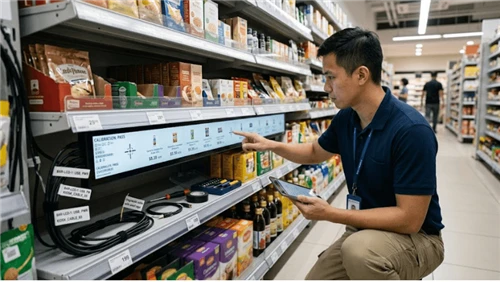
The Fundamental Constraint
Electronic Shelf Labels operate under a physical constraint that no amount of marketing can obscure: electrophoretic particles move through viscous fluid, and viscous fluid resists motion. No software update is going to fix this.

The refresh rate of an ESL-typically 300ms to 2000ms for a full screen update-emerges directly from the time required for charged titanium dioxide and carbon black particles to migrate through hydrocarbon solvent under an applied electric field. The particles encounter drag forces (Stokes drag, if you want the technical term, the math behind it matters less than the practical effect: particles slow down in thick fluid). They interact electrostatically with neighboring particles. They adhere to capsule walls after prolonged rest.
Every millisecond of refresh time reflects real molecular-scale events occurring inside millions of microcapsules simultaneously. Those coming from an LCD or OLED background should abandon that mental model entirely. These are not displays that "scan" pixels with electrons. These are electrochemical systems that physically relocate matter.

Driving Waveforms: Where Engineering Meets Electrochemistry
The driving waveform is where optimization efforts concentrate most intensively. It's a voltage-time sequence that must accomplish four objectives simultaneously: erase the previous image, activate sluggish particles, establish a reference grayscale, and write the new image-all while minimizing power consumption, ghosting artifacts, and total refresh duration.

Erasure comes first. The display drives all pixels to a uniform optical state, typically white. Why bother? Because EPD particles exhibit path-dependent behavior. A pixel transitioning from black to gray follows a different trajectory than one transitioning from white to gray. This became evident during early deployments when customers complained about inconsistent grayscale rendering. Erasure forces all pixels to a common starting point, eliminating dependence on initial conditions.
Activation follows-high-frequency alternating voltage (±15V at 50-100Hz) that oscillates particles between optical extremes. This process shakes loose particles that have gotten comfortable. Particles that have remained stationary develop increased surface adhesion to capsule walls and neighboring particles. Testing reveals the optimal activation duration by analyzing the inflection point of the brightness-versus-time curve-the exact moment when particle mobility reaches maximum responsiveness. Go shorter and sluggish particles get left behind. Go longer and power gets wasted.
Then comes reference grayscale establishment. The display creates a uniform white reference state because EPD grayscale accuracy depends critically on starting from a known optical baseline. Notably, inserting a brief zero-voltage interval after this phase improves subsequent grayscale consistency. The particles need a moment to stabilize before being asked to hit precise intermediate positions.
Finally, image writing. Pixel-specific voltages and durations drive particles to target positions. A 16-level grayscale requires precise control of particle vertical distribution within each microcapsule-particles at the top surface produce white, at the bottom produce black, and intermediate positions produce grays.
Pushing Toward 300ms
How fast can ESL systems actually go? Aggressive waveform optimization has demonstrated 180ms reduction in activation phase duration and 120ms reduction in reference grayscale phase. These gains come from several techniques refined over multiple deployment cycles.
Inflection point analysis allows monitoring of real-time optical response rather than using fixed activation times. Polarity switching reduction matters because reversing voltage polarity generates current spikes and wastes energy-sequencing operations to minimize these transitions adds up. And strategic insertion of 0V intervals exploits particle momentum, allowing continued migration without power expenditure.
The theoretical minimum for current-generation EPD materials appears to be approximately 200ms for acceptable image quality. Some panels have been pushed to 180ms in controlled conditions, but quality degradation becomes noticeable. Breaking this barrier will require materials innovation, not waveform cleverness.
Refresh Modes: The Speed-Quality-Ghosting Trilemma

Every ESL refresh involves an inescapable three-way tradeoff. No engineering can escape it; one can only choose which compromises to accept. Deployment experience across grocery, electronics, and pharmacy retail environments has produced strong conclusions about when to use each mode.
Global Refresh (GC16 Mode)
This is the full reset-750-2000ms of black-white-black flashing that forces every particle through complete migration cycles. It looks dramatic, customers sometimes ask if the labels are malfunctioning, but it's the only mode that fully eliminates accumulated positional errors.
Global refresh is necessary after extended partial refresh sequences, when displaying high-fidelity images, or when ghosting has become visually objectionable. One grocery chain initially resisted the "ugly flashing" and tried running pure partial updates. Three weeks later, their promotional labels were nearly unreadable. They now run global refresh every night during closed hours.
Partial Refresh
Partial refresh updates only the pixels that differ between frames, completing in 250-500ms. The time savings are substantial-measurements show 70% power reduction on typical price updates-but a tradeoff exists.
Unchanged pixels receive no driving voltage. Their particles gradually settle into increasingly stable configurations. Stable sounds good until one realizes stable also means immobile. After 5-10 partial refresh cycles, ghosting artifacts become visible. This threshold varies by manufacturer; some panels tolerate 15 cycles, others show problems after 6. The only reliable approach is disciplined periodic global refresh interspersion.
Fast Refresh (DU Mode)
Direct Update mode sacrifices grayscale capability entirely. Every pixel is binary-black or white, nothing in between. This enables 120-250ms updates with a single flash, but text edges look aliased and images are out of the question.
For price-only ESL applications displaying numeric characters, DU mode often represents the sweet spot. A side-by-side test in a consumer electronics store revealed that customers couldn't distinguish DU-rendered prices from GC16-rendered prices at normal viewing distances. The power savings were significant.
A2 Animation Mode
At 80-120ms, A2 mode approaches video-capable refresh rates. It has been used for product demos and interactive kiosk applications.
But the tradeoffs are severe. Ghosting accumulates rapidly. Contrast decreases. Fine detail disappears after a few cycles. One client wanted animated promotional content on shelf labels-technically possible with A2, but the image quality degradation after 30 seconds made it impractical. This mode exists for pen input and brief demonstrations, not production ESL deployment.
Choosing the Right Mode
How to pick? Honestly, content type usually decides for you. Photographic images demand GC16; price numerals can use DU. Update frequency shifts the balance-infrequent updates favor quality, frequent updates favor speed. And regardless of primary mode, global refresh must occur at defined intervals. There's no escaping the ghosting accumulation problem.
Display Performance Parameters
Contrast Ratio
EPD contrast ratios typically range from 8:1 to 15:1, with premium panels reaching 20:1. Comparing to LCD specifications (1000:1+) is misleading.
EPD contrast is measured under ambient illumination-the actual conditions where customers read shelf labels. LCD contrast collapses under high ambient light; EPD contrast improves. ESL readability measurements in store environments with 800+ lux overhead lighting show nearby LCD screens washed out completely.
Barcode scanners need somewhere around 6:1 contrast to read reliably-we've tested this across multiple scanner models. Every commercial ESL we've measured clears this bar easily, which means laser scanners can read barcodes directly off the electronic display without issues.
Resolution and Pixel Density
| Display Size | Typical Resolution | DPI | Application |
|---|---|---|---|
| 1.54" | 152×152 | 140 | Compact price tags |
| 2.13" | 250×122 | 130 | Standard shelf labels |
| 2.9" | 296×128 | 112 | Promotional tags |
| 4.2" | 400×300 | 110 | Product information |
| 7.5" | 640×384 | 100 | Large format signage |
ESL pixel density (100-150 DPI) reflects a deliberate engineering choice, not a technological limitation. Higher resolution requires more pixels, each requiring individual driving-increasing refresh time, power consumption, and component cost.
Some clients have requested 200+ DPI displays. When asked about viewing distance, the answer was always over 50cm. At that distance, 100 DPI provides adequate text legibility. Over-specifying resolution wastes resources without visible benefit.
Color Capability
Standard black-and-white ESL remains the workhorse: fastest refresh (300ms), lowest power, highest reliability. It handles 90% of price display applications effectively.
Adding a third color-typically red or yellow-introduces promotional highlighting capability but complicates the physics. Colored particles exhibit different electrophoretic mobility than black and white particles, requiring extended driving waveforms. Expect 30-50% longer refresh times. Some red/white/black panels need 1200ms for clean color rendering, which often surprises clients expecting the same speed as monochrome.
Four-color systems using E Ink Spectra 3100 technology enable simultaneous black/white/red/yellow display. Useful for brand-specific accent colors, but refresh times extend further.
Full-color panels using ACeP Gallery technology can produce photographic images. The cyan-magenta-yellow-white particle system is genuinely impressive-product photos displayed on these panels are often assumed to be printed. But 1500ms+ refresh times and significantly higher costs limit application to premium use cases where visual impact justifies the expense.
When it comes to color, the question is always whether the extra information value justifies the hit to refresh time, power, and unit cost. Nine times out of ten, monochrome does the job.
Ghosting: The Persistent Artifact
Ghosting is not a defect to be eliminated. It's an intrinsic characteristic of electrophoretic technology requiring management. Anyone promising ghost-free EPD performance is either misrepresenting the technology or selling panels that refresh slowly enough to hide the problem.
Where Ghosting Comes From
Three mechanisms contribute. Incomplete particle migration-particles failing to reach intended positions due to insufficient driving duration or voltage. Residual charge distribution-uneven charge accumulation on capsule walls affecting subsequent particle motion. And particle adhesion hysteresis-particles that have remained stationary developing increased surface adhesion.
Considerable time has been spent characterizing ghosting behavior across different panel manufacturers. The variations are significant; some panels ghost visibly after 5 partial updates while others tolerate 12-15.
Environmental Factors Make It Worse
Temperature matters enormously. Solvent viscosity increases at low temperatures, impeding particle motion and exacerbating ghosting. Below 10°C, refresh times need extension or visible artifacts must be accepted. Below 0°C, standard panels become problematic-completely illegible displays have been observed in refrigerated cases using panels not rated for cold operation.
Battery voltage affects ghosting too. Depleted batteries deliver reduced driving voltage, causing incomplete particle migration. One pharmacy client experienced mysterious ghosting problems that turned out to be failing batteries in a batch of labels. ESL systems should implement low-battery detection with preemptive maintenance alerts.
Refresh history compounds everything. A pixel repeatedly displaying the same content develops increasingly persistent particle configurations. Static content ghosts faster than dynamic content-counterintuitive until the adhesion mechanism is understood.
Managing Ghosting in Practice
Periodic global refresh remains the primary mitigation. The typical recommendation is mandatory full-screen refresh after every 5-10 partial updates, though the optimal interval varies by panel and operating conditions.
Temperature-compensated lookup tables help in variable environments. Driving parameters stored in LUTs indexed by temperature automatically extend waveform duration at low temperatures. Measurements show 40% ghosting reduction using well-tuned temperature compensation versus fixed parameters.
Historical frame compensation is more sophisticated-adjusting current driving waveforms based on pixel-level refresh history to compensate for accumulated positional bias. Not all ESL controllers support this, but it makes a measurable difference on panels that have been in service for months.
Content design matters too. White backgrounds with black text produce less visible ghosting than inverse color schemes. ESL templates should be designed with ghosting characteristics in mind-avoid large solid black regions that will ghost obviously, prefer white backgrounds.
System-Level Refresh Performance
Individual ESL refresh time is only one component of system update latency. For deployments with thousands of labels, network architecture dominates total update time. Some clients obsess over 50ms panel refresh improvements while ignoring network bottlenecks that add 30 seconds to their update cycles.
Communication Protocols
Proprietary sub-1GHz RF systems offer maximum coverage area and building penetration. Gateway-to-label communication range exceeds 25 meters, which matters in large-footprint retail environments. Bandwidth limitations constrain simultaneous update capacity, but for typical retail update patterns this rarely becomes the bottleneck.
Bluetooth Low Energy with PAwR (Periodic Advertising with Responses, added in BLE 5.4) enables standardized bidirectional communication with massive device counts. A single access point can theoretically address 32,640 labels-128 groups times 255 labels per group. The periodic advertising interval determines system latency; shorter intervals provide faster response at higher power cost. BLE systems have been deployed with 1-second intervals for time-sensitive applications and 10-second intervals for routine price updates.
Network topology follows a star pattern with centralized gateways. Each gateway covers a defined zone; overlapping coverage ensures redundancy. Large retail deployments require careful RF channel planning-one deployment where two gateways on adjacent channels created interference patterns caused 15% packet loss.
Real-World Throughput
In production systems, 3,000 label updates in 5 minutes through a single gateway is consistently achievable. End-to-end latency from server command to display completion runs 3-10 seconds depending on network load and retry requirements.
The critical insight from deployment experience: for typical retail update scenarios where price changes propagate to thousands of labels, system-level network performance constrains total update time rather than individual label refresh speed. Optimizing individual refresh rates below 500ms provides diminishing returns when network propagation requires seconds.
Power Consumption and Battery Life
EPD power consumption occurs almost exclusively during refresh events. Standby current is negligible-microamperes have been measured. This profile enables multi-year battery life from coin cells, which remains one of the strongest arguments for EPD-based ESL.
What Consumes Power
Pixel count has a linear relationship-larger displays consume proportionally more. Grayscale depth matters because 16-level GC16 requires more complex waveforms than binary DU mode. Refresh mode selection has major impact; global refresh consumes 2-3× the power of partial refresh. And temperature affects power draw because cold environments require longer waveforms.
Battery Life in Practice
For CR2450 lithium coin cells with approximately 600mAh capacity, observed performance is as follows:
| Daily Updates | Expected Life |
|---|---|
| 1 | 10+ years |
| 2-3 | 5-8 years |
| 4-5 | 3-5 years |
| 10+ | 1-2 years |
These projections assume room temperature operation. Cold storage applications-refrigerated and frozen sections-experience accelerated battery drain from both increased refresh power and reduced battery capacity at low temperatures. A label rated for 5 years at room temperature might last 2 years in a refrigerated case.
Every refresh consumes finite battery capacity. One client wanted animated price promotions running continuously-the batteries lasted three weeks. System architects must define update frequency requirements before hardware selection. A label requiring hourly updates needs different battery architecture than one updated daily.
Temperature Effects on Performance
Temperature influences ESL performance through multiple mechanisms, making it the single most important environmental variable. This has been demonstrated repeatedly across deployments in climate-controlled retail floors, refrigerated cases, frozen food sections, and outdoor applications.
Solvent Viscosity
This gets into some chemistry, but the short version: EPD solvent gets thicker when cold. The relationship roughly follows an Arrhenius curve-without getting too deep into the thermodynamics, what matters is that the effect is exponential, not linear.
At 25°C (reference condition), particles exhibit nominal mobility. At 0°C, viscosity roughly doubles, halving particle velocity. At -20°C, viscosity increases approximately 4×, requiring proportionally extended waveform durations. The math predicts this pretty well, though real-world results sometimes vary depending on the specific solvent formulation each manufacturer uses.
Testing of one manufacturer's "wide temperature" claims by running their panels at -15°C revealed refresh times extended from 400ms to 1100ms. The panels worked, but the specifications had implied much better cold performance.
Operating Range Classifications
Standard panels cover 0°C to 40°C with baseline performance. Extended range panels handle -10°C to 50°C with moderate waveform compensation. Wide temperature panels-necessary for freezer cases-operate from -25°C to 60°C using specialized front-plane laminate materials, integrated temperature sensing, and adaptive waveform selection. True freezer-grade panels optimized for -30°C to 10°C exist but command premium pricing.
Temperature Compensation
Wide-temperature ESL incorporates on-chip temperature sensors, multiple waveform parameter sets stored in memory, and automatic parameter selection based on measured temperature. Extended waveform durations for cold operation and reduced voltage swings for high-temperature operation.
The performance penalty for wide-temperature operation is non-trivial. Measurements show refresh times at temperature extremes run double to triple room-temperature performance. Clients deploying in refrigerated environments need to factor this into their update timing calculations.
Where ESL Requirements Diverge NEW SECTION
The generic "retail ESL" specification covers perhaps 60% of real-world deployments. The remaining 40% involves specialized requirements that emerge only when examining specific vertical markets. What works in a consumer electronics store fails spectacularly in a frozen food warehouse. The following sections document deployment experiences across industries where standard ESL assumptions break down.
Fresh Food and Grocery: Dynamic Pricing Meets Perishable Inventory
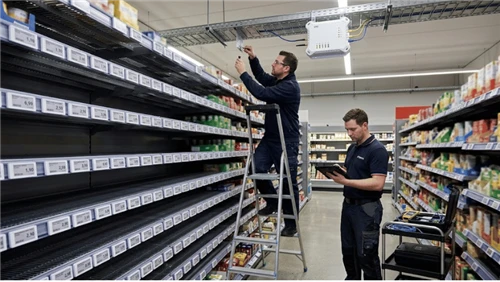
Fresh food retail represents the most demanding ESL application for a simple reason: product value degrades continuously while displayed. A steak that costs $15/lb on Monday morning might be worth $7/lb by Wednesday evening if it hasn't sold. Traditional paper labels can't capture this value curve. ESL can-but the implementation requirements differ substantially from standard grocery pricing.
Dynamic markdown pricing requires update frequencies that would drain standard ESL batteries within months. A fresh food department running four price updates daily-morning stock, midday adjustment, evening markdown, overnight reset-consumes battery at 4× the rate of a center-store label updated once weekly. Battery chemistry selection shifts from standard CR2450 coin cells toward higher-capacity lithium thionyl chloride cells or rechargeable options with inductive charging stations built into shelf fixtures.
Expiration date display adds information density requirements. A simple price tag needs perhaps 50 characters. A fresh food label displaying price, unit price, pack date, sell-by date, and use-by date needs 150+ characters at readable font sizes. Display real estate increases accordingly-2.9" and 4.2" labels become standard where 2.13" suffices for center store.
One grocery chain's fresh seafood department deployed 4.2" three-color ESL with integrated NFC for customer smartphone interaction. The red accent color highlights items approaching sell-by dates with automatic progressive markdown pricing: 15% off at 48 hours remaining, 30% at 24 hours, 50% at 12 hours. The backend integration required real-time inventory management system connectivity-the ESL infrastructure essentially became part of the inventory shrink reduction system rather than just a pricing tool. Shrink reduction of 23% in the pilot department paid for the entire deployment in seven months.
Cold case environments introduce the temperature complications discussed earlier. Dairy coolers running at 4°C cause noticeable refresh slowdown. Meat cases at 2°C are worse. Frozen food cases at -18°C require specialized wide-temperature panels that cost 40-60% more than standard units. One frozen food retailer initially deployed standard panels in their ice cream section; the labels became unreadable within a week as ghosting accumulated from inadequate refresh at operating temperature.
The temperature gradient within refrigerated cases creates additional complexity. Air curtain systems produce temperature variations of 8-12°C between the front edge (warmer, near ambient air mixing) and the back (colder, near the evaporator). Labels at the front of a dairy case might operate at 8°C while labels at the back operate at 2°C-different enough to require different waveform timing. Sophisticated deployments implement per-label temperature sensing with individualized refresh parameters.
Perishable inventory tracking integration represents the next evolution. When ESL systems connect bidirectionally with inventory management, the label becomes a sensor as well as a display. Stock-out detection-identifying when a shelf position is empty based on lack of sales activity-enables automatic replenishment alerts. One produce department reduced out-of-stock incidents by 34% using ESL-integrated inventory monitoring that flagged positions with no sales activity for more than 4 hours during peak periods.
Warehouse and Industrial Logistics: Scale Changes Everything
Industrial warehouse ESL deployments operate under constraints that retail system architects rarely encounter. A grocery store might have 15,000 SKUs across 40,000 square feet. A distribution center serving that grocery chain has 50,000+ SKUs across 500,000 square feet with ceiling heights of 40 feet. The RF propagation models that work in a 12-foot-ceiling retail environment fail completely in a warehouse with steel racking extending to 35 feet.
Bin location identification requires different display priorities than retail price tags. The dominant information isn't price-it's location code, SKU, and quantity. Warehouse ESL templates typically display location identifiers in 48-point or larger fonts readable from 3+ meters, enabling forklift operators and pick-pack workers to identify locations without approaching the bin. Contrast ratio requirements tighten because viewing occurs under variable industrial lighting-some aisles under direct high-bay fixtures at 1500+ lux, others in shadow at 200 lux.
Pick-to-light integration extends ESL beyond passive display into active workflow guidance. LED indicators integrated with e-paper displays flash to direct workers to pick locations. The EPD shows what to pick; the LED shows where to pick. Combined systems reduce pick error rates from typical 0.5-1% ranges down to 0.1% or better. The power budget shifts-LED indication during picking operations consumes more power than the e-paper refresh cycle. Battery architectures adapt accordingly, often moving to AA lithium cells or wired power for high-activity locations.
High-bay rack environments stress RF communication systems. Metal racking creates multipath interference. Tall aisles produce shadow zones. A single gateway covering 25 meters in retail might cover only 8-10 meters in a dense warehouse environment. Gateway density increases 3-4× compared to retail deployments for equivalent coverage. Some warehouse deployments run hybrid networks-sub-1GHz for penetration in dense rack areas, WiFi for open staging areas, with middleware unifying the communication layer.
Forklift-mounted mobile displays represent an emerging warehouse ESL variant. Rather than fixed shelf labels, displays mount on forklift masts and receive real-time picking instructions as operators navigate the warehouse. These devices update continuously-location, quantity, next destination-requiring power architectures completely different from static shelf labels. Hardwired power from the forklift electrical system is standard; battery operation isn't viable for continuous-update applications.
Inventory count automation leverages bidirectional ESL communication. RFID integration enables automatic cycle counting-products tagged with RFID pass near ESL units equipped with RFID readers, and inventory counts update without manual scanning. A distribution center deployment reduced physical inventory count labor by 60% using ESL-integrated RFID cycle counting that maintained perpetual inventory accuracy above 99%.
Harsh environment ratings matter in industrial contexts. IP54 dust and splash resistance is baseline for warehouse ESL; IP65 becomes necessary in environments with washdown cleaning procedures. Chemical resistance matters in facilities handling solvents or cleaning agents. One automotive parts warehouse required labels resistant to brake fluid and transmission fluid exposure-standard ESL housings degraded within months. Specialized enclosures with chemical-resistant polycarbonate housings added 35% to unit cost but proved essential for deployment longevity.
Healthcare and Pharmacy: Accuracy Is Non-Negotiable
Pharmacy ESL deployments face regulatory requirements absent from conventional retail. A pricing error in a grocery store means customer complaints and potential legal exposure under price accuracy laws. A medication labeling error in a pharmacy can mean patient harm or death. The risk profile fundamentally changes system design priorities.
Drug identification display requires information density beyond typical retail ESL. A pharmacy shelf label must display: drug name (brand and generic), strength, dosage form, NDC number, price, unit price, manufacturer, and often storage requirements. Fitting this on a 2.13" label requires careful typography-or more commonly, deployment of 2.9" or larger displays. Some pharmacies use 4.2" labels with QR codes linking to complete prescribing information.
Barcode accuracy verification becomes critical. Pharmacy staff scan medications multiple times during dispensing workflows-receiving, shelving, pulling, verification, dispensing. The ESL-displayed barcode must scan correctly at every step. This tightens contrast ratio requirements beyond retail minimums. Testing across pharmacy scanning equipment reveals that older pharmacist verification scanners-some still using CCD technology rather than modern laser or imaging scanners-require 10:1 or better contrast for reliable reads. Panel selection must account for worst-case scanning equipment in the installed base.
Controlled substance areas introduce physical security requirements. Schedule II-V medications require secured storage with access logging. ESL in controlled substance cabinets must integrate with cabinet access control systems-displaying restricted access indicators, logging which labels were visible during each cabinet opening, potentially disabling display during unauthorized access attempts. One hospital pharmacy integrated ESL with their controlled substance management system to display real-time inventory counts that update automatically as medications are dispensed, eliminating manual count reconciliation.
Refrigerated medication storage combines pharmacy accuracy requirements with cold-chain temperature challenges. Vaccines, insulin, and certain biologics require storage between 2-8°C. Wide-temperature ESL panels are mandatory. Some pharmacy cold storage applications require temperature logging with ESL-integrated sensors that display current temperature alongside medication information-providing visual verification that storage conditions remain within specification without requiring staff to check separate monitoring equipment.
Hospital pharmacy operations add complexity beyond retail pharmacy. Medication carts, automated dispensing cabinets, and satellite pharmacy locations each present different ESL requirements. Cart-mounted ESL requires ruggedized construction surviving repeated transport; displays must remain readable under the fluorescent lighting typical in hospital corridors. Automated dispensing cabinet integration requires communication protocols compatible with cabinet management software-often proprietary systems with limited third-party integration capabilities.
Regulatory compliance documentation requires audit trails that retail ESL systems rarely provide. Joint Commission accreditation for hospital pharmacies requires documentation of medication labeling accuracy. ESL management systems must log every label update with timestamp, user authorization, and content change details. One hospital system's Joint Commission survey specifically examined their ESL audit trail capabilities; the surveyor requested documentation of label accuracy verification procedures for the past 12 months.
Electronics and High-Value Retail: Real-Time Competitive Pricing
Consumer electronics retail operates in a price-transparent market where customers routinely check competitor pricing on smartphones while standing in the store. The ESL value proposition shifts from labor savings toward competitive response capability-the ability to match or beat competitor prices in real-time rather than waiting for overnight price file updates.
Competitive price monitoring integration connects ESL systems with price intelligence services that scrape competitor websites continuously. When a major competitor drops their price on a flagship smartphone, the price intelligence service detects the change within minutes, the pricing engine evaluates margin rules, and updated prices propagate to shelf labels within the 3-10 second network latency window. One electronics retailer reduced price-driven walkouts by 18% after implementing real-time competitive price matching through their ESL infrastructure.
Rich product information display suits the higher consideration purchases typical in electronics retail. A customer buying a $1,500 laptop wants specifications-processor, memory, storage, display resolution, battery life. Larger format ESL (7.5" and above) enables specification display that previously required printed spec cards. Some electronics retailers deploy combination fixtures with e-paper for pricing and specifications alongside small LCD screens for promotional video content-leveraging each technology's strengths.
Accessory attachment display uses ESL to drive attachment sales. A display showing "works with:" information links primary products to compatible accessories-cases for phones, cables for laptops, games for consoles. Dynamic attachment pricing can offer bundle discounts displayed on the accessory ESL when the primary product ESL indicates inventory levels that need movement.
Anti-theft integration becomes relevant for high-value merchandise. ESL systems can integrate with electronic article surveillance (EAS) and RFID-based inventory tracking. When an EAS tag is removed without proper deactivation, the associated ESL can display an alert or change appearance. More sophisticated implementations update inventory counts in real-time as products are removed from security fixtures, enabling immediate stock-out awareness.
Product lifecycle pricing for electronics follows predictable patterns-launch premium pricing, competitive mid-life pricing, clearance end-of-life pricing. ESL enables automated lifecycle pricing rules that adjust margins based on product age, inventory levels, and successor product launch schedules. When a new iPhone launches, the previous generation's ESL automatically updates with clearance pricing according to pre-defined margin rules, without manual intervention.
Demo unit management in electronics retail uses ESL variants designed for product display fixtures. These units often integrate with security tethers, power management systems, and interactive kiosks. The display might show pricing when idle and switch to feature highlights when customers interact with the demo product. Some implementations use proximity sensors to detect customer presence and update displayed content accordingly.
Industrial Parts and MRO: Long-Tail Inventory Challenges
Maintenance, repair, and operations (MRO) distributors and industrial parts suppliers manage inventory profiles radically different from consumer retail. A typical MRO distributor carries 100,000+ SKUs with long-tail distribution-20% of SKUs generate 80% of revenue while 80% of SKUs sit with minimal movement. Traditional labeling approaches fail economically when label maintenance costs exceed product margin for slow-moving items.
High-SKU-count economics shift ESL ROI calculations. In grocery retail, ESL payback comes primarily from labor savings on price changes. In MRO distribution, payback comes from inventory accuracy improvement and reduced obsolescence on slow-moving stock. A fastener distributor reduced inventory write-offs by 31% after deploying ESL-integrated inventory tracking that identified slow-moving stock for promotional pricing before obsolescence.
Technical specification display requirements resemble pharmacy more than grocery. Industrial parts require display of dimensional specifications, material grades, certifications, and compatibility information. A bearing distributor's ESL shows: part number, manufacturer, bore diameter, outer diameter, width, speed rating, load rating, and applicable specifications (ISO, ABEC, etc.). Information density requirements push toward larger displays and careful typographic design.
Bin location systems in parts distribution often use proprietary location coding schemes developed over decades of operation. ESL integration must accommodate legacy location formats while potentially enabling migration toward standardized location coding. Change management becomes as significant as technical implementation-warehouse staff accustomed to location codes they've used for 20 years resist format changes regardless of system capabilities.
Customer-facing terminals at parts counters benefit from ESL integration. When a customer requests a part, counter staff query the system, and ESL displays at the storage location light up or display pickup instructions. Some parts distributors have implemented "bring to counter" workflows where ESL displays at bin locations show pick instructions and counter personnel names, enabling multiple simultaneous customer service interactions with clear pickup identification.
Kitting and assembly operations use ESL to guide component selection for multi-part assemblies. A hydraulic system kit might include pump, motor, valves, fittings, hose, and fluid-each stored in different warehouse locations. ESL displays at each location show the kit order, quantities needed, and completion status. Integration with assembly documentation displays work instructions alongside component identification.
Vendor-managed inventory (VMI) programs leverage ESL for visibility sharing. When suppliers manage inventory levels at customer locations, ESL can display replenishment status, incoming shipment dates, and stock availability. This transparency supports just-in-time manufacturing programs requiring reliable parts availability without excess inventory investment.
ESL vs. Alternative Display Technologies NEW SECTION
ESL selection isn't merely about choosing the best e-paper panel. It's about choosing the right display technology for the application. E-paper competes with LCD shelf displays, segment displays, and traditional paper labels-each with distinct performance characteristics, cost structures, and application sweet spots. The following analysis provides the technical foundation for technology selection decisions.
E-Paper (EPD) Electronic Shelf Labels

Operating principle: Electrophoretic particle migration in microcapsule suspension under applied electric field. Bistable-maintains image without power.
Strengths: Zero power consumption when static (true bistability), excellent ambient light readability, wide viewing angles (170°+), paper-like appearance that integrates naturally with retail environments, multi-year battery life from coin cells, sunlight readability for outdoor and high-brightness applications.
Limitations: Slow refresh (300-2000ms for full update), limited color capability (1-4 colors for commercial products, full-color emerging), ghosting artifacts requiring periodic full refresh, cold temperature performance degradation, higher initial unit cost than LCD alternatives.
Cost structure: Display modules $3-15 depending on size and color capability; complete ESL units with controller, communication, housing, and battery $8-40; infrastructure (gateways, management software) adds $0.50-2 per label for typical deployments.
Optimal applications: Price-centric retail labeling with infrequent updates (grocery, general merchandise, pharmacy), outdoor or high-ambient-light environments, deployments prioritizing battery longevity over update speed, applications requiring paper-like aesthetics.
LCD Shelf Displays

Operating principle: Liquid crystal light modulation with LED backlight. Requires continuous power for backlight; display state not maintained without power.
Strengths: Fast refresh (60Hz standard, suitable for video), full color capability with millions of colors, high brightness for attention-grabbing promotions, ability to display video and animation, mature technology with extensive supplier ecosystem.
Limitations: Continuous power consumption (3-15W for typical shelf-edge displays), poor ambient light performance (washed out appearance in bright retail environments), viewing angle limitations (±60° typical before color shift), backlight failure is common failure mode, requires wired power infrastructure.
Cost structure: Display modules $15-50 depending on size; complete networked shelf displays $50-200; installation costs often exceed hardware costs due to power infrastructure requirements.
Optimal applications: Promotional end caps where animation attracts attention, video-capable advertising displays, time-limited promotional campaigns, environments with controlled lighting (mall interiors, airport shops), applications where power infrastructure already exists.
Segment LCD Displays

Operating principle: Simple liquid crystal segments (like calculator displays) driven by dedicated segment drivers. Very low power but limited to pre-defined character sets.
Strengths: Extremely low cost ($0.50-2 per display), very low power consumption (microamps for static display), wide temperature range, simple driving electronics, proven reliability over decades of deployment.
Limitations: Fixed segment patterns limit displayable content (typically numerals and limited characters only), no graphics capability, limited size options, aesthetically dated appearance, each character requires dedicated segment pattern.
Cost structure: Display modules under $1 in volume; complete price display units $2-5; minimal infrastructure costs.
Optimal applications: Pure numeric price display where content flexibility isn't required, extreme cost-sensitive deployments, high-volume applications prioritizing unit economics over capability, harsh environment deployments where sophisticated electronics create reliability risk.
Paper Labels (Manual)
Operating principle: Printed paper labels inserted in plastic holders or adhered directly to shelf edges. Updated manually by store staff.
Strengths: Lowest technology cost (effectively zero for display hardware), unlimited graphical flexibility, no electronics to fail, no infrastructure requirements, familiar workflow for retail staff.
Limitations: Labor-intensive update process (15-30 seconds per label for experienced staff), error-prone (estimated 5-15% price accuracy issues in typical retail), materials and printing consumables costs, limited ability to execute rapid price changes, environmental waste from label disposal.
Cost structure: Label holders $0.10-0.50 each; paper labels $0.01-0.05 each; ongoing labor and materials costs typically exceed ESL lifecycle costs within 2-4 years for high-update-frequency applications.
Optimal applications: Very small retail operations where labor cost is negligible (owner-operated shops), extremely low update frequency environments, temporary or pop-up retail where infrastructure investment isn't justified, applications requiring unusual physical formats not available in electronic options.
Technology Selection Framework
Decision criteria for display technology selection involve multiple factors that must be weighted according to application priorities:
Update frequency strongly influences technology selection. Applications with less than weekly updates rarely justify ESL investment; paper labels remain economical. Applications with daily updates reach ESL breakeven within 2-3 years. Applications with multiple daily updates strongly favor ESL economics.
Content complexity affects technology choice. Pure numeric price display can use segment LCD at lowest cost. Prices plus limited text (product names, unit pricing) suit e-paper ESL. Rich graphic content or video requires LCD despite higher power costs.
Environmental conditions constrain options. High ambient light (outdoor, windows, bright retail lighting) favors e-paper's reflective display. Controlled lighting environments can use LCD effectively. Extreme temperatures (refrigerated, outdoor) require appropriate panel ratings regardless of technology choice.
Power infrastructure availability often determines feasibility. Locations without available power or where running power would be prohibitively expensive essentially mandate battery-powered ESL. Locations with power infrastructure already in place (above-shelf lighting circuits) can consider LCD options.
Total cost of ownership analysis should consider:
| Cost Component | Paper Labels | Segment LCD | E-Paper ESL | LCD Shelf Display |
|---|---|---|---|---|
| Initial hardware per position | $0.25 | $3 | $20 | $100 |
| Infrastructure per position | $0 | $0.50 | $1.50 | $25 |
| Annual labor cost per position | $15-50 | $1 | $0.50 | $0.50 |
| Annual materials/power per position | $5-10 | $0.25 | $0.10 | $8 |
| Typical 5-year TCO per position | $100-300 | $20 | $30 | $175 |
These figures vary substantially based on local labor costs, update frequencies, and deployment scale. The calculation typically favors ESL for update frequencies above 1-2 times weekly in developed-economy labor markets.
Hybrid Deployment Strategies
Few retailers deploy a single display technology across all applications. Hybrid strategies match technology to application requirements within a single retail environment:
E-paper for price, LCD for promotion uses ESL for routine pricing throughout the store while deploying LCD screens at end caps, checkout areas, and promotional hot spots where video capability and high brightness attract customer attention. This approach captures ESL efficiency benefits for the bulk of labels while preserving promotional flexibility where it matters most.
Segment LCD for price, e-paper for information deploys inexpensive segment displays for pure numeric pricing while using larger e-paper displays for detailed product information where content complexity justifies the cost premium. This approach minimizes cost for high-volume basic labels while enabling rich information display where customer value justifies investment.
Temperature-zone technology matching deploys standard ESL in ambient retail areas while using wide-temperature variants in refrigerated zones and potentially opting for hardier segment displays in freezer sections where even wide-temperature e-paper performance becomes marginal. Technology selection follows environmental requirements rather than applying uniform specifications.
Scale-appropriate infrastructure might use ESL with full network infrastructure in large-format stores while deploying standalone segment displays or even paper labels in smaller format stores where infrastructure investment doesn't scale economically. Technology selection considers deployment scale alongside technical requirements.
Emerging Technologies
High-Speed EPD Research
Laboratory demonstrations have achieved 75Hz refresh rates on e-paper panels-approaching LCD territory. These demos at industry conferences are genuinely impressive, but production deployment remains distant.
The key enabling technologies include liquid crystal additives that dope electrophoretic fluid with compounds inducing backflow effects. Research papers report 2.8× speed improvement while simultaneously reducing driving voltage by 50%. Thin-film front-plane laminates reduce particle migration distance. Novel nanoparticle formulations optimize surface charge characteristics and reduce hydrodynamic radius. And machine learning-optimized waveform generation adapts in real-time to display state and environmental conditions.
These technologies remain in development. Specifying production ESL products based on laboratory results is not advisable.

Color E-Paper Evolution
E Ink Gallery 3 technology demonstrates where color EPD is heading. Black/white refresh has dropped to 350ms, down from 2000ms in previous generations. Fast color mode hits 500ms. Standard color mode runs 750-1000ms. Best quality color mode still needs 1500ms.
Color EPD is transitioning from "barely usable" to "practically viable" for selected applications. Expect continued improvement, but monochrome will retain speed and power advantages indefinitely due to fundamental particle physics differences.
Performance Specifications for System Design
Minimum Viable Specifications
For general retail shelf labeling, these numbers represent the floor:
Refresh time should hit 2000ms or better for global mode, 500ms or better for partial. Contrast ratio needs to exceed 8:1. Resolution should reach at least 100 DPI. Viewing angle must span 170° or wider. Operating temperature range should cover 0°C to 40°C. Battery life should exceed 5 years at 2 updates per day.
Enhanced Specifications
For demanding applications-frequent updates, cold storage, promotional content-specifications tighten:
Refresh time should hit 1000ms for global, 300ms for partial. Contrast ratio should exceed 12:1. Resolution should reach 120 DPI or higher. Color capability (3-4 color) becomes relevant. Operating temperature range should span -25°C to 50°C. Battery life should exceed 3 years at 4 updates per day.
Specification Validation
Vendor specifications should be verified under realistic conditions. This is not optional-significant gaps between datasheet claims and production performance have been encountered.
Test refresh time at minimum and maximum operating temperatures, not just room temperature. Confirm contrast ratio under actual store lighting conditions, not laboratory illumination. Validate battery life projections with intended update frequency and content type-vendor projections typically assume best-case scenarios. Verify system-level update latency with target label count to ensure network architecture scales appropriately.
Matching Technology to Application
Electronic shelf label technology selection ultimately comes down to matching capabilities to requirements. The physics of electrophoretic displays establishes firm boundaries-refresh rates, temperature sensitivity, ghosting behavior-that no amount of optimization will transcend. Understanding these boundaries enables realistic system design and appropriate technology selection.
For deployments where the constraints fit the application-moderate update frequencies, ambient temperature operation, price-focused content-ESL delivers compelling value through labor elimination, pricing accuracy improvement, and operational flexibility. For applications pushing against ESL limitations-high-frequency updates, extreme temperatures, rich media content-alternative technologies or hybrid approaches may prove more appropriate.
The technology continues advancing. Refresh rates improve incrementally. Color capability expands. Temperature ranges widen. But the fundamental physics remains. Successful ESL deployment requires working within these constraints, not pretending they don't exist.