The marketing brochure says 70% transparency. The actual unit you receive, fully assembled with its edge-lit backlight system, delivers 8–15%. That gap between spec sheet and shop floor is where most transparent LCD screen purchases go wrong, and where informed buyers gain an edge worth examining in detail below.

The Transparency Number Nobody Explains
A transparent LCD panel tested in isolation, no backlight module attached, can indeed hit 70% light transmission. But you cannot use that panel alone. It requires a showcase enclosure with LED backlighting to make the displayed content visible at all. Once integrated, the system transparency drops dramatically, though how dramatically depends on factors most spec sheets never mention.
Industry specialists at Crystal Display Systems confirm this distinction is rarely clarified upfront (crystal-display.com). Stronger white LED backlighting actually makes the display appear more transparent to the human eye, because brighter content creates sharper contrast against the see-through areas. Dimmer setups look murky, not cleaner.
Two things this means for your site survey. First, ambient light kills content visibility; direct sunlight washes out even 1,500-nit panels regardless of rated brightness. Second, any supplier quoting transparency percentages should specify whether they mean the bare panel or the complete showcase assembly. We've seen procurement teams sign off on specs that turned out to reference bare panels, then face a round of change orders when the installed units looked nothing like the demo.
Why Your Quote Has an Expiration Date
Raw material costs in this category have been volatile. Indium, the core conductor in transparent LCD panels, saw prices climb over 100% between early 2023 and early 2026 (strategicmetalsinvest.com). If you're comparing quotes from different periods, the numbers may not be comparable. We recommend confirming quote validity windows upfront and, for larger rollouts, discussing framework agreements that lock pricing across phased deliveries. For a more detailed breakdown of what drives final project costs, see our guide on transparent LED screen cost.
Where Transparent LCD Screens Deliver Measurable Results
LCD holds 58.3% of transparent display market revenue, with automotive and retail verticals driving adoption fastest (mordorintelligence.com). But aggregate market numbers don't tell you which deployments actually pay back.
The clearest ROI signal comes from automotive showrooms. Audi City London replaced physical display vehicles with gesture-controlled digital configuration screens. The result: seven vehicles sold per week, most at higher-than-expected spec levels (europe.autonews.com). That's not a vanity metric. Seven high-margin units per week, in a space that previously held two or three physical cars, represents a floor-space yield improvement that pays for the technology within months. The controlled environment matters: consistent lighting, limited screen count, brand context where the technology itself becomes part of the purchase experience.

Nike and Adidas have deployed similar configurations across flagship locations in Paris, Europe, and North America, using transparent LCD showcases to layer product storytelling over physical merchandise (prodisplay.com). The pattern holds: screen counts under 20, lighting controlled, brand premium justifying the investment.
Large-scale convenience store deployments tell a different story. The Cooler Screens case, over 10,000 refrigerator screens across 700 Walgreens locations, demonstrated that high-volume, harsh-condition rollouts require system integration capabilities far beyond hardware selection. Screen reliability wasn't the failure point; inventory data synchronization, CMS failover design, and environmental controls were. For procurement teams evaluating deployments above a few dozen units in demanding environments, system integration expertise matters as much as hardware specs.
Making the Business Case
Digital signage in general drives an average 32% sales increase for displayed products, with 58% of shoppers actively noticing in-store displays and nearly half reporting that displays influenced their purchase decisions (mytotalretail.com). Transparent screens amplify that effect in ways standard displays cannot replicate: shoppers see physical merchandise while digital content overlays it, eliminating the either/or tradeoff. For more inspiration on how retailers are putting this into practice, see our roundup of creative retail display ideas for 2026.
Cost structures vary significantly by project scope, installation environment, and content complexity. Rather than quoting generic ranges here, we find it more useful to scope projects individually. Flagship retail environments with controlled lighting and limited screen counts typically see returns within the first operating year. Multi-location rollouts benefit from phased pilots that validate assumptions before scaling.
Last year a European retail client insisted on a full ambient light survey before committing to panel specs. That extra step caught a skylight orientation issue that would have rendered the entire installation unusable during peak afternoon hours. The survey cost a few hundred euros. The avoided rework would have been five figures.
Matching Technology to Deployment Scale
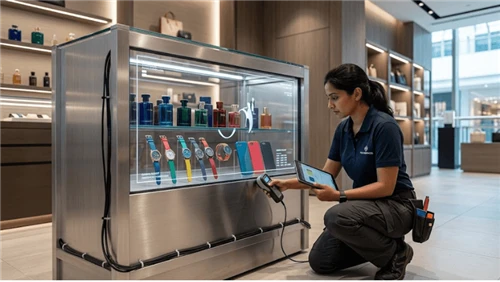
Transparent LCD showcases perform best in environments with three characteristics: controllable ambient lighting, limited screen counts, and applications where the see-through effect serves a functional purpose.

For projects fitting this profile, the technology is mature and the supply chain is established. Large-format museum installations, automotive showrooms, luxury retail flagships, and trade show centerpieces fall squarely in this category.
Deployments requiring high unit counts across convenience-store or quick-service environments present different challenges. The technology works, but integration complexity rises sharply with scale, environmental variability, and real-time data dependencies. We typically recommend scoping a 5–10 unit pilot before committing to larger orders in these environments.
MicroLED and other emerging technologies continue to advance, but for projects with 2025–2026 deployment windows, transparent LCD remains the mature choice with established supplier ecosystems and predictable execution paths.
Looking for clarity on whether transparent LCD fits your project? Request a consultation → - we'll walk through site conditions, content requirements, and realistic project scoping before you commit.
FAQ
Q: How much does a transparent LCD screen cost?
A: Pricing depends on screen size, enclosure requirements, and installation complexity. We scope projects individually to give you accurate budgets rather than generic ranges that may not apply to your situation.
Q: What's the real transparency of transparent LCD displays?
A: Complete systems with backlighting deliver 8–15% transparency, versus the 70% sometimes cited for bare panels. For a deeper look at how LCD compares to alternative technologies, see our guide on clear LCD screen vs traditional retail displays. The visual impact depends heavily on backlight configuration and ambient lighting.
Q: Transparent LCD vs transparent OLED-which should I choose?
A: LCD wins on price and supplier diversity. Transparent OLED wins on visual transparency (38–45%) but limits you to specific sizes and a single major supplier. Your deployment scale and budget typically make the choice clear.
Q: Can transparent LCD screens work in refrigerated cases?
A: Yes, with panels rated for -18°C or below. Refrigerated deployments add system integration complexity that requires supplier expertise beyond hardware selection.