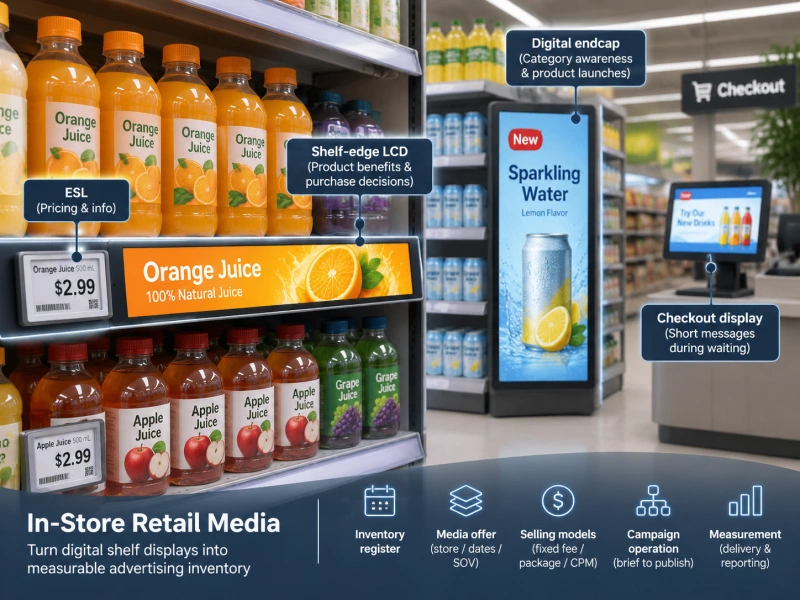
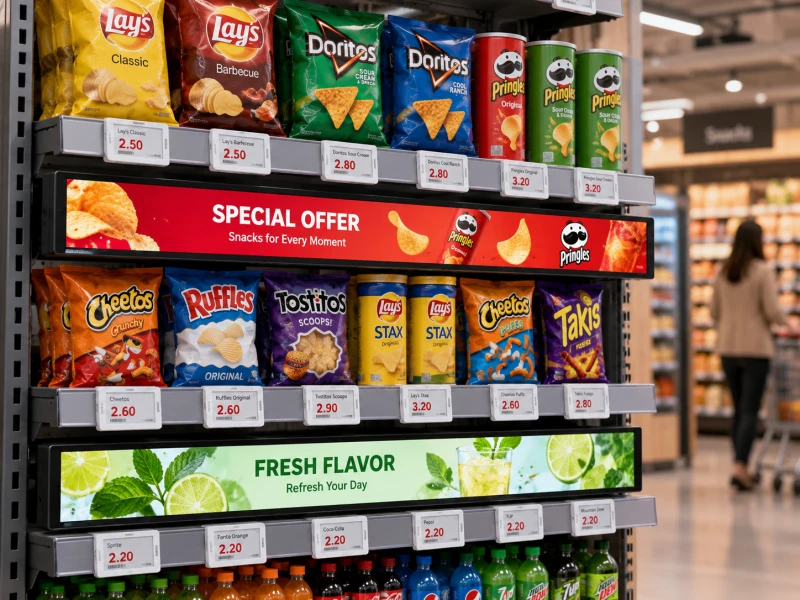
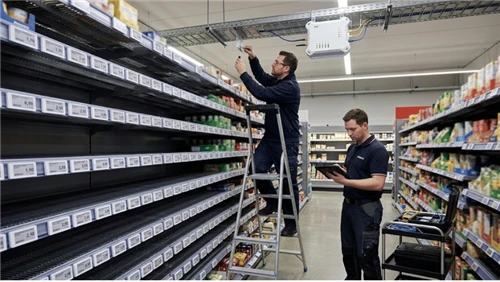
This is where electronic shelf labels for BOPIS can serve a second purpose beyond digital pricing. When an electronic shelf label is digitally associated with a SKU and its shelf position, its LED can help direct an associate to the product required for an online order.
Walmart describes this function as Pick to Light, using LED guidance on digital shelf labels to help associates find products while fulfilling pickup and delivery orders. The important point is that the LED is only one part of the workflow. Effective BOPIS picking still depends on accurate product data, inventory visibility, order management, item verification, and a clear exception process.

Why Product Search Becomes a BOPIS Bottleneck
A retail store is not designed like a fulfillment warehouse. Shelves are built for shoppers, merchandising and promotions rather than optimized pick paths. During a normal shift, an associate may also be dealing with customers, replenishment carts, promotional displays and products that have been moved from their expected locations.
The problem becomes more obvious in dense categories. A refrigerated section may contain many products from the same brand with different flavors and pack sizes. A pharmacy shelf may hold similar packages with different formulations. An electronics fixture may contain dozens of nearly identical cables or adapters.
A handheld device can tell the picker to go to Aisle 6, Bay 3. It does not always eliminate the final visual search across a crowded shelf. An ESL solution with controllable LEDs can make that final location visible at the shelf edge.
How LED-Guided BOPIS Picking Works
The most useful way to understand an ESL picking system is as a chain of connected actions rather than a standalone hardware feature:
Online order → order or picking system → SKU location → ESL platform → gateway → flashing label → item verification → order staging

1. The Order Is Released to the Store
The retailer's order management system determines which store will fulfill the BOPIS order. The picking application then creates a task containing the required SKUs, quantities and other fulfillment information.
IBM's BOPIS workflow documentation illustrates why inventory and order systems remain central: stores need inventory synchronization, demand updates, product scanning and shortage handling before an order can be completed successfully.
The ESL does not decide what should be picked. Its role starts once the picking application knows which SKU the associate needs to find.
2. The SKU Must Be Mapped to the Correct Shelf Position
LED guidance is only useful when product-location data is accurate. A working relationship typically needs to exist between the SKU, the physical shelf position and the ESL ID.
This makes ESL data readiness and label binding and commissioning operational requirements rather than setup details.
If a product moves to another bay but the location record is not updated, the system can activate exactly the label it was told to activate and still send the employee to the wrong place.
3. The Picking Application Triggers the Shelf LED
Once the picker selects an order line, the application can pass a request through an API, middleware layer or other supported integration to the ESL management platform. The platform then identifies the relevant label and sends the command through the wireless infrastructure.
The exact architecture depends on the retailer's software stack. For stores already connecting business systems with ESLs, the principles are similar to those used in POS and ERP integration.
More advanced deployments may also need rules governing which light flashes, for how long and for which task. This becomes particularly important when designing ESL LED task orchestration for several store workflows.
4. The Associate Still Verifies the Item
A flashing LED answers one question: Where should I look?
It does not always answer another: Did I pick the correct product?
A customer may have returned the wrong package to the shelf, or two nearly identical variants may have been placed next to each other. For that reason, retailers may combine LED-guided picking with product-code confirmation or barcode and QR code scanning.
The practical division is simple: the LED reduces search effort; verification protects picking accuracy.
5. Exceptions Need Their Own Workflow
Not every product will be where the system expects it to be. A SKU may have sold out moments earlier, been moved to an endcap, remained in the back room, or simply been misplaced.
When this happens, the picker should not keep searching indefinitely. The application should provide a defined next action, such as checking a secondary location, requesting replenishment, selecting an approved substitute or flagging the item as unavailable.
This is also why BOPIS performance depends on more than shelf guidance. Problems with on-shelf availability cannot be solved by making an LED flash faster.
What Changes With Multiple Pickers and Batch Picking?
A single picker following one order is the simplest case. Real stores may have several associates working at the same time or may batch products from several orders into one picking route.
In those environments, LED behavior needs to be designed around task ownership. Depending on the ESL platform and picking software, a retailer may use different LED colors, controlled flashing patterns, task IDs or handheld confirmation to prevent one associate from responding to another associate's signal.
These capabilities should be verified during system design rather than assumed. Not every label or software platform supports the same LED controls.
Batch picking also changes the workflow. The shelf signal should tell the associate where the SKU is located, while the handheld or picking application still needs to tell the associate which tote, customer order or staging container receives the product.
How Should Multiple Product Locations Be Handled?
A common retail complication is that one SKU does not always have one location. The same product may appear on its regular shelf, an endcap, a seasonal display and a checkout fixture.
For BOPIS, the system therefore needs more than a simple SKU-to-label relationship. A useful location hierarchy may include:
- store;
- department or zone;
- aisle;
- bay;
- shelf or fixture;
- facing or ESL position.
The picking application should also have a rule for selecting the preferred location. That could be the normal shelf position, the closest valid display on the current route, or another location determined by store operations. The ESL should execute that decision rather than make it.
ESL-Guided Picking vs. Dedicated Pick-to-Light
The two approaches use a similar visual idea, but their deployment logic is different.
A traditional Pick-to-Light system is normally installed specifically to support fulfillment at bins or storage positions. An ESL network is usually installed first for pricing and product information, with LED-guided tasks added to the same shelf infrastructure.
For a high-throughput fulfillment center, dedicated Pick-to-Light may still be the more appropriate architecture. For a retail store that already needs digital pricing across thousands of shelf positions, using LED-equipped ESLs for BOPIS can extend existing infrastructure instead of creating a second light system at the shelf edge.
Retailers comparing broader fulfillment technologies can also separate this store-level use case from the different methods covered in warehouse picking systems.
What Does the Technical Architecture Need?
A practical BOPIS ESL design usually includes five functional layers:
- OMS or picking application: creates and controls the fulfillment task.
- Product and location data: identifies the SKU and where it should be found.
- Integration layer: passes the requested LED action to the ESL platform.
- ESL platform and gateway network: sends the command to the appropriate label.
- Verification interface: confirms that the correct product was picked.
For larger stores, gateway placement and RF coverage matter because a label cannot provide useful real-time guidance if task commands do not reach the intended shelf reliably.
Plan the Fallback Before the Pilot Starts
BOPIS cannot stop because one shelf label is unavailable. A serious pilot should define what happens when the normal guidance path fails.
Typical fallback cases include:
- a label is offline or has been removed;
- a gateway or network segment is unavailable;
- the SKU is bound to the wrong position;
- the product has moved to another display;
- the picking application cannot send an LED command.
The fallback may return the associate to aisle-and-bay coordinates, product images, barcode search or another existing picking method. Retailers planning these scenarios can use the same principles applied to ESL offline operations: the failure mode should be predictable before the store depends on the system during peak fulfillment periods.
When Does ESL-Guided BOPIS Picking Make Sense?
The strongest business case is not simply "a store with online orders." The value depends on where associates are actually losing time.
| Store Condition | Likely Value of ESL Guidance |
|---|---|
| Existing ESL infrastructure | Higher, because the shelf network is already deployed |
| High BOPIS order volume | Higher, because small search-time reductions repeat across many order lines |
| Dense shelves with similar SKUs | Higher, because final shelf identification is difficult |
| Low inventory accuracy | Limited until inventory and location data improve |
| Most fulfillment time is spent walking between departments | ESL may help shelf search but will not solve route design |
| Very low BOPIS volume | Dedicated picking functionality may be difficult to justify on its own |
This distinction matters when calculating value. An ESL project should not claim that every minute of fulfillment labor will disappear. The useful question is how much time is currently spent locating products at the final shelf position and whether that problem occurs often enough to justify integration.
How to Run a Useful BOPIS ESL Pilot
A pilot should begin with a measurable problem rather than a store-wide rollout.
Select a department with meaningful online order volume, dense assortments and reliable product-location data. Record performance before LED guidance is introduced, then repeat the measurement after the workflow is enabled.
Useful metrics include:
- average picking time per order;
- average search time per order line;
- order lines picked per hour;
- first-pick accuracy;
- exception and substitution rate;
- time spent resolving unavailable products;
- time from order release to staging.
The existing electronic shelf label pilot checklist can support broader deployment testing, while an ESL ROI assessment can help separate measurable operating improvements from assumptions.
If the pilot shows that associates are finding shelf positions faster but total order time barely changes, the main bottleneck may be elsewhere: route design, inventory exceptions, staffing or staging. That is still a useful result because it prevents a retailer from attributing every fulfillment problem to the shelf.
The Real Value: Connecting Digital Orders to Physical Shelf Locations
For BOPIS, the most useful role of an electronic shelf label is not simply replacing paper price tags. Once a label is associated with a SKU and a physical location, software can address that exact point on the shelf.
That creates a practical connection between a digital order and the place where an associate needs to act.
LED-guided picking works best when the retailer treats it as one layer of a larger fulfillment process: accurate product data, reliable location mapping, inventory visibility, a picking application, item verification and well-defined exception handling still matter.
For retailers planning a BOPIS pilot, LEGOYO can review label requirements, LED workflows, store layout, gateway coverage and integration needs before deployment. Contact LEGOYO to discuss the requirements of your retail project.
FAQ
Can electronic shelf labels be used for BOPIS?
Yes. ESLs with controllable LEDs can be linked to SKUs and triggered during a BOPIS picking task to identify the expected shelf position. The picking application and product-location data are still required to determine which label should be activated.
Is ESL-guided picking the same as Pick-to-Light?
They use a similar visual-guidance principle, but the infrastructure can differ. Dedicated Pick-to-Light systems are normally built specifically for fulfillment, while ESL-guided picking reuses electronic shelf labels that may also handle pricing and product information.
Does the LED confirm that the correct product was picked?
No. It identifies the expected shelf position. Barcode, product-code or another verification method may still be needed to confirm the exact SKU.
Can several associates use LED-guided picking at the same time?
Potentially, but multi-picker operation should be verified against the ESL hardware and picking software. Retailers need clear rules for task ownership, LED behavior and confirmation so signals do not become ambiguous.
What happens if an ESL is offline during a BOPIS order?
The picking process should fall back to another location method, such as aisle and bay coordinates, product images or barcode search. A pilot should test this failure mode before the workflow is used during peak periods.
Which retailers are most likely to benefit?
Stores with frequent BOPIS orders, large or dense assortments, similar-looking SKUs and existing ESL infrastructure generally have the clearest reason to evaluate LED-guided picking. The final decision should be based on measured search time and fulfillment bottlenecks rather than store format alone.