A shelf-edge screen can show an advertisement without becoming a viable media business. Brands also need to know which placements they are buying, how often their creative will run, whether delivery can be verified, and how results will be measured.
Digital shelf displays connect those commercial requirements with the place where products are compared. For retailers, the task is to build an offer that advertisers can buy repeatedly and store teams can maintain. That requires coordinated inventory, campaign operations, display hardware, and measurement.

What Is In-Store Retail Media?
In-store retail media is advertising inventory offered to brands inside physical stores, using retail data to support planning, delivery, and measurement. Relevant data might include store formats, product assortments, category sales, and shopping patterns; individual shopper identification is not a prerequisite.
Compared with general retail advertising, a media network adds a defined buying process, accountable delivery, and reporting. Installing digital signage supplies the communication channel; operating a retail media network supplies the commercial service.
The connection is visible in industry investment. In an announcement dated October 29, 2026, Vusion confirmed its acquisition of In-Store Media, combining connected-store technology with an established media operator. This illustrates the convergence of infrastructure and advertising operations, rather than proving any particular screen's return.
How Retailers Sell Digital Shelf Advertising
Start with an inventory register. Give every placement a store, aisle, category, device identifier, screen format, operating schedule, and availability status. A beverage-shelf placement should only enter a brand's package when the relevant products are stocked and the screen is serviceable.
The media offer can then specify participating stores, campaign dates, creative duration, category restrictions, and share of voice. For example, one ten-second slot in a repeating sixty-second loop represents 16.7% of scheduled airtime. It does not establish how many shoppers see the advertisement or how frequently each person encounters it.
- Fixed placement fee: Charge for an agreed location and period, with explicit delivery obligations.
- Campaign package: Bundle selected shelf screens, endcaps, or store groups, stating each component's allocation.
- CPM: Charge per thousand impressions only when the impression definition, estimation method, and reconciliation rules are agreed.
Reserve space for retailer messages and essential product information before selling capacity. Contracts should address competitor adjacency, unavailable stock, missed delivery, and replacement advertising or credits.
Decide who operates the service. A retailer may sell directly while outsourcing installation, or appoint a media operator to handle sales and reporting. Record ownership of advertiser relationships, inventory allocation, data access, maintenance, and revenue settlement. Otherwise, a screen outage can become a dispute between the advertiser, software provider, hardware supplier, and store team, with nobody responsible for resolving the missed campaign.
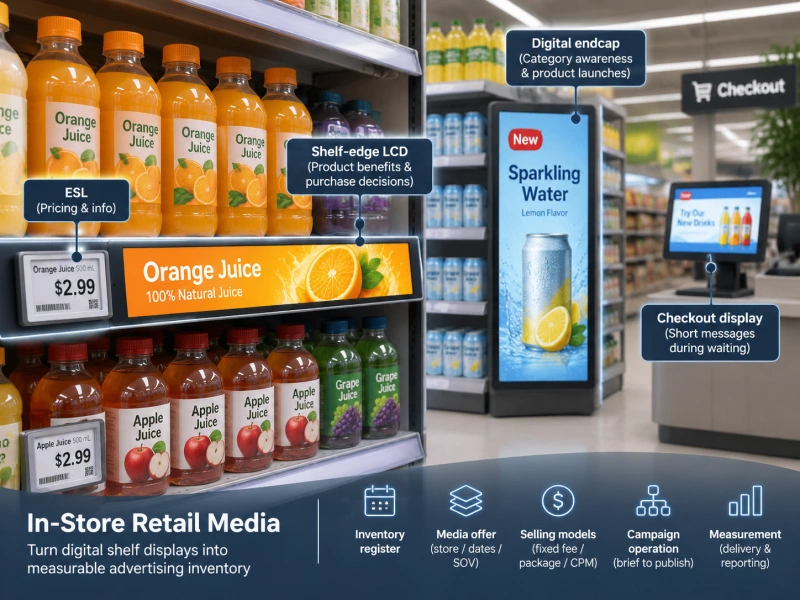
Match Each Display to Its Advertising Job
| Format | Best role | Planning constraint |
|---|---|---|
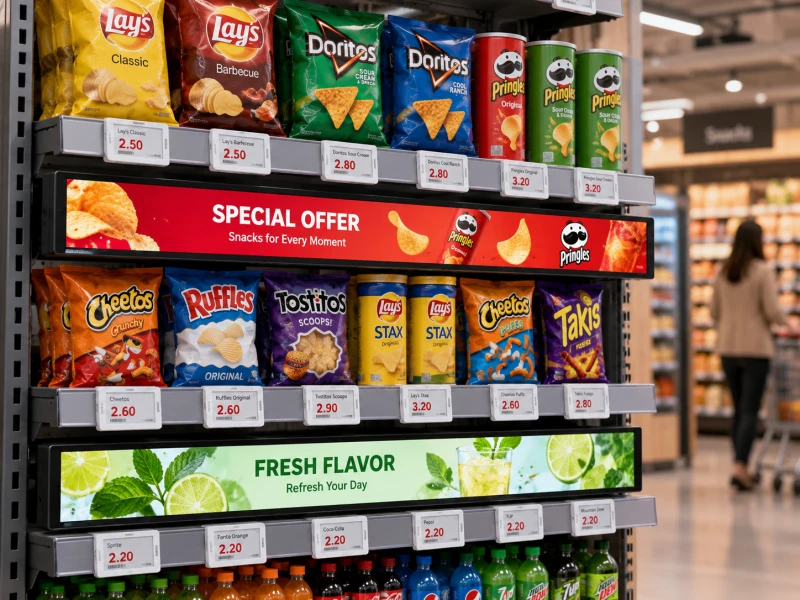
| Shelf-edge LCD displays | Product benefits and nearby purchase decisions | Narrow layouts, viewing angles, shelf access |
| ESLs alongside shelf-edge LCDs | Keep pricing and advertising roles coordinated | Capabilities vary; e-paper labels generally do not support video |
| Digital endcap displays | Category awareness and product launches | Product availability and aisle sightlines |
| Checkout displays | Short messages during waiting periods | Payment instructions and transaction visibility take priority |
A shelf position offers product proximity, not guaranteed attention. Check visibility with products stocked, trolleys passing, and shoppers standing at normal browsing distances.

From Brand Booking to Verified Delivery
A workable campaign process connects the media team, merchandising, store operations, and technical support:
- Brief and book: Agree objectives, products, stores, dates, budget, placements, and success metrics.
- Approve: Review claims, pricing, creative dimensions, product availability, and category conflicts.
- Schedule: Assign campaign and creative identifiers to the correct device groups and time windows.
- Publish: Distribute approved assets through the CMS and confirm successful downloads.
- Reconcile: Compare scheduled delivery with valid playback records, investigate gaps, and report any adjustments.
A brand's booking document should name the promoted products and distinguish guaranteed placements from estimated audience delivery. State whether creative production, measurement, and reporting are included in the media fee. Specify submission deadlines and cancellation terms. Automated buying is an optional capability of the selected platform, not a feature supplied by the display itself.
The CMS manages content and assignments; a built-in or external media player executes the playlist; the LCD renders the output. Procurement should test CMS integration and publishing with the intended hardware, rather than assume every platform supports the same controls.
Require local caching, campaign expiry rules, fallback content, and buffered logs during outages. Logs should identify device, creative, campaign, timestamp, and playback duration. Reconcile them with device-health monitoring: a player can report playback while a panel is dark. Where creative spans adjacent screens, validate multi-screen synchronization separately.
Connect product references to the retailer's catalogue so campaigns follow the intended assortment. Define how stock alerts pause advertising and how quickly price changes reach creative that includes an offer. These integrations require agreed data feeds and responsibilities; screen connectivity alone does not provide them.
Specify Hardware for the Actual Shelf
Measure usable shelf width, vertical clearance, bracket depth, and cable routes before choosing screen dimensions. Native resolution and aspect ratio must suit the creative; stretching a standard landscape advertisement into a narrow strip can make product text unreadable.
Evaluate brightness and reflection control under store lighting. Check off-axis readability, glare, and whether mounting obstructs labels or replenishment. Refrigerated locations require confirmation of the complete assembly's environmental suitability.
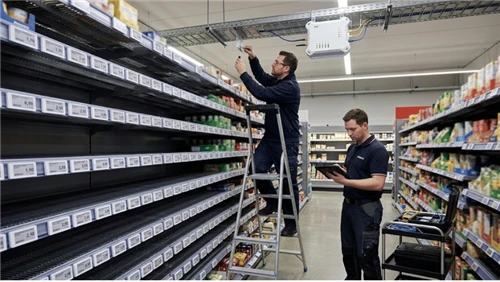
Specify daily operating hours, power distribution, network access, service access, and replacement procedures. Enclosed shelf installations also need appropriate thermal management and ventilation. Remote monitoring cannot compensate for inaccessible connectors or an overheated player.
Acceptance testing should include power restoration, connection loss, expired campaigns, and panel failure. Document who detects each fault, who resolves it, and how affected advertising delivery is reconciled.
Create Advertising That Works Without Sound
Use one recognizable product image, one useful benefit, and a concise message. A shopper entering halfway through a loop should still understand the advertisement. Keep important information visible without waiting for a final frame.
Test shelf-edge content layouts at actual viewing distance. If prices appear, define their authoritative source and update process. An optional QR code can extend product education, but essential offer details should remain readable on the screen.
Measure Playback, Exposure, and Incremental Sales Separately
The December 2024 IAB and IAB Europe standards distinguish ad plays, gross impressions, opportunity to see, and likelihood to see. Use named metrics with disclosed methods instead of treating every screen event as an audience impression.
- Delivery: Report valid plays, completed duration, device availability, and missed schedules.
- Exposure: Explain the screen zone, visibility conditions, audience inputs, dwell assumptions, and modelling limitations.
- Engagement: Count QR scans or coupon actions separately; they represent only participating shoppers.
- Outcomes: Compare incremental product or category sales against an appropriate control, reporting uncertainty.
Provide scheduled versus delivered airtime by store, excluded faults, compensating delivery, and the version of each creative. Show measured counts separately from modelled estimates. If a campaign combines shelf, endcap, and checkout inventory, disclose whether audiences overlap and whether the report can deduplicate them. Without that capability, avoid calling the sum of exposures unique shoppers.
Opportunity to see does not confirm attention. Repeated exposure across screens also does not establish unique reach. Avoid multiplying total store footfall by every playback and presenting the result as measured viewers.
Evidence supports testing, with limits. A Journal of Marketing study first published in 2025 examined 237 campaigns involving approximately 30 million shoppers across ten stores during 2018–2022. Its headline 8.1% effect represents higher purchase odds, which the authors approximate as purchase probability for these low-probability purchases. It is not an 8.1-percentage-point increase. The screens were ceiling-mounted in main aisles, so the result is not a shelf-edge LCD benchmark.
For a local incrementality test, randomize comparable stores where practical, or match them using baseline sales and format. Account for pricing, promotions, seasonality, stockouts, and other media. Agree the sample size, reporting window, and analysis before launch; simple before-and-after growth cannot isolate advertising's contribution.
Budget for Operations and Data Collection
Request an itemized project quote covering displays, players, mounting, electrical work, installation, networking, integration, and spares. Compare the operating ratings and support terms of commercial displays and consumer televisions, rather than purchase price alone.
Recurring costs include CMS licences, connectivity, creative adaptation, media sales, reporting, maintenance, electricity, and partner revenue shares. Model revenue using realistically sold inventory, not the theoretical value of every available slot.
For a simplified cash-payback estimate, divide initial deployment cost by average monthly net cash contribution after recurring expenses. A non-positive contribution produces no payback. Keep advertising income separate from estimated merchandising benefits to avoid double counting.
Run conservative, expected, and stronger-demand scenarios. Vary sold airtime, realized selling price, outages, and service visits. A model that only works at full occupancy leaves little room for weak advertiser demand or deployment delays. Advertisers should assess their own incremental profit against campaign cost separately from the retailer's media revenue.
Audience sensors are optional. Before adding them, document collected data, processing locations, retention, access, and third-party sharing. Assess privacy requirements for the actual design. A vendor's claim of anonymous analytics should prompt verification of data flows.
Run a Pilot That Answers a Commercial Question
Illustrative scenario, not a customer case: A beverage brand books a six-week supermarket campaign using shelf screens near its stocked products. The agreement defines participating locations, airtime allocation, creative versions, reporting, and remedies for missed delivery.
Select treatment and control stores before launch, checking whether the sample can detect a commercially meaningful effect. Keep pricing and promotions comparable. Monitor playback and panel health, record stockouts, and replace expired or unavailable-product advertising with approved fallback content.
For this example, use a ten-second silent creative featuring the beverage pack and one product benefit. Agree the maximum acceptable missed delivery, recovery time, and field-service workload before launch. These are project acceptance thresholds, not universal industry benchmarks. If sales data are too noisy to support a conclusion, extend the test or report the result as inconclusive.
At completion, review delivery, estimated exposure, incremental sales with uncertainty, operating costs, and advertiser renewal interest. Expand only when the buying process, economics, and maintenance workload are workable. Resolve nonstandard shelf dimensions or mounting constraints through custom LCD planning before ordering at scale.
FAQ
1. What is in-store retail media?
In-store retail media is advertising inventory offered within physical stores, using retail data to plan placements, deliver campaigns, and measure results. Digital shelf screens are one possible format.
2. Are shelf-edge LCDs the same as electronic shelf labels?
No. Electronic shelf labels primarily display prices and product information. Shelf-edge LCDs support richer visual advertising, including product imagery and video. The two technologies can work together.
3. How do brands buy digital shelf advertising?
Brands book defined stores, placements, dates, and airtime through the retailer or its media partner. Pricing may use fixed placement fees, campaign packages, or CPM with a disclosed impression methodology.
4. Can digital shelf advertising be updated remotely?
Yes, when displays have compatible media players, network connections, and a content management system. Retailers should test scheduling, local caching, campaign expiry, and playback reporting before launch.
5. How should campaign performance be measured?
Measure delivery, estimated exposure, shopper interactions, and incremental sales separately. Playback logs confirm player activity but do not prove shopper attention. Estimating incremental sales requires an appropriate test-and-control design.
6. Are cameras necessary for in-store retail media?
No. Retailers can sell clearly defined placement packages without cameras. If audience sensors are added, review their data collection, processing, retention, and access arrangements before deployment.
7. What determines deployment cost and payback?
Costs include displays, players, installation, software, creative production, maintenance, and media operations. Payback depends on initial investment and retained advertising income after recurring expenses; there is no universal payback period.
8. What should retailers include in a first pilot?
Define placements, campaign objectives, delivery thresholds, and measurement methods before launch. Share shelf drawings, viewing conditions, CMS requirements, and pilot quantities with the LEGOYO retail display team.