Lessons from America's Largest ESL Deployment
Retail is at a turning point. Over half of retailers say their current technology can't keep up with where the business needs to go. Digital investments often take forever to pay off. But Walmart has figured it out-not through small pilots that never go anywhere, but through full-scale digitalization that is fundamentally reshaping how America's largest retailer operates.
How Walmart is using Electronic Shelf Labels to improve store efficiency
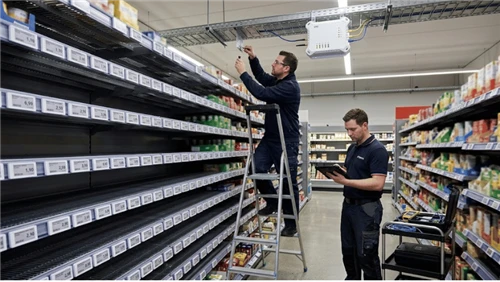
In June 2024, Walmart announced plans to deploy electronic shelf labels across 2,300 U.S. stores by 2026. By December 2024, the company extended its contract with technology provider VusionGroup for over $1 billion, accelerating the rollout to all 4,600 U.S. stores. This represents the largest ESL deployment in North American retail history-an estimated 400 to 500 million digital price tags across more than 120,000 products per store.
For retailers asking the critical question-how do you modernize without breaking what's already working?-Walmart's transformation offers a detailed playbook.
The Scale of Walmart's Challenge
Before going digital, Walmart faced operational challenges familiar to retailers everywhere. Each store stocks more than 120,000 products, each requiring an individual price tag. Every week, stores process thousands of pricing updates for new items, Rollbacks, and markdowns. During peak seasons, the volume escalates dramatically.
The daily reality of paper-based pricing created significant friction:
Labor-intensive price changes consumed hours of associate time that could have gone toward helping customers. A price update that required two full days of manual work now completes in minutes with ESL technology.
Pricing discrepancies between shelf tags and point-of-sale systems created checkout headaches. Customers would bring items to the register only to find the displayed price didn't match what rang up-the kind of experience that erodes trust quickly.
Limited promotional agility made it nearly impossible to coordinate flash sales or respond to competitive pricing moves in real time. When you're relying on associates walking aisles with label guns, launching a synchronized price promotion across thousands of stores isn't realistic.
E-commerce fulfillment challenges grew as online orders increased. Store associates picking orders for delivery and curbside pickup needed faster ways to locate products across massive floor plans.
The U.S. Market Shift
Walmart's ESL adoption marks a significant milestone for the North American retail market, which has traditionally lagged Europe in adopting digital shelf technology. The reasons for this historical hesitation include the low cost of traditional paper labeling (around 5 cents per tag compared to $5 or more for ESLs) and the substantial upfront investment required for deployment.
However, the landscape has shifted dramatically. Rising labor costs, omnichannel complexity, and the need for real-time pricing synchronization between online and in-store channels have changed the calculus. Walmart's move is expected to accelerate ESL adoption across the entire U.S. retail sector.
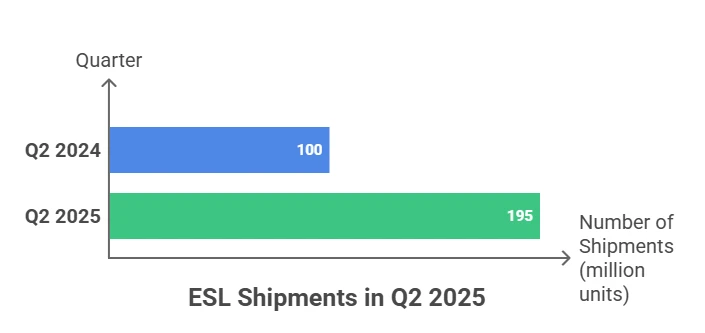
Industry data confirms this momentum. ESL shipments surged from just over 100 million units per quarter to nearly 200 million units in the second quarter of 2025-a 211.4% year-over-year increase-driven primarily by Walmart's deployment.
How ESLs Work
Electronic shelf labels use E-ink (electrophoretic display) technology-the same paper-like screens found in e-readers. Unlike LCD displays, E-ink screens reflect ambient light rather than emitting their own, creating displays that look like printed paper and remain readable under any store lighting conditions, from any viewing angle.
Power consumption is extraordinarily low. Because E-ink displays only consume power when the image changes, batteries typically last five years or more with standard daily update cycles. No wiring is needed-tags mount using clips, hooks, or magnetic attachments to standard shelf rails.
Walmart's deployment primarily uses smaller tags in the 1.5-inch to 3-inch range, which account for the majority of shelf labels in a typical store. Mid-sized tags (4 to 6 inches) handle about 5.5% of deployment volume, typically positioned for products requiring more detailed information or greater visibility.
Size Selection by Store Format
Choosing the right ESL size depends on product type, shelf layout, and typical customer viewing distance:
Compact tags (2.66" to 4.2") work well for standard shelf pricing in supermarket aisles, convenience stores, and areas with tight shelf spacing. These sizes balance visibility with efficient use of shelf edge real estate.
Mid-range tags (5.8") provide the optimal balance between visibility and flexibility for most supermarket applications. They accommodate additional information like promotional callouts, member pricing, or product details while fitting standard label holder rails.
Large format tags (7.3"+) serve endcaps, bulk displays, and departments where customers view from greater distances. Electronics sections, appliance displays, and warehouse club environments benefit from these larger screens.
LCD digital signage (10.1" to 15.6") handles high-impact promotional locations-endcaps, new product launches, and featured items that benefit from video capability and vibrant color displays. These require power connections but deliver visual impact that static displays can't match.

Temperature Considerations
Standard E-ink labels operate reliably between 0°C and 40°C (32°F to 104°F), making them suitable for standard retail environments and refrigerated cases. Freezer environments below -18°C (0°F) require low-temperature variants with appropriate moisture protection. Retailers should specify temperature ratings during procurement to avoid compatibility issues in cold storage areas.
Operational Transformation: Real Results
Walmart's results demonstrate the operational impact of comprehensive ESL deployment.
Pricing efficiency gains are dramatic. Updates that required two days of manual labor now complete within minutes. The Me@Walmart app allows associates to process price updates with just a few clicks, pushing changes directly to labels across the store floor.
Pricing accuracy improves as the system eliminates manual transcription errors. When prices change in Walmart's merchant systems, they automatically synchronize to shelf labels-removing the gap that historically caused checkout disputes.
Associate productivity shifts from low-value repetitive tasks to customer-facing activities. As one Walmart team lead noted, associates can now spend more time assisting customers and less time on repetitive tasks like manual price tag changes.
E-commerce fulfillment accelerates through "pick-to-light" functionality. When store associates pick orders for delivery or curbside pickup, ESL tags flash LED indicators to guide them directly to products. With e-commerce now representing 18% of Walmart's total revenue-and online grocery orders continuing to grow-this capability has become essential.
Stock replenishment simplifies through "stock-to-light" features that use the same LED indicators to highlight shelves requiring attention. Associates can quickly identify and address low-stock conditions without scanning every shelf.

Beyond Pricing: The Omnichannel Connection
Walmart's ESL deployment is one component of a broader digital transformation creating true omnichannel capability. The company has reached 93% same-day delivery coverage across U.S. households, with plans to extend to 95% by late 2025. More than half of e-commerce fulfillment center volume now flows through next-generation automated facilities.
Digital shelf labels connect to this ecosystem in multiple ways:
Real-time inventory visibility improves as ESL data integrates with inventory management systems. The same infrastructure that updates prices can track product availability, flag out-of-stock conditions, and coordinate replenishment.
Pricing consistency across channels becomes achievable when in-store prices update through the same systems driving online pricing. Customers checking prices on the Walmart app see the same information displayed on shelf tags.
Customer experience enhancement extends to providing more information at the point of decision. ESL tags can display QR codes linking to product details, nutritional information, sourcing data, or customer reviews-bringing online research capabilities to physical shopping.
Advertising and retail media integration opens new possibilities. Walmart's retail media business exceeded $4.4 billion in annual revenue in 2024. Digital shelf labels can potentially display brand-sponsored content or targeted promotions, creating new revenue streams.
Implementation Realities
Retailers evaluating ESL deployment should understand that the technology isn't plug-and-play. Successful implementation requires careful planning across several dimensions.
System Integration
ESL data flows from ERP or POS systems via APIs, database connections, or file exports. Major retail software platforms typically offer pre-built connectors, but custom systems may require development work. Technical teams should engage with ESL suppliers early in the planning process to map integration requirements and timelines.
Site Assessment
Physical store surveys identify base station placement requirements, tag quantities by department, and solutions for special environments like freezers, endcaps, or non-standard shelving. Signal coverage, mounting options, and power access (for any LCD components) all require advance planning. Skipping this step leads to coverage gaps and inventory shortages during rollout.
Pilot Before Scale
Walmart began with a pilot store in Grapevine, Texas before announcing broader deployment. Starting with a single department or aisle allows teams to validate that prices sync correctly, updates happen within acceptable timeframes, and store staff can handle new workflows. Resolving issues at small scale is far cheaper than troubleshooting across thousands of stores.
Training and Change Management
Store teams need clear procedures for binding tags to products, troubleshooting offline labels, and following escalation processes for technical issues. Documentation of common scenarios prevents IT teams from fielding calls for routine matters. The goal is empowering store associates to own the technology in their daily work.
Addressing Common Concerns
Dynamic Pricing Questions
ESL technology enables rapid price changes, raising questions about "surge pricing"-adjusting prices based on demand, time of day, or other factors. Walmart has explicitly stated it has no plans to implement dynamic pricing in the way airlines or ride-sharing services do. The focus is operational efficiency, not price manipulation.
Research from the University of California Rady School of Management (July 2025) found that supermarkets are not engaging in widespread dynamic pricing despite having the technological capability. The competitive nature of grocery retail and consumer expectations around price consistency constrain how retailers can use real-time pricing capabilities.
Sustainability Impact
ESL deployment supports environmental goals by eliminating paper waste from constant tag printing. Walmart uses battery-less ESL technology powered through smart rails with ultra-low-power Bluetooth connectivity-reducing environmental impact compared to solutions requiring frequent battery replacement. The long operational life of E-ink displays (five years or more) further reduces the environmental footprint compared to disposable paper alternatives.
Consumer Trust
Transparent, accurate pricing actually builds trust by eliminating the frustration of shelf-to-checkout discrepancies. Clear ESL displays can provide more product information than paper tags ever could, including sourcing details, allergen information, or sustainability certifications. The technology enables transparency rather than obscuring it.
Technology Options for Different Needs
E-ink Electronic Shelf Labels
The workhorse technology for large-scale rollouts. Paper-like readability, minimal power consumption, and simple installation make E-ink ideal for standard shelf pricing across thousands of SKUs. Walmart's deployment demonstrates that comprehensive E-ink coverage is both technically feasible and economically viable at massive scale.
Key specifications to evaluate:
Display resolution and contrast for readability across viewing distances
Communication protocol (Bluetooth, proprietary RF, Wi-Fi) affecting update speed and infrastructure requirements
LED indicator capability for pick-to-light and stock-to-light applications
NFC support for customer interaction features
Temperature range for compatibility with refrigerated environments
Mounting options matching existing shelf rail systems
LCD Digital Signage
Vibrant displays capable of video playback and dynamic content serve different purposes than standard E-ink labels. Product demonstration videos, rotating promotional images, and countdown timers create engagement that static displays can't match. Power requirements make LCD practical for strategic locations rather than universal deployment.
Consider LCD signage for endcaps, new product launches, high-margin categories, and brand showcase areas. Single-sided and double-sided configurations serve different fixture types.
Interactive Kiosks
Self-service touchscreen displays extend digital capabilities beyond shelf edges. Interactive kiosks support product lookup, loyalty program enrollment, order placement, and customer service functions. They bring the app experience into physical stores for customers who prefer that interaction mode.
Transparent Displays
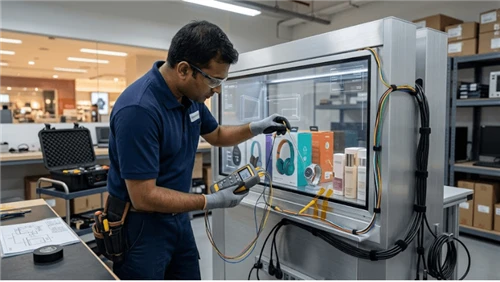
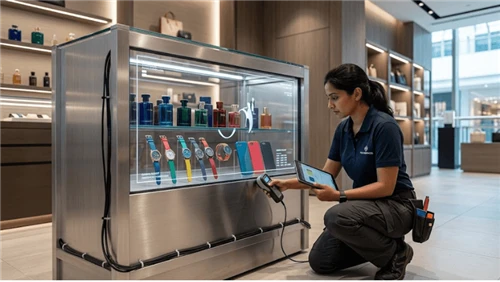
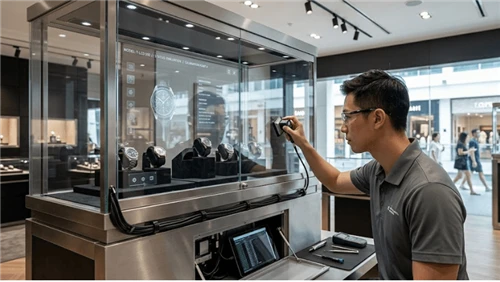
Emerging technology allows digital content overlay on physical product showcases-ideal for premium merchandise where customers need to see both the actual item and dynamic promotional content simultaneously.
What's Coming Next
The technology continues advancing. Four-color E-ink now delivers vibrant displays that older monochrome screens couldn't match. AI-driven pricing analytics can factor in demand patterns, competitor pricing, and inventory levels for more sophisticated pricing strategies.
Walmart's 2024-2025 technology roadmap includes AI-powered tools for associates, computer-vision checkout, and predictive demand sensing. ESL infrastructure integrates with these broader capabilities, providing the physical layer connecting digital systems to store shelves.
The company is deploying AI tools across its 2.1 million associates worldwide, with the Me@Walmart app serving as the platform for streamlined workflows and intelligent task management. This represents the next stage of transformation-ESLs as one component of an AI-enhanced retail operation.
The Competitive Reality
Walmart's investment creates competitive pressure across retail. As one industry analyst noted, Walmart is the most competed-against retailer in the U.S., and its ESL deployment has raised the stakes for every competitor trying to match or beat them on prices and promotions.
Other retailers have implemented ESL technology-including Whole Foods, Schnuck Markets, and Good Food Holdings-but Walmart's scale changes the market dynamic. Once this deployment completes, Walmart can adjust prices as quickly as it wants, with higher compliance and lower cost than competitors still relying on paper-based systems.
For retailers mapping their own digital transformation, the technology exists today: E-ink electronic shelf labels from compact 2.66" units to large 7.3" displays, LCD digital signage for visual impact, transparent displays for product showcases, and interactive kiosks for self-service applications.
Walmart's ESL deployment represents the largest digital shelf transformation in U.S. retail history. The company isn't dabbling with pilot programs-it's committing over $1 billion to deploy the technology across its entire store fleet.
The operational benefits are clear: pricing updates that took two days now complete in minutes, associate productivity shifts from manual tagging to customer service, e-commerce fulfillment accelerates through pick-to-light guidance, and pricing accuracy improves across online and in-store channels.
For retailers evaluating similar investments, Walmart's experience demonstrates that comprehensive digitalization-not token experiments-delivers real results. The technology exists. The ROI case is proven. The question isn't whether to go digital-it's how fast and how completely.
Those who move decisively, deploying at scale rather than testing around the edges, position themselves to compete where consumer expectations keep rising and operational efficiency determines survival. Walmart's transformation took years of planning and significant investment. The competitive advantage goes to those who start now.
For retailers evaluating electronic shelf label solutions, comprehensive product options span E-ink displays from 2.66" to 7.3", LCD digital signage from 10.1" to 15.6", and integrated display solutions for diverse retail environments.