Walk into a convenience store. No routine greetings, no clerk asking "Need any help?", no waiting at the checkout counter. You simply pick what you need, take it, and walk straight out - your phone has already completed the payment, and the digital receipt arrives instantly.
This goes far beyond saving time in line. For many consumers, unmanned stores create a "disturbance-free" shopping environment: no upselling, no social pressure, no sense of being watched. You can take your time comparing products, deliberate repeatedly, even show up at 3 a.m. in pajamas to buy instant noodles - without interacting with anyone.

This scenario is gradually becoming reality. Behind it is a complete technology ecosystem built on electronic shelf labels, smart displays, and self-service terminals.
What Exactly Can Unmanned Stores Bring To Retailers?
Structural optimization of labor costs
A typical 24-hour convenience store usually requires 4-6 employees working in shifts. In first-tier cities, labor costs alone can exceed 300,000 dollar annually. Unmanned stores can reduce on-site staff to 1-2 people (mainly responsible for restocking and maintenance), achieving labor cost savings of 50-70%.
More importantly, these savings are sustainable. As minimum wage standards rise year after year and hiring becomes increasingly difficult, traditional retail's labor cost pressure continues to climb, while the marginal cost of automation equipment decreases annually.
Why are unmanned stores not staffed by 0 people?
In practice, "unmanned" does not mean completely without staff. Most unmanned convenience stores retain 1–2 on-site employees to handle situations that technology alone cannot fully eliminate.
These include temporary network instability, exception handling during system failures, and assisting customers who are unfamiliar with self-service or grab-and-go processes. In addition, on-site staff help ease internal transition by shifting from repetitive checkout work to higher-value tasks such as restocking, equipment checks, and customer guidance.

Price accuracy and compliance risk
Inconsistency between shelf tags and checkout prices is one of the most common complaints in retail. Traditional stores need to update dozens or even hundreds of prices daily - promotions launching, sales ending, supplier price adjustments, competitive responses... Manually replacing paper tags is not only time-consuming and laborious but also error-prone.
Electronic shelf label systems connect directly with POS systems. Once backend prices are adjusted, shelf tags can sync within minutes. This means:
What customers see is what they get - price complaints approach zero
Promotions can execute with minute-level precision
Avoiding regulatory penalties caused by pricing errors
Data-driven refined operations
Traditional retail data collection mostly stops at the checkout counter - only knowing what products were sold, but unable to understand how long customers hesitated in front of shelves, which products were picked up and put back, how different products were compared.
The sensor network in unmanned stores can capture complete shopping behavior data:
Dwell time: How long do customers stand in front of specific shelves?
Pick and return: Which products are taken and then put back?
Traffic heatmap: What are customers' walking paths in the store?
Abandonment rate: How many customers select products but don't complete the purchase?
This data can be directly used to optimize shelf layouts, adjust product selection, and formulate promotional strategies.
Shrinkage control
Unmanned stores are often questioned: without staff supervision, are products more likely to be stolen?
In fact, the combination of comprehensive sensor systems, video surveillance, and identity binding often results in lower shrinkage rates in unmanned stores than traditional ones. Every product pickup and return is recorded, every customer is linked to a payment account. Even if anomalies occur, the system can quickly locate the problematic product and associated account.
Small Unmanned Convenience Store Complete Solution
Taking a 100-square-meter community convenience store as an example, let's see how to build an unmanned retail system using LEGOYO's product line.
System Architecture Overview

Customer enters
QR code scan / facial recognition

Shelf area
E-ink electronic shelf labels + sensors

Customer takes product
Sensor detection → Added to virtual cart

Promotion area
stretched bar LCD + 10.1" dual-sided price screen

Customer exits
Automatic settlement → Digital receipt

Alternative path
Self-checkout terminal (Kiosk)
Foundation Layer: E-ink ESL - Ensuring Price Accuracy
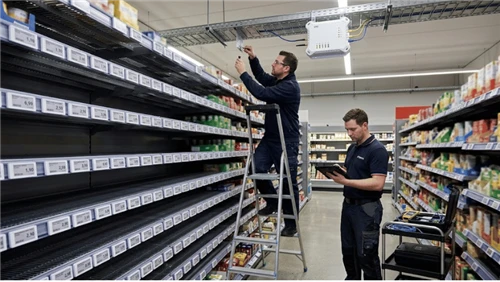
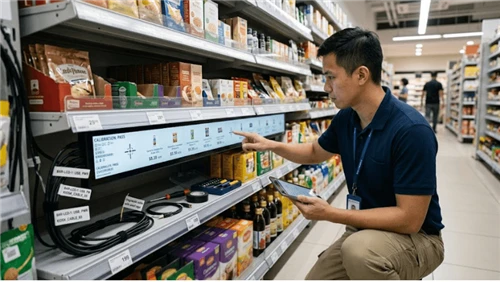
Electronic shelf labels are the foundation of the system. In a convenience store with 800-1,000 SKUs, every product position needs coverage.
Recommended Configuration:
|
Area |
Recommended Model |
Quantity Estimate |
Features |
|
Standard shelves |
2.66" E-ink electronic shelf label |
500-600 units |
Compact design, suitable for densely displayed daily necessities and snacks |
|
Beverage/dairy coolers |
4.2" E-ink electronic shelf label |
100-150 units |
Larger fonts, operating temperature covers 0℃-40℃, adapts to refrigerated environments |
|
Featured recommendation area |
5.8" E-ink electronic shelf label (with NFC and 7-color LED) |
50-80 units |
LED flashing attracts attention, NFC supports phone tap for details |

Key Technical Points:
All labels sync in real-time with backend ERP/POS systems via wireless base stations
Battery life can exceed 5 years (based on 1-3 refreshes per day)
Supports black, white, and red three-color display, highlighting promotional prices
Interaction Layer: Bar LCD - Driving Dynamic Promotions
E-ink labels excel at static information display, while stretched bar LCD screens can play videos and create visual impact, making them ideal carriers for dynamic promotions.
Recommended Configuration:
|
Application Location |
Recommended Model |
Function |
|
Shelf edge promotion strip |
28" / 35.5" stretched bar LCD |
Scrolling flash discounts, new product recommendations, member-exclusive prices |
|
Cooler top |
37.8" dual-sided stretched bar LCD |
Display beverage promotion videos, frozen treat ads, dual-sided design ensures visibility from both sides of the aisle |
|
Checkout area / exit |
49" stretched bar LCD |
Remind last-minute promotions, spend-threshold discount countdowns |

Linkage with Electronic Shelf Label System:
When the backend launches a promotional campaign:
Electronic shelf labels automatically update to promotional prices
Stretched bar LCDs simultaneously play corresponding promotional visual content
Both systems are coordinated by a unified content management system (CMS)
Such linkage avoids the awkwardness of "tags changed but screens didn't" or "screens playing but tags unchanged."
Safety Layer: Self-Checkout Terminal - The System's Safety Net
Even in "grab and go" frictionless payment technology, backup solutions remain indispensable. Weather impacts, equipment failures, network fluctuations, and products requiring age verification like alcohol - there are always scenarios that need self-confirmation or human intervention.

Recommended Configuration:
LEGOYO's Android smart service touchscreen self-service terminal is a suitable choice:
21.5" touchscreen, supporting QR code, NFC, bank card, and multiple payment methods
Can integrate ID card reader (for restricted products like alcohol and tobacco)
Built-in printer, can issue paper receipts
Supports WiFi and 4G networks, can operate independently when the main network is interrupted
In a 100-square-meter store, typically 1-2 self-service terminals are configured as backup, also serving as customer service points (checking points, processing returns and exchanges, etc.).
Solution Overview
|
Equipment Type |
Model |
Quantity |
Unit Price Range |
Subtotal |
|
E-ink electronic shelf labels |
2.66/4.2/5.8" mixed |
700 units |
$50-150 |
$50,000-80,000 |
|
Stretched bar LCD |
28-49" mixed |
5-8 units |
$2,000-5,000 |
$15,000-30,000 |
|
Self-checkout terminal |
Android Kiosk |
2 units |
$8,000-15,000 |
$16,000-30,000 |
|
Wireless base station + gateway |
- |
3-5 units |
$1,000-2,000 |
$5,000-8,000 |
|
Total |
$86,000-148,000 |
Based on annual labor cost savings of approximately 150,000 dollar, the equipment investment payback period is about 8-12 months.
Customized Industry Solutions for Different Products
Unmanned retail is not limited to convenience stores. Different product categories have their own display requirements and regulatory demands, requiring tailored display solutions.
Unmanned Pharmacy
Pharmaceutical retail is under strict regulation. Every medication has approval numbers, expiration dates, usage and dosage, contraindications, and other key information. Traditional paper tags cannot carry this content, but electronic shelf labels can.
Core Customized Solution: 5.8" E-ink Electronic Shelf Label (with NFC function)
The NFC function of this product has significant value in pharmacy scenarios:
Information extension: The label displays drug name, price, and specifications. Customers tap the NFC area with their phone to retrieve complete package inserts, usage and dosage, and precautions
Prescription drug control: NFC can link with the membership system to verify whether the customer holds a valid prescription for the medication
Medication reminder: After purchase, customers can register for medication reminder services via NFC
Supporting Display Equipment:
|
Location |
Equipment |
Function |
|
Prescription drug cabinet |
7.3" E-ink label |
Large screen displays complete drug information, cabinet door must be unlocked to retrieve medication |
|
OTC shelf |
5.8" NFC label |
Supports phone tap to query details |
|
Checkout area |
Self-service terminal + ID card reader |
Prescription drug purchases require identity verification |
|
Health section |
42x23" transparent LCD |
Display health product efficacy videos, physical products placed behind the screen |
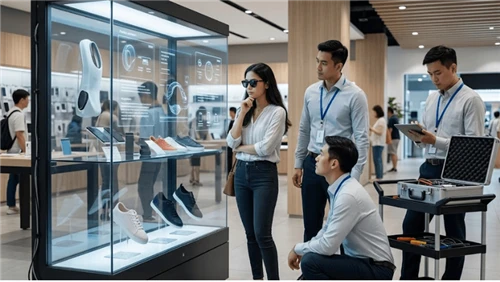
Unmanned Electronics Store
Consumer electronics is another category highly dependent on information display. When customers are shopping for phones, earbuds, or power banks, they often need to compare specifications of multiple products.
Core Customized Solution: Transparent LCD + Large-Format Digital Signage
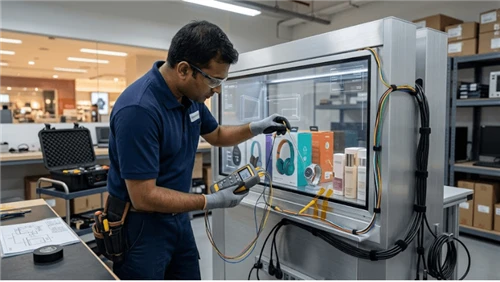
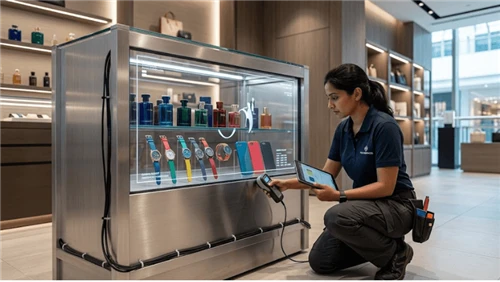
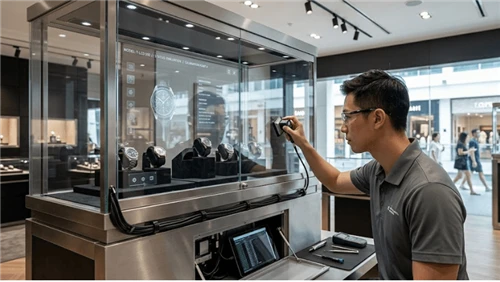
Transparent LCD display cabinets (27x10" / 42x23") become highlights of unmanned electronics stores:
Physical products are placed behind the transparent screen
The screen overlays product specifications, comparison information, and promotional prices
Customers obtain digital information while viewing the actual product
Supports touch interaction, customers can actively retrieve more details
Special Handling for High-Value Products:
|
Product Type |
Display Solution |
Security Measures |
|
Phones/tablets |
Transparent LCD display cabinet |
Electronic lock + device automatically unlocks pickup port after purchase |
|
Earbuds/accessories |
15.6" dual-sided LCD price screen |
Open shelf display, sensor tracking |
|
Large appliances |
Sample display + self-service terminal ordering |
Products shipped from back warehouse or delivery arranged after customer orders |
Data Application Example:
Transparent LCD screens can record customer interaction behavior: Which phone was clicked and viewed the most? After customers compared products A and B, which one did they ultimately choose? This data can be directly fed back to procurement and marketing teams, guiding subsequent product selection and pricing strategies.
Key Considerations for Technology Implementation
System Integration: Collaboration Beyond Hardware
Electronic shelf labels and displays themselves are just hardware. Their true value depends on deep integration with existing business systems:
ERP/Inventory management system: Product information, inventory data, cost prices
POS system: Sales prices, promotion rules, member discounts
CMS content management: LCD playback content, scheduling, and screen splitting strategies
LEGOYO's solutions provide standard API interfaces and pre-built connectors for mainstream retail software, but specific integration still requires collaboration between enterprise IT teams and vendors. It is recommended to clarify data flows and interface specifications early in the project.
Phased Implementation: From Pilot to Full Rollout
It is not recommended to complete a full store transformation at once. A more prudent path is:
Select 1-2 categories to deploy electronic shelf labels, verify price synchronization accuracy
Add stretched bar LCDs in key promotional areas, evaluate sales improvement effects
Deploy self-service terminals, train employees to familiarize with new processes
Roll out to the entire store, gradually reduce manual checkout counters
Each phase should have clear measurement indicators: label update timeliness, price complaint rate, promotional area sales, self-checkout proportion, etc. Drive decisions with data, not by feeling.
Technology Serves Experience
The essence of unmanned retail is not "replacing clerks," but reshaping the shopping experience. For customers, it means a freer, more private, more efficient way to shop; for retailers, it represents lower operating costs, more precise data insights, and more flexible promotional execution.
The technology infrastructure supporting all this - electronic shelf labels, smart displays, self-service terminals - is becoming increasingly mature and economical. You don't need to be a tech giant like Amazon; any store has the opportunity to achieve smart upgrades.
The key lies in finding the right partner, selecting proven products, and developing a phased implementation plan. Technology is always a tool. The ultimate goal is to let every customer who walks into the store enjoy a better shopping experience.