Can You Customize a Transparent LED Screen?
Yes. But that's not the point.
"Customization" in the transparent LED screen industry is a marketing buzzword. Open any manufacturer's website, and you'll see "customization available," "tailored to your needs," "one-stop customization service." This creates an illusion: as if any shape, size, or effect desired can be produced.
90% of so-called "customization" is just modular assembly-mix and match.

The basic unit of a transparent LED screen is the module-typically standard pieces of 500mm×500mm or 1000mm×500mm. A 3m×2m screen? Take 6 modules and piece them together. 5m×3m? Piece together 15.
True customization-non-standard module sizes, irregular cuts, special curvatures-most manufacturers simply don't want to do, or they'll quote a price designed to discourage acceptance. Why? Because "customization" in manufacturing means new molds, production line adjustments, individual quality inspections-all costs. And transparent LED screen margins are already being squeezed; manufacturers have no incentive to accommodate special requirements.
What "Customization" Actually Means (So Sales Can't Bullshit You)
Size-Customizable, but in a grid
Transparent screen sizes are integer multiples of module sizes. Common module specifications: 500×500mm, 500×1000mm, 1000×500mm, 1000×1000mm. 3.5 meters wide? Doesn't exist-it's either 3 meters or 4 meters. 2.7 meters tall? 2.5 meters or 3 meters-pick one.
Some manufacturers can do "cut modules" to achieve non-standard sizes, but this means custom PCBs, new molds, starting at 30-50% cost increase, and 2-4 weeks longer lead time. Whether it's worth it requires calculation.

Pixel Pitch-The core choice
P3.9, P7.8, P10, P15, P20... This parameter directly determines the balance between clarity, transparency, and price.
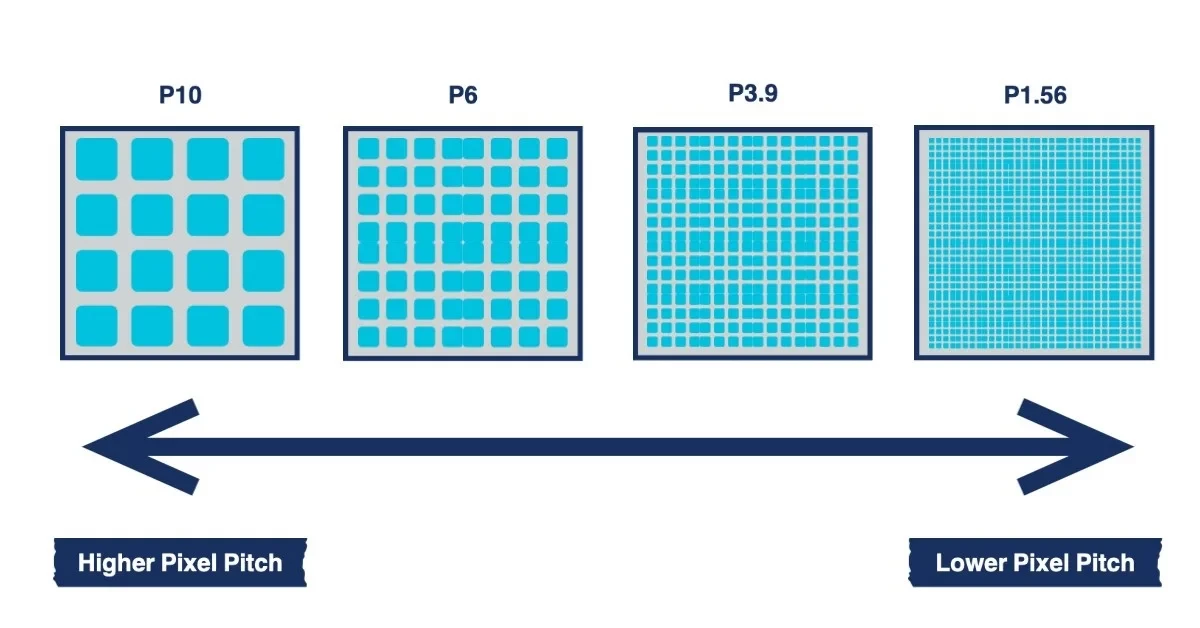
P3.9 works for 3-6 meter viewing, gets you 55-65% transparency, costs the most. P7.8 suits 6-12 meters, transparency bumps up to 65-75%, mid-range pricing. P10 is for 10+ meters out, 70-80% transparent, more affordable. P15 and P20? Those are for billboards-15-30 meter viewing distance, 75-85% transparency, cheapest option.
Smaller pixel pitch isn't always better-what's better is what matches the viewing distance. Shopping mall atriums, outdoor curtain walls, close-up window displays-the requirements are completely different.
Brightness-Big difference between indoor and outdoor
Indoor use: 800-2000 nits is enough. Outdoor or direct sunlight: at least 4000-6000 nits, otherwise nothing will be visible during the day.
Brightness is customizable, but higher brightness means greater power consumption, more heat, higher price. Ask the manufacturer whether they're quoting "peak brightness" or "sustained operating brightness"-some manufacturers quote peak values that can't actually be maintained during continuous use.
How are you mounting this thing?
Hanging from the top works for mall atriums and stage backdrops. Ground-standing or stacking suits temporary exhibitions. Surface-mounted or embedded-attached to the inside of glass curtain walls-is the most common architectural application. Column-mounted with independent bracket support works for outdoor advertising.
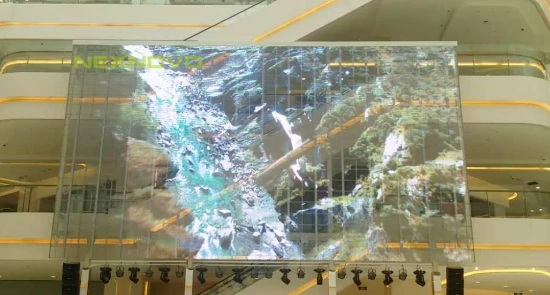
Installation method determines module maintenance orientation (front maintenance or rear maintenance), accessory selection, and even the structural design of the modules themselves. This must be decided before ordering-not figured out during installation.
Front maintenance or rear? Get this wrong and you're tearing down walls

Rear maintenance means removing modules from the back. Requires at least 50cm space behind the screen. Lower cost. Front maintenance means removing modules from the front. Suitable for wall-mounted installations with no space behind, more complex module structure, 10-20% higher cost.
Choose the wrong maintenance method, and an entire wall might need to be torn down just to replace one module.
Control System-Avoid lock-in
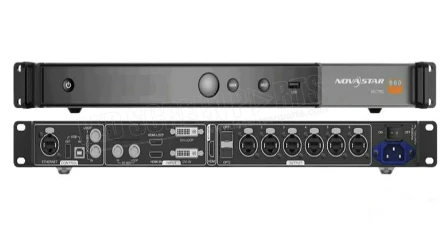
Reputable manufacturers will give a choice: use their proprietary control system, or use industry-standard ones (NovaStar, Colorlight, Linsn).
Recommendation: Choose a universal system. Proprietary systems are shackles. Future upgrades and maintenance will be at their mercy.
Protection Rating-Depends on the scenario
Indoor dry environment: IP30-IP40 is sufficient. Indoor humid or water vapor: IP54. Semi-outdoor or full outdoor: IP65 or higher. Each level up in protection rating adds 5-15% to the price. Don't over-engineer, but don't underspec and have the screen ruined by water either.
Appearance Details-Adjustable but limited
Frame color (black/white/silver/gray), LED strip color, power box position-most manufacturers can accommodate these.
But expectations should be limited: LED chip colors, strip width, module thickness-these are standardized. Unless the volume is large enough to justify a dedicated production line, there's no changing them.
So-called "customization" is 80% about making combinations within fixed options. Get pixel pitch, brightness, size, installation method, maintenance method, control system, and protection rating right-the screen is tailor-made. Get them wrong, and no amount of money spent on "special shapes" will save it. The remaining 20%? Either outrageously expensive or simply not accepted.
The Transparency Scam
The core selling point of transparent LED screens is "transparency." But this industry's labeling of transparency is a mess.
When a manufacturer says 80% transparency, how did they get that number? Some measure the ratio of gaps between LED strips to total area-that's geometric transparency. Some measure actual light transmittance-that's optical transparency. Some exclude the frame, power supply, and cables entirely, measuring only the most transparent area. Some even quote "theoretical transparency" that the actual product can't achieve. There's no unified standard-the numbers are whatever the manufacturer decides.
High transparency means thinner LED strips, larger spacing, fewer LED chips. Fewer LED chips means lower brightness, sparser pixels. Stand 3 meters away from a P10 screen with 85% transparency, and the image is scattered-pixels are clearly visible. It's not a "screen" but rows of glowing dots.
So when a manufacturer boasts "90% transparency," the questions to ask are: what's the pixel density? What's the actual brightness? What viewing distance? If these aren't clarified, regret follows after signing the contract.

Many project failures stem from exactly this: the client was impressed by "high transparency," but after installation discovered the content was invisible during the day and too glaring at night. Transparent, yes-but half the screen's functionality was ruined.
Forget "Customization"-Start with Viewing Distance
Rather than obsessing over "can it be customized," figure out one thing: what is the viewing distance? This determines pixel pitch. Pixel pitch determines cost, transparency, display quality-it determines almost everything.
The calculation is simple: Minimum viewing distance (meters) ≈ Pixel pitch (millimeters)
A P3.9 screen works fine for viewing within 4 meters. A P10 screen only comes together from 10+ meters away. A P20 screen is meant for viewers dozens of meters away. Choose the wrong pixel pitch, and no amount of money will save it.
Here's something I've seen over and over: mall window displays with P10 or even P16 transparent screens, owners complaining about poor results. Window viewing distance is just 2-3 meters-a P10 with pixels bigger than a thumb installed, and expected to look good? But P10 is cheap-saved money, ruined the effect.
The true meaning of "customization" isn't having a manufacturer build some oddly-shaped screen-it's finding the balance point among pixel pitch, transparency, brightness, and budget that best fits the scenario. This requires professional judgment, not filling out a requirements form and waiting for quotes.
Curved Screens Look Amazing at Trade Shows. In Real Projects, They're a Nightmare.
Curved, cylindrical, wave-shaped, spherical-these are the most eye-catching things at exhibitions, and what manufacturers love to showcase as their "customization capabilities."
But in real projects, irregular screens have far more pitfalls than flat screens.
Costs don't increase linearly-they increase exponentially. A curved screen of the same area might cost 2-3 times as much as a flat screen because it requires flexible PCBs or small-sized module assembly, with low yield rates and complex processes.
Curvature has physical limits. A manufacturer might say "we can do curved," but what's the minimum bending radius? The limit for standard products is around 500-1000mm. Want a tighter curve? LED chips will fall off, PCBs will crack.
There's another issue many people don't consider: seams are magnified on curved surfaces. Module seams on flat screens can be controlled to be nearly invisible to the naked eye. But on curved surfaces, modules meet at angles, making seams obvious-especially on dark scenes, where visible black lines appear.
And then there's maintenance. When a module fails on a flat screen, remove it, replace it-takes minutes. Curved screen modules are made at custom angles. Replacing one might mean waiting for the manufacturer to produce it again. What if it's discontinued?
Irregular screens can be done. But unless the scenario truly requires an irregular shape for the effect, flat screens are preferable. Cheaper, more stable, easier to maintain.
Where the Money Actually Goes (And Where You're Getting Marked Up)
Understanding this industry's profit structure reveals where the markup is in quotes.
The biggest cost component of transparent LED screens is the LED chip, accounting for 30-40% of total cost. Chip manufacturers (Sanan, Changelight, Epistar) are upstream, with gross margins of 15-25%-these prices are relatively transparent.
Packaging-turning chips into LED beads-accounts for 15-20%. Companies like Nationstar and MLS handle this, with gross margins of 10-20%.
Where margins are highest is in screen manufacturing and system integration-gross margins of 20-40%. This is also where the most markup exists.
The quote received might have gone through 2-3 layers from manufacturer to end user: manufacturer → regional distributor → integrator → end user. Each layer adds 10-30%. The same product through different channels can vary by 50% in price.
There's also a hidden profit point: the control system. Many manufacturers use proprietary protocols-once their screen is used, their control cards, their software, their technical support must be used. Subsequent maintenance, upgrades-whatever price they quote, there's no choice.
How to avoid pitfalls? Try to source directly from screen manufacturers, skipping intermediaries. Insist on universal control systems (NovaStar, Colorlight are industry standards)-don't get locked into proprietary systems. Compare at least three quotes-if there's significant price variation for the same specifications, something requires investigation.
The Screen Is Only Half the Cost. Seriously.
For a transparent LED screen, the product itself might only account for 50-60% of total investment. Where does the rest go?
Installation and supporting systems.
Transparent screens look light and thin, but they're not lightweight-8-15 kg per square meter. A 100-square-meter glass curtain wall with transparent screens adds nearly a ton of additional load. Can the existing curtain wall structure handle it? Does it need reinforcement? These aren't the manufacturer's responsibility-they need professional structural engineer assessment.

Electrical is another issue. Transparent screens consume 200-600 watts per square meter. At 100 square meters, that's 20-60 kilowatts. Is the electrical distribution system adequate? Are dedicated power lines needed?
What about heat dissipation? LEDs generate heat, and glass curtain walls don't breathe. The space between screen and glass gets very hot, especially on south-facing facades in summer. Without addressing heat dissipation, screen lifespan suffers significantly.
Construction coordination is also troublesome. For new buildings, transparent screens need to be coordinated with curtain wall design in advance. For renovation projects, exterior facade work might require approvals. Commercial buildings also need to consider how construction affects business operations.
This is true "customization"-not customizing a screen, but customizing a complete solution. Manufacturers or integrators who consider all of this are the ones with real delivery capability. Those who only talk about screens without discussing installation are either waiting to charge extra later or planning to disappear after delivery.
The Bottom Line
The word "customization" makes transparent LED screens seem omnipotent. But actually, this is a mature industrial product with clear technical boundaries and economic principles.
What manufacturers can do is help find the right configuration within established technical frameworks. What manufacturers cannot do is defy the laws of physics.
Rather than asking "can it be customized," ask "what is actually needed?" Figure out viewing distance, ambient brightness, installation conditions, and budget limits. Once these constraints are defined, the optimal solution naturally emerges. The rest is just finding a reliable manufacturer to execute it.