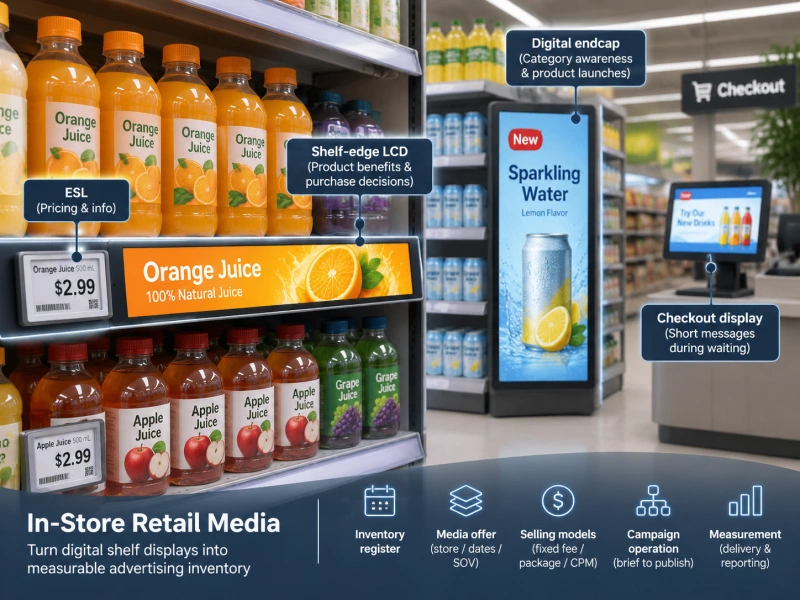
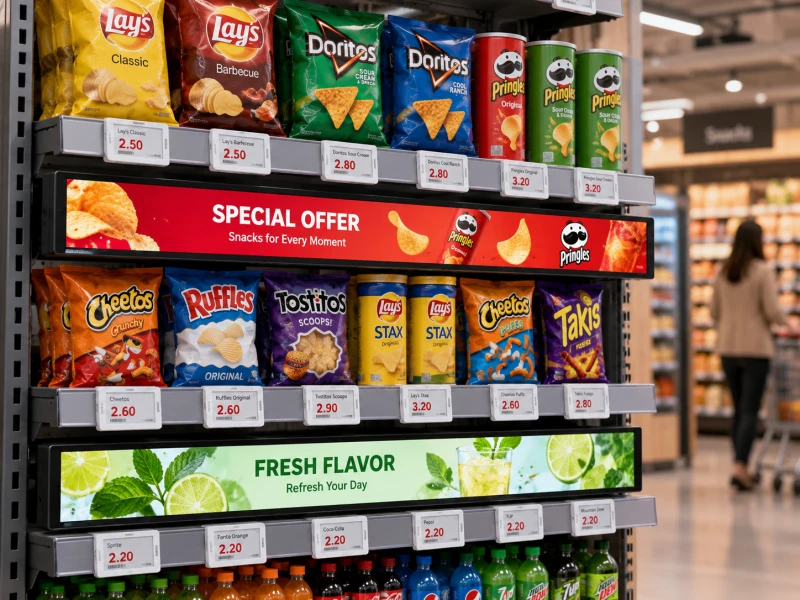
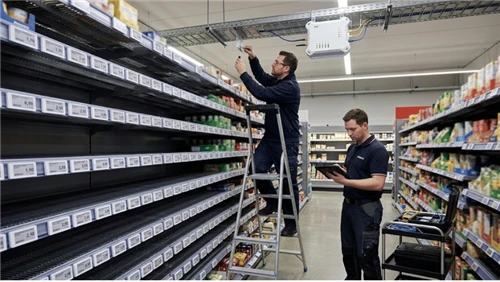
The advantages and disadvantages of electronic shelf labels are tightly connected. Centralized updates can reduce repetitive shelf-label work, but they make upstream data and integration more important. A digital display can keep a static image visible without continuous display power, but the complete device still has a lifecycle that must be supported. Faster promotion execution creates flexibility, but it also increases the need for pricing governance and change control.
That is why a simple "pros" list and "cons" list can mislead a retail buyer. The useful question is not whether an ESL advantage is real in the abstract. It is what conditions make the advantage real, what new dependency comes with it, and how a retailer can verify the trade-off before rollout.
This guide focuses on those paired trade-offs. For a benefits-by-store-function view, see digital shelf label benefits, use cases, and limits. For a disadvantages-only review, see the separate guide to digital price tag drawbacks.

The short answer: ESLs replace some manual friction with a managed digital system
The core advantage of an ESL system is control: approved shelf content can be distributed electronically instead of being printed, sorted, carried through the store, and replaced manually. The core disadvantage is dependency: the shelf now depends on a chain of data, software, communications, device binding, operating ownership, and support.
| Potential advantage | Condition that makes it real | Paired disadvantage or dependency | What to verify |
|---|---|---|---|
| Faster shelf updates | Approved source data can flow reliably to the correct label | Integration and reconciliation become critical | Trace one change end to end, including failure handling |
| Less repetitive paper-label work | Most target changes can be completed and verified digitally | Device monitoring, replacement, binding, and exception work remain | Compare the old task map with the new operating task map |
| More consistent multi-store execution | Stores use controlled data, templates, permissions, and rollout rules | A bad centralized change can affect a wider scope | Review approvals, scopes, rollback, exception and audit controls |
| Richer shelf-edge content | Templates are readable and based on governed product data | Template complexity and content quality require ownership | Test real assortment data on representative shelf positions |
| Low display power for e-paper | The proposed device uses suitable e-paper technology and operating conditions | Battery, hardware, firmware, spares, and end-of-life still require planning | Request model-specific lifecycle assumptions and replacement process |
| More flexible promotion execution | Pricing policy, approvals, timing, and customer communication are controlled | Faster changes can increase governance and trust risk | Test authorization, scheduling, audit trail, and correction workflow |
The rest of the article explains why each pair matters. None of these rows should be treated as a universal performance promise for every ESL product or retailer.

Advantage: faster price execution - Disadvantage: stronger data dependency
With paper labels, an approved price change usually creates a physical store task. With an ESL system, the shelf display can become an electronic endpoint in the pricing workflow. That can shorten the operational path between an approved change and the shelf.
The trade-off is that the quality of the shelf outcome becomes more dependent on the quality of the upstream process. A fast digital path does not help if the source price is wrong, a product is bound to the wrong shelf position, an update fails silently, or a local override is applied outside the governed workflow.
The buyer should therefore evaluate the entire transaction, not only display refresh. The site's guide on how an ESL update moves from source data to a verified shelf state separates source, mapping, rendering, delivery, refresh, and reconciliation. That same separation is useful when assessing this trade-off.
What to verify: choose a real product and an approved test change. Record where the value originates, how the item and shelf label are associated, what the platform sends, how completion is represented, what the shelf shows, and what happens when one stage fails. The advantage is proven only when the process is faster without making errors harder to detect.
Advantage: less repetitive label handling - Disadvantage: work changes rather than disappearing
Electronic updates can reduce printing, sorting, aisle-by-aisle replacement, and other repetitive tasks associated with paper shelf labels. That is an important operational advantage in environments where price and promotion changes create significant manual work.
But a digital system introduces different tasks: monitoring update exceptions, replacing damaged or depleted devices, maintaining product-to-label bindings, managing templates, supporting store users, handling access, coordinating software changes, and investigating mismatches. These activities may be less repetitive, but they require explicit ownership.
This is why universal labor-saving percentages are weak planning inputs. The real comparison is a task map. List the current paper-label tasks and the proposed digital tasks, identify which roles perform them, and decide which tasks are removed, reduced, transferred, or newly created.
What to verify: during a representative pilot, record the work required for normal changes and the work required for exceptions. Include replacement, rebinding, store audit, failed update, emergency correction, and user support. The operational advantage is strongest when the new exception workload is visible and manageable rather than simply omitted from the business case.
Advantage: central consistency - Disadvantage: central mistakes can travel farther
Central management can make it easier to coordinate templates, promotions, and approved shelf information across multiple stores. The same system can also reduce local variation when stores are expected to execute the same commercial decision at the same time.
Centralization creates a larger failure domain. A configuration error, incorrect campaign scope, bad source file, permission mistake, or integration defect can affect more than one label or one store. The stronger the central control, the more important approval, scoping, audit, exception handling, and rollback become.
That does not make centralization a disadvantage by itself. It means the benefit should be paired with change control. Retailers should be able to answer who can publish changes, which stores or departments a change affects, how bulk changes are reviewed, how an error is identified, and how the intended state is restored.
What to verify: test both a normal multi-label update and an intentionally incorrect or incomplete change in a safe environment. Confirm that the team can see the affected scope, stop or correct the change, identify what reached the shelf, and retain enough evidence to explain the result.

Advantage: richer shelf-edge information - Disadvantage: templates become an operating asset
A digital shelf display can support more structured content than a static printed price strip, depending on the proposed model, display technology, template design, and business data available. Retailers may use that flexibility for product information, promotion states, unit pricing, barcodes, QR codes, stock-related cues, or other approved content.
The trade-off is that template design becomes part of operations. A technically supported field can still be unreadable, crowded, mapped incorrectly, or inappropriate for a particular shelf position. More content is not automatically better content.
Readability should be checked with real assortment data, representative shelf heights, normal viewing angles, relevant lighting, and the exact proposed hardware. Long product names, unusual prices, multilingual fields, promotional badges, and regulatory or unit-price information can expose problems that a polished sample template does not.
What to verify: build a small "worst-case content set" using the longest names, widest values, required fields, and unusual promotional states from the retailer's own data. Render those examples on the proposed display and review them in representative shelf conditions. This proves the content model, not just the screen.
Advantage: e-paper can hold a static image without continuous display power - Disadvantage: the device still has a lifecycle
Many ESL systems use e-paper because a shelf label spends much of its time showing a static image. E Ink describes its displays as bistable: the image remains visible when power is removed, so the display itself does not need continuous power simply to hold that image.
That property should not be turned into a universal battery-life claim. Device life depends on the complete product and operating profile, including display size, update behavior, communication design, temperature, indicators or other functions, battery choice, firmware, and maintenance practice. KioskTagScreen's own site has conflicting legacy battery-life statements, so a procurement decision should use model-specific documentation and assumptions rather than a generic number.
The lifecycle disadvantage is broader than batteries. Retailers need a replacement process, spare strategy, firmware/support policy, end-of-life notice, warranty boundary, and method for keeping the shelf binding correct when hardware is exchanged.
What to verify: request lifecycle assumptions for the exact proposed model and configuration, identify which assumptions depend on update frequency or environment, and ask how replacement and end-of-support are handled. Treat any quoted service life as conditional unless its operating basis is clear.
Advantage: flexible promotions - Disadvantage: faster change increases governance pressure
Electronic shelf labels can make scheduled and centrally coordinated shelf changes easier to execute than a paper process. That can be valuable for planned promotions, markdowns, category changes, or other authorized price events.
The same flexibility can create governance concerns if "we can change prices quickly" is confused with "any change should be allowed." Retailers still need pricing policy, permissions, approvals, timing rules, auditability, consumer communication practices, and compliance review appropriate to the markets where they operate.
The technology does not decide whether a pricing strategy is fair, lawful, or acceptable to customers. It only changes the operational ability to execute a change. The business must define the policy boundary independently.
What to verify: separate technical capability from commercial authorization. Test whether the platform can restrict roles, schedule approved changes, show who initiated them, report what was applied, and support correction. Legal or regulatory requirements should be confirmed for the relevant jurisdiction rather than generalized from a vendor presentation.
Advantage: software-managed scale - Disadvantage: integration, security, and support become system concerns
Managing a fleet through software can make a large number of shelf endpoints easier to organize than independent manual labels. The system can provide centralized configuration, monitoring, user roles, templates, and other management functions depending on the selected platform.
Scale also creates system-level dependencies. The retailer has to consider interface ownership, credentials, supplier access, logs, network boundaries, software lifecycle, incident response, and support escalation. A secure radio protocol alone does not secure the complete application and operating model.
For deeper requirements, use the electronic shelf label cybersecurity procurement guide. At pros-and-cons stage, the important conclusion is simply that manageability and dependency grow together: a more connected system can be easier to control centrally, but it must be governed as infrastructure rather than as a collection of screens.
Separate inherent trade-offs from implementation problems
Some disadvantages come with the nature of the technology; others are symptoms of weak implementation. Mixing them together makes the decision less useful.
| Type of downside | Example | Can it be eliminated? | Decision treatment |
|---|---|---|---|
| Inherent project cost | Hardware, software, integration, mounting, deployment, support | No; it can only be scoped and compared | Use a complete cost model rather than tag price alone |
| Technology lifecycle | Devices, batteries where applicable, firmware, replacement, end-of-life | No; it must be planned | Require lifecycle evidence and ownership |
| Implementation risk | Poor product mapping, weak network design, bad templates, missing exception process | Often reducible | Test and close before scale |
| Governance risk | Unauthorized changes, unclear roles, uncontrolled supplier access | Reducible but never irrelevant | Design permissions, audit, review and escalation |
| Business-case uncertainty | Assumed labor or error savings that were never measured | Reducible through baseline measurement | Use retailer-specific evidence, not universal ROI claims |
The cost side deserves its own analysis. The ESL cost-driver guide explains why hardware, software, integration, mounting, rollout, and service scope need to be separated before comparing quotations.

Use a trade-off test instead of a generic pros-and-cons score
A retailer does not need every advantage to be maximized. It needs the advantages that matter to its operating model to outweigh the costs and dependencies under realistic conditions. A simple review can use four questions for each claimed benefit:
- What operating problem does this advantage solve? If the current process is not painful or important, the benefit may have little economic value.
- What must be true for the advantage to occur? Identify required data, integration, hardware, workflow, or staffing conditions.
- What new dependency or downside is introduced? Include lifecycle, support, security, exception, and change-control work.
- What evidence would prove the net result in our environment? Use source data, logs, shelf checks, task observations, defect records, or other project-specific evidence.
This method avoids a common scoring error: giving a technology one positive point for "automation" and one negative point for "cost" without showing whether the automation matters to the retailer or what the cost includes.
When paper labels may still be the better operational choice
An ESL system is not automatically the right next step for every store. Paper can remain reasonable where shelf information changes infrequently, the assortment is small or simple, centralized execution is not a meaningful requirement, integration complexity is disproportionate to the operating problem, or the organization is not ready to own another connected store system.
The key is to compare the real current-state burden with the full future-state operating model. A retailer should not adopt ESLs merely because the hardware is capable, and it should not reject them merely because the initial project is more complex than replacing paper. The decision should reflect the frequency and consequence of shelf changes, the ability to govern data, the store environment, the support model, and the evidence produced by a representative evaluation.
If the trade-offs are acceptable and the organization is ready to move from "should we?" to "which solution fits?", use the ESL solution selection guide. The broader electronic shelf label solutions page provides the commercial system context.