The expensive failures in unattended and retail display projects often happen at interfaces, not inside the headline component. For commercial LCD chroma 4:4:4, the narrow question is How can a commercial LCD deployment prove that the source, transport, input mode, scaling, and panel path preserve crisp text and correct pixel mapping? This guide is written for AV engineers, digital-signage integrators, control-room teams, content owners, and display QA staff. It deliberately owns source-to-panel signal fidelity for text/UI content, not general resolution selection; neighboring pages should keep ownership of broader selection, networking, software, optical, or maintenance topics.
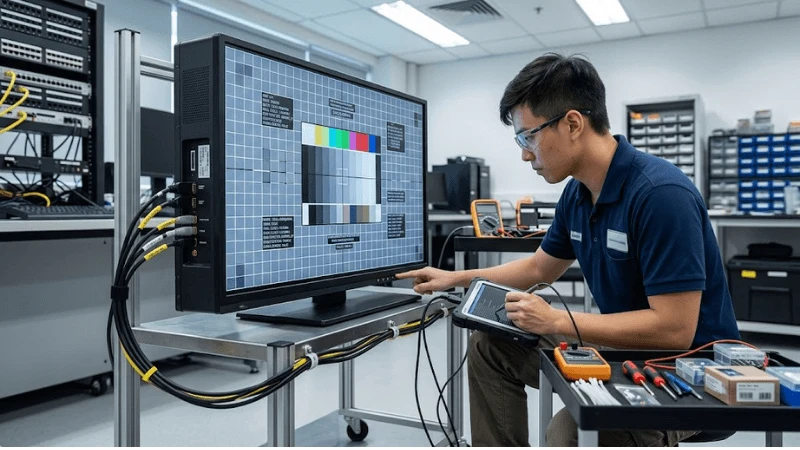
The practical goal is not to eliminate every exception; it is to make the supported range, failure state, and recovery path explicit. The project should be able to name the approved state for source output format, show how transport chain interacts with it, and reproduce at least one adverse condition such as "A player silently switches to subsampled output after an EDID change." on production-equivalent hardware. Where a numerical limit matters, use the exact model documentation, applicable standard, or an approved project requirement; do not turn a sample value into a universal claim.
For adjacent context, use Bar LCD Display Screen, Commercial LCD VESA Mounting, Commercial LCD Airflow and Dust Control. Those resources provide broader product or integration context; the acceptance result for this article still has to be proven on the exact project configuration.
During topic research, public technical/product material from Samsung Business, LG Business, and E3 Displays was reviewed to understand category terminology and common buyer questions. Competing commercial claims are not treated as LEGOYO facts and are not linked from this publishable article. Model-specific limits, certifications, measured performance, case outcomes, and ROI must be verified against the applicable primary source before they are used in a project decision.
Define the system boundary before you compare solutions
Existing EDID/interface article owns compatibility negotiation broadly; this page owns chroma sampling and 1:1 pixel clarity. A clear boundary prevents two common mistakes: buying a component because a generic capability sounds right, and rejecting a component for a failure that is actually caused by the enclosure, player, site, workflow, or service process. The test object should be the production-equivalent system with the same interfaces that will exist after rollout.
Start the design review by writing three columns: what is controlled by the component supplier, what is created by integration, and what can change after handover. Then add the user-visible consequence when each item leaves the approved state. This creates a useful handoff between engineering, procurement, commissioning, and field service.
Scope-to-failure map
| Control point | What the project must define | Representative failure to challenge |
|---|---|---|
| Source output format | Record resolution, refresh, color encoding, bit depth/range and chroma mode emitted by the player or PC. | A player silently switches to subsampled output after an EDID change. |
| Transport chain | Include extenders, switchers, splitters, receivers and converters in the validated path. | The direct source-to-display test passes but a matrix switch changes the negotiated format. |
| Display input label/mode | Some display processing changes with input mode or PC-oriented settings, so preserve the approved configuration. | A factory reset returns the HDMI input to a video-processing mode that softens text. |
| Scaling and overscan | Confirm source resolution maps to the intended panel raster without unwanted zoom, overscan or non-integer scaling. | Fine one-pixel lines blur because the content is rescaled even though the desktop reports the expected resolution. |
| Test patterns | Use chroma/text and single-pixel patterns appropriate to the source path rather than judging only photographs or video. | A marketing loop looks fine while colored small text is visibly contaminated. |
| Fleet readback | Where possible, capture input status or configuration so a service team can distinguish content problems from signal-mode drift. | One screen in a wall is soft but the team cannot identify its negotiated input state. |
Engineering controls that deserve explicit requirements
The following controls are not generic feature-list items. Each one can change the field result for commercial LCD chroma 4:4:4, so the approved state, evidence method, owner, and retest trigger should be visible in the project record.
Source output format
A design review should connect this item to a test, an owner, and a retest trigger. Record resolution, refresh, color encoding, bit depth/range and chroma mode emitted by the player or PC. The evidence should make it possible to distinguish a defect in source output format from a change in transport chain. A useful negative case is: A player silently switches to subsampled output after an EDID change. Record the configuration before corrective action so the recovery does not erase the cause.
For production and service, identify the physical datum, software setting, firmware revision, material, or workflow that establishes source output format. State which substitutions are allowed without retest and which ones invalidate the old result. This turns a one-time pilot observation into a maintainable requirement.
Transport chain
Put this item in the controlled requirement set before the pilot is signed off. Include extenders, switchers, splitters, receivers and converters in the validated path. The evidence should make it possible to distinguish a defect in transport chain from a change in display input label/mode. A useful negative case is: The direct source-to-display test passes but a matrix switch changes the negotiated format. Record the configuration before corrective action so the recovery does not erase the cause.
Display input label/mode
This control needs a reproducible baseline, not an informal setup note. Some display processing changes with input mode or PC-oriented settings, so preserve the approved configuration. The evidence should make it possible to distinguish a defect in display input label/mode from a change in scaling and overscan. A useful negative case is: A factory reset returns the HDMI input to a video-processing mode that softens text. Record the configuration before corrective action so the recovery does not erase the cause.
For production and service, identify the physical datum, software setting, firmware revision, material, or workflow that establishes display input label/mode. State which substitutions are allowed without retest and which ones invalidate the old result. This turns a one-time pilot observation into a maintainable requirement.
Scaling and overscan
Review this interface with production and service in the same room, because both can change it. Confirm source resolution maps to the intended panel raster without unwanted zoom, overscan or non-integer scaling. The evidence should make it possible to distinguish a defect in scaling and overscan from a change in test patterns. A useful negative case is: Fine one-pixel lines blur because the content is rescaled even though the desktop reports the expected resolution. Record the configuration before corrective action so the recovery does not erase the cause.
Test patterns
The supplier answer is only the starting point; the delivered configuration must make the result observable. Use chroma/text and single-pixel patterns appropriate to the source path rather than judging only photographs or video. The evidence should make it possible to distinguish a defect in test patterns from a change in fleet readback. A useful negative case is: A marketing loop looks fine while colored small text is visibly contaminated. Record the configuration before corrective action so the recovery does not erase the cause.
For production and service, identify the physical datum, software setting, firmware revision, material, or workflow that establishes test patterns. State which substitutions are allowed without retest and which ones invalidate the old result. This turns a one-time pilot observation into a maintainable requirement.
Fleet readback
Treat this as a change-controlled parameter whenever it can alter field behavior. Where possible, capture input status or configuration so a service team can distinguish content problems from signal-mode drift. The evidence should make it possible to distinguish a defect in fleet readback from a change in source output format. A useful negative case is: One screen in a wall is soft but the team cannot identify its negotiated input state. Record the configuration before corrective action so the recovery does not erase the cause.
Failure modes: diagnose the interface, not just the visible symptom
Field teams often replace the most visible component first. That can make an intermittent problem disappear while leaving the true interface defect in place. A better fault model starts with the observable symptom, lists the two or three controlled variables that can create it, and captures evidence before reset or replacement.
| Observed failure | Primary control to inspect | Useful reproduction condition | First diagnostic action |
|---|---|---|---|
| A player silently switches to subsampled output after an EDID change. | Source output format | native-resolution single-pixel grid | capture the state before changing configuration |
| The direct source-to-display test passes but a matrix switch changes the negotiated format. | Transport chain | colored small-text/chroma pattern | isolate the interface and reproduce on a known-good reference |
| A factory reset returns the HDMI input to a video-processing mode that softens text. | Display input label/mode | black/white and colored line pairs | compare unit/revision history before replacing parts |
| Fine one-pixel lines blur because the content is rescaled even though the desktop reports the expected resolution. | Scaling and overscan | direct source-to-display baseline | restore the approved baseline and rerun the adverse case |
| A marketing loop looks fine while colored small text is visibly contaminated. | Test patterns | full production switcher/extender chain | contain the user impact, then preserve logs/photos/measurements |
Do not use a single successful retry as proof of root cause. If a reboot, reconnection, cleaning step, or module swap restores service, record it as recovery evidence and keep the incident open until the team can explain why the state changed. Recurrence after the same service action is especially valuable evidence.

Build an acceptance test that represents the field
A factory demo should answer the project question, not merely show that the product turns on. For commercial LCD chroma 4:4:4, include the normal condition, a tolerance edge, a service/replacement state, and at least one controlled failure. Preserve the exact unit and revision so the evidence can be reused during troubleshooting without pretending that a later substitution is identical.
Minimum test sequence
- Native-resolution single-pixel grid
- Colored small-text/chroma pattern
- Black/white and colored line pairs
- Direct source-to-display baseline
- Full production switcher/extender chain
- Factory reset or input reconnect followed by configuration restore
| Step | Condition | Main control exercised | Evidence to retain |
|---|---|---|---|
| 1 | Native-resolution single-pixel grid | Source output format | Pass/fail result tied to unit, revision, configuration, and test condition |
| 2 | Colored small-text/chroma pattern | Transport chain | Pass/fail result tied to unit, revision, configuration, and test condition |
| 3 | Black/white and colored line pairs | Display input label/mode | Pass/fail result tied to unit, revision, configuration, and test condition |
| 4 | Direct source-to-display baseline | Scaling and overscan | Pass/fail result tied to unit, revision, configuration, and test condition |
| 5 | Full production switcher/extender chain | Test patterns | Pass/fail result tied to unit, revision, configuration, and test condition |
| 6 | Factory reset or input reconnect followed by configuration restore | Fleet readback | Pass/fail result tied to unit, revision, configuration, and test condition |
Acceptance criteria should be observable. "Works normally" is weak because it does not define the task, population, environment, duration, or failure threshold. Prefer statements such as "the defined workflow completes under the approved production configuration and the specified adverse condition produces the expected state, alert, containment, or recovery." Attach measurements where the decision genuinely depends on them.
What to save in the evidence package
- Exact product model, hardware/firmware/software revision and production BOM state
- Fixture, enclosure, player, network, power, content, merchandise or peripheral configuration that affects the test
- Test method, tools and relevant environmental or operating conditions
- Pass/fail result plus photographs, logs, measurements, event records or inspection notes appropriate to the topic
- Open deviations, corrective actions, temporary controls and the person who can close them
- Retest triggers for supplier substitution, software update, site change and field replacement
RFQ questions that expose hidden integration scope
Two quotations are not comparable until they carry the same responsibility boundary. For commercial LCD chroma 4:4:4, ask suppliers to answer with the exact quoted configuration, the evidence they can provide, and the conditions they exclude. A "yes" to a feature question is less useful than a drawing, supported-state definition, test record, service instruction, or sample that the buyer can verify.
- Which input modes preserve the intended chroma and pixel mapping?
- Can the display report current input resolution/format?
- What settings control overscan, scaling or PC mode?
- Which transport devices in the proposed system have been tested with the source format?
- Can supplier acceptance use project text/UI patterns, not only video?
- Which configuration changes require rechecking 1:1 mapping?
Normalize the quote before comparing price
- Exact model and revision, including accessories and project options
- Included integration work versus buyer/system-integrator responsibility
- Test evidence supplied with the production configuration
- Known exclusions, tolerance limits and conditions that require a different design
- Spare/replacement strategy and configuration restoration method
- Change-notification commitment for parts or firmware that can alter the approved result
A different technical architecture is not automatically inferior. Keep the outcome and evidence requirement fixed, then allow each supplier to show how its architecture achieves them. Mandating an implementation only makes sense when an adjacent system interface genuinely requires it.
Keep the approved state alive after handover
Commissioning closes the project only if operations can recognize the same state later. Give field teams a concise baseline for source output format, transport chain, and display input label/mode; include a safe recovery sequence and say which actions require engineering review. If a technician can change the result during normal service, that service step belongs in the control plan.
Fleet signals worth trending
- text-clarity complaints
- screens found with scaling/overscan drift
- signal-format mismatches after service
- player/display negotiation incidents
- configuration restore failures
Trend these signals by site, hardware revision, software release and last service action. One incident rarely proves a design defect, but clustering can reveal a supplier lot, configuration change, environmental condition, or maintenance practice that was invisible during pilot testing. Preserve enough history to compare "before" and "after" rather than counting tickets alone.
Retest triggers
- A supplier substitution changes source output format or the part that establishes it.
- A firmware, driver, player, OS or configuration change can affect transport chain.
- A fixture, enclosure, mounting, wiring, lighting, power, cleaning, site or workflow change alters display input label/mode.
- A field replacement changes scaling and overscan or removes a calibration/configuration dependency.
- The adverse condition "A player silently switches to subsampled output after an EDID change." appears again in the field.

Decision gate: approve, revise, or stop
- Boundary: Can another team reproduce the approved state for source output format?
- Interface: Is ownership clear where transport chain interacts with display input label/mode?
- Adverse case: Did the test include "A player silently switches to subsampled output after an EDID change." or an equally representative failure?
- Recovery: Can service restore operation without destroying diagnostic evidence?
- Lifecycle: Is there a retest trigger when scaling and overscan or another controlled dependency changes?
Close the review as approve, revise, or stop. If a gap is accepted temporarily, record the owner, temporary control, evidence still required, and the event that closes the exception. For related engineering boundaries, see Commercial LCD Input Signal Failover, Commercial LCD Scheduled Power Control, Commercial LCD Luminance Uniformity Testing, Stretched LCD Player, EDID, and Interface Compatibility.
FAQ
Q: What is the first thing to verify for commercial LCD chroma 4:4:4?
A: Start with the approved baseline for source output format and transport chain. Capture the current configuration and recent service/change history before resetting or replacing parts.
Q: Can a supplier datasheet replace project acceptance testing?
A: No. Product documentation defines a starting capability boundary. Project testing proves the final combination of hardware, configuration, enclosure, site conditions, workflow and service method that will actually be deployed.
Q: Which test should be included in a pilot?
A: At minimum include native-resolution single-pixel grid, colored small-text/chroma pattern, and one adverse/service condition such as factory reset or input reconnect followed by configuration restore. The objective is to expose the interface most likely to change after rollout.
Q: What should trigger a retest?
A: Retest after a component, firmware, driver, mounting, optical, electrical, environment, workflow or service change that can affect source output format, transport chain, or display input label/mode.
Q: How should two supplier solutions be compared?
A: Normalize the exact configuration, inclusions, exclusions, evidence, integration responsibility, service access, replacement method and change-control commitment. Only then compare commercial terms.
Q: What evidence is most useful months after deployment?
A: Evidence tied to unit identity and revision: configuration readback, photographs, measurements, logs, test conditions, defect disposition, service history and the exact acceptance requirement. Context makes the record reusable.
Final recommendation
The strongest approach to commercial LCD chroma 4:4:4 is to make the field condition reproducible. Freeze the configuration that matters, challenge it with a realistic adverse case, preserve evidence, and make service/revision changes trigger an explicit retest. That is more useful than a long feature list because it tells procurement what to buy, commissioning what to prove, and operations what to protect.
For wider project context, return to LEGOYO Products, LEGOYO Solutions, and LEGOYO Technical Blog. When the site conditions, interfaces, intended workflow and acceptance evidence are ready for a configuration review, use Request a Quote.