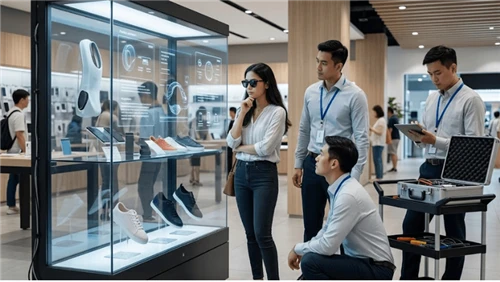
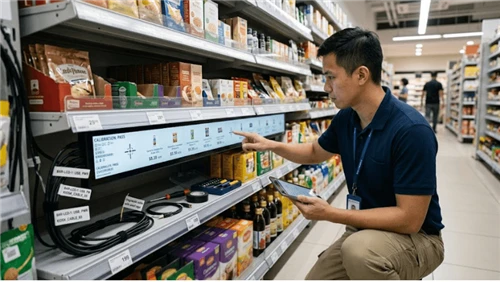
A useful engineering specification begins with the field condition that must work, not with a supplier checkbox. For commercial LCD portrait orientation, the narrow question is What must be revalidated when a commercial LCD is installed in portrait orientation, including model support, airflow, heat, viewing behavior, mounting, cabling, and content? This guide is written for digital-signage integrators, AV designers, retail fixture teams, facilities engineers, and procurement managers. It deliberately owns orientation-specific integration and exact-model validation rather than generic landscape-versus-portrait design; neighboring pages should keep ownership of broader selection, networking, software, optical, or maintenance topics.
That distinction matters because the same symptom can come from hardware, configuration, installation, environment, or service history. The project should be able to name the approved state for exact-model orientation support, show how airflow path interacts with it, and reproduce at least one adverse condition such as "An installer rotates the display the opposite direction from the model's designed thermal path." on production-equivalent hardware. Where a numerical limit matters, use the exact model documentation, applicable standard, or an approved project requirement; do not turn a sample value into a universal claim.
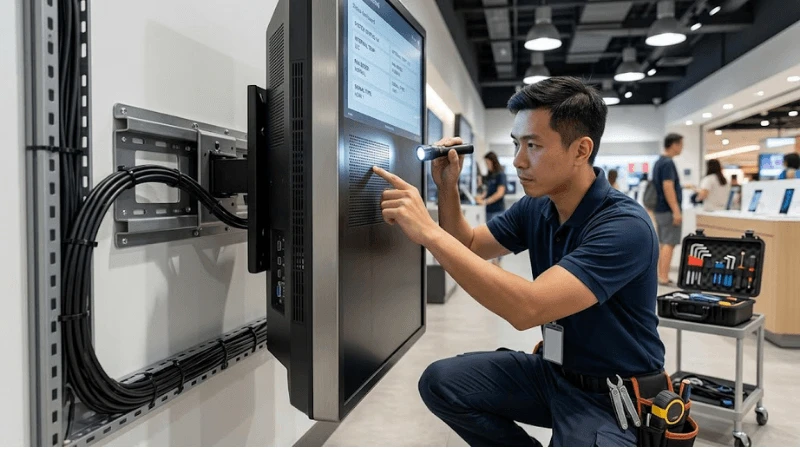
For adjacent context, use Bar LCD Display Screen, Commercial LCD VESA Mounting, Commercial LCD Airflow and Dust Control. Those resources provide broader product or integration context; the acceptance result for this article still has to be proven on the exact project configuration.
During topic research, public technical/product material from Samsung Business, LG Business, and E3 Displays was reviewed to understand category terminology and common buyer questions. Competing commercial claims are not treated as LEGOYO facts and are not linked from this publishable article. Model-specific limits, certifications, measured performance, case outcomes, and ROI must be verified against the applicable primary source before they are used in a project decision.
Define the system boundary before you compare solutions
VESA mounting and thermal pages own those subjects broadly; this page owns the orientation-specific combination. A clear boundary prevents two common mistakes: buying a component because a generic capability sounds right, and rejecting a component for a failure that is actually caused by the enclosure, player, site, workflow, or service process. The test object should be the production-equivalent system with the same interfaces that will exist after rollout.
Start the design review by writing three columns: what is controlled by the component supplier, what is created by integration, and what can change after handover. Then add the user-visible consequence when each item leaves the approved state. This creates a useful handoff between engineering, procurement, commissioning, and field service.
Scope-to-failure map
| Control point | What the project must define | Representative failure to challenge |
|---|---|---|
| Exact-model orientation support | Use the model installation guide to confirm permitted portrait direction, tilt and ventilation conditions. | An installer rotates the display the opposite direction from the model's designed thermal path. |
| Airflow path | Check vents, fans, convection paths and cabinet openings after rotation, including nearby walls or trims. | A vent that was clear in landscape becomes blocked by a vertical fixture rail. |
| Heat distribution | Measure relevant enclosure/display temperatures at intended content and brightness after the complete portrait installation reaches steady operation. | One vertical edge runs hotter because heat rises through a path not represented in the bench test. |
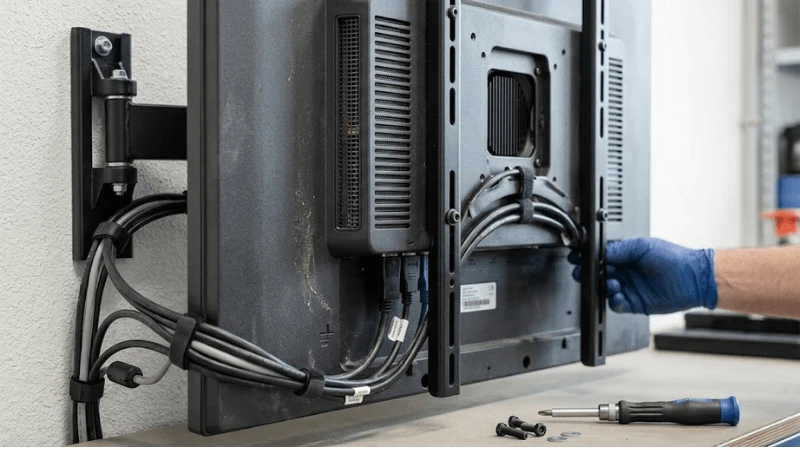
| Mount load path | Confirm bracket orientation, fastener access, center of mass and cable bend space in portrait. | A bracket is technically compatible but service cables are crushed between the display and wall. |
| Viewing and polarizer behavior | Review expected viewer height, off-axis angles, eyewear and content orientation with the exact panel. | A portrait installation creates an unfavorable viewing condition at the primary approach path. |
| Content and service controls | Ensure orientation settings, player rotation and diagnostics remain correct after reset/replacement. | A replacement player boots landscape and operators stretch content to compensate. |
Engineering controls that deserve explicit requirements
The following controls are not generic feature-list items. Each one can change the field result for commercial LCD portrait orientation, so the approved state, evidence method, owner, and retest trigger should be visible in the project record.
Exact-model orientation support
Put this item in the controlled requirement set before the pilot is signed off. Use the model installation guide to confirm permitted portrait direction, tilt and ventilation conditions. The evidence should make it possible to distinguish a defect in exact-model orientation support from a change in airflow path. A useful negative case is: An installer rotates the display the opposite direction from the model's designed thermal path. Record the configuration before corrective action so the recovery does not erase the cause.
For production and service, identify the physical datum, software setting, firmware revision, material, or workflow that establishes exact-model orientation support. State which substitutions are allowed without retest and which ones invalidate the old result. This turns a one-time pilot observation into a maintainable requirement.
Airflow path
This control needs a reproducible baseline, not an informal setup note. Check vents, fans, convection paths and cabinet openings after rotation, including nearby walls or trims. The evidence should make it possible to distinguish a defect in airflow path from a change in heat distribution. A useful negative case is: A vent that was clear in landscape becomes blocked by a vertical fixture rail. Record the configuration before corrective action so the recovery does not erase the cause.
Heat distribution
Review this interface with production and service in the same room, because both can change it. Measure relevant enclosure/display temperatures at intended content and brightness after the complete portrait installation reaches steady operation. The evidence should make it possible to distinguish a defect in heat distribution from a change in mount load path. A useful negative case is: One vertical edge runs hotter because heat rises through a path not represented in the bench test. Record the configuration before corrective action so the recovery does not erase the cause.
For production and service, identify the physical datum, software setting, firmware revision, material, or workflow that establishes heat distribution. State which substitutions are allowed without retest and which ones invalidate the old result. This turns a one-time pilot observation into a maintainable requirement.
Mount load path
The supplier answer is only the starting point; the delivered configuration must make the result observable. Confirm bracket orientation, fastener access, center of mass and cable bend space in portrait. The evidence should make it possible to distinguish a defect in mount load path from a change in viewing and polarizer behavior. A useful negative case is: A bracket is technically compatible but service cables are crushed between the display and wall. Record the configuration before corrective action so the recovery does not erase the cause.
Viewing and polarizer behavior
Treat this as a change-controlled parameter whenever it can alter field behavior. Review expected viewer height, off-axis angles, eyewear and content orientation with the exact panel. The evidence should make it possible to distinguish a defect in viewing and polarizer behavior from a change in content and service controls. A useful negative case is: A portrait installation creates an unfavorable viewing condition at the primary approach path. Record the configuration before corrective action so the recovery does not erase the cause.
For production and service, identify the physical datum, software setting, firmware revision, material, or workflow that establishes viewing and polarizer behavior. State which substitutions are allowed without retest and which ones invalidate the old result. This turns a one-time pilot observation into a maintainable requirement.
Content and service controls
A design review should connect this item to a test, an owner, and a retest trigger. Ensure orientation settings, player rotation and diagnostics remain correct after reset/replacement. The evidence should make it possible to distinguish a defect in content and service controls from a change in exact-model orientation support. A useful negative case is: A replacement player boots landscape and operators stretch content to compensate. Record the configuration before corrective action so the recovery does not erase the cause.
Failure modes: diagnose the interface, not just the visible symptom
Field teams often replace the most visible component first. That can make an intermittent problem disappear while leaving the true interface defect in place. A better fault model starts with the observable symptom, lists the two or three controlled variables that can create it, and captures evidence before reset or replacement.
| Observed failure | Primary control to inspect | Useful reproduction condition | First diagnostic action |
|---|---|---|---|
| An installer rotates the display the opposite direction from the model's designed thermal path. | Exact-model orientation support | manufacturer-supported portrait direction verified | capture the state before changing configuration |
| A vent that was clear in landscape becomes blocked by a vertical fixture rail. | Airflow path | installed airflow/clearance inspection | isolate the interface and reproduce on a known-good reference |
| One vertical edge runs hotter because heat rises through a path not represented in the bench test. | Heat distribution | temperature survey after representative duty | compare unit/revision history before replacing parts |
| A bracket is technically compatible but service cables are crushed between the display and wall. | Mount load path | mount and cable service-access check | restore the approved baseline and rerun the adverse case |
| A portrait installation creates an unfavorable viewing condition at the primary approach path. | Viewing and polarizer behavior | viewer walk-through at expected heights/angles | contain the user impact, then preserve logs/photos/measurements |
Do not use a single successful retry as proof of root cause. If a reboot, reconnection, cleaning step, or module swap restores service, record it as recovery evidence and keep the incident open until the team can explain why the state changed. Recurrence after the same service action is especially valuable evidence.
Build an acceptance test that represents the field
A factory demo should answer the project question, not merely show that the product turns on. For commercial LCD portrait orientation, include the normal condition, a tolerance edge, a service/replacement state, and at least one controlled failure. Preserve the exact unit and revision so the evidence can be reused during troubleshooting without pretending that a later substitution is identical.
Minimum test sequence
- Manufacturer-supported portrait direction verified
- Installed airflow/clearance inspection
- Temperature survey after representative duty
- Mount and cable service-access check
- Viewer walk-through at expected heights/angles
- Power cycle/factory reset and orientation restore
| Step | Condition | Main control exercised | Evidence to retain |
|---|---|---|---|
| 1 | Manufacturer-supported portrait direction verified | Exact-model orientation support | Pass/fail result tied to unit, revision, configuration, and test condition |
| 2 | Installed airflow/clearance inspection | Airflow path | Pass/fail result tied to unit, revision, configuration, and test condition |
| 3 | Temperature survey after representative duty | Heat distribution | Pass/fail result tied to unit, revision, configuration, and test condition |
| 4 | Mount and cable service-access check | Mount load path | Pass/fail result tied to unit, revision, configuration, and test condition |
| 5 | Viewer walk-through at expected heights/angles | Viewing and polarizer behavior | Pass/fail result tied to unit, revision, configuration, and test condition |
| 6 | Power cycle/factory reset and orientation restore | Content and service controls | Pass/fail result tied to unit, revision, configuration, and test condition |
Acceptance criteria should be observable. "Works normally" is weak because it does not define the task, population, environment, duration, or failure threshold. Prefer statements such as "the defined workflow completes under the approved production configuration and the specified adverse condition produces the expected state, alert, containment, or recovery." Attach measurements where the decision genuinely depends on them.
What to save in the evidence package
- Exact product model, hardware/firmware/software revision and production BOM state
- Fixture, enclosure, player, network, power, content, merchandise or peripheral configuration that affects the test
- Test method, tools and relevant environmental or operating conditions
- Pass/fail result plus photographs, logs, measurements, event records or inspection notes appropriate to the topic
- Open deviations, corrective actions, temporary controls and the person who can close them
- Retest triggers for supplier substitution, software update, site change and field replacement
RFQ questions that expose hidden integration scope
Two quotations are not comparable until they carry the same responsibility boundary. For commercial LCD portrait orientation, ask suppliers to answer with the exact quoted configuration, the evidence they can provide, and the conditions they exclude. A "yes" to a feature question is less useful than a drawing, supported-state definition, test record, service instruction, or sample that the buyer can verify.
- Does the exact display model support the required portrait direction and duty?
- What clearances or ventilation rules change in portrait?
- Can the mounting hardware be serviced without removing adjacent fixtures?
- Are connectors/cables accessible with the display rotated?
- What configuration stores display and player orientation?
- What model/revision substitutions require renewed portrait thermal testing?
Normalize the quote before comparing price
- Exact model and revision, including accessories and project options
- Included integration work versus buyer/system-integrator responsibility
- Test evidence supplied with the production configuration
- Known exclusions, tolerance limits and conditions that require a different design
- Spare/replacement strategy and configuration restoration method
- Change-notification commitment for parts or firmware that can alter the approved result
A different technical architecture is not automatically inferior. Keep the outcome and evidence requirement fixed, then allow each supplier to show how its architecture achieves them. Mandating an implementation only makes sense when an adjacent system interface genuinely requires it.
Keep the approved state alive after handover
Commissioning closes the project only if operations can recognize the same state later. Give field teams a concise baseline for exact-model orientation support, airflow path, and heat distribution; include a safe recovery sequence and say which actions require engineering review. If a technician can change the result during normal service, that service step belongs in the control plan.
Fleet signals worth trending
- portrait-only thermal alarms
- orientation configuration resets
- cable/mount service incidents
- portrait-site display failures
- viewer complaints tied to angle/orientation
Trend these signals by site, hardware revision, software release and last service action. One incident rarely proves a design defect, but clustering can reveal a supplier lot, configuration change, environmental condition, or maintenance practice that was invisible during pilot testing. Preserve enough history to compare "before" and "after" rather than counting tickets alone.
Retest triggers
- A supplier substitution changes exact-model orientation support or the part that establishes it.
- A firmware, driver, player, OS or configuration change can affect airflow path.
- A fixture, enclosure, mounting, wiring, lighting, power, cleaning, site or workflow change alters heat distribution.
- A field replacement changes mount load path or removes a calibration/configuration dependency.
- The adverse condition "An installer rotates the display the opposite direction from the model's designed thermal path." appears again in the field.
Decision gate: approve, revise, or stop
- Boundary: Can another team reproduce the approved state for exact-model orientation support?
- Interface: Is ownership clear where airflow path interacts with heat distribution?
- Adverse case: Did the test include "An installer rotates the display the opposite direction from the model's designed thermal path." or an equally representative failure?
- Recovery: Can service restore operation without destroying diagnostic evidence?
- Lifecycle: Is there a retest trigger when mount load path or another controlled dependency changes?
Close the review as approve, revise, or stop. If a gap is accepted temporarily, record the owner, temporary control, evidence still required, and the event that closes the exception. For related engineering boundaries, see Commercial LCD Input Signal Failover, Commercial LCD Scheduled Power Control, Commercial LCD Luminance Uniformity Testing, Stretched LCD Player, EDID, and Interface Compatibility.
FAQ
Q: What is the first thing to verify for commercial LCD portrait orientation?
A: Start with the approved baseline for exact-model orientation support and airflow path. Capture the current configuration and recent service/change history before resetting or replacing parts.
Q: Can a supplier datasheet replace project acceptance testing?
A: No. Product documentation defines a starting capability boundary. Project testing proves the final combination of hardware, configuration, enclosure, site conditions, workflow and service method that will actually be deployed.
Q: Which test should be included in a pilot?
A: At minimum include manufacturer-supported portrait direction verified, installed airflow/clearance inspection, and one adverse/service condition such as power cycle/factory reset and orientation restore. The objective is to expose the interface most likely to change after rollout.
Q: What should trigger a retest?
A: Retest after a component, firmware, driver, mounting, optical, electrical, environment, workflow or service change that can affect exact-model orientation support, airflow path, or heat distribution.
Q: How should two supplier solutions be compared?
A: Normalize the exact configuration, inclusions, exclusions, evidence, integration responsibility, service access, replacement method and change-control commitment. Only then compare commercial terms.
Q: What evidence is most useful months after deployment?
A: Evidence tied to unit identity and revision: configuration readback, photographs, measurements, logs, test conditions, defect disposition, service history and the exact acceptance requirement. Context makes the record reusable.
Final recommendation
The strongest approach to commercial LCD portrait orientation is to make the field condition reproducible. Freeze the configuration that matters, challenge it with a realistic adverse case, preserve evidence, and make service/revision changes trigger an explicit retest. That is more useful than a long feature list because it tells procurement what to buy, commissioning what to prove, and operations what to protect.
For wider project context, return to LEGOYO Products, LEGOYO Solutions, and LEGOYO Technical Blog. When the site conditions, interfaces, intended workflow and acceptance evidence are ready for a configuration review, use Request a Quote.