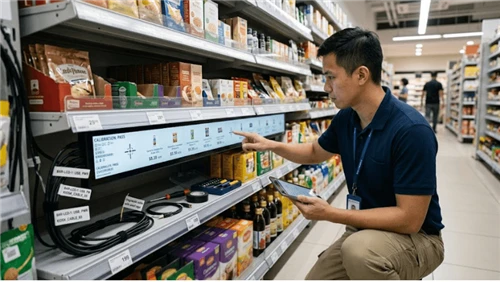
For most retailers, the question is not whether electronic shelf labels work - it is whether the math works for their specific store. ESLs cut pricing labor substantially, reduce shelf-to-checkout price mismatches, and become cheaper than paper over time. Paper labels cost almost nothing to start and require no infrastructure. The gap between those two positions is where the real decision lives.
This guide walks through the actual cost structure of each system, what the research says about ROI, which store types benefit most, and what tends to go wrong during ESL deployments - so you can make an informed call rather than one based on vendor promises.
How Each System Actually Works
Paper shelf labels are printed tags inserted into shelf edge rails by hand. Every price change - whether driven by a weekly promotion, a competitor adjustment, or a clearance markdown - requires a staff member to print new tags, walk the affected aisles, remove old labels, and insert replacements. In a grocery store running a weekly ad cycle across thousands of SKUs, that process consumes a measurable share of available labor hours every single week.
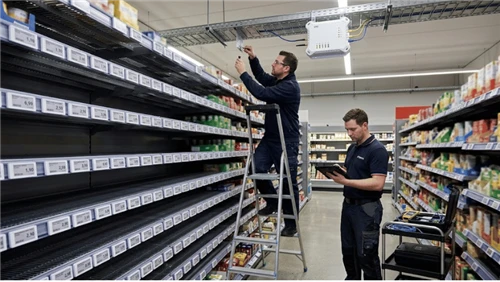
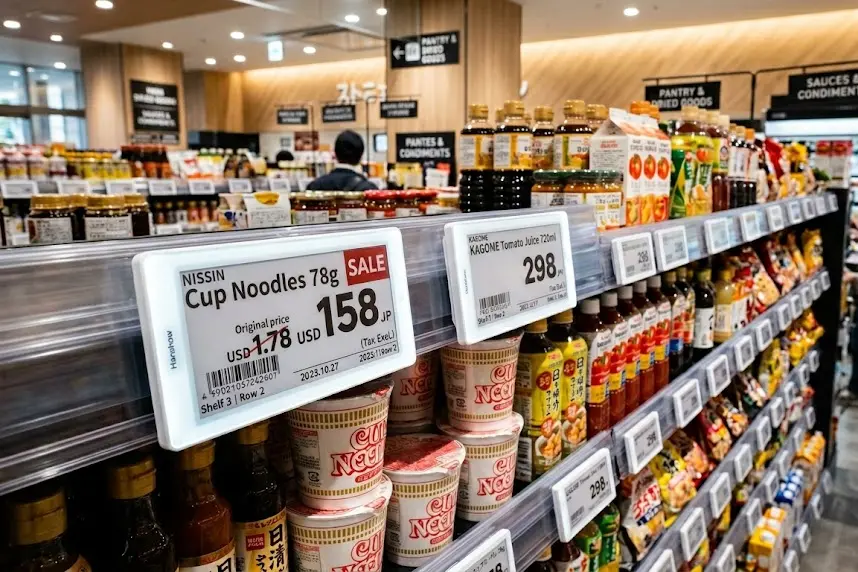
Electronic shelf labels replace that physical tag with a battery-powered e-ink or LCD display connected wirelessly to a central management platform. When a price changes in your POS or pricing software, the update pushes to every affected label within minutes - no walking the floor, no manual insertion. The system runs on four layers: the labels themselves, wireless gateways installed throughout the store, a software platform, and your existing backend (POS, ERP, or inventory system).
That architecture distinction matters. The real comparison is not paper versus a screen - it is a manual, person-dependent process versus a connected infrastructure. That framing changes how you evaluate cost, integration complexity, and long-term value.
The True Cost of Running Paper Labels at Scale
Paper labels look cheap because the per-unit material cost genuinely is cheap. A roll of thermal stock and a desktop printer runs a few hundred dollars. The problem is what surrounds that hardware.
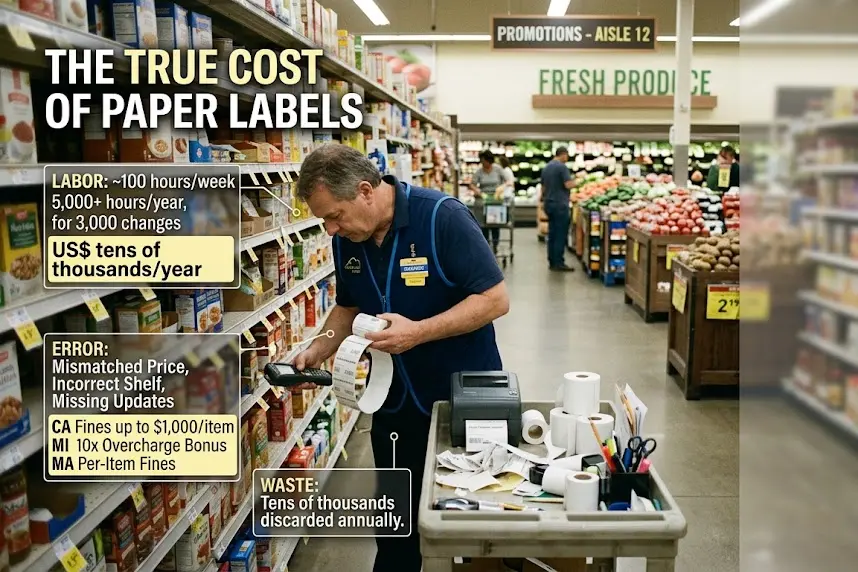
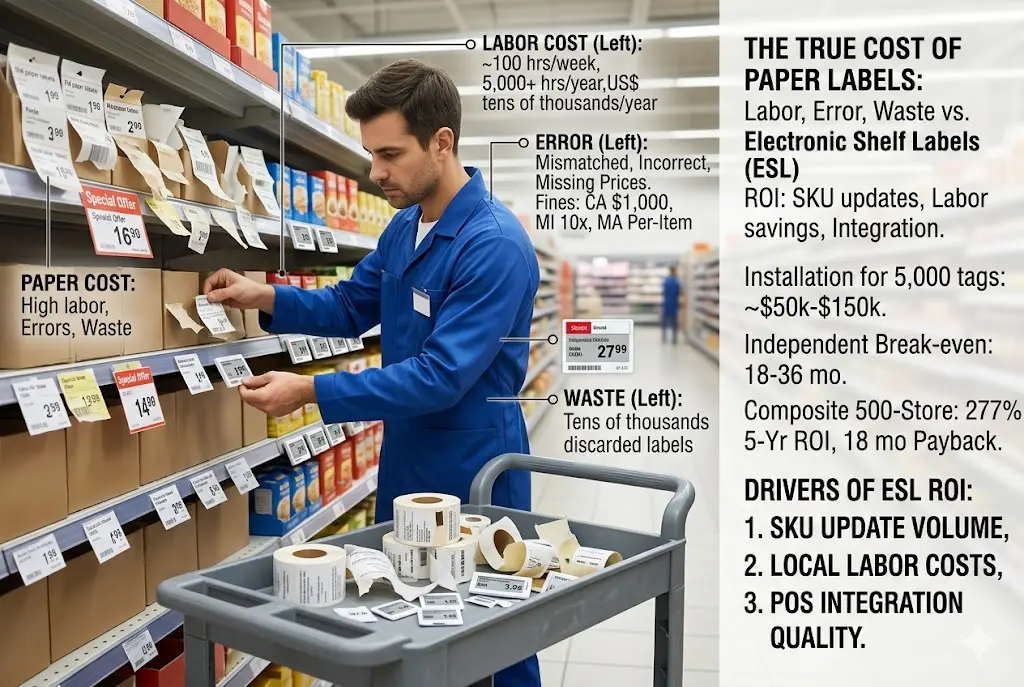
Consider the actual labor involved. A store running weekly promotions across 500 actively-priced items needs someone to print, walk, locate, remove, and replace tags every week. Industry estimates suggest a trained associate takes roughly two minutes per label change - meaning 3,000 weekly price changes across a store translate to approximately 100 labor hours per week, or over 5,000 hours per year, devoted entirely to tag management. At US median retail wages, that adds up to tens of thousands of dollars annually in labor that produces no direct customer value.
Then there is the error cost. Manual processes produce inconsistencies. A tag goes on the wrong product. An aisle update misses one shelf position. The price the customer sees does not match what rings up at checkout. In states with enforced price accuracy laws, that inconsistency carries financial consequences: California allows fines of up to $1,000 per mis-scanned item, Michigan requires retailers to pay consumers ten times the overcharge amount as a bonus, and Massachusetts imposes per-item fines for prices that scan higher than the shelf tag. NIST maintains a full state-by-state overview of retail pricing regulations. Reputational damage compounds the regulatory exposure - a checkout surprise is one of the fastest ways to lose a repeat customer.
Finally, paper generates ongoing material waste. A store running weekly promotions across 3,000 items produces tens of thousands of discarded paper and plastic tags per year. As sustainability reporting requirements expand for larger retail chains, that waste stream is no longer just an operational afterthought.
What Changes When You Switch to Electronic Shelf Labels
Labor Reallocation
The most immediate impact is labor. When price updates push wirelessly, the hours previously absorbed by tag-swapping are freed for customer-facing work. Walmart cited this explicitly in its 2024 announcement to expand digital shelf labels across 2,300 U.S. stores, describing how associates who previously spent hours replacing paper tags could redirect that time to serving customers on the floor. By early 2026, Walmart accelerated further, announcing a full rollout to all approximately 4,600 U.S. locations by year-end. A reported case from an independent grocery operator cited by the U.S. Chamber of Commerce described saving up to 50 labor hours per week after deployment - with an expected payback period under two years.
Pricing Accuracy
When a price changes in your management software, every connected label updates to the same value simultaneously. There is no version gap between the promotion database and the shelf edge. For retailers running tiered promotional structures - member pricing, buy-two-get-one, limited-time markdowns - that synchronization is the difference between a promotion that executes cleanly and one that generates checkout disputes all week.
Dynamic Pricing Becomes Operationally Viable
Paper labels make intraday pricing changes impractical - the economics of printing and physically replacing tags multiple times a day do not work. ESLs remove that constraint. Fresh food and bakery departments can schedule automated markdown sequences as expiration dates approach, reducing shrink without requiring manual intervention. For food retailers where perishable waste is a meaningful cost, this capability alone can shift the investment calculus significantly.
It is worth addressing a concern that comes up regularly: ESLs do not change prices on their own. They display what your pricing software sends. All updates are initiated by your team. The label is a display device, not a pricing engine.
Sustainability
E-ink displays are bistatic - they consume power only during an update, not while holding a static image. Battery life on standard e-ink shelf labels typically runs five to seven years. Labels are reused when products are discontinued or planograms are reset. The reduction in paper, ink, and plastic consumed over a five-year deployment at a mid-size store is substantial, and increasingly relevant for retailers with audited ESG commitments.
What Does ESL ROI Actually Look Like?
A 2022 Total Economic Impact study commissioned by ESL provider Pricer and conducted by Forrester Consulting - based on interviews with three grocery retail businesses - found a five-year ROI of 277% and a payback period of approximately 18 months for a composite 500-store omnichannel grocery chain. That study was sponsored by a vendor, so it should be read with appropriate context, but the methodology was independent and the sample was real operators. The full study is publicly available for retailers who want to examine the assumptions.
Independent grocers operating single locations report a wider range. Most deployments for stores with active promotional calendars hit break-even somewhere between 18 and 36 months, with the timeline depending heavily on three variables:
- How many SKUs need regular updates. A store with 8,000 items and a weekly ad cycle sees far more labor displacement than one with 800 stable-priced products.
- Current labor costs in your market. In high-wage markets, the savings from eliminated label-change hours accumulate faster.
- Integration quality. An ESL system that connects cleanly to your existing POS delivers full value from day one. A poorly integrated system that requires manual data exports replicates much of the friction it was meant to eliminate. This is the most underweighted variable in most purchase evaluations.
Hardware costs for standard e-ink electronic shelf label systems typically range from $5 to $15 per label, with larger color displays or models with LED indicators running higher. A 5,000-label store deployment, including gateways and installation, commonly falls between $50,000 and $150,000 depending on store complexity and vendor. That is a real capital outlay - particularly for independent operators - and it deserves honest accounting rather than being buried in projected savings.
The single most useful pre-purchase exercise is tracking actual labor hours spent on label management for one month. Most retailers who do this find the number higher than their initial estimate.
Where ESL Deployments Tend to Go Wrong
ESL deployments rarely fail because the technology does not work. They run into problems for more predictable reasons.
Wi-Fi and network infrastructure. ESLs rely on wireless gateways placed throughout the store. Older buildings with thick concrete walls or metal shelving can create coverage gaps that require additional gateways - a cost that should be scoped before purchase, not discovered during installation.
POS and backend integration. If your pricing platform does not have a documented integration path for the ESL system you are evaluating, custom development adds time and cost. Most major retail software stacks - including SAP Retail, Oracle Retail, and common mid-market cloud POS platforms - have established integration paths, but validating this upfront is essential. Our deployment readiness guide for digital price tags covers what to verify before signing a contract.
Staff training and change management. Associates accustomed to paper processes need time to adapt to the new workflow. Stores that treat training as an afterthought tend to see underutilization of system features during the first few months - particularly around promotional scheduling and dynamic pricing capabilities.
Phased vs. full-store deployment. Rolling out to the highest-velocity sections of the store first (fresh food, weekly promotional aisles) lets you validate ROI before committing to a full deployment. It also surfaces integration or coverage issues on a manageable scale.
Which Retail Environments Benefit Most
The stores where ESLs deliver the strongest returns share a few characteristics: high SKU count (2,000 or more), frequent price changes (weekly or more often), meaningful labor costs, and existing digital infrastructure that ESLs can connect to without heavy custom development.
Grocery and supermarket operators benefit most directly. Fresh departments dealing with daily markdown sequences for perishables, combined with weekly circular pricing and loyalty-tier rates, represent exactly the operating environment ESLs were designed for. Pharmacy and health product retailers - where regulatory pricing accuracy requirements are strict - also see outsized value. Warehouse and distribution environments, where labels need to track bin locations and inventory status beyond just price, are a growing deployment context. Our shelf-edge display options span a range of sizes and configurations suited to different store environments and rail standards.
Smaller specialty retailers with under 500 SKUs, stable pricing, and minimal promotional activity may find the payback period less compelling - not because ESLs do not perform, but because the problem they solve is less acute. For those businesses, a targeted deployment in the highest-turnover section of the store is often a more practical entry point than committing to a full rollout.
Side-by-Side Summary
| Dimension | Paper Labels | Electronic Shelf Labels |
|---|---|---|
| Upfront cost | Very low (printer + stock) | High ($50K–$150K+ for mid-size store) |
| Ongoing labor cost | High - scales with SKU count and promo frequency | Minimal - updates push automatically |
| Pricing accuracy | Error-prone; human handling in every update | High; synchronized updates across all labels |
| Update speed | Hours to days per full-store cycle | Minutes for full-store update |
| Dynamic pricing | Not practical at scale | Fully supported |
| Infrastructure required | None | Wireless gateways, software platform, POS integration |
| Sustainability | Ongoing paper and plastic waste | Labels reusable for 5–7+ years |
| Break-even timeline | Immediate | Typically 18–36 months depending on store profile |
| Best fit | Small stores, stable pricing, pop-up retail | Mid to large stores, active promo calendars, high labor costs |
Paper labels win on simplicity and zero infrastructure dependency. For a pop-up concept, a small specialty retailer with infrequent pricing changes, or any environment where technical support is limited, that simplicity is genuinely valuable.
Electronic shelf labels win on every operational metric at scale. Past the break-even point, the savings are durable and compound over time. The tradeoff is upfront capital, integration work, and the operational discipline required to maintain a connected system.
The most useful question to ask before making a decision is not "which system is better" but "what does our current pricing operation actually cost us, fully loaded?" Most retailers who track that number for a month find the answer more informative than any vendor comparison.
If you are evaluating specific hardware configurations for your store, our product inquiry page is the place to start a scoping conversation.
Frequently Asked Questions
Will electronic shelf labels work with my existing POS system?
Most modern ESL platforms connect to standard POS and ERP systems via API, flat-file import, or direct database integration. Major retail software stacks - including SAP Retail, Oracle Retail, and common cloud POS platforms - have documented ESL integration paths. Validating compatibility with your specific platform before purchase is the most important due-diligence step. Integration complexity is where most deployment timelines and budgets slip.
How long do the batteries last?
E-ink ESL batteries typically last five to seven years under normal retail conditions with several price updates per day. LCD-based labels consume more power and generally need recharging or replacement on a two-to-three year cycle. Battery life is a total-cost-of-ownership variable that is easy to overlook in initial hardware comparisons but meaningful over a five-year deployment horizon.
What are the most common reasons ESL deployments underperform?
Three issues come up repeatedly: inadequate wireless coverage in older buildings, integration gaps between the ESL platform and the existing POS, and insufficient staff training on promotional scheduling features. All three are addressable during the pre-deployment scoping phase - which is why that phase deserves as much attention as the hardware decision itself.
What happens to the labels during a power outage or connectivity loss?
E-ink displays are bistable: they hold their last image without any power. If connectivity drops, labels continue showing the current price indefinitely. They do not go blank or display error states. Pending updates queue and push when the connection is restored.
Are there situations where paper labels still make more sense?
Yes. Stores with under 300–500 SKUs, minimal promotional activity, and low labor costs may not reach a favorable break-even within a realistic planning horizon. Pop-up retail, temporary installations, and markets where technical support infrastructure is limited are also contexts where paper remains practical. ESLs are not universally superior - they are the better option for stores where manual pricing management represents a genuine, measurable operational cost.
Do ESLs enable surge pricing without store approval?
No. ESL systems display whatever your pricing software sends them. They do not generate or change prices autonomously. Every update is initiated by your team through your management platform. Concerns about unauthorized dynamic pricing - which surfaced during Walmart's rollout - reflect how the technology could theoretically be misused, not how it functions by default. Walmart has stated explicitly that its current deployment is not used for demand-based surge pricing.