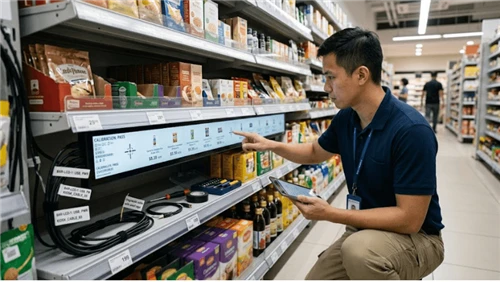
Electronic shelf labelling has moved well past the early-adopter stage. Grand View Research estimates the global ESL market at roughly USD 2 billion in 2025, growing at over 15 percent annually. Walmart alone is deploying digital shelf labels across all of its U.S. stores, with a rollout targeting more than 2,300 locations by 2026. For mid-size and large retailers still relying on paper tags, the question is no longer whether ESL technology is mature enough. It is whether your store operations, data quality, and integration stack are ready to benefit from it.
This guide covers the full picture: what electronic shelf labelling actually involves, how the system architecture works, which retail environments gain the most value, what drives cost, and how to evaluate vendors and plan a rollout that delivers measurable results.

What Is Electronic Shelf Labelling?
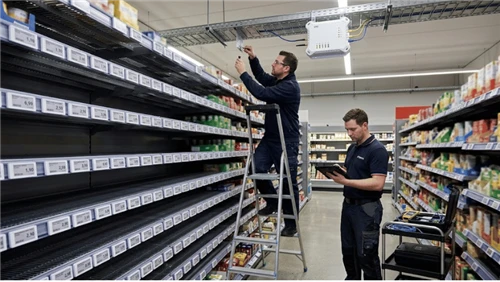
Electronic shelf labelling is a system that replaces paper price tags with small digital displays managed from a central platform. Instead of printing and manually swapping labels every time a price or promotion changes, retailers push updates wirelessly to hundreds or thousands of labels at once.
But calling it a "digital price tag" undersells what is actually involved. A complete electronic shelf label solution typically includes four layers:
- Digital shelf labels - the e-ink or LCD screens mounted on the shelf edge
- Wireless communication infrastructure - gateways that bridge the software and the shelf
- Management software - the platform that controls content, templates, scheduling, and monitoring
- Backend integration - connections to POS, ERP, inventory, and promotion systems
The label is what shoppers see. The value is in everything behind it. A poorly integrated ESL deployment is just an expensive screen; a well-integrated one becomes the real-time link between your pricing decisions and the shelf edge.
How an Electronic Shelf Labelling System Works
Understanding the architecture matters because it determines what goes wrong when it goes wrong - and where the real cost and complexity sit. For a deeper walkthrough, see our article on how electronic shelf labels work from a retailer's perspective.

The Labels Themselves
Most modern ESL systems use e-ink (electronic paper) displays. The technology is bistable, meaning the display only draws power when the content changes - not while holding an image. According to E Ink Holdings, the originator of the technology, this enables battery lifetimes of up to five years under typical update conditions. In practice, battery life depends heavily on update frequency, label size, and ambient temperature. Retailers operating in cold-chain environments or running multiple daily updates should expect shorter cycles and should factor battery replacement logistics into their planning.

Labels come in various sizes - commonly from 1.5 inches up to 12 inches or more - and some support multi-color displays (black, white, red, yellow) for promotional highlighting. Choosing the right mix depends on shelf spacing, product category, and whether you need the label to do more than show a price. For a comparison of display technologies, see our breakdown of e-ink versus OLED for shelf labels.
Wireless Gateways and Communication
Labels cannot update themselves. They receive data through wireless gateways installed throughout the store - typically one gateway covers a defined zone of shelving. The communication protocol varies by vendor: some use proprietary sub-GHz radio, others use Bluetooth Low Energy (BLE) or 2.4 GHz bands. What matters operationally is not which frequency the vendor chose, but whether the network achieves reliable, store-wide coverage without dead zones that cause missed updates.

A missed update is not just a technical glitch. If a promotion goes live at the register but the shelf still shows the old price, you create exactly the kind of pricing discrepancy that ESL is supposed to eliminate.
Software and Backend Integration
This is where most of the operational value - and most of the implementation risk - lives. The ESL management platform should pull pricing, product, and promotion data from your authoritative systems: POS, ERP, inventory management, or a centralized pricing engine. When integration is configured correctly, price changes approved in the backend appear on the shelf within minutes, sometimes seconds.
When integration is done poorly, the problems show up fast. Duplicate SKUs, orphaned label assignments, promotion rules that conflict with the ERP - these are the issues that turn a pilot into a frustration. If your product and pricing data is messy today, ESL will not clean it up. It will display the mess more visibly.
Why Retailers Switch to Electronic Shelf Labels
Retailers do not invest in ESL because the labels look modern. They invest because paper-based pricing creates recurring operational drag that scales badly. Here is where the return typically shows up. For a more detailed look at the tradeoffs, see our article on the advantages and disadvantages of electronic shelf labels.
Speed of Price and Promotion Changes
In a store with 20,000 SKUs, a weekly promotion cycle can mean hundreds of label swaps. With paper, that requires printing, sorting by aisle, walking the store, and verifying placement - a process that routinely consumes multiple staff hours per event. With ESL, the same update pushes from the system in bulk. One U.S. grocery store owner using VusionGroup's system reported saving roughly 50 labor hours per week on pricing tasks alone.
Pricing Accuracy
Shelf-to-checkout price mismatches are a persistent source of customer complaints, compliance risk, and wasted staff time at the register. Every manual label swap is an opportunity for human error: wrong tag on the wrong hook, outdated promotion still showing, new price printed but not yet placed. ESL ties the shelf edge directly to the source system, which significantly tightens accuracy - especially across multi-store operations where consistency is hardest to maintain manually. Curious about the real-world consequences of pricing errors? See what happens when price displays are wrong.
Labor Reallocation
ESL does not eliminate the need for store staff. What it does is shift time away from repetitive tag replacement toward higher-value tasks: merchandising, replenishment, customer assistance, and fulfillment. In stores using ESL-driven pick-to-light features, labels can flash to guide e-commerce order pickers to the right product - a function that directly supports omnichannel operations.
Richer Shelf-Edge Communication
Depending on the system, labels can display more than a price: unit pricing, promotional flags, QR codes linking to product details, low-stock indicators, or loyalty-tier messaging. This turns the shelf edge from a static price marker into an active communication surface - useful in categories where product comparison matters, such as electronics, health products, or specialty food.
Paper Labels vs. Electronic Shelf Labelling: A Practical Comparison
| Area | Paper Labels | Electronic Shelf Labelling |
|---|---|---|
| Price updates | Manual print-sort-place cycle | Centralized, pushed in bulk |
| Pricing accuracy | Depends on staff execution speed and consistency | System-driven, tighter control |
| Promotion execution | Hours per event in large stores | Scheduled or instant rollout |
| Labor demand | Ongoing manual replacement | Reduced routine label work; staff shifts to higher-value tasks |
| Multi-store consistency | Difficult to standardize | Central template and pricing control |
| Information flexibility | Limited to printed content | QR codes, LEDs, promotions, dynamic content |
| Scalability | Breaks down in high-SKU, high-change environments | Designed for frequent, large-scale updates |

Paper labels still work in small shops with stable pricing and a handful of SKUs. But once you manage multiple stores, run weekly promotions, or carry thousands of products, the manual approach becomes a bottleneck - not just for efficiency, but for accuracy.
Where Electronic Shelf Labelling Delivers the Most Value
ESL can technically work in any retail format, but the return varies significantly by environment. The stores that benefit most share a common pattern: high SKU counts, frequent price changes, or strict accuracy requirements.

Supermarkets and Grocery
Grocery is the largest ESL end-use segment globally, and for good reason. Supermarkets deal with thousands of SKUs, weekly ad cycles, perishable markdowns, and regulatory pricing requirements. The labor saved on tag changes alone often justifies the investment in high-volume stores. For more detail, read about electronic shelf labels in grocery store environments.
Electronics Retail
Electronics stores benefit from ESL's ability to display more than a price. Spec comparisons, model numbers, QR-linked product pages, and promotional highlights help shoppers self-serve in categories where staff availability is often limited.
Pharmacies
Pharmacy retail demands pricing precision and controlled product information. Even minor discrepancies can raise compliance concerns or erode customer trust. Centralized label management reduces that risk considerably.
Hardware, DIY, and Specialty Stores
Large-assortment stores often struggle with product findability. ESL labels with LED indicators can support staff-assisted picking, restocking workflows, and customer wayfinding - especially in warehouse-format environments.
When ESL Fits - and When It Does Not
Not every store benefits equally from ESL deployment, and timing matters as much as format.
ESL is usually a strong fit when:
- Prices or promotions change frequently - weekly or more often
- Staff spend significant hours on label maintenance each week
- Pricing discrepancies between shelf and checkout are a recurring problem
- The business manages thousands of SKUs or multiple store locations
- Central pricing control and multi-store consistency are priorities
- The store supports omnichannel fulfillment and in-store picking
ESL may not be the right first investment when:
- The store has very few SKUs and prices rarely change
- Product and pricing data in the POS or ERP is still unreliable - ESL will amplify data problems, not fix them
- There is no defined integration path between the ESL platform and existing systems
- No budget or ownership has been assigned for a pilot phase
In those cases, the better first step is usually data cleanup, system integration planning, or process standardization. Deploying ESL on top of broken data is one of the most common - and most avoidable - mistakes.
Key Features to Evaluate Before Choosing an ESL System
Most ESL vendors present similar high-level feature lists. The differences that matter show up in daily operations, integration depth, and long-term support. When comparing ESL manufacturers, focus on these areas:
Display Type and Label Sizes
Start from your shelf reality, not from a product brochure. Ask whether the vendor offers the specific sizes you need for your shelf profiles, whether the displays are readable at your typical shelf-to-shopper distance, and whether specialized labels exist for freezer, fresh food, or outdoor environments. If color-coded promotions matter, confirm multi-color e-ink options are available and test them under your store lighting.
Battery Life and Replacement Logistics
Vendor claims of "up to 5 years" or "up to 10 years" battery life are based on ideal conditions - low update frequency, moderate temperatures, small label sizes. In a high-turnover grocery environment with multiple daily updates, real-world battery life may be closer to 3 years. Ask the vendor what their replacement process looks like at scale: Can batteries be swapped in the field, or does the entire label unit need replacing? How does the system flag low-battery devices before they go dark?
Software, API, and Integration Depth
This is the single most important evaluation area. An ESL system that cannot deeply integrate with your POS, ERP, and promotion engine is an isolated tool - and isolated tools create more work, not less.
Check: Does the platform support real-time sync or only batch updates? Is there an open API? How are conflicts handled when the ERP and the promotion system send different prices for the same SKU? What does the error log look like, and who monitors it? These questions matter more than the label's pixel count.
Centralized Management and Multi-Store Control
For chains, the management layer is often more important than the hardware. Evaluate whether the platform supports centralized pricing and template control, store grouping and regional overrides, role-based access for headquarters versus store-level users, and scheduled campaign deployment with audit trails.
Advanced Features: LEDs, QR, NFC
Features like LED-guided picking, NFC tap interactions, and QR-linked product pages are genuinely useful - but only if they match a real workflow need. Buying LED capability "just in case" adds cost without return. Start with the features that solve a current problem. Build toward advanced capabilities as your deployment matures. For more on choosing the right feature set, see our guide on how to choose a retail electronic shelf label solution.
Electronic Shelf Labelling Cost: What Actually Drives the Investment
There is no single price for ESL because the total cost depends on store size, label mix, integration scope, and rollout model. Rather than asking "How much does ESL cost?" the more productive question is "Where does the cost concentrate, and what levers do I control?" For a detailed cost analysis, see our breakdown of electronic shelf label costs for retailers.
Hardware
Labels, gateways, mounting accessories, and any environment-specific components (freezer-rated labels, anti-theft mounts). The biggest variable is label count and size mix - a 7.5-inch label costs several times more than a 2.13-inch one, and most stores need a mix of sizes across departments.
Software
Licensing models vary: per-store, per-label, per-user, or bundled with hardware. Ask what is included in the base license versus what requires add-ons. Features like advanced analytics, multi-store dashboards, and API access may be priced separately.
Installation and Deployment
Site surveys, gateway installation, label mounting, network configuration, and staff training all carry costs. A phased rollout - starting with a pilot department - spreads this investment and lets you validate the ROI model before committing to full deployment. See our step-by-step on how to install electronic shelf labels.
Ongoing Support and Maintenance
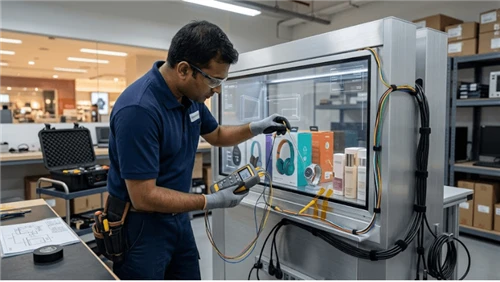
Battery replacements, software updates, device failures, and integration changes over time are all part of the total cost of ownership. Ask vendors to specify their support SLA, their approach to firmware updates, and who bears the cost of device replacement within the warranty period and after it expires.
If you want to model the financial case before committing, try our ESL ROI calculator to estimate payback based on your store's specific parameters.
How to Implement ESL Successfully: A Practical Roadmap
Technology selection is only half the equation. The other half - and typically where projects succeed or fail - is planning, data readiness, and change management.

Step 1: Define the Business Problem First
Before evaluating vendors, be specific about what you are trying to solve. "We want digital labels" is not a business case. "We spend 40 staff-hours per week on label changes across 12 stores and still have a 3 percent shelf-to-checkout pricing error rate" is a business case. Defining the problem quantitatively also gives you the KPIs you will use to evaluate the pilot later.
Step 2: Audit Your Data and Integration Readiness
Run a data quality check on your POS and ERP before you install a single label. Are SKU records complete and consistent? Are promotion rules clearly structured? Does your pricing system have a single source of truth, or do prices live in multiple disconnected places? ESL will surface every data inconsistency you currently have - fixing them after deployment is far more expensive than fixing them before.
Step 3: Start With a Focused Pilot
Choose a department or category where the pain is visible and measurable. A promotion-heavy aisle in a supermarket, a high-SKU electronics section, or a pharmacy with strict pricing compliance requirements are all strong pilot candidates. Avoid piloting in a low-traffic, low-change area where the benefits will be hard to observe.
Step 4: Train Staff Before Go-Live, Not After
Store teams need to understand what the system does, how to handle exceptions, and where to escalate problems. Training should cover day-to-day label monitoring, battery and connectivity alerts, promotion validation, and the escalation path when something looks wrong. A rollout goes noticeably smoother when staff trust the system - and trust comes from understanding, not from a surprise installation.
Step 5: Measure With Clear KPIs
Do not judge a pilot by whether the labels "work." Judge it by operational impact:
- Hours spent on pricing tasks before and after deployment
- Shelf-to-checkout pricing discrepancies per week
- Promotion execution time (from approval to shelf)
- Label update success rate (percentage of updates confirmed)
- Staff adoption rate and issue frequency
Without these metrics, you cannot build a credible case for scaling the pilot to additional stores.
Common Mistakes That Undermine ESL Projects
Most ESL failures are not hardware failures. They are planning failures. Based on patterns seen across retail deployments, these are the most common ones:
- Selecting a vendor before confirming integration requirements. The label quality may be excellent, but if the software cannot talk to your POS or ERP without custom middleware, you have bought a problem.
- Rolling out broadly before running a pilot. Full-store deployment on day one multiplies every data and process issue you did not catch early.
- Ignoring shelf data quality. If your planogram, SKU master, or shelf-location mapping is unreliable, labels end up on wrong products or fail to match what is actually on the shelf.
- Underestimating staff training. Untrained staff cannot troubleshoot basic issues, which leads to ticket overload and delayed fixes.
- Comparing vendors only on label price. The cheapest label means nothing if the software is rigid, the integration is shallow, and the support disappears after installation.
- Buying advanced features with no current use case. NFC, LED, color displays - all useful in the right context, all wasted cost if you do not have the workflow to use them.
- Failing to define success metrics before launch. Without baseline measurements, you cannot prove ROI, which makes it harder to secure budget for the next phase.
Vendor Evaluation Checklist
When you are ready to compare ESL suppliers, these are the questions that separate a good vendor from a risky one. Use this as a working checklist during the evaluation process.
- Does the vendor support direct integration with your specific POS and ERP systems?
- Is there an open API with documentation, or is integration handled only through the vendor's professional services?
- What is the real-world battery life under conditions similar to yours (update frequency, temperature, label size)?
- What does the battery replacement process look like at scale - field-swappable or full unit replacement?
- Can the platform manage multiple stores from a single dashboard with role-based access?
- How does the system handle update failures - automatic retry, alert, or silent failure?
- What are the licensing terms - per-label, per-store, per-user?
- What does post-installation support include, and for how long?
- Can the vendor provide references from retailers in a similar format and scale?
- What is the typical timeline from pilot to full rollout?
Frequently Asked Questions
What is electronic shelf labelling?
Electronic shelf labelling is a system that uses digital displays, wireless communication, and centralized management software to replace paper price tags in retail stores. Updates are pushed from backend systems to labels on the shelf, eliminating the need for manual tag changes. Learn more about how ESL solutions work.
How long do ESL batteries last?
E-ink-based ESL labels typically last between 3 and 10 years, depending on display size, update frequency, and environmental conditions. Vendor claims of "up to 10 years" assume low-frequency updates under ideal temperatures. Retailers should ask for real-world data that matches their operating conditions, not just brochure specifications.
Can electronic shelf labels integrate with POS and ERP software?
Yes. Most modern ESL platforms are designed to integrate with POS, ERP, and inventory management systems. The quality and depth of that integration - real-time versus batch sync, error handling, API flexibility - varies significantly between vendors and should be a primary evaluation criterion.
Is electronic shelf labelling suitable for small stores?
It depends on the store's pricing complexity. A small shop with 500 SKUs and monthly price changes will see limited return. A small pharmacy with strict compliance requirements or a specialty store with frequent promotions may benefit more than its size suggests. The business case is driven by operational pain, not store square footage.
What is the difference between a digital price tag and an ESL system?
A digital price tag is the display hardware - the screen on the shelf edge. An ESL system includes the display, wireless gateways, management software, and backend integration that together enable centralized, automated label management at scale. Buying labels without the system is like buying monitors without a computer.
Does ESL enable dynamic pricing?
The technology allows prices to be changed frequently and remotely, which makes dynamic pricing strategies technically possible. Whether a retailer uses that capability for time-based markdowns, competitive matching, or demand-based adjustments is a business decision, not a technology limitation. Walmart, for example, has publicly stated it does not use ESL for surge pricing.
What should retailers ask an ESL vendor before buying?
Focus on integration depth, update reliability, battery replacement logistics, multi-store management, licensing terms, post-installation support, and real-world references from comparable retailers. The label hardware is the most visible part of the system, but it is rarely where the real risk or value sits.
Conclusion
Electronic shelf labelling is not a futuristic concept - it is an operational tool already running at scale in some of the world's largest retail chains. The technology is mature, the market is growing rapidly, and the use cases are well proven in grocery, pharmacy, electronics, and multi-format retail.
But the value of ESL does not come from replacing paper with a screen. It comes from connecting the shelf edge to your pricing, promotion, and inventory systems in a way that reduces manual work, improves accuracy, and frees staff for higher-value tasks.
For retailers ready to move forward, start with a focused pilot in a high-impact area, measure results against clear KPIs, and scale based on evidence. For retailers still evaluating, invest first in data quality and integration readiness - that groundwork will determine whether your ESL deployment succeeds or disappoints.
If you are exploring electronic shelf label options, focus on operational fit, integration quality, vendor support, and total cost of ownership. The display is the part shoppers see. Everything behind it is the part that determines whether the system earns its place in your store.