This guide focuses on exactly that: what the current generation of ESL hardware can do beyond basic pricing, where the return on investment actually comes from, which store formats benefit most, and what to pressure-test before committing to a vendor. It draws on Legoyo's experience supplying display systems across more than 10,000 retail projects in over 40 countries. Retailers comparing specific hardware configurations and display types before narrowing down vendors may find our guide to digital price tag formats and specifications a useful companion reference.

What Modern ESLs Can Do Beyond Showing a Price
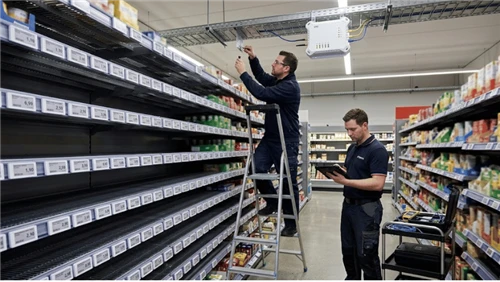
Early deployments used ESLs for one thing: displaying a price. Current systems are substantially more capable, and the expanded feature set is often what tips the ROI calculation for mid-size operators who might otherwise find the per-unit hardware cost hard to justify.
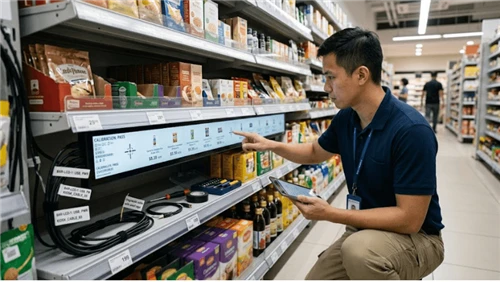
The core use case remains real-time pricing - updating a single SKU or pushing a store-wide promotional price in seconds rather than hours. The functions that see regular use in production deployments beyond that include:
- Stock-level alerts displayed directly on the label, flagging to floor staff when a facing is running low without requiring a manual scan
- Allergen and origin declarations, along with certifications such as organic or non-GMO - relevant for compliance in states with specific shelf-labeling requirements
- QR codes linking shoppers to recipes, manufacturer pages, reviews, or loyalty program offers pulled up on their own phones, bridging the gap between physical shelf and online research behavior
- LED flash signals triggered by a store associate's mobile app, guiding staff to the exact location of a product for restocking or online order picking without radio communication
- NFC tap interaction on equipped models, letting a shopper's phone pull up extended product content with a single tap of the label
The LED flash function - what Walmart calls "pick to light" and "stock to light" - has arguably become the second most important driver of ESL adoption after pricing labor savings. As click-and-collect orders account for a growing share of grocery revenue, the ability to route a picker to an exact shelf location in a large-format store has shifted from a convenience feature to an operational necessity. Our electronic price screen digital signage range covers multi-function display configurations that support these shelf-edge use cases in detail.
For category-level promotional content - motion graphics, brand campaigns, or animated offers - a bar-format LCD display mounted at the shelf header or end cap serves that purpose better than e-ink. These two technologies regularly coexist in the same store: ESLs at every product facing for per-SKU data, bar LCD displays at shelf and category level for promotional content. The decision is not either/or. For panel specifications, available sizes, and mounting options on bar LCD units, the bar LCD display product range covers the hardware options currently available.

The Business Case: Where the Returns Actually Come From
Judson Naifeh, owner of Naifeh's Cash Saver in Tennessee, was processing as many as 2,000 price changes per week using paper tags and spending roughly 50 labor hours doing it. After deploying digital shelf labels, his team reduced that to a file download and a single send. "Three minutes later, you've got 2,000 price changes," he told CO- by the U.S. Chamber of Commerce. He expects full return on investment in under two years.
The labor savings calculation is straightforward to model for your own store: multiply your weekly price-change count by average minutes per paper tag swap, divide by 60, and multiply by your local hourly labor rate. A store running 800 weekly changes at three minutes each, with labor at $16 an hour, spends roughly $640 per week on pricing labor alone - around $33,000 per year before accounting for error correction and compliance re-labeling. At that volume, the math tends to favor ESLs within two to three years on labor savings alone.
Pricing accuracy is the second driver, and it is routinely underestimated because most retailers do not track shelf-to-register discrepancies systematically. The gap generates customer complaints, manager time, and in some states, direct regulatory exposure. ESLs remove that gap structurally rather than through better process discipline.
The third driver is dynamic pricing of perishables. Research from UC San Diego's Rady School of Management, cited in CNBC's 2025 coverage of U.S. ESL adoption, found that dynamic pricing on grocery items reduces food waste by up to 21 percent. In practice, this means automatically marking down rotisserie chicken at 5 p.m., discounting produce based on sell-by date, and adjusting bakery pricing in the final trading hour - without a manager walking the floor with a label gun. For stores running significant perishable inventory, this return can exceed the labor savings in dollar terms.
Who Is Deploying ESLs Right Now, and at What Scale
Walmart's rollout to 2,300 stores is the headline figure, backed by a contract with VusionGroup valued at approximately €1 billion. The impact at store level is concrete: Daniela Boscan, a Food and Consumable Team Lead at a Walmart store in Hurst, Texas, described in a Walmart corporate blog post what the shift felt like operationally - a price change that used to take two days now takes minutes.
Whole Foods has tested ESLs in nearly 50 locations. Schnucks, a regional Midwest chain, committed to full-store deployment to improve pricing accuracy and reduce labor overhead. The Defense Commissary Agency, which operates grocery stores at U.S. military bases worldwide, deployed ESLs across more than 240 locations in 2018 - one of the earliest large-scale U.S. deployments on record. In home improvement, Busy Beaver became the first U.S. hardware retailer to run ESLs across every SKU in the store in 2021.
Warehousing is a growth application that the grocery-centric ESL conversation tends to overlook. Replacing static rack labels with wirelessly updated displays reduces the time and error rate associated with inventory location changes, pick path updates, and slot reassignments across large distribution environments. Our breakdown of how ESLs are applied to warehouse racking operations covers the specific integration architecture and the pick accuracy gains that operators in that environment typically measure.

When ESLs May Not Be the Right Investment
Most ESL deployments that underperform do so not because the technology failed but because the store environment was not suited to it from the start.
If your store runs fewer than 300 to 400 price changes per week, the labor savings may not generate enough return to justify hardware and software costs within a reasonable payback window. A specialty retailer with a curated, slowly-turning product range faces a fundamentally different math than a grocery operator running daily promotions and perishable markdowns. Low price-change frequency is the clearest early signal to slow down the evaluation.
Non-standard shelving - curved gondolas, rotating fixtures, refrigerated open cases with unusual rail geometry - adds installation complexity that standard vendor quotes often do not reflect. This is worth surfacing in the RFQ stage, not during installation.
Cold-chain environments require hardware specifically rated for sustained low-temperature operation. Standard ESL units are not designed for freezer aisles or walk-in refrigerators; using them there accelerates battery degradation and risks display failure. If any portion of your store is maintained below 32°F, low-temperature certification needs to be a mandatory spec, not an afterthought. The full ESL hardware range covers temperature ratings and mounting options by product line.
Legacy POS or ERP systems with limited API access can stretch integration timelines from weeks to months. That does not automatically make ESLs the wrong choice, but it needs to be in the implementation budget and timeline from day one.
What Electronic Shelf Labels Typically Cost
Hardware pricing varies significantly by display size, color capability, and order volume. Entry-level two-color e-ink labels - black and white, small format, suited to standard grocery or pharmacy shelving - typically start in the $3 to $8 per unit range at scale. Mid-range units with three-color displays, adding red or yellow for promotional highlighting, run roughly $8 to $15 per unit. Larger-format labels and full-color LCD units can exceed $20 per unit and are generally deployed selectively at high-traffic facings rather than across every SKU.
Hardware is the most visible cost item but not always the largest over a five-year horizon. Gateway infrastructure, professional installation, and software licensing - charged either as a flat fee or as a per-label SaaS subscription - add meaningfully to total cost of ownership. A full-store deployment in a mid-size grocery (25,000 to 40,000 square feet, 20,000 to 30,000 SKUs) typically carries an all-in first-year investment in the range of $150,000 to $400,000, depending on label density, software choice, and integration scope. Naifeh's Cash Saver's experience of sub-two-year payback sits on the favorable end of that range, driven by a high weekly price-change volume that maximizes the labor savings.
For a breakdown of how system architecture choices - label density, gateway coverage model, and software licensing structure - affect both upfront outlay and ongoing operating cost, our ESL deployment solutions overview maps different configurations to common retail formats.
Seven Questions to Ask Any ESL Vendor Before You Sign
1. What is your documented integration path to our specific POS and ERP platform? Not a general claim of compatibility - a documented, tested connector with reference customers running the same stack. This question alone filters out vendors whose "integration" is actually a custom project that the initial quote did not price.
2. How long does a full-store price update take at our SKU count? Test this in a real store environment, not a vendor demo room. A store running 30,000 SKUs needs verified performance data under realistic load conditions, not a feature description.
3. What is the battery life estimate for our specific operating conditions? Give the vendor your store temperature range and your expected daily update frequency per label. The spec sheet number assumes standard conditions that many stores, particularly those with cold-chain sections or high promotional frequency, do not match.
4. How does the system behave when a gateway goes offline? Are missed updates queued and retried automatically once the gateway recovers? What does the label display if it loses connection - does it hold the last image or go blank? These are not edge cases; they are routine events in a live retail environment and the answer should be specific, not vague.
5. What are the full five-year costs? Build a model that includes hardware, gateways, installation, software licensing, battery replacement labor across five years, and support contract fees. Some vendors price ESLs as a lease that bundles everything; others charge separately. The headline per-label cost rarely gives you what you need for a capital decision.
6 and 7. What is your label replacement lead time, and do you have reference deployments in our specific retail vertical? Labels fail in production. A two-to-four-week replacement window creates real operational exposure if there is no protocol for managing a blank or frozen price tag at shelf. On the vertical question: grocery experience does not automatically transfer to cold-chain, pharmacy compliance labeling, or warehouse racking environments. Ask for a reference customer in your own category.
Frequently Asked Questions
What is the realistic battery life of an electronic shelf label in a working store?
The figure most vendors lead with is five to seven years. That estimate assumes room-temperature conditions and modest update frequency - a few price changes per day per label. Two variables shorten that window significantly in practice: cold-storage environments and high promotional frequency. A grocery store running dynamic perishable pricing with multiple daily updates per label in a refrigerated aisle may see three to three-and-a-half years on standard e-ink units. Freezer aisles below 32°F require purpose-built low-temperature hardware; standard units are not rated for those conditions. Some vendors offer wired configurations for environments where battery replacement would otherwise become a regular operational burden. Whatever figure a vendor quotes, ask them to confirm it against your specific temperature range and daily update count per label - not the default assumption on their spec sheet. For a practical comparison of how different display technologies hold up across varying retail conditions, our piece on e-paper price tag performance covers the tradeoffs in operational terms.
Do electronic shelf labels enable surge pricing, and should retailers expect pushback from customers?
This concern entered public debate when Kroger's ESL deployment drew scrutiny in 2024, including a formal letter from a U.S. senator. The retailer's response was direct: it does not use ESLs for surge pricing and the labels give it data to identify where prices can come down, particularly on perishables approaching sell-by dates. The academic record supports that framing. Researchers at the University of Texas at Austin published findings in 2025 showing no statistically significant price increases following ESL adoption across U.S. grocery data. What dynamic pricing through ESLs looks like in practice is rotisserie chicken marked down from $7.99 to $5.99 at 5 p.m., or produce discounted against its sell-by date - prices moving down, not up. Retailers who have handled customer communication proactively - shelf messaging, staff training, announcements at rollout - consistently report that shopper reception is positive once the actual use case is understood.
What is the practical difference between e-ink and LCD for shelf labels, and how do I choose?
The terminology - electronic shelf label, digital price tag, digital shelf label - is used interchangeably across vendors and trade press. The distinction that matters for procurement is not the name but the display technology underneath. E-ink is the right choice for most standard retail deployments: low power consumption, five-plus-year battery life, excellent readability in varied lighting, and sufficient color capability (black, white, red, yellow on current three- and four-color units) for most promotional highlighting needs. LCD is the right choice when you need full-color video capability, higher refresh rates, or richer branded content displayed at the shelf edge - typically at featured product locations or high-traffic category headers rather than across every SKU. Most stores end up running both: e-ink at every facing, LCD at selected positions. Our guide to digital price tag types and specifications breaks down these distinctions by hardware category and helps map specific display types to deployment scenarios.
How difficult is ESL integration with an existing POS system, and what goes wrong most often?
Integration complexity is the most consistently underestimated variable in ESL procurement. Modern platforms offer pre-built connectors for major retail POS and ERP systems, and for stores running standard, unmodified platforms the process can move relatively quickly. Trouble surfaces most often in two scenarios: heavily customized POS environments where the standard connector does not account for local modifications, and legacy platforms with limited or undocumented API access. In the first case, integration becomes a custom development project the initial quote may not have covered. In the second, the timeline can stretch from weeks into months.
The most reliable mitigation is a multi-department pilot rather than a single-aisle test. A broader pilot covers different product types and pricing behaviors, surfaces edge cases at manageable scale, and gives your IT team time to stabilize the data pipeline before it carries the full store's pricing operations. Even a well-run pilot across four departments typically uncovers one or two integration scenarios a single-aisle test would have missed entirely. For a detailed breakdown of integration architecture considerations and the questions worth asking vendors before issuing an RFQ, the ESL system architecture and cost guide covers the technical decision points in depth.