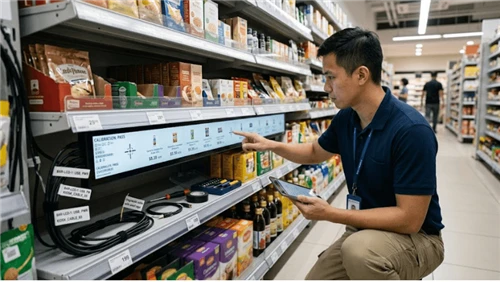
If you are researching digital price tags, chances are you have more than one question on your mind. What exactly are they? How do they connect to your existing systems? Are they the same thing as electronic shelf labels? And most importantly - is the investment justified for your type of store?
This guide goes beyond surface-level definitions. It covers how electronic shelf label systems work in practice, where they deliver the strongest operational impact, what a realistic rollout looks like, and how to evaluate whether your store is ready for the switch from paper to digital shelf-edge pricing.
What Are Digital Price Tags?
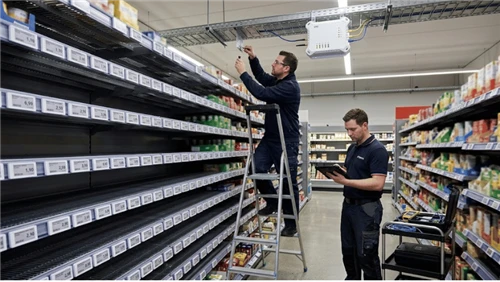
Digital price tags - also called electronic shelf labels (ESLs) or digital shelf labels - are small electronic displays mounted on store shelves to show pricing, product details, and promotional information. They replace traditional printed paper labels, allowing retailers to update shelf-edge content remotely instead of printing and swapping tags by hand.

In the industry, "electronic shelf label" is the standard technical term, while "digital price tag" is the phrase most people use when searching online. Both typically refer to the same thing: a shelf-mounted display connected to a central management platform that pushes updates wirelessly.
Modern digital price tags can display far more than a selling price. Depending on the system, a single tag may show product names, unit pricing, promotional messages, barcodes, QR codes, stock codes, and even limited color highlights for category or campaign branding. That flexibility turns them into a shelf communication tool, not just a pricing device.
Are Digital Price Tags the Same as ESLs?
Yes, in most practical contexts they are. ESL is the term used by manufacturers, integrators, and industry analysts. "Digital price tag" and "digital shelf label" are more common among retailers evaluating the technology for the first time. If you see these terms used interchangeably in vendor materials, it is because they describe the same core product - a wirelessly updated electronic shelf label designed for retail environments.

How Do Digital Price Tags Work?
A digital price tag is not a standalone screen. It operates as part of a broader ESL system that connects hardware, software, and your existing business infrastructure. Understanding the system architecture matters because it determines how reliably prices reach the shelf - and how much manual work it actually eliminates.

Core Components of an ESL System
A typical deployment involves four elements working together:
The tags themselves.
These are the e-paper or LCD displays attached to shelf edges. Sizes range from small labels suitable for grocery aisles to larger displays for electronics or promotional endcaps. Most modern tags use e-paper (electronic ink) technology, which only consumes power during a screen refresh - not while displaying static content. According to E Ink, the company behind the dominant e-paper technology used in ESLs, this enables battery lifetimes of up to five years and wide viewing angles under standard store lighting.
Communication infrastructure.
In-store gateways or access points transmit pricing updates from the central platform to the tags. Communication protocols vary - options include Bluetooth Low Energy, Sub-GHz radio, or proprietary RF. The protocol choice affects range, update speed, scalability, and battery life, so it is worth understanding the trade-offs during vendor evaluation.
Management software.
This is the platform where retail teams manage pricing templates, schedule promotions, assign content to individual tags, and monitor system health. Software usability varies significantly between vendors. A strong platform should let your team handle day-to-day operations - including exceptions and overrides - without requiring IT intervention for every change.
Business system integration.
For consistent pricing, the ESL platform needs to connect to your existing POS, ERP, or product information management system. This integration layer is what ensures the price a shopper sees on the shelf matches the price at checkout. Poor integration is one of the most common sources of post-deployment frustration.
How Price Data Reaches the Shelf
The data flow is straightforward in concept: your pricing source (POS, ERP, or product database) feeds into the ESL management software, which pushes updates through in-store gateways to the relevant tags. When a price changes upstream, the system delivers the update to the shelf - sometimes within seconds, sometimes on a scheduled cycle depending on your configuration.
For retailers managing thousands of SKUs across multiple locations, this means a national promotion rollout that once took days of manual label changes can happen centrally in minutes. One Walmart associate in Texas reported that digital shelf labels reduced the time spent on pricing tasks by roughly 75%, as described in Walmart's corporate announcement about its ESL expansion.
Why E-Paper Dominates ESL Displays

Most digital price tags in production today use e-paper displays rather than LCD or OLED. The reason is practical: e-paper is bistable, meaning it holds an image without drawing power. Energy is only consumed during a screen refresh. This characteristic makes it uniquely suited to retail environments where content changes periodically but must remain visible around the clock. Industry data shows that e-paper labels typically achieve battery lifetimes between three and ten years depending on display size, update frequency, and environmental conditions. Tags operating in freezer environments or with frequent daily updates will land on the shorter end of that range.
E-paper also offers paper-like readability with near 180-degree viewing angles and no glare under bright store lighting - a meaningful advantage over backlit screens when tags are mounted at different shelf heights. For a deeper comparison of display technologies, see our article on ESL refresh rates and display performance.
Why Retailers Switch from Paper to Digital Price Tags
Retailers do not adopt digital price tags to look modern. They switch because paper labels create measurable operational drag - in labor hours, pricing errors, promotional execution speed, and shelf-edge compliance. Here is where the impact tends to be most concrete.
Faster Price and Promotion Execution
With paper labels, a routine price change involves printing, sorting by aisle, walking the floor, swapping tags, and verifying accuracy. In a high-SKU grocery store running weekly promotions, this process can consume dozens of staff-hours per week. An independent grocery operator profiled by the U.S. Chamber of Commerce reported saving up to 50 labor hours per week after deploying digital shelf labels, with an expected ROI payback in under two years.
Digital price tags compress that cycle dramatically. Updates pushed from a central system reach the shelf in minutes, which matters most for weekly promotions, category-wide repricing, seasonal campaigns, competitive market responses, and coordinated multi-store rollouts.
Shelf-to-Checkout Price Consistency
Price mismatches between the shelf and the register are one of the most persistent operational problems in physical retail. They erode shopper trust, trigger complaints, and in some jurisdictions create regulatory exposure. When paper labels fall behind the system of record, the gap grows quietly until a customer notices. To understand the real consequences, read our breakdown of what happens when price displays are wrong.
Digital price tags do not eliminate every pricing error automatically - data quality, integration reliability, and operational discipline still matter. But because updates propagate from the same source feeding the POS, the risk of shelf-register mismatch drops significantly compared to manual paper-based workflows.
Reduced Manual Workload for Store Teams
Label maintenance is time-consuming and repetitive. In stores with large assortments or frequent promotional rotations, it can become the single biggest non-customer-facing task for floor staff. Digital price tags shift that burden from manual shelf walks to system-managed updates, freeing associates for higher-value activities: customer service, merchandising, replenishment, and shelf-edge compliance checks.
More Agile Promotional Control
Paper labels limit how quickly and frequently a retailer can adjust shelf messaging. Digital tags remove that friction, making it practical to run flash promotions, time-bound markdowns on perishables, or category-specific campaigns without overwhelming store operations. For retailers interested in dynamic pricing strategies enabled by ESLs, this flexibility becomes a competitive advantage - not just an efficiency gain.
Paper Price Tags vs. Digital Price Tags: A Practical Comparison
Both systems serve the same basic function, but they suit very different operational realities. The table below summarizes the key differences:
| Factor | Paper Price Tags | Digital Price Tags |
|---|---|---|
| Upfront cost | Very low (paper, ink, printer) | Higher (tags, gateways, software, integration) |
| Ongoing labor cost | High - manual printing, sorting, placing | Low - updates pushed centrally |
| Price update speed | Hours to days depending on store size | Minutes to seconds |
| Pricing accuracy | Prone to human error and timing gaps | System-driven, tied to POS/ERP source |
| Promotional agility | Limited by labor capacity | High - changes pushed on schedule or on demand |
| Multi-store consistency | Difficult to coordinate | Centrally managed |
| Scalability | Scales linearly with labor | Scales through software and infrastructure |
| Environmental impact | Recurring paper and ink waste | Reusable displays, multi-year battery life |
When Paper Labels May Still Be Sufficient
Paper labels remain a reasonable choice for stores with a small SKU count, infrequent price changes, simple promotional calendars, minimal labor pressure, and no need for centralized pricing across multiple locations. A single-location specialty boutique with 200 products and quarterly price reviews, for example, may not face enough operational friction to justify the investment.
The key question is not whether digital tags are "better" in the abstract - they almost always are on a feature-by-feature basis. The question is whether your store's operational pain is large enough to warrant the transition cost and integration effort right now.
Which Retailers Benefit Most from Digital Price Tags?

The business case strengthens in proportion to SKU count, pricing frequency, store count, and labor cost pressure. These retail formats tend to see the fastest return:
Grocery and Supermarkets
Grocery is the largest adopter of ESL technology globally, accounting for a dominant share of deployments according to multiple industry market analyses. The combination of large assortments (often 30,000+ SKUs), frequent weekly promotions, perishable markdowns, and tight labor budgets makes the operational case especially strong. Our guide to electronic shelf labels in grocery stores covers this segment in more detail.
Electronics and Fast-Moving Price Environments
Consumer electronics, mobile accessories, and other categories where prices shift frequently to match online competition benefit from the speed of centralized digital repricing. In these environments, a 48-hour delay in updating shelf prices can mean lost margin or lost sales.
Pharmacy, Hardware, and High-SKU Specialty Stores
Stores with wide assortments but limited floor staff often struggle most with manual label maintenance. Pharmacy environments may also face stricter accuracy requirements for displayed pricing. Hardware chains carrying tens of thousands of parts and fasteners find that even small per-tag labor savings compound quickly at scale.
Multi-Store Chains Needing Centralized Execution
For chain operators, the ability to push a pricing or promotional change to every location simultaneously is often the single most compelling benefit. It reduces the coordination overhead of regional rollouts and limits the execution gap between headquarters decisions and shelf-level reality. Walmart's decision to expand digital shelf labels to all of its approximately 4,600 U.S. stores demonstrates how large-scale retailers view this as essential infrastructure, not a pilot experiment.
Stores That May Not Need Them Yet
A small independent shop with a limited product range and stable pricing may not experience enough daily friction to justify the investment today. That does not mean the technology is irrelevant - it means the timing and cost-benefit calculation differ. As the global ESL market continues growing rapidly (industry analysts project the market to reach between USD 5 and 10 billion by the early 2030s), hardware costs are declining and entry points are becoming more accessible for smaller retailers.
What Does an ESL Rollout Actually Look Like?
One of the biggest gaps in most "guides" to digital price tags is that they skip the deployment reality. Here is what a typical rollout involves, based on common implementation patterns across the industry.

Step 1: System Assessment and Integration Planning
Before selecting hardware, the priority is understanding how your pricing data flows today. Which system is the source of truth - POS, ERP, a merchandising platform? How clean is your product data? Are there exceptions or manual overrides that happen at store level? Mapping this data landscape upfront avoids a common failure: deploying a capable ESL system on top of messy upstream data, which exposes rather than solves pricing inconsistencies.
Step 2: Store Survey and Infrastructure Readiness
Store layout directly impacts deployment scope. Key considerations include shelving type and rail compatibility, signal coverage (especially in stores with thick walls or metal shelving), refrigerated and freezer zones (which require tags rated for low temperatures - some models support operation down to -25°C), power access for gateways, and network connectivity for cloud-based platforms. For practical guidance on this stage, see our article on how to install electronic shelf labels.
Step 3: Pilot Deployment
Most retailers start with a single store or a few departments within a store. The pilot tests real-world integration, identifies data mapping issues, exposes workflow gaps (such as how staff handle exceptions when a tag fails to update), and validates whether the software interface is practical for store-level teams - not just IT.
Step 4: Training and Process Adaptation
Technology adoption fails when store teams are not prepared. Effective rollout includes training on the management software, clear protocols for handling exceptions (a tag showing the wrong price, a gateway going offline, a promotion that needs an emergency override), and adjustments to existing workflows. The shift from "print and place" to "manage and monitor" changes the nature of the work, not just the tools.
Step 5: Scaled Deployment
After the pilot validates the system, rollout expands to additional stores. Scalability questions become critical at this point: Can the platform handle your full store count? Does the vendor offer rollout planning support? What does the timeline look like for 50, 200, or 1,000 locations? Retailers who skip these questions during evaluation often discover bottlenecks only after committing to a vendor.
What to Consider Before Choosing a Digital Price Tag System
Vendor evaluation goes well beyond comparing tag prices. Here is a practical framework for making a more informed decision.

Integration Depth and Data Flow
Ask how the system connects to your POS, ERP, or product database. Does it support real-time sync or batch updates? Where does the source of truth live? How are pricing exceptions handled? A system that requires manual re-entry or CSV uploads for every update will create new friction instead of eliminating it.
Tag Hardware: Sizes, Durability, and Environment Support
Different departments may require different tag sizes. A small 1.54-inch label may work for a grocery shelf, while a pharmacy or electronics section might benefit from a 4.2-inch display or a 5.8-inch format. Durability matters in high-contact zones, and freezer-rated models are non-negotiable for cold chain retail.
Software Usability and Promotion Control
Evaluate the management platform from the perspective of the people who will use it daily - store managers and floor staff, not just IT. Can they build templates, schedule promotions, handle exceptions, and monitor tag status without excessive complexity? Our guide on how to choose retail electronic shelf label software covers this in detail.
Total Cost of Ownership, Not Just Tag Price
A cheaper tag does not mean a cheaper system. Total cost includes tags, gateways, software licensing, integration development, installation labor, training, and ongoing support. Industry data suggests hardware averages USD 15–25 per tag, but gateway infrastructure and integration costs can push a mid-sized rollout above USD 100,000. For a detailed cost breakdown, see our analysis of electronic shelf label costs for retailers.
Vendor Support and Scalability
A system that performs well in a single pilot store is not necessarily ready for 100 locations. Evaluate the vendor's track record with multi-store deployments, their support infrastructure, and their roadmap for future capabilities. Ask for references from retailers of similar scale and complexity.
Common Mistakes Retailers Make When Adopting Digital Price Tags
Evaluating Based on Tag Price Alone
The tag is a component, not the system. Retailers who optimize for the lowest per-unit cost often discover that the software is limited, integration is painful, or support is insufficient. The total workflow - from data source to shelf display - is what determines real value.
Underestimating Data Quality Requirements
An ESL system automates the delivery of pricing data to the shelf. If that upstream data is inconsistent, incomplete, or poorly governed, automation amplifies the problem rather than solving it. Retailers with known data quality issues should address those before or during ESL deployment, not after.
Skipping Staff Training and Change Management
Store teams who are not trained on exception handling, system monitoring, and the new operational workflow will revert to workarounds or ignore the system. Adoption is a people challenge as much as a technology challenge.
Not Testing at Realistic Scale
A pilot with 500 tags in one department does not expose the same issues as a full-store deployment with 10,000 tags and multiple gateways. Push the pilot far enough to surface real operational challenges before committing to chain-wide rollout.
Pros and Cons of Digital Price Tags
No technology is without trade-offs. Here is an honest summary. For a more comprehensive discussion, see our dedicated article on the advantages and disadvantages of electronic shelf labels.
Advantages
- Significant reduction in manual label-change labor, especially for high-SKU and multi-store retailers
- Near-real-time pricing updates from a central system, improving speed and consistency
- Better shelf-to-checkout price alignment, reducing customer complaints and compliance risk
- More agile promotional execution without proportional labor cost increases
- Multi-year battery life with low maintenance requirements for e-paper models
- Cleaner, more uniform shelf-edge presentation
- Foundation for future capabilities such as dynamic pricing, pick-to-light fulfillment, and in-store analytics
Disadvantages
- Higher upfront investment compared to paper labels, including hardware, software, and integration
- Requires clean, well-structured pricing data - exposes upstream data quality issues
- Integration with legacy POS or ERP systems can be complex and time-consuming
- Battery replacement at scale (thousands of tags) requires planning, even with multi-year lifespans
- Staff training and change management are essential for successful adoption
- Consumer perception concerns - some shoppers associate digital tags with dynamic or "surge" pricing
Are Digital Price Tags Worth the Investment?
The answer depends less on the technology's capabilities and more on your store's operational profile.
When the Business Case Is Strongest
Digital price tags tend to deliver the clearest return when a retailer manages a large number of SKUs (typically 5,000+), executes frequent pricing or promotional changes (weekly or more often), operates multiple stores that need consistent pricing execution, faces rising labor costs or staffing constraints for manual shelf tasks, and needs tighter alignment between shelf pricing and the system of record.
How to Think About ROI
Rather than focusing narrowly on tag cost versus paper cost, evaluate the full range of business processes affected: labor hours spent on label changes, frequency and cost of pricing errors, promotional execution speed and compliance rates, shelf-to-checkout mismatch incidents, and coordination overhead for multi-location rollouts. Our ESL ROI calculator guide provides a more structured framework for building your own business case.
Questions to Ask Vendors Before Deciding
- How does your system integrate with our specific POS/ERP platform?
- What does a typical implementation timeline look like for a store our size?
- How are pricing exceptions and failed updates handled?
- What tag models are rated for freezer and cold-chain environments?
- Can your platform scale to our projected store count over the next three years?
- What does your training and post-deployment support program include?
- Can you provide references from retailers in our segment or at similar scale?
Frequently Asked Questions About Digital Price Tags
How long do digital price tag batteries last?
Most e-paper-based ESL tags run on coin cell batteries that last between three and ten years, depending on display size, communication protocol, update frequency, and operating temperature. Tags in freezer environments or with high daily update volumes will consume battery faster. Some next-generation systems are exploring energy-harvesting approaches to reduce or eliminate battery dependence entirely.
Do digital price tags need Wi-Fi?
Not typically. Most ESL systems communicate through dedicated protocols such as Bluetooth Low Energy, Sub-GHz radio frequencies, or proprietary RF - not the store's Wi-Fi network. The gateways that relay updates to the tags do need a network connection (wired or wireless) to reach the management server, but the tags themselves operate independently of Wi-Fi.
How much do digital price tags cost?
Individual tag hardware generally falls in the USD 15–25 range per unit, though prices vary by size, display type, and order volume. However, the total system cost - including gateways, software licenses, integration, installation, and training - is substantially higher. A mid-sized single-store deployment can exceed USD 100,000 when all components are included. Costs are trending downward as the market matures and adoption scales.
Can digital price tags work in freezers and refrigerated areas?
Yes, but not all models. Freezer-rated ESL tags are specifically engineered for low-temperature operation. E Ink's Aurora product line, for example, supports operation down to -25°C. Retailers with cold chain requirements should verify temperature ratings and consider separate testing in refrigerated zones before committing to a particular hardware model.
Do digital price tags always sync with POS systems?
Not automatically in every configuration. Synchronization depends on the integration architecture - specifically, whether the ESL platform is connected to the POS in real time, via scheduled batch updates, or through an intermediary system. Real-time integration delivers the highest accuracy but requires more robust technical setup. For more on how these systems connect, see our detailed guide on how electronic shelf labels work.
What are the disadvantages of digital price tags?
The most common challenges are the upfront investment cost, integration complexity with legacy systems, the need for clean upstream data, staff training requirements, and battery management at scale. Some retailers also face consumer concerns about dynamic pricing - though most major retailers using ESLs have publicly stated they do not use them for demand-based surge pricing.
How long does a full-store rollout take?
Timelines vary widely depending on store size, integration complexity, and vendor capacity. A single pilot store might take four to eight weeks from planning to go-live. Scaling to dozens or hundreds of locations typically unfolds over six to eighteen months, depending on infrastructure readiness and rollout resources.
The Bigger Picture: Where the Market Is Heading
The global electronic shelf label market was valued at approximately USD 2 billion in 2025, with multiple industry research firms projecting growth to between USD 5 and 10 billion by the early 2030s at compound annual growth rates above 12%. Major deployments like Walmart's rollout across all 4,600 U.S. stores signal that ESL is moving from early-adopter territory to mainstream retail infrastructure.
Regulatory developments are also accelerating adoption. The European Union's Digital Product Passport, entering force in 2026, will require real-time access to product composition and recycling data at the point of sale - a requirement that static paper labels cannot meet. Meanwhile, rising labor costs in North America and government automation mandates in Japan are strengthening the financial and compliance case for digital shelf-edge systems worldwide.
For retailers evaluating this technology today, the question is shifting. It is no longer "Is this proven?" - the deployments of Walmart, Kroger, Whole Foods, and thousands of European grocery chains have answered that. The better question is: "Which parts of our pricing and shelf operations are creating the most friction, and can an ESL system address them at a cost and timeline that works for us?"
If you are ready to explore what digital shelf labels could look like in your store, get in touch with our team to discuss your requirements and request a tailored evaluation.