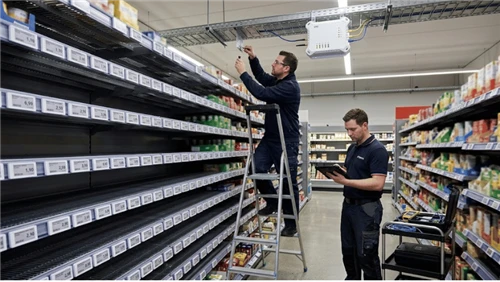
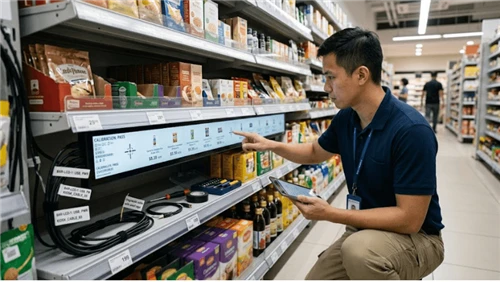
The gap between early adopters and everyone else is widening quickly. Walmart has deployed digital shelf labels across roughly 2,300 U.S. stores and, as of early 2026, announced plans to extend the technology chain-wide before year's end. At Naifeh's Cash Saver, an independent grocer in Covington, Tennessee, the store had been processing up to 2,000 price changes per week - a workload that consumed roughly 50 labor hours. After switching to ESLs, that same task takes under three minutes. Those hours are now spent on the floor.
This article breaks down where ESLs actually create operational value, what the ROI picture looks like, and what separates successful rollouts from ones that underdeliver.
What Changes When You Replace Paper Tags with ESLs
An electronic shelf label system is not a single product - it is a four-layer architecture: the e-ink displays on the shelf rail, wireless gateways that push updates to those displays, a management platform that controls content and scheduling, and backend integrations with your POS and inventory systems. The label is what shoppers see. The operational value lives in everything behind it.
The table below summarizes what changes at the operational level when a store moves from paper to digital shelf-edge pricing:
| Operational area | Paper tag system | ESL system |
|---|---|---|
| Price update method | Print, sort, walk aisles, swap by hand | Central dashboard push, seconds per category |
| Shelf-to-POS accuracy | Manual reconciliation, frequent lag | Same live database, always synchronized |
| Promotional rollout | Requires advance labor scheduling | Scheduled or trigger-based, no associate required |
| Multi-location consistency | Region-by-region coordination | Single update propagates to all locations simultaneously |
| Associate time on pricing tasks | Several hours per day in grocery | Minutes per day |
| Paper and print costs | Ongoing consumable expense | Eliminated after deployment |
For a closer look at how the system architecture works in practice - including gateway placement, software integration, and common deployment pitfalls - the full technical walkthrough of how ESL systems are structured covers each layer in detail.
Labor Savings: The Most Immediate ROI Driver
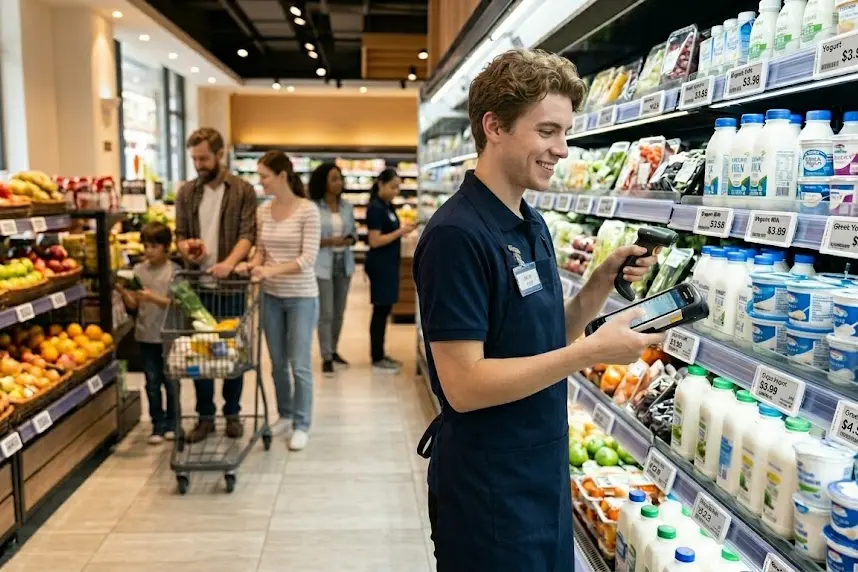
Retail pricing is a high-frequency, repetitive task. In a mid-size grocery store, the weekly workload includes promotions going live and expiring, supplier cost adjustments, perishable markdowns, and competitive price responses. Each change under a paper system requires printing, sorting by aisle, and physical tag replacement. The cumulative hours add up fast - and unlike customer service or merchandising, none of that work creates revenue.
A study by Pricer, one of the major ESL platform providers, found that retailers who implemented ESLs saw an average 20 percent reduction in total in-store labor costs. That figure covers the full store operation. The impact on pricing-specific labor is more concentrated: for stores with high price-change volumes, that task essentially disappears as a staffing line item. A separate Forrester Total Economic Impact study commissioned by Pricer found an average ESL payback period of 18 months across the retailers analyzed.
To be clear about the numbers: the 20 percent figure refers to total in-store labor costs across all functions. The 60 to 80 percent reduction cited for pricing-related labor specifically is a different and narrower metric - it reflects what happens to the subset of associate time spent exclusively on tag changes, not the full labor budget. Both figures are real, but they measure different things.
The downstream effect is harder to quantify but arguably more important. When associates are no longer spending hours on tag replacement, they are available for work that actually affects the customer experience - locating items, answering questions, keeping displays organized. That reallocation shows up in throughput and basket size, not just the labor cost column.
Pricing Accuracy and the Compliance Risk You're Probably Underestimating
Pricing errors are a persistent operational liability - and most retailers underestimate how costly they are until they face a public incident. In 2025, a Consumer Reports investigation found widespread pricing discrepancies at Kroger-owned stores - expired sale tags on more than 150 grocery items, with an average overcharge of $1.70 per item. The investigation triggered a Senate inquiry and multiple class-action lawsuits. Kroger's own internal audits had previously flagged that nearly 6 percent of items in sampled stores had incorrect price tags.
The root cause in most of those cases was not malice - it was staffing. When a store has thousands of tags and not enough hours to update them, the shelf falls behind the system. ESLs close that gap structurally. Because the shelf display and the checkout system draw from the same live pricing database, discrepancies cannot accumulate between system updates and physical tag cycles. Price integrity stops being a labor discipline problem and becomes a system property.
For retailers in high-price-volatility categories - fresh produce, proteins, commodity-linked grocery, or any store running active promotions across thousands of SKUs - this matters daily. The shelf that is perpetually behind the data creates both a customer trust problem and a regulatory exposure. In several U.S. states, overcharging customers even on a paper tag error carries a fine per incident.
The accuracy benefit also extends to multi-channel operations. When the ESL platform integrates with an omnichannel commerce stack, a single pricing action updates both the physical shelf and the online product page simultaneously - removing a friction point that frequently generates customer service contacts and abandoned carts.
Dynamic Pricing in Physical Retail: What ESLs Make Possible
Paper tags cannot respond to conditions. ESLs can. That distinction opens a set of operational capabilities that are theoretically attractive but practically impossible without digital shelf infrastructure.
Dynamic pricing in brick-and-mortar retail has been more popular in Europe and Asia for over a decade - fewer than 25 percent of U.S. grocery retailers currently use it in any form, according to research from UC San Diego's Rady School of Management. The same research found that automated markdown pricing for perishables could reduce food waste at grocery retailers by 21 percent or more, while also increasing gross margins. That combination - less shrink and better margins - is what makes this more than a sustainability talking point.
In practice, the rules a retailer can build with ESLs look like this:
- Mark down prepared foods by a set percentage two hours before close, triggered automatically
- Activate a perishable discount when inventory age exceeds a threshold in the warehouse management system
- Push a price match on a specific SKU category when a competitor's pricing feed updates
- Run a flash promotion during a defined window without any associate involvement
These rules execute without requiring staff to touch the shelf. For a pharmacy retailer, the same logic applies to near-expiry OTC inventory. For a fashion retailer, it applies to end-of-season clearance - triggering incremental markdowns on aging SKUs automatically rather than waiting for a scheduled markdown event that may come too late to clear stock.
The ESL solution stack that enables this kind of rules-based automation requires proper integration between the label management platform and the inventory or warehouse management system - the display at the shelf edge is the output of a data pipeline that starts with stock-level tracking. Getting that integration right is where the real implementation work happens.
Beyond the Price Tag: Operational Functions Most Retailers Overlook
The pricing use case drives most ESL purchase decisions, but modern deployments surface several secondary functions that have measurable operational value - particularly for stores that have moved into omnichannel fulfillment.
Pick-to-light and stock-to-light. Associates or third-party pickers fulfilling online orders can activate an LED indicator on any shelf label using a mobile device. In a store carrying 20,000 or more SKUs, navigating directly to a specific product - rather than cross-referencing a paper list - meaningfully reduces pick time and error rates. Walmart cited this feature explicitly as a driver of its ESL adoption, noting its impact on click-and-collect and delivery operations.
Low-stock signaling. ESL displays can surface inventory status at the shelf edge, flagging restocking needs without requiring an associate to pull up a system lookup. This gives floor staff actionable information during a routine aisle walk rather than requiring a dedicated inventory scan cycle.
Multi-field product information. A shelf label is not limited to a price. Modern ESL templates can display unit pricing, allergen information, origin data, promotional callouts, and QR codes linking to product content. For pharmacy, that means expiry-linked pricing and dosage callouts. For specialty food, it means origin and dietary certification flags. The electronic price screen digital signage format extends this further - combining label-level accuracy with larger display capability for high-traffic shelf sections where richer content is worth the added real estate.
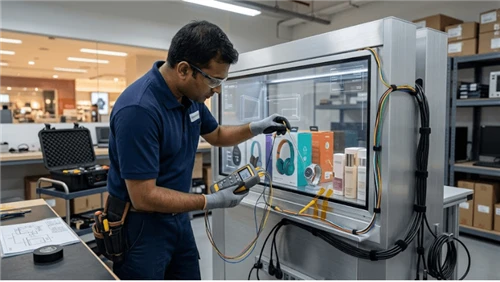
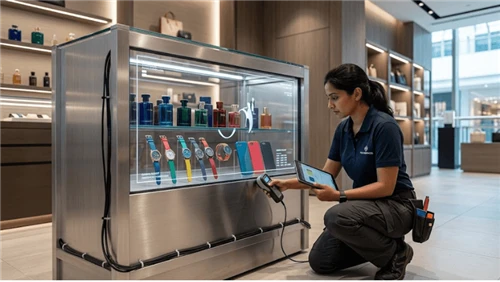
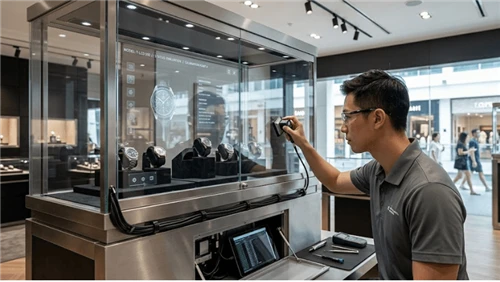
For higher-traffic promotional zones - category entrances, endcaps, checkout adjacencies - bar LCD display screens serve a different but complementary function: carrying brand and promotional messaging at a scale that shelf-edge labels are not designed for. The two systems are not redundant; they operate at different distances in the customer journey. Similarly, in specialty retail, electronics, or luxury goods environments where merchandise lives inside cases, transparent LCD screens built into display cases deliver product information without obstructing the view of the product itself.
What ESL Deployment Actually Costs - and When It Pays Back
The question retailers most frequently underweight in their ESL evaluation is cost. The hardware, software licensing, integration, and installation together represent a real upfront commitment that varies significantly by store size, SKU count, and system complexity.
Publicly available deployment data gives a useful reference range. Maurer's Market IGA, a 20,000-SKU grocery store in Wisconsin Dells, Wisconsin, paid approximately $208,000 for a full-store ESL installation. Industry analysis from the Forrester TEI study places the average payback period at around 18 months for retailers with moderate-to-high price change volumes, driven primarily by labor savings and shrink reduction.
A rough framework for sizing your own ROI:
- Weekly price change volume under 100: Labor savings are modest; ESLs may still be justified by accuracy and compliance benefits, but the payback period will stretch beyond two years for most store sizes
- Weekly price change volume of 300 to 1,000: This is where ESLs typically generate a clear financial case. Labor savings alone often support an 18 to 24 month payback at this volume
- Weekly price change volume above 1,000 (common in grocery and pharmacy): The financial case is strongest here. At this volume, pricing labor costs are high enough that ESL savings cover the hardware investment within 12 to 18 months in many deployments
These are directional estimates. Actual payback depends on current labor rates, SKU count, number of locations, and the platform you choose. For a structured approach to evaluating your specific situation, the decision guide for retailers evaluating digital price tags covers the readiness checklist, including integration requirements and the operational profiles where ESLs deliver the clearest return.
What Determines Whether Your ESL Rollout Actually Pays Off
The operational benefits of ESLs are well-documented, but they are not delivered by the hardware - they are delivered by a working system. Several implementation factors determine whether a deployment reaches its projected returns or falls short.
Data quality is the first and most common failure point. If the pricing data in your POS or ERP is inconsistent - duplicate SKUs, promotional logic that has not been structured correctly, or product hierarchies that do not map cleanly to shelf positions - those problems become visible immediately at the shelf edge. Paper systems absorb data problems quietly. An ESL system makes them consequential. Clean pricing data is a prerequisite, not something to address after deployment begins.
Gateway coverage within the store footprint determines update reliability. ESL systems communicate through wireless gateways typically mounted in the ceiling or on shelving uprights. Areas outside reliable gateway range will show stale pricing - a problem that defeats the accuracy purpose of deploying ESLs in the first place. A proper RF site survey before installation is standard practice for any experienced ESL integrator.
Staff training affects how much of the system's value gets captured. Price updates are intuitive. Scheduled promotions, pick-to-light activation, inventory alert thresholds, multi-field template management - these require users who understand the platform. Retailers that invest in structured onboarding reach full utilization faster and see fewer support issues in the first year. Those that treat the platform as self-explanatory typically use 40 to 50 percent of its capabilities for the first several months.
A phased pilot approach reduces deployment risk. Most retailers deploy ESLs in one or two departments first - typically the section with the highest price-change volume - to validate the data pipeline, test gateway coverage, and train a core group of users before expanding store-wide. This approach surfaces integration issues when they are cheap to fix rather than after the full store is live.
For retailers exploring hardware options, the full ESL product range includes sizes from 1.53 inches to 9.5 inches, with e-ink displays designed for standard shelf rail compatibility and ERP/POS integration. If your evaluation is still at the specification stage, the shelf display buying guide for retail signage covers the hardware decision criteria in detail.
Frequently Asked Questions
How much time do electronic shelf labels actually save on pricing tasks?
The answer depends on weekly price change volume and the current labor model. For stores processing under 100 price changes per week, the time savings are noticeable but modest - likely 5 to 10 hours per week on dedicated pricing labor. For stores in the 500 to 2,000+ changes per week range, the savings are dramatic: that work essentially collapses from a multi-day, multi-associate task to a few minutes of system operation. The Forrester study of Pricer deployments found labor-related savings to be the single largest component of ESL ROI across the retailers analyzed. Stores with very low price change volumes still benefit from accuracy and compliance improvements, but the payback period will be longer.
Do electronic shelf labels require replacing existing shelf fixtures?
In most cases, no. Modern ESL systems are designed to attach to standard retail gondola rails and cooler rails using slot-in, clip-on, magnetic, or bracket-mount configurations. The primary infrastructure requirement is the wireless gateway network - ceiling or upright-mounted access points that provide communication coverage across the store floor. For refrigerated and frozen sections, most manufacturers offer mounting hardware rated for the humidity and temperature environment. A physical site assessment before deployment will confirm fixture compatibility and identify any sections that need adapted hardware.
How do ESLs connect to existing POS and inventory systems?
ESL management software integrates with POS and ERP systems through direct API connections for modern cloud-based platforms, or through middleware for legacy systems. The integration involves mapping pricing and product data fields from the source system to ESL display templates, configuring update frequency, and testing the full data pipeline before go-live. Most retailers run a phased pilot in one or two departments first to validate the integration before full-store deployment. The complexity and timeline depend on how structured and clean the source data is - stores with well-maintained pricing databases typically complete integration in a few weeks; those with legacy or inconsistent data structures take longer.
What happens to ESL displays during a power or network outage?
E-ink displays are bistable, meaning they retain the last displayed image without requiring continuous power. If the network goes down or the store loses power, labels continue showing the last successfully pushed price update - they do not go blank. When connectivity restores, the system queues and syncs any updates that were pending. This is a meaningful operational advantage over LCD-based shelf displays, which would go dark in a power interruption. For retailers in regions with unreliable grid power, this property is particularly relevant.
How long do ESL batteries last, and what does replacement look like?
Battery lifespan varies by update frequency and label size, but most commercial e-ink ESL units are rated for five to ten years under typical retail update loads - one to three updates per day. Replacement is handled during scheduled maintenance cycles rather than as reactive breaks. Management platforms typically flag labels approaching end-of-life so replacements can be batched and handled efficiently during off-peak hours. Some manufacturers now offer ambient-light-harvesting variants that eliminate batteries entirely; these are an available option for retailers with strong sustainability mandates, though they remain a premium configuration rather than a standard deployment choice.
Are ESLs worth it for smaller stores with fewer SKUs?
The honest answer is: it depends on your specific cost drivers. A single-location store with 3,000 SKUs and low price change frequency will see a longer payback period than a multi-location chain with 15,000 SKUs and daily promotional pricing. That said, the accuracy and compliance benefits - particularly the elimination of shelf-to-checkout price discrepancies - have value independent of pricing volume. Retailers that have faced pricing error complaints, regulatory scrutiny, or customer trust issues often find the compliance case compelling even when the pure labor ROI is modest. The right starting question is not "how many SKUs do I have" but "how much does our current pricing process cost us, and what would it cost us if we got it wrong publicly."