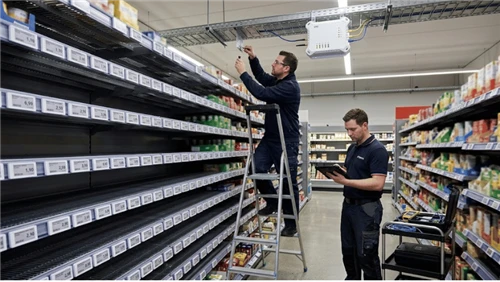
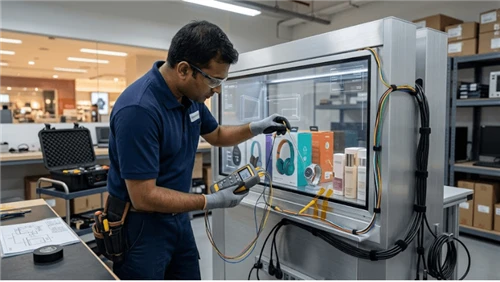
Bare display modules cost approximately $5–$300, development kits with driver boards cost approximately $10–$450, and finished e-paper displays cost approximately $800–$2,500.
A 2.9-inch e-ink module costs $15. A 25-inch e-ink monitor costs $2,000. This is not a typo. This is the reality of a market controlled by a single company, constrained by patents, and starved of competition.

The Price Landscape
The actual numbers are staggering in their range.
At the small end-1.5" to 2.9" panels for electronic shelf labels and IoT sensors-you're looking at $5 to $20 for bare modules, $10 to $30 with driver boards. Commodity pricing. The ESL market has driven volumes high enough to make these genuinely affordable.
The 4.2" to 5.8" range covers wearables and small displays. Prices climb to $18–$45 for bare modules, $25–$60 with driver boards-still reasonable for most projects.

Six inches is where most consumers first encounter e-ink. The Kindle Paperwhite. The format refined over fifteen years. This is the e-reader standard, and the pricing reflects that maturity: $30 to $65 for the module, $45 to $80 with a driver board. Not cheap, but not outrageous. You're paying roughly $5–$10 per diagonal inch at this size.
Then the curve steepens dramatically.
Larger tablets use 7.5" to 7.8" panels-the Kobo Sage, various Boox models. Module prices jump to $70–$100, or $90–$130 with driver electronics. The price-per-inch starts climbing. At 10.3 inches, professional e-note territory, you're looking at $100–$180 for the module alone. Add a driver board and you've crossed $130–$220. The reMarkable 2, Boox Note series-they all use panels in this class. We've now passed $10-per-inch and kept going.
The 13.3-inch panels sit at the upper end of what most consumers will encounter. Boox Max. Fujitsu Quaderno. These large-format devices use panels costing $140–$280 for the module, $180–$350 with driver electronics. Every additional inch of diagonal commands a significant premium.
And then there's the 25.3-inch class-desktop e-ink monitors, the white whale of the e-paper world. Raw panel costs hit $800–$1,200. Finished monitors retail for $1,500–$2,500. The economics here barely make sense, but we'll get to that.
Color changes everything. Color displays cost 1.5× to 3× more than their monochrome equivalents across every size class. A 13.3-inch Kaleido 3 color module retails for $449 from E Ink's official shop-and that's just the panel. Gallery 3 full-color panels with 50,000 colors command even higher premiums, though exact pricing is rarely disclosed publicly.
These prices have barely moved in a decade. That fact alone tells you something is broken.
Why E-Ink Costs What It Costs
E Ink Holdings, a Taiwanese company, controls over 95% of the global e-paper display market. Let that number sink in. Every Kindle. Every Kobo. Every reMarkable. Every Boox. Every Supernote. Every electronic shelf label in every supermarket, every pharmacy, every warehouse. All of them use E Ink panels.
This is not market dominance. This is monopoly.
The company's origin story traces back to MIT's Media Lab in the 1990s, where researchers developed the core microencapsulated electrophoretic technology. The spin-off company, E Ink Corporation, was acquired by Taiwan's Prime View International in 2009. Three years later, in 2012, E Ink absorbed SiPix, its only significant competitor at the time. The result is a supply chain with a single chokepoint.
When you buy any e-paper device from any manufacturer, your money eventually flows to one company in Hsinchu, Taiwan.

Patents make the monopoly durable. The core microencapsulated electrophoretic display patent, filed in 1996, has expired. In theory, this should have opened the floodgates. Anyone should be able to manufacture e-paper displays using the basic technology.
But E Ink did not rest during those patent-protected years.
The company spends approximately $150 million annually on R&D-a mid-teens percentage of revenue. For a display manufacturer, this is extraordinarily high. Samsung Display, operating at vastly larger scale, spends a smaller percentage of revenue on research. E Ink's R&D intensity rivals pharmaceutical companies.
This investment generates continuous patent filings. Color filter arrays. Faster refresh waveforms. Flexible plastic substrates. Improved contrast ratios. Low-temperature operation. Each generation of technology brings new intellectual property. Each new feature adds another layer to the fortress.
The original patent expiration changed nothing. The fortress simply grew new walls.
Any competitor attempting to enter the market faces a choice: license E Ink's technology (and accept their pricing power), develop alternative approaches that navigate around thousands of patents (expensive and time-consuming), or accept that their products will be technologically inferior (and therefore commercially unviable).
There's also a vicious cycle at play that benefits the monopolist. E Ink's total annual revenue hovers around $1 billion. That sounds like a lot until you compare it to the global display panel market, which exceeds $150 billion annually. E-paper occupies a fraction of a fraction of the display industry.
Small market means small production volumes. E Ink operates fabs that are tiny compared to the massive Gen 10.5 facilities that BOE and Samsung use for LCD and OLED production. Small volumes mean no economies of scale. The fixed costs of manufacturing-cleanrooms, equipment, engineering staff-get spread across fewer units.
No economies of scale mean prices stay high. A 6-inch e-ink panel costs $30–$60. A 6-inch LCD panel costs $3–$8. The manufacturing processes share similarities, but the volume difference creates an order-of-magnitude price gap.
High prices limit adoption. Consumers look at e-ink devices, see the premium over LCD alternatives, and often choose the cheaper option. Device manufacturers limit their e-ink product lines because the market is smaller.
Limited adoption keeps the market small. And the cycle continues.
This is a self-reinforcing trap that only breaks if someone invests billions of dollars to reach scale-or if a major technology shift makes current manufacturing irrelevant. Neither has happened. Neither appears imminent.
The LCD Comparison
The price gap between e-ink and LCD deserves explicit attention, because it illustrates just how distorted e-paper pricing has become.
At the 6-inch size-the e-reader standard-an LCD panel costs $3 to $8. An e-ink panel costs $30 to $60. That's an 8× to 10× premium for e-paper. Both technologies are mature. Both are manufactured at scale (though vastly different scales). The e-ink premium cannot be explained by manufacturing complexity alone.
At 10 inches, LCD panels run $8 to $15. E-ink panels cost $100 to $180. The ratio has worsened to 10× to 12×. You could buy ten LCD panels for the price of one e-ink panel.
The 25-inch size class reveals the absurdity in full. A 25-inch LCD panel-the kind inside a basic office monitor-costs $40 to $80. A 25-inch e-ink panel costs $800 to $1,200. That's a 15× to 20× premium.
A finished 25-inch LCD monitor sells for under $100 at retail, including the panel, driver electronics, enclosure, power supply, and profit margin. A finished 25-inch e-ink monitor sells for $2,000 or more.
The technology is different, yes. E-ink requires precise waveform generation. The manufacturing process uses microencapsulation rather than liquid crystal alignment. Yields may be lower, tolerances tighter.
But is the technology 15× to 20× more complex? Is it 15× to 20× more expensive to manufacture at equivalent scale?
No. The price difference is not justified by technology alone. It's justified by market structure. When one company controls supply and faces no competition, prices reflect market power, not manufacturing cost.
Color Technology: Kaleido, Gallery, and Spectra
Color e-ink has arrived, but in multiple flavors with dramatically different characteristics and price points.
Kaleido
Kaleido represents E Ink's mass-market color solution. The technology places a color filter array (CFA) over a standard black-and-white e-ink layer-conceptually similar to how LCD displays produce color, though the underlying pixel technology differs completely. The result: 4,096 colors at 150 PPI color resolution, with the underlying monochrome layer still delivering 300 PPI for black-and-white content. Text remains sharp because it renders at full resolution. Color images appear somewhat muted and lower-resolution because they're filtered through the CFA.
Refresh rates remain acceptable for reading-comparable to monochrome panels. You won't notice significant delays when turning pages or scrolling through color content.

The trade-offs are real. Colors look washed out compared to LCD or OLED. Saturation is limited. The 150 PPI color resolution means fine color details appear slightly soft. Direct sunlight readability-e-ink's killer feature-is somewhat reduced because the color filter absorbs light.
Kaleido 3 modules cost roughly 50–80% more than equivalent monochrome panels. A 7-inch Kaleido 3 panel might cost $50–$70 where a monochrome panel costs $30–$40. The premium is significant but not prohibitive, which is why Kaleido has appeared in consumer devices like the Kobo Libra Colour and various Boox color models.
Gallery 3
Gallery 3 is a fundamentally different approach, and it commands fundamentally different pricing. Instead of filtering white light through color arrays, Gallery 3 uses a four-pigment system-cyan, magenta, yellow, and white-packed into each microcapsule. Every pixel contains all four pigments, which can be selectively moved to the viewing surface through different electrical field sequences.
No color filter required. The result: approximately 50,000 colors at full 300 PPI resolution across the entire display. Color images are dramatically more vivid than Kaleido. The technology approaches what you might call "good enough" color reproduction for many use cases.
The trade-off is speed. Moving four different pigment types to precise positions takes time. A full-quality color refresh can take up to 1.5 seconds. Fast refresh modes exist but sacrifice color accuracy. You're not watching video on a Gallery 3 display. You're not even scrolling smoothly through a color document.
Gallery 3 panels are reserved for premium applications. E Ink doesn't publish pricing, and finished products using Gallery 3 rarely break out panel costs. But the evidence is clear in retail prices: color e-note tablets using Gallery 3 command $500–$800 premiums over monochrome equivalents with identical features. A reMarkable 2 costs $450. A comparable Gallery 3 color device costs $900 or more.

Spectra 6
And then there's Spectra 6, which targets a completely different market: signage and retail displays. The technology uses six-color output from a four-pigment microcup architecture, optimized for large-format displays that change infrequently. Think grocery store promotional signs, airport information displays, museum exhibit labels-applications where you need color, size, and zero power consumption between updates. Panel sizes reach 75 inches in 2025. Prices run into thousands of dollars. Sales happen exclusively through B2B channels with negotiated contracts, volume commitments, and custom integration services.
If you're reading this article trying to figure out how to buy a Spectra 6 panel for a personal project, the answer is: you probably can't, and you definitely can't afford it.
What Different Buyers Actually Pay
The e-ink market serves radically different buyers at radically different price points. Where you sit in the hierarchy determines what you pay.
Hobbyist/Maker Tier
If you're building a personal project-a smart home display, an e-paper weather station, an art installation-you're shopping at Waveshare, Adafruit, Good Display, or AliExpress. Your typical purchase: a 2.9" to 7.5" development kit with driver board, ribbon cables, and sample code. Price range: $15 to $120 depending on size and features.
Reality check: you're paying retail prices with full markup. Every middleman takes a cut. Waveshare buys panels from E Ink (or authorized distributors), adds driver electronics, writes documentation, handles shipping, and provides customer support. All of that costs money.

A 7.5-inch Waveshare three-color kit costs $50–$90 depending on where you buy it. That same panel, when purchased by Amazon in quantities of millions, probably costs under $20 including the driver electronics. You're paying a 3× to 4× premium for the privilege of buying one unit at a time.
This isn't unfair-small-quantity distribution has real costs. But it means hobbyist budgets get consumed quickly. Building a four-panel e-ink dashboard might cost $300 in panels alone.
Small Production Tier
Once you're ordering 100–1,000 units for prototyping or small-scale production, the game changes. You're working through distributors, Alibaba suppliers, or attempting direct factory contact. Pricing typically runs 20–40% below retail at these volumes. A panel that costs $60 on Waveshare might be available at $40–$45 through a distributor relationship.
But reality gets complicated. Quotes require NDAs-suppliers don't want competitors knowing their pricing. Minimum order quantities create barriers: you might need to commit to 500 units to get the good price, but you only need 200 for your initial production run. Lead times extend to weeks or months. Quality consistency becomes your problem.
Small buyers have no leverage. E Ink doesn't care about your 500-unit order. They're selling millions of panels to Amazon. Your business lives or dies based on allocation decisions made for customers a thousand times your size.
Enterprise/OEM Tier
At 10,000+ units annually, you're dealing directly with E Ink sales representatives or authorized manufacturing partners. Industry estimates suggest large OEMs pay $10–$15 for a 6-inch panel-compared to $30–$60 at retail. Volume pricing is real, and the gap is enormous.
Amazon, Kobo, Rakuten, and major ESL vendors like Pricer and SES-imagotag operate at this tier. They negotiate multi-year contracts, guaranteed allocation, custom specifications, and pricing that individual buyers will never see. The gap between retail and volume pricing may exceed 70%.
These relationships also come with obligations: volume commitments, development partnerships, sometimes exclusivity windows on new technology. When E Ink launches a new panel size or color technology, the big OEMs often get first access.
If you're trying to launch a consumer e-reader company and compete with Kindle pricing, understand that you're not just competing with Amazon's brand and ecosystem. You're competing against their component costs, which are likely 50–70% lower than yours.
Secondary Market
There's also a shadow market for e-ink panels that most buyers never consider: recycled and surplus components. Sources include recycled Kindles and Kobos (the screens often outlast the devices), decommissioned electronic shelf label systems (stores upgrade and discard old hardware), surplus inventory from cancelled projects, and manufacturing overruns.
Prices run 30–50% of new panel cost. A 6-inch panel that costs $40 new might be available for $15–$20 from a recycler.
The trade-offs are significant. No warranty-if the panel is defective, you eat the loss. Potential degradation-e-ink panels can develop stuck pixels or uneven contrast over time and usage. Unknown history-you don't know how many refresh cycles the panel has experienced or how it was stored.
Most importantly, recycled panels require custom driver development. You're not getting a neat development kit with documentation. You're getting a bare panel, maybe with a ribbon connector, and you need to figure out the pinout, driving waveforms, and initialization sequences yourself.
This market is suitable only for experienced hardware developers with oscilloscopes, patience, and tolerance for failure. It's not for hobbyists building their first e-paper project.
Finished Product Pricing
Bare panels are one thing. Finished devices are what most consumers actually buy, and the pricing reflects far more than just the panel cost.
A finished e-reader or e-note device includes the e-ink panel, but also: a processor (typically ARM-based), RAM and storage, battery, touch layer (capacitive or electromagnetic), front light system, plastic or aluminum enclosure, buttons and ports, software development, regulatory certification, packaging, and profit margins for manufacturer and retailer.
Panel cost might represent 20–40% of the bill of materials for a consumer device. Everything else adds up.
E-Readers ($100–$280)

The Kindle Paperwhite and Kobo Clara occupy the $100–$180 range for basic monochrome 6-inch e-readers. Premium features-warm lighting, larger storage, waterproofing-push toward the higher end. Color e-readers like the Kobo Libra Colour have arrived in the $200–$280 range, using Kaleido technology. The ~$100 premium over monochrome equivalents reflects both the panel cost increase and the novelty factor.
At these prices, e-readers have become genuinely affordable for most readers. A Kindle Paperwhite costs less than a dozen hardcover books. The value proposition is clear, even with e-ink's premium over LCD.
E-Note Tablets ($400–$900)
This is where prices escalate dramatically for e-note tablets. The reMarkable 2 costs around $450. The Boox Note Air series runs $400–$500. Supernote devices occupy similar territory. At 10.3 inches, these are professional tools marketed toward note-takers, academics, and business users who want a paper-like writing experience.
The value proposition is less obvious here. A $450 e-note tablet competes against a $329 base iPad that does everything the e-note does, plus millions of other things. E-note buyers are paying specifically for the paper-like experience, the distraction-free environment, and the reduced eye strain.
Large-format 13.3-inch e-notes push into the $550–$800 range. Color versions-using Gallery 3-can exceed $900. At these prices, you're buying a specialized tool for specialized workflows. The market is small but dedicated.

E-Ink Monitors ($500–$2,500)
E-ink monitors represent the most extreme price-to-value calculation in the entire market. The 10.3-inch Dasung Paperlike 103 costs $500–$800. This is a secondary monitor the size of a large tablet, suitable for displaying documents or reference material while working on a primary screen. The 13.3-inch monitors from Boox (Mira series) and Dasung (HD-FT) run $800–$1,200. At this size, you can reasonably read full documents, edit text, or browse websites-if you can tolerate the refresh rate.
The 25.3-inch desktop monitors are the flagship products: Dasung Paperlike 253 at $2,250, Boox Mira Pro at similar prices, color versions pushing toward $2,500.

$2,250 buys you a lot in the display market. A 32-inch 4K OLED monitor with 120Hz refresh, HDR support, and millions of colors: about $900. A 27-inch professional photo editing monitor with factory color calibration: about $700. A 49-inch ultrawide curved gaming monitor: about $800.
For the price of one 25.3-inch e-ink monitor, you could buy two professional-grade OLEDs and have money left over.
E-ink monitors are not competing on value. They are not competing on features. They are selling to buyers with specific needs-eye strain reduction, paper-like aesthetics, glare elimination-who have literally no alternatives. The manufacturers know this. The prices reflect it.
The Hidden Costs Nobody Tells You About
If you're building a product with e-ink-not buying a finished device, but developing something new-the panel price is just the beginning.
Driver Electronics
Raw e-ink panels don't accept simple digital inputs. They require controller boards capable of generating complex waveforms-precisely timed voltage sequences that move charged pigment particles within the microcapsules. Off-the-shelf controllers exist. The IT8951 is common for larger panels. Various controllers from Good Display and Waveshare handle smaller sizes. These add $10–$50 to your bill of materials, depending on resolution and features. Custom driver development-if you need specific features, lower cost at volume, or smaller form factors-adds weeks of engineering time. You need hardware engineers who understand high-voltage switching, timing constraints, and EMI management. This expertise is not common.
Waveform Development
And then there's waveform tuning-this is the part that really gets people. E-ink displays don't simply turn pixels on and off. Each refresh involves a carefully calibrated sequence of voltage pulses that must account for the previous pixel state, the desired new state, temperature, and desired image quality.
These waveform lookup tables are the secret sauce of e-ink display quality. Good waveforms produce crisp text with minimal ghosting. Bad waveforms produce muddy images, visible artifacts, and premature pixel wear.
Waveform development is not documented. There is no public specification. There is no standardized format. This is a dark art acquired through trial and error, equipment-intensive characterization, and sometimes expensive consulting engagements with E Ink or authorized partners.
Companies like Good Display and Waveshare provide pre-tuned waveforms with their development kits. This works fine for prototyping and small-scale production. Custom implementations-different operating conditions, different panel variants, optimized refresh modes-require reverse engineering existing waveforms or developing new ones from scratch.
Budget accordingly.
Touch Integration
Most consumer e-ink devices include touch input, either capacitive (finger touch) or electromagnetic (stylus, using Wacom or similar digitizer technology). Touch layers are not included in base panel pricing. They're separate components that must be bonded to the display, calibrated, and integrated with your software. Capacitive touch integration adds 20–30% to panel cost. A $50 panel becomes $60–$65 with touch. Electromagnetic digitizer integration-required for precise stylus input in e-note applications-adds similar premiums, sometimes more.
Front Light Systems
E-ink displays are reflective. They look great in ambient light but become useless in darkness. Most consumer devices include front lighting to address this limitation. Front light systems use edge-mounted LEDs and light guides to distribute illumination across the display surface. Well-designed front lights are invisible when off and provide even illumination when active. Poorly designed front lights create visible hotspots, uneven brightness, and distracting glare. Front light modules add $5–$20 per unit depending on quality and features like color temperature adjustment. Design integration-ensuring the light guide bonds properly to the display without affecting optical quality-requires additional engineering.

Supply Chain Risk
Perhaps the most significant hidden cost: single-source dependency. E Ink Holdings is your only supplier for electrophoretic displays. If they have a production problem, you have a production problem. If their prices increase, your margins decrease. If demand from larger customers (Amazon, major ESL vendors) consumes available allocation, your orders get pushed back.
There is no fallback. There is no second source. There is no alternative supplier you can qualify during a shortage.
Prudent hardware companies build relationships with multiple suppliers for critical components. With e-ink, this is impossible. Your supply chain has a single point of failure, controlled by a company whose interests may not align with yours.
What Happens Next
Predicting the future is hazardous. Predicting the future of a monopoly-controlled market is doubly so. But certain trends seem likely.
Near-Term (1–2 Years)

In the next year or two, color panel prices will decline slowly as Kaleido 3 production scales. The technology is mature enough for mass production, and competition among device manufacturers should create some price pressure. Large-format displays above 25 inches will enter higher-volume production. The 25.3-inch monitors currently on market are essentially hand-built premium products. As production standardizes, prices might decline 10–20%. The electronic shelf label market continues expanding rapidly, driving overall demand for e-ink panels. This is good news for the technology's future, though ESL growth primarily benefits small panel production rather than consumer-oriented sizes.
No significant price disruption should be expected in this timeframe. E Ink's monopoly remains secure. Manufacturing investments take years to materialize. Nothing on the near-term horizon threatens the status quo.
Medium-Term (3–5 Years)
In the next year three, additional core patents will expire, theoretically opening opportunities for competition. Whether anyone will exploit these openings remains uncertain.
Chinese competitors present the most realistic threat to E Ink's dominance. Guangzhou OED has developed electrophoretic technology for years with limited commercial success. BOE-the world's largest display manufacturer-has invested in DES (Digital Electrophoretic System) technology that could potentially compete with E Ink's offerings.
If these competitors reach commercial viability-big if-prices could decline 20–30% as device manufacturers gain negotiating leverage. Competition doesn't need to capture majority market share to affect pricing; the mere existence of a credible alternative changes the negotiating dynamic.
Flexible e-paper costs should decrease as manufacturing processes mature. Flexible panels currently command significant premiums over rigid glass-backed displays. These premiums may shrink as production scales.
Unknown Variables
But nobody can predict: Will BOE or other display giants invest seriously in electrophoretic technology? BOE has the manufacturing capacity, the engineering talent, and the financial resources to challenge E Ink directly. But e-paper is a tiny market by BOE's standards. A $1 billion market is a rounding error for a company with $30+ billion in annual revenue. The strategic case for massive investment is unclear.
Will alternative technologies achieve commercial success? Cholesteric LCD offers some e-paper-like characteristics (bistable, reflective) with potentially lower manufacturing costs. Electrowetting displays promised much but delivered little commercially. New technologies may emerge. Whether any can match e-ink's combination of characteristics-contrast, bistability, viewing angle, flexibility-remains to be seen.
Will E Ink preemptively cut prices to defend market share? Monopolists facing potential competition sometimes reduce prices strategically, accepting lower margins to discourage investment by potential competitors. E Ink could cut prices 20–30% and remain profitable. Would they sacrifice margin to preserve monopoly? The decision isn't purely economic-it involves game theory, corporate strategy, and assessments of competitive threats that outsiders can't evaluate.
Will Apple, Samsung, or other major players enter the market? A major consumer electronics company developing serious e-ink products could reshape the entire supply chain. Apple's interest in e-paper has been rumored for years with nothing to show. Samsung has the display manufacturing expertise to compete with E Ink directly if motivated. Neither has made meaningful moves in this direction.
The honest assessment: nobody knows. The most likely outcome is continued gradual evolution-slowly declining prices, slowly improving technology, slowly expanding applications-rather than dramatic disruption. But disruption, if it comes, could come quickly.
E-ink display pricing is not determined by manufacturing complexity, material costs, or technological sophistication. It is determined by market structure.
One company controls supply. Patents block competition. The market is too small to attract well-funded challengers. Prices remain high because nothing forces them lower.
For buyers, this creates a simple calculation:
Under $50 gets you small development modules-2.9" to 5.8"-for prototyping, IoT projects, and learning. At this price point, e-ink makes sense for hobbyist projects even with the premium over LCD. The unique characteristics-paper-like appearance, bistability, daylight readability-justify the cost for appropriate applications.
$100–$300 covers consumer e-readers and basic e-note devices. The 6-inch e-reader market has reached genuine maturity and reasonable pricing. If you want a dedicated reading device, the value proposition is solid.
$400–$800 buys professional e-note tablets and small e-ink monitors. You're paying substantial premiums for paper-like writing experiences and eye-strain reduction. These are tools for specific workflows, not general-purpose devices.
$1,500–$2,500 is desktop e-ink monitor territory. Buyers at this tier have specific needs-serious eye strain issues, particular aesthetic preferences, professional applications requiring paper-like displays-and no alternatives. The prices reflect captive demand.
$3,000 and above represents specialized large-format displays, custom industrial applications, and digital signage solutions. These are enterprise purchases with enterprise budgets, negotiated through B2B channels.
These prices are not fair. They are not efficient. They are not reflective of the underlying technology's manufacturing cost at reasonable scale. They are simply the cost of buying from a monopoly in a market where no one has built a viable alternative.
The question is not whether e-ink displays are expensive. They are, undeniably.
The question is whether anyone will break E Ink Holdings' grip on the market before the technology becomes obsolete-superseded by some future display technology that offers e-paper's benefits without its constraints and without its monopoly pricing.