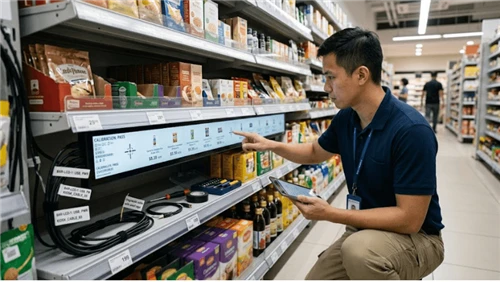
Electronic shelf labels help optimize warehouse racking by replacing static paper labels with wirelessly updated digital displays that sync with your warehouse management system in real time. That means fewer labeling errors, faster order picking, and accurate inventory visibility across every aisle, rack, and bin-without dispatching staff on manual update rounds every time a SKU moves.
If your warehouse still runs on printed stickers and handwritten tags, you already know the problems: inventory records that don't match what's actually on the shelf, pickers burning time hunting for items that got relocated last week, and a steady drip of mispicks that turn into returns and customer complaints. ESL technology addresses each of those bottlenecks at the source-the label itself. Below, we walk through how it works in racking environments, where the biggest operational gains show up, and what to expect when you deploy it.

Why Traditional Warehouse Labeling Falls Short
Paper labels in a warehouse have a hard life. They peel off in humid dock areas, crack and curl inside freezers, and turn illegible after a few weeks of forklift vibration and dust. But the bigger issue isn't physical durability-it's that paper can't keep pace with how often things change in a modern warehouse.
Products get reslotted. New SKUs show up every week. Seasonal demand reshuffles entire zones. Each of those changes means someone has to print a new label, walk out to the rack, swap it, and update the WMS record to match. In practice, that last step-the WMS update-is where things break down. Labels get swapped but the system doesn't get updated, or the system changes but nobody reprints the label. Either way, the picker standing in front of bay C-14 is now looking at information that may or may not be correct.
The result is a warehouse where the digital record and the physical shelf are constantly drifting apart. When the Georgia Tech Supply Chain & Logistics Institute studied inventory accuracy across distribution operations, the gap between what the WMS says and what's actually on the shelf was wide enough to drive meaningful downstream costs-mispicks, shorted orders, and wasted labor chasing discrepancies. That drift is structural when your labeling infrastructure requires a human in the loop for every update.

What ESL Brings to Warehouse Racking Operations
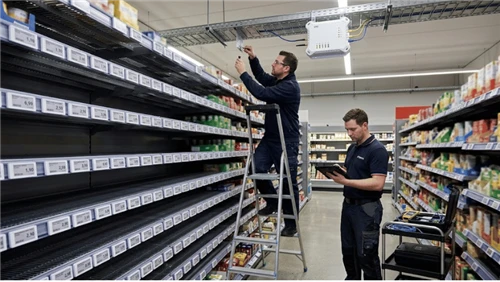
An ESL in a warehouse context is a different animal from the price tags you see in retail. The underlying technology is the same-e-ink display, low power draw, wireless connectivity-but the job it does is fundamentally operational. Each e-ink rack label acts as a location identifier, a picking guide, and a real-time inventory indicator, all in one device.
Here's what the setup looks like. Each label mounts directly to a rack beam, shelf lip, or bin divider using a clip or magnetic bracket. It connects wirelessly to a base station (access point) mounted overhead, which communicates with your ESL management server. That server ties into your WMS or ERP. When a product gets reassigned to a different slot in the system, the old label clears and the new one populates-typically within 30 seconds to two minutes depending on your refresh configuration. When a picking order comes through, the label's built-in LED can flash to guide the picker directly to the correct bay.
One thing that matters more than people expect: how the label attaches to the beam. In selective pallet racking, we typically see clip-on brackets that hook over the front face of a step beam. They hold firm under forklift vibration and don't obstruct the pallet overhang. For lighter-duty shelving-think carton flow or static shelving in a pick module-rail-mount clips or adhesive-backed magnetic strips work better because the label sits flush with the shelf edge and doesn't catch on totes sliding past. Getting the mounting right avoids the single most common early complaint: labels that fall off or get knocked loose.

Pick-to-Light Integration: Where Speed Meets Accuracy
Order picking is where most warehouse labor hours go. The traditional process-print a pick list or load tasks onto a handheld scanner, walk the aisles, read the location code, find the bay, pick the item-works, but every step in that chain involves a human reading, interpreting, and deciding. That cognitive load is where errors creep in, especially during high-volume shifts when fatigue sets in.
ESL-based pick-to-light flips the model. When an order enters the WMS, the system triggers LED indicators on the specific rack labels where target items sit. The picker scans a barcode to start the task, walks to the illuminated labels, picks the displayed quantity, and confirms with a button press on the label itself. There's no list to cross-reference, no location code to decode. The rack is literally telling you where to go and what to grab.
We've seen this approach cut picking time noticeably in facilities running 5,000+ SKU locations-enough that some operations were able to absorb a 15–20% volume increase without adding headcount. The accuracy improvement is equally significant: when the picker doesn't have to interpret a location code, wrong-slot picks essentially disappear.
The same infrastructure works in reverse for inbound workflows. During receiving or replenishment, the system lights up the destination bins, guiding staff to the correct put-away location without cross-referencing a printed manifest. Operations with high SKU density-e-commerce fulfillment, pharmaceutical distribution, electronics component warehousing-tend to see the most dramatic efficiency gains because the cognitive load of navigating thousands of similar-looking bins is exactly what pick-to-light eliminates.
Dynamic Slotting Without the Relabeling Project
Slotting strategy-deciding which product goes where on your racks-is one of the highest-leverage optimization moves in warehousing. Put your fast movers at ergonomic pick heights close to pack stations, and you cut travel time. Balance pick density across zones, and you reduce congestion. Get it wrong, and your pickers are walking past slow-moving pallets to reach the items they actually need.
The problem is that optimal slotting isn't static. Demand shifts seasonally, new products launch, old ones get discontinued, and promotional spikes can temporarily turn a C-mover into your highest-velocity SKU. With paper labels, every reslotting event is a mini project: print labels, walk the racks, swap them out, update the system, verify. It's enough overhead that most warehouses reslot once or twice a year at best-even when their data is screaming that current placement is costing them travel time every single day.
ESLs make reslotting a software operation. Reassign a product to a new bin in your WMS, and the labels update themselves. No print run, no walk-the-floor exercise, no mismatch risk between the physical label and the system record. This makes it practical to reslot continuously-weekly, or even triggered automatically by velocity thresholds in your WMS.
Where this really pays off is the compounding effect. A warehouse that reslots quarterly might capture 60% of its potential travel savings. One that reslots continuously, responding to actual demand patterns in near-real-time, captures significantly more-and the labor cost of doing so drops to nearly zero because there's no physical label work involved.
Cold Storage and Harsh Environment Performance
If you've operated a freezer warehouse, you already know the label problem. Standard adhesive labels curl, crack, and detach below -18°C (0°F). Barcodes become unscannable. Ink fades. You end up with racks where half the positions have degraded or missing labels, and pickers are relying on memory or handwritten notes taped inside plastic sleeves.
Specialized cold-rated ESL hardware handles temperatures down to -25°C. E-ink displays actually perform well in cold conditions-the technology doesn't emit light or require continuous power, so there's no thermal cycling stress on the display itself. The batteries in cold-rated units are engineered differently from standard warehouse ESLs, with chemistry optimized for low-temperature discharge. Expect three to four years of battery life in a freezer environment versus five or more in ambient conditions. The housings carry IP67 moisture ratings, which matters when labels are constantly moving between freezer and dock temperatures and condensation is a fact of life.
One mounting detail specific to cold storage: magnetic brackets tend to outperform adhesive and clip options on freezer racking. The constant thermal cycling weakens adhesive bonds over time, and some clip designs become brittle. A strong rare-earth magnet on a steel beam doesn't care what the temperature is.

Choosing the Right ESL Size for Your Racking Configuration
Not every rack position needs the same label. The right size depends on viewing distance, information density, and the type of picking activity happening in that zone.
Compact labels (2.13" to 2.9") work best at arm's length-bin shelving, carton flow lanes, and pick modules where the operator is standing right in front of the position. A 2.66-inch e-ink rack label fits standard shelf rails and displays a SKU number, bin quantity, and scannable barcode without taking up space that the product needs.
Mid-range labels (4.2" to 5.8") suit pallet racking bays and wider shelf sections where the picker or forklift operator is reading from a few feet back. A 5.8-inch warehouse display label has enough screen real estate for location codes, product descriptions, lot information, and a barcode that's scannable from forklift cab distance.
Large format labels (7.3" and up) are for staging areas, bulk storage zones, and dock doors where you need visibility from 10 feet or more. Large-format e-ink displays can show zone maps, handling instructions, and hazmat indicators alongside the standard location data.
Most warehouse deployments end up using two or three sizes. A typical layout might run compact labels in the each-pick shelving area, mid-range on selective pallet racking, and large format at staging lanes and dock assignments. The key is matching the label to the workflow and the viewing distance-not standardizing on one size for the whole building.

System Integration: Connecting ESL to Your WMS and ERP
The labels are the visible part of the system. The part that actually makes it work is the integration layer between your WMS and the ESL management platform. Getting this right is the difference between a warehouse with fancy digital labels and a warehouse where those labels are genuinely driving operational improvement.
The architecture is straightforward: base stations (wireless access points) are distributed across the facility, typically one per 800 to 1,200 square feet depending on racking density and ceiling height. Each base station maintains connections with the labels in its coverage zone. Your WMS feeds data-location assignments, inventory quantities, pick task triggers, replenishment alerts, lot and batch tracking-through an API to the ESL management server, which pushes updates to the labels via the base stations.
Most established ESL providers offer pre-built connectors for major WMS platforms like SAP EWM, Manhattan Associates, Blue Yonder, and Oracle WMS Cloud. If you're on a proprietary or legacy system, integration usually goes through database views, flat file exports, or custom middleware. Budget two to four weeks for integration development and testing, with another one to two weeks of parallel operation to validate data consistency.
The critical point: your WMS needs to treat the ESL network as a real-time output channel, not a batch process. If label updates only push on a schedule-say, every 15 minutes-you lose the pick-to-light responsiveness and the ability to reslot on the fly. The integration should trigger label updates on the same events that update your WMS inventory records: receipt confirmation, pick confirmation, cycle count adjustment, slot reassignment. That event-driven connection is what turns ESLs from a labeling upgrade into an operational control layer. As Walmart's billion-dollar ESL deployment across thousands of stores demonstrated, the technology can handle synchronization at massive scale-and the same integration principles apply whether you're running a retail network or a single high-volume distribution center.
Calculating the Business Case
The ROI conversation around warehouse ESL comes down to three cost buckets, and they're worth separating because they show up on different lines of your P&L.
First: labor. Every label change that currently requires a person to print, walk, swap, and verify is labor you can redirect. The savings scale with SKU count and reslotting frequency. A facility managing 10,000+ active locations that reslots even modestly throughout the year can realistically expect to recover the equivalent of two to three full-time headcount-not from layoffs, but from reassigning those hours to receiving, QC, or value-added services that are currently understaffed.
Second: accuracy. Mispick rates in paper-labeled warehouses typically land in the 1–3% range. ESL-equipped facilities with pick-to-light consistently push that below 0.1%. The dollar value of that improvement depends on your order profile-average order value, return shipping cost, customer compensation policy-but for operations handling thousands of orders per day, the annual savings from fewer returns and reshipped orders add up fast.
Third, and this is the one that often gets undervalued: throughput density. Faster picking, quicker reslotting, and less time spent resolving discrepancies collectively increase the volume your existing building can handle. In a market where industrial lease rates keep climbing and new space takes 12+ months to build out, extracting more capacity from your current footprint is real money-even if it never appears as a line item in the ESL justification spreadsheet.
Most deployments recover their investment within 18 to 24 months, with labor savings alone often covering 60–70% of the total system cost within the first year.
Implementation: Start Where the Pain Is Sharpest
A phased rollout beats a big-bang deployment every time, but "phased" doesn't mean "start with the easiest zone." It means start with the zone where labeling problems are costing you the most today.
For most warehouses, that's the high-velocity each-pick area-the zone with the most SKU density, the highest pick frequency, and the most reslotting activity. This is where paper labels fail fastest and where pick-to-light delivers the most immediate time savings. It also gives you the clearest before-and-after data to build the case for expanding to the rest of the facility.
If your biggest pain point is cold storage accuracy or dock staging confusion, start there instead. The goal of the pilot is to demonstrate measurable improvement in a context that matters to your operation-not to test the technology in a low-stakes corner where nobody will notice the difference.
Plan on four to six weeks for a pilot zone: one to two weeks for base station installation and label mounting, one week for WMS integration and testing, and two to three weeks of live operation with parallel tracking to measure results. An ESL solution provider experienced in warehouse applications will survey your facility, determine base station placement based on your racking layout and building construction, and help you identify the zone where digital labeling delivers the clearest payback.
Frequently Asked Questions
Q: How long do ESL batteries last in a warehouse environment?
A: Under typical warehouse usage with one to three display updates per day, e-ink ESL batteries last roughly five years. Cold storage environments and heavy LED indicator usage shorten that to three to four years. Battery replacement is a simple swap at the label-no system reconfiguration needed, and the label reconnects automatically.
Q: Can electronic shelf labels work with my existing WMS?
A: Yes. Most ESL platforms provide APIs and pre-built connectors for major WMS providers including SAP EWM, Manhattan Associates, Blue Yonder, and Oracle WMS Cloud. For proprietary or legacy systems, integration typically works through database views, file-based exports, or custom middleware. Expect two to four weeks for integration development and testing.
Q: What is the difference between ESL and traditional barcode rack labels?
A: Traditional barcode labels are static-they show fixed information and have to be physically replaced when anything changes. ESLs display dynamic content that updates wirelessly, can include LED indicators for pick guidance, and show real-time information like inventory counts and lot data. They can also switch between multiple display views depending on the workflow (picking mode vs. replenishment mode vs. cycle count mode). The tradeoff is a higher per-label cost upfront, offset by significantly lower ongoing labor and error costs.
Q: Are electronic shelf labels suitable for high-rack and very narrow aisle (VNA) configurations?
A: Yes, and VNA is actually one of the stronger use cases. In narrow aisles where a person can't easily walk up to a label to read it or swap it, the ability to update content remotely is especially valuable. Larger-format labels with high-contrast e-ink remain legible at the read distances typical of VNA turret truck operations. Mounting brackets attach to standard rack beams without encroaching on aisle clearance or pallet overhang zones.
Q: How do ESLs support inventory cycle counting?
A: ESLs can display the current system-recorded quantity alongside the location identifier, giving cycle counters a visual reference without scanning each position individually. When a counter spots a discrepancy, some systems allow a button press on the label to flag it directly. More advanced implementations use LED indicators to route counters through priority locations in sequence, which tightens up the count process and reduces the time spent walking non-productive paths between count positions.