We've seen this pattern three times in the past eighteen months: a multi-site operator sends out an RFQ, selects the lowest bidder, and six months later half the fleet is offline. The root cause is almost never component failure. It's supplier structure. When your kiosk vendor doesn't control their own manufacturing, you inherit problems from factories they've never visited, running processes they can't audit.
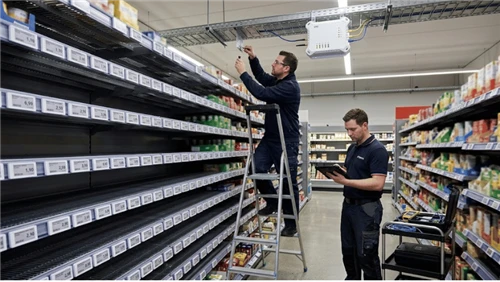
This isn't a hypothetical. Our service team recently took over maintenance for a regional transit deployment where 19 of 47 units had failed within their first year. The original supplier had subcontracted enclosure fabrication to one shop, electronics integration to another, and final assembly to a third. When the touch panels started delaminating, nobody could determine whether the fault lay in the bonding adhesive, the ambient temperature cycling during shipping, or the installation procedure. The warranty claim is still unresolved.

That project taught us something we now tell every prospective customer: the question isn't whether a touch screen kiosk supplier can deliver units. It's whether they can trace a field failure back to its source and fix it before your next order.
Why Supplier Selection Got Harder in 2025
The consolidation wave finally hit. Zebra acquired Elo Touch Solutions for $1.3 billion in August 2025, and three mid-tier manufacturers we used to see at trade shows have quietly exited the market. For procurement teams, this means your approved vendor list from 2023 needs
revalidation-not because the surviving companies got worse, but because the competitive pressure that kept them sharp has changed.
Here's what this means for your next RFQ: lead times are stretching, custom engineering capacity is tighter, and suppliers who used to negotiate aggressively on price are now holding firm. If you're planning a large-format self-service kiosk deployment in 2026, the conversation needs to start earlier than you're used to.
Six Factors That Separate Reliable Suppliers from the Rest
Every touch screen kiosk supplier claims reliability. Strip that word down to operational meaning and it breaks into six testable dimensions.

1. Manufacturing Ownership
Does the supplier own their fabrication and assembly lines, or do they broker capacity from contract manufacturers? This isn't about nationalism or reshoring politics. It's about traceability. When a field failure occurs, a vertically integrated supplier can pull production records, identify the batch, and determine whether the issue is isolated or systemic. A supplier who assembles other people's parts cannot.
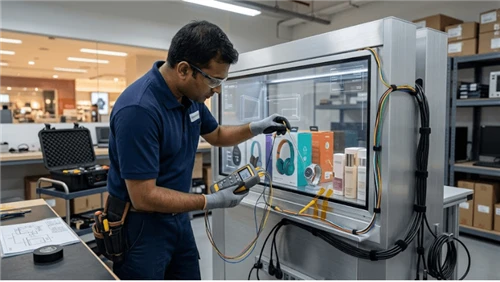
At Legoyo, we operate our own sheet metal fabrication, powder coating line, and electronics integration facility across a manufacturing footprint that's been building display technology for over 24 years. When something goes wrong-and things always eventually go wrong-we know where to look. Last quarter, we traced a batch of intermittent touch failures to a specific adhesive lot within 72 hours of the first field report.
2. Custom Engineering Depth
Surface-level customization (logo placement, color matching) is table stakes. The real test is whether a supplier can modify enclosure geometry for site-specific ADA compliance, reroute thermal management for high-ambient deployments, or integrate payment hardware from a processor you've already contracted with.
Our engineering team processed 68 change orders last quarter across active kiosk display projects. That number tells you something: we understand that custom self-service terminal projects require ongoing adaptation, not catalog products with cosmetic modifications. A supplier averaging fewer than ten ECOs per quarter is probably selling you what they already have, not what you actually need.
3. Certification Documentation
UL listing, FCC compliance, ADA accessibility verification, PCI-DSS certification for payment integration-these aren't negotiable, and they're not interchangeable between product lines. A supplier may have UL certification for their indoor pedestal kiosk but not for their outdoor wall-mount variant.
Our current certifications cover the full range of Legoyo interactive kiosk configurations: indoor floor-standing units from 21.5" to 65", wall-mounted displays, and outdoor-rated enclosures with IP65 protection. We can provide certificate numbers specific to your configuration within 24 hours of a request. If a vendor can't do the same, ask why.
4. Post-Deployment Support Infrastructure
The flashiest RFQ responses often come from suppliers with the weakest service networks. Before signing, ask: Where is your nearest service depot to my deployment sites? What's your average response time for a down-unit call? Do you offer remote monitoring, and if so, what's the monthly cost per unit and what does it actually detect?
Remote monitoring typically runs $15-40 per unit monthly. Whether that's worth it depends on your deployment density and your tolerance for reactive maintenance. For a campus with fifty kiosks within a ten-minute walk of a facilities team, the ROI is marginal. For a distributed network across multiple states, the service-call reduction usually pays for itself within the first year.
5. Delivery Performance History
83% of our orders over the past twelve months shipped within two days of the confirmed date. The remaining 17% were split roughly evenly between early shipments (customer-requested expedites) and delays averaging four days, primarily on highly customized configurations requiring additional QA cycles. That's the distribution. A supplier who can't produce this level of detail doesn't track it, which tells you something about their operational maturity.
Quoted lead time and actual lead time are different numbers. Ask for on-time delivery rate over the past twelve months-not as a percentage, but as a distribution: how many orders shipped early, on time, one week late, two weeks late, more than two weeks late?
6. Total Cost of Ownership Thinking
The supplier who quotes $4,200 per unit and the supplier who quotes $5,800 per unit might deliver the same five-year cost. The difference shows up in maintenance contracts, software licensing models, spare parts availability, and end-of-life transition support.
We've calculated TCO for enough competitive bids to know that hardware cost typically accounts for 30-40% of the five-year total. The rest splits between software subscriptions, service agreements, and the operational overhead of managing the deployment. Any digital kiosk supplier who can't walk you through this breakdown is hiding something-or hasn't thought about it, which is worse.
Technical Specifications: What Matters for Your Deployment
A procurement team that understands touch technology negotiates differently. Suppliers notice when you ask the right questions.

Touch Technology Selection
PCAP delivers the responsiveness users expect from smartphones, with flush-mount glass that resists contamination and cleans easily. We specify PCAP for indoor retail, hospitality, and healthcare deployments where the user experience premium justifies the cost. IR touch makes sense for large-format displays (65 inches and above) where PCAP manufacturing costs become prohibitive, and for gloved-operation environments where capacitive sensing doesn't work.
The tradeoff: IR requires a raised bezel that can trap moisture and debris in outdoor installations. On our outdoor touchscreen kiosk builds, we compensate with channel drainage and sealed gasket designs that add roughly $180 per unit but eliminate the moisture ingress failures we used to see.
Three scenarios complicate this decision tree: high-vandalism environments where flush glass creates a target, semi-outdoor installations with partial weather exposure, and deployments where users rotate between gloved and ungloved operation. Each requires a different technical approach that we can walk through when you're ready to discuss your specific sites.
Display Brightness
West-facing installations in direct afternoon sun need 2,500 nits minimum. East-facing units with morning exposure can often work at 1,800 nits. Covered outdoor locations-drive-throughs, transit shelters, building overhangs-typically perform well at 1,000-1,500 nits.
We've seen deployments specified at 2,200 nits across an entire network when half the units were under cover and could have saved $400 per unit with a lower-brightness panel. The right specification comes from a site survey, not a product catalog. We include site assessments in our standard proposal process for any multi-location commercial kiosk project.
ROI Reality Check
Return on investment calculations for self-service kiosks range from conservative to fantasy. Here's how to tell the difference.

Labor cost displacement is real but context-dependent. Published case studies claiming $20,000+ annual savings per kiosk are typically modeling replacement of a full-time equivalent-a calculation that only works if you're actually eliminating a position, not redistributing tasks. More realistic modeling for most QSR and retail deployments shows labor reallocation value of $8,000-$12,000 per unit annually: not position elimination, but shift-hour reduction and redeployment to higher-value customer interaction.
Upsell capture is the variable most operators underestimate. Our restaurant clients consistently see 12-18% ticket lift from kiosk orders versus counter orders, driven by systematic modifier prompts and combo suggestions that human cashiers skip during rush periods. On a $14 average ticket with 400 daily transactions, that's $600-$1,000 in additional daily revenue per location.
The payback timeline depends more on your deployment scale than your industry. A multi-site QSR operator we worked with last year deployed 34 units across 12 locations-stores averaging 350-450 daily transactions each. Total hardware investment was $186,000. Breakeven came at month eleven based on documented labor reallocation and verified ticket lift. For operators with similar transaction volumes and staffing structures, that's a realistic benchmark. Lower-volume locations typically see payback extending to 14-18 months.
Starting the Conversation
Evaluating touch screen kiosk suppliers is straightforward once you know what to verify. Manufacturing ownership, engineering depth, certification documentation, service infrastructure, delivery history, and TCO modeling-these six factors predict deployment success better than any product demo.
Legoyo builds self-service kiosk solutions for retail, hospitality, healthcare, and transit operators who need more than catalog products. If you're planning a deployment and want to start with a technical conversation rather than a sales pitch, our engineering team publishes specification guides for each application category, and we're set up to do site assessments before you've committed to anything.
The goal is to make sure you're talking to the right supplier-whether that's us or someone else.