The electronic shelf label industry has changed dramatically since 2015, with notable shifts in market dynamics and pricing structures.
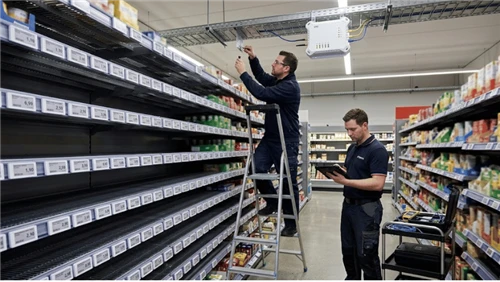
This year electronic shelf labels are replacing traditional paper price tags in grocery stores across America. Whole Foods, Amazon Fresh, and Kroger already use this technology, along with stores in Canada, Europe, Asia and other regions.
Following its previous plan to expand VusionGroup's DSLs to 2,300 stores by 2026, the partners will ramp up installations across all of Walmart's 4,600 stores in the U.S.
Official media statistics show Global Electronic Shelf Labels (ESL) Market size was USD 2.206 Billion in 2024 and will reach USD 2.784 Billion in 2025, growing to USD 12.574 Billion by 2033, exhibiting a CAGR of 20.74% during the forecast period. Global Electronic Shelf Labels (ESL) Market growth stems largely from 67% retailer adoption of pricing automation, 61% preference for e-paper displays, and 54% integration with real-time inventory systems.
In a 2024 report, The Food Industry Association found that "24% of food retailers surveyed are currently using Electronic Shelf Labels (ESLs) and 29% plan to use them in the future." The trade group says this technology will save an average store over 7,000 price tags a week, improve the in-person shopping experience, and increase the store's efficiency.

By 2024, over 55% of Tier-1 retailers in developed economies had adopted ESL systems. The global installed base of ESL tags surpassed 450 million units by the end of 2023, a sharp rise from 325 million units in 2021.
Since manufacturers introduced the first electronic shelf labels in 2000, the price of small and medium-sized electronic shelf labels has dropped from fifty dollars to fifteen dollars.
Before discussing the solutions, the following section examines ESL cost structures in detail.
How Much Does ESL Cost?
Label Pricing Overview
Prices range from about $5 to over $20 per label. Why such an extensive range? Size and display capabilities drive per-unit cost variation. The bigger the label, the higher the cost.

The least expensive shelf labels measure about 2 inches wide. They display basic product names, product information, prices, and barcodes. As you add more display size and data, the prices increase. A large electronic shelf label advertising promotion and displaying basic graphics will cost over one hundred dollars. For most digital price tagging, expect costs under $20 per piece.
Price Range by Size
1.5-inch to 2.5-inch labels – Range from $5 to $15 per unit
3-inch to 4.2-inch labels – Expect to pay between $15 and $30 per unit
5-inch and above – These premium labels can cost $30 to over $100 per unit, especially if they include full-color displays and interactive elements

By Features
Basic models: Prices range from $5 to $10 per unit for smaller, simple displays that show basic information like prices and stock levels
Advanced models: Larger, more advanced labels with color displays or promotional content capabilities can cost anywhere from $15 to $50 or more
Customization options: Some models include NFC functionality or LED lighting, which can push the cost even higher
Solum offers competitive pricing with options ranging from $8 to $15 per label, depending on size and features. Bulk purchase discounts make it a cost-effective choice for larger rollouts. A basic monochrome e-ink label might cost between $5 and $8, while a larger, full-color label with advanced features could range from $15 to $20.
Total System Cost
The investment goes beyond just the labels. Retailers also need management software (ESL Cloud Platform), which requires an upfront payment of around $500, along with monthly subscription fees. A one-time payment option runs from $1500 to $2000. Gateway hardware (Base Station), priced between $150 and $300, enables wireless communication between the labels and the POS System.


The ESL also needs a gateway and administration software in addition to labels themselves. The gateway handles the uploading and release, linking the ESL to the program. This costs between $300 and $400 for a gateway that can update 1,000 and 3,000 price tags. A 1,000-square-meter retail business needs three to four gates, which means the total cost of the gateway is around $1,200. The ESL provider will determine the cost of the ESL management software. The maintenance price usually comes included in the regular fee of roughly $500.
Each electronic shelf label provider will have their own pricing model, but in general the investment runs about $11-12 per label. That price includes hardware, software, and integration.
What would deploying a complete electronic shelf label system for a store cost?
ESL Cost Calculation Formulas
Basic Cost Formula
Total ESL Investment = Label Cost + Gateway Cost + Software Cost + Installation Cost + Hidden Costs
Where:
Label Cost = (Small Labels × $8) + (Medium Labels × $22) + (Large Labels × $65)
Small label average price $5-$15, using midpoint $8
Medium label average price $15-$30, using midpoint $22
Large label average price $30-$100+, using midpoint $65
Gateway Cost = Number of Gateways × $350 (1 gateway per 2,000 labels)
Gateway price range $300-$400, using midpoint $350
Each gateway supports 1,000-3,000 labels
Software Cost = $1,500 (one-time) or $500 upfront + $100-500/month subscription
Installation Cost = $5,000 base + ($2,500 × Store Size ÷ 10,000 sq ft)
Base installation range $5,000-$10,000 for typical stores
Hidden Costs = $8,000 base + ($3,500 × SKU Count ÷ 5,000)
Hidden costs range $8,000-$15,000 including integration complexity, training, and disruption

Label Distribution Reference (Industry Average)
Small labels (1-3 inch): 45% of total installations globally
Medium labels (3-7 inch): 30% of total market volume
Large labels (7-10 inch): 10% of installations
All-In Cost Reference
Industry benchmark: $11-12 per label including hardware, software, and integration.
Real-World Cost Breakdown: Three Store Scenarios
A Corner Store Owner's Investment Analysis
A convenience store owner in Ohio operates a 2,000 square foot shop with about 800 products on the shelves. Most items-around 70%-are standard grocery and snack items that need small labels. Another 25% are larger items like beverages and household goods requiring medium-sized displays. The remaining 5% are specialty products where premium large labels work best.
For this store break down as follows.
For 560 small labels at $8 each, that totals $4,480. The 200 medium labels come to $4,400, and 40 large labels add another $2,600. Total label investment: $11,480.
Small stores face proportionally higher costs than larger operations. Only one gateway is needed since the label count is under 2,000-for $350. Software runs $1,500 for a one-time license. Installation for a store this size still costs around $5,500 because there is a baseline cost regardless of square footage. Hidden costs-integration work, staff training, operational disruption during rollout-add up to roughly $8,560.
Grand total: $27,390.
Dividing that by 800 labels yields about $34 per label all-in. That figure exceeds the $11-12 industry benchmark by a wide margin. Small deployments simply do not benefit from economies of scale. Industry data shows deployment costs of $50-70 per unit are not unusual for stores of this size.
This investment decision requires careful consideration for stores of this scale.
The Maurer's Market Story: What a $208,000 Investment Represents
When Jeff Maurer decided to outfit his 25,000 square foot supermarket with electronic shelf labels, he approached the budget with detailed planning. With roughly 20,000 SKUs across his store, the investment would be large.
His configuration leaned toward a practical mix: 60% small labels for standard grocery items, 30% medium labels for produce and deli sections, and 10% large displays for promotions and featured products. If we calculate according to this formula, label costs alone of $358,000-but that assumes premium pricing across the board.
The actual outcome was as follows. Maurer negotiated effectively. His final investment came in at $208,000 total, which works out to $10.40 per label when including everything. That aligns almost perfectly with industry benchmarks for deployments at his scale.
Bulk purchasing brought his per-label costs well below list price. His 10 gateways (one for every 2,000 labels) probably ran around $3,500. Software licensing added another $1,500. Installation for a store his size-roughly $11,250 based on the square footage formula-was likely bundled into the vendor's package. And while hidden costs run $22,000 for a 20,000-SKU operation under typical conditions, experienced vendors often absorb some of that into their quoted price.
Published price ranges serve as starting points for negotiation, not final numbers. At scale, aggressive buyers can achieve costs closer to $10 per label than $20.
Inside Carrefour's Villabé Hypermarket: When ESL Becomes a Million-Dollar Technology Play
The Carrefour Villabé project represents something entirely different from a typical ESL rollout. This was not just about replacing paper tags-it was a flagship implementation designed to showcase what becomes possible when electronic shelf labels become part of a broader retail technology ecosystem.

The scope tells the story: 70,000 electronic shelf labels spread across 100,000 square feet. Carrefour did not stop there. They integrated 500 shelf-monitoring cameras and installed 7,000 EdgeSense rails for advanced inventory tracking. This was retail infrastructure reinvention.
The labels themselves, split across roughly 55% small units, 35% medium displays, and 10% large promotional screens, would cost around $1.3 million at standard pricing under normal circumstances. Carrefour's configuration included advanced features-color displays, NFC capability, LED indicators, integration with their analytics platform. That premium functionality pushed hardware costs about 40% higher, into the $1.8 million range.
Supporting infrastructure added to the budget. Thirty-five gateways at $350 each contributed about $12,250. Enterprise software licensing ran about $5,000. Installation costs, scaled for a facility this size and including the complexity of integrating with existing systems, likely reached $42,000. Hidden costs-training for hundreds of staff, integration with legacy platforms, operational disruption during phased rollout-approached $57,000.
Then there is the EdgeSense equipment that makes Villabé unique. Five hundred cameras at roughly $200 each: $100,000. Seven thousand sensor rails at $15 per unit: $105,000. That represents $205,000 in technology that most ESL deployments do not include.
The complete investment: about $2.14 million, working out to about $30.63 per label.
This is not a price tag replacement project-it is a real-time inventory intelligence system, a dynamic pricing platform, and an omnichannel operations hub wrapped into one deployment. For hypermarket operators considering similar transformations, Villabé represents the ceiling of what becomes possible, not the floor of what is necessary.
Three Budget Tiers
Small Deployment (10,000 Labels): Deploying 10,000 electronic price tags requires $60,000-100,000. Implementing ESL demands a major investment of time and money, which requires a shift in pricing practices. The initial cost of a 10,000-tag system can reach $100,000.
Medium Deployment (20,000 SKUs Store): For Maurer, who has about 20,000 SKUs in his store, the investment ran about $208,000. The cost of converting to DSLs can vary based on the features offered and other factors, but reports indicate that retailers should expect to pay $100,000-$200,000 for digital shelf labels at this scale.
Large Deployment (30,000 Label System): Large-scale deployments of 30,000 tags require initial investments approaching $350,000. Numbers at that level can give operational teams and management serious pause, making it challenging to justify the capital outlay.
Typical Retail Store Reference: For a 10,000 sq ft store with 5,000 SKUs, expect $49,000-$54,000 for basic implementation (labels, gateways, software, integration). Adding premium features like color displays or advanced analytics can push this to $70,000-$90,000. Hidden costs (integration complexity, training, disruption) add another $8,000-$15,000.
How to Choose Major Vendors?
Overview of Four Major Vendors
VusionGroup (formerly SES-imagotag): VusionGroup provides IoT & Data solutions for physical commerce, serving over 350 large retailer groups around the world in Europe, Asia and North America. The company started under the name "Store Electronic Systems" (SES) in 1992 and equipped its first store with electronic shelf labels in 1993. VusionGroup has over 850 employees. VusionGroup's sales reached €1,011 million in 2024 (an increase of 25% from 2023). In 2023, VusionGroup sold 350 million Electronic Shelf Labels in 45,000 stores. Its main contracts are: Carrefour, Colruyt, Edeka, Lidl, The Co-operative Group, and Walmart.

SES is the ESL market leader with about 250mm ESLs installed to date, representing about 50% market share. By revenue, SES is about 50% larger than Pricer and by bookings, it is about 3x the size. SES leads Pricer by about two years with innovations. SES also spends about 4x what Pricer does on R&D.

SOLUM: SoluM is aiming to surpass BOE in electronic shelf labels within the next three years to become the world's largest vendor. In 2019, BOE acquired France's SES Imagotag, which is the world's largest ESL maker. Sweden's Pricer ranks second. SoluM is third. SoluM formed in 2015 when it split off from Samsung Electro-Mechanics. CEO Jun recruited engineers from Samsung Electronics four years ago for the ESL business. SoluM aimed to make ESL a solution business rather than a device business by securing software competence. The company can design, produce and distribute ESL in turn-key for customers.
Pricer: Pricer offers the most reliable electronic shelf label system in the world. At the core of the system lies the label itself, which has to be extremely reliable, robust, and long-lasting. With experience from three decades in retail pricing and task management, Pricer can solve even the most complex operational issues. Pricer's enterprise-grade electronic shelf-labeling solution helps retailers save time with automatic price updates. It offers greater cost-efficiency than paper and improves customers' experience with accurate, reliable pricing. Pricer helps retailers take the right path to performance by providing an ESL platform with the lowest total cost of ownership (TCO).
Pricer delivers strong ROI based on operational efficiencies and digitally enhanced store estates that help to protect margin. The study found that Pricer delivers a five year ROI of 277%. Forrester's research shows that deploying Pricer's solution equates to a Net Present Value (NPV) of 96.02 million Euros.
Hanshow: While Lidl has apparently decided on SES-imagotag as its ESL supplier, Aldi Nord and Süd are still in an extended proof of concept with various suppliers: Solum, SES-imagotag, Hanshow and Pricer. Lidl and Aldi Nord have equipped a handful of shops in Germany completely or partially with ESL. Aldi Süd already has more than 100 stores.
Quick Decision
Retailers, including Walmart, IGA, Whole Foods, Amazon Fresh, Kroger, Hy-Vee, ShopRite, and Schnucks are increasingly embracing digital shelf labels. Ahold Delhaize USA is piloting ESLs at undisclosed locations with hopes of scaling the technology.
With major retail chains like Walmart, Kroger, and Costco constantly seeking ways to optimize pricing strategies and enhance operational efficiency, ESL adoption is growing rapidly.

Is the ROI Worth It?
A Real Case Study: Maurer's Market
"With labor shortages and inflationary times, now is the appropriate and right time to do it," Maurer's Market Owner Jeff Maurer says of his decision to switch to electronic shelf labels.
Traditional shelf labels may seem simple and easy, but when considering the challenges, ESLs become increasingly more attractive, Maurer says. Challenges to traditional shelf labels include:
Reduced staff productivity: considerable time and labor required to change and maintain printed shelf labels
Pricing integrity issues: ensuring pricing consistency between shelf price and POS price
Pricing flexibility issues: pricing agility, like happy hour and market-driven pricing
"Our costs are changing constantly, so we are now in a position where we can make those retail price changes much more quickly, much more efficiently than we ever could before," Maurer says. "We're getting thousands of price changes every week. Before, that was a manual process," Maurer adds, detailing the need to print, separate, and hang shelf tags. "It was extremely time consuming and prone to error."
This flexibility can also reduce the store's shrink. "If we're heavy on a product and have excess inventory, we could make a decision at that moment to reduce the price to try to help move that inventory along faster," Maurer explains.
That frees up employees' time to focus on customer service and other value-adds. Employees spend about 80% less time on paper tag updates on average once a store switches to ESL, according to SES Imagotag data.
One grocery store owner saved as many as 50 labor hours per week and said he expects a return on his investment in digital shelf labels in under two years.
"A price change that used to take an associate two days to update now takes only minutes with the new DSL system," said Daniela Boscan, a Food and Consumable Team Lead at a Walmart store in Hurst, Texas. "This efficiency means we can spend more time assisting customers and less time on repetitive tasks."
ROI Calculation Formulas
A common question from retail management concerns break-even timelines, which requires detailed ROI calculations.
Annual Savings Formula
Total Annual Savings = Labor Savings + Paper Savings + Pricing Error Savings + Energy Savings + Dynamic Pricing Gains
Where:
Labor Savings = Weekly Hours on Price Tags × 80% Reduction × Hourly Wage × 52 weeks
ESL reduces time spent on paper tag updates by about 80% on average
Paper Savings = Weekly Tags Changed × $0.003/tag × 52 weeks
Average store saves over 7,000 price tags per week
Pricing Error Savings = Annual Revenue × 0.5%
Pricing errors affect 5-8% of retail inventory; ESL achieves close to 100% pricing accuracy
Energy Savings = ~$500/year (e-ink displays use minimal power)
E-ink technology requires power only when updating display
Dynamic Pricing Gains = Annual Revenue × 0.5-2%
Dynamic pricing accounts for about 16% of total ROI
ROI Formula
Annual ROI (%) = (Total Annual Savings ÷ Total Investment) × 100
Payback Period (Years) = Total Investment ÷ Total Annual Savings
Payback Period Adjustment by Price Change Frequency
High frequency (daily): Payback × 0.6 (40% faster) → 3-6 month payback
Medium frequency (weekly): Payback × 1.0 (baseline) → 12-18 month payback
Low frequency (monthly): Payback × 1.8 (80% slower) → may never achieve acceptable ROI
Labor Savings Benchmark
Mid-sized grocery stores save $20,000-$30,000 annually in labor costs
ESL integration reduces pricing labor by about 95%
ROI Reality Check: What Three Different Retailers Can Actually Expect
The Convenience Store Analysis
Returning to the Ohio convenience store owner's $27,390 investment, the potential returns merit examination.
Staff currently spends about 8 hours weekly managing price tags-printing them, sorting them, walking the aisles to replace them. At $15 per hour, that represents $6,240 annually in direct labor. With ESL cutting that workload by 80%, the store would reclaim about $4,992 in labor costs each year.
The smaller savings add up as well. Paper tag costs at 200 tags weekly run about $31 per year-not large, but real money. More important: the store does about $800,000 in annual revenue, and pricing errors cost retailers around 0.5% of sales on average. That represents $4,000 potentially lost to checkout discrepancies and customer complaints. Energy savings on a store this size run around $300 annually. And if the store actually uses dynamic pricing capability-adjusting prices based on inventory levels and time of day-another $4,000 in margin improvement becomes possible.
This could potentially save a total of approximately $13,323 annually.
At that savings rate, payback period is just over 2 years on paper. But the store only changes prices monthly, not daily. Low price-change frequency means the store captures less value from the automation. Adjusting for that reality pushes actual payback closer to 3.7 years.
That explains why industry data shows smaller stores see ROI in 4-6 years, not the 18-month figures vendors commonly cite. For some small operators, it makes sense. For others, the capital might be better deployed elsewhere.
What Made Maurer's Numbers Work
Jeff Maurer's situation was fundamentally different, and understanding why explains when ESL investments truly pay off.
His 25,000 square foot supermarket was consuming 50 hours of staff time weekly on price management. At $18 per hour, that represents $46,800 in annual labor dedicated to a task that adds zero customer value. ESL's 80% reduction translates to $37,440 in recaptured productivity.
But the factor that truly tipped the scales: Maurer's pricing coordinator retired, and he faced a choice: hire a replacement at $45,000 annually (including benefits), or let the ESL system handle the workload. He chose the technology. That single decision added $45,000 in annual savings that most ROI calculations miss.
His store changes prices constantly-"thousands of price changes every week," in his words. That frequency matters enormously. With $15 million in annual revenue, even modest improvements compound quickly. Pricing error elimination saves roughly $75,000 annually. Dynamic pricing on perishables and overstock items-something impossible with paper tags-contributes an estimated $225,000 in margin improvement.
When totaling his annual savings-$37,440 in labor, $45,000 in avoided hiring, $75,000 in error reduction, $1,092 in paper costs, $500 in energy, and the dynamic pricing gains-potential returns exceed $380,000 annually against a $208,000 investment.
Even using conservative estimates that exclude dynamic pricing (since those gains depend heavily on execution), Maurer's payback period lands around 9-10 months with high-frequency price changes, or 15-16 months at baseline assumptions.
Maurer himself estimates 1.5 to 2.5 years for full ROI, with half coming from labor and paper savings alone. That conservatism is probably wise-real-world results vary-but his fundamentals strongly favor the investment.
The Carrefour Scale: Different Math Entirely
At hypermarket scale, ROI calculations enter different territory. Carrefour's Villabé investment of about $2.14 million demands proportionally larger returns to justify the capital.
The labor equation scales dramatically. Managing 70,000 price points manually requires dedicated teams-roughly 200 staff hours weekly across multiple shifts. At €20 per hour (about $22), that represents $237,000 in annual labor. The 80% reduction delivers about $166,400 in direct savings.
Paper costs at 15,000 weekly tag changes contribute another $2,340 annually-meaningful at scale, though minor relative to total investment. Energy savings on a facility this size run about $2,000 yearly.
Where hypermarket economics diverge is in error costs and dynamic pricing potential. With $80 million in annual revenue flowing through the store, pricing errors at 0.5% represent $400,000 in annual exposure. The ability to execute real-time competitive pricing, flash promotions, and time-based markdowns on perishables contributes an estimated $1.6 million in margin improvement-though capturing that value requires sophisticated pricing strategy, not just technology deployment.
Carrefour's EdgeSense integration adds another dimension. Shelf-monitoring cameras and sensor rails enable inventory intelligence that reduces out-of-stocks and overstock situations. Conservative estimates suggest $240,000 in annual inventory optimization value.
Combining all categories yields potential annual savings exceeding $2.4 million-which would suggest payback in under a year. That represents the optimistic case.
Conservative projections excluding dynamic pricing gains show annual savings around $570,000. At that rate, payback extends to 3.8 years-still acceptable for a strategic infrastructure investment, but far from the quick wins smaller operators might expect.
For large supermarket operators, probably 2-4 years to full ROI, depending heavily on how aggressively they leverage dynamic pricing capabilities.
5-Year Net Benefit Calculation
Formula:
5-Year Net Benefit = (Annual Savings × 5) - Total Investment
|
Store Type |
Investment |
Annual Savings |
5-Year Savings |
5-Year Net Benefit |
|
Small (800 SKUs) |
$27,390 |
$13,323 |
$66,615 |
+$39,225 |
|
Medium (20,000 SKUs) |
$208,000 |
$159,032 |
$795,160 |
+$587,160 |
|
Large (70,000 SKUs) |
$2,144,050 |
$570,740 |
$2,853,700 |
+$709,650 |
Verification: Pricer delivers a five year ROI of 277% according to Forrester research.
ESL Cost Solutions for Different Retail Sizes
1. By Store Size
Small Stores (Convenience Stores/Specialty Stores)
Small Store Deployment Quantity: Other retail segments, including convenience stores, kiosks, and pop-up shops, are increasingly adopting ESL systems to enhance operational accuracy and streamline price management. In over 100 diverse retail settings, each store installs between 20 and 50 ESL units.
Small Store Cost Constraints: High initial installation costs and integration complexity limit adoption in small retail outlets. Deployment can cost between USD 50–70 per unit, which can be prohibitive for smaller stores with thousands of shelves.
Small Store Infrastructure Requirements: In addition to the tags, stores need antennas or base stations to send the signal to the ESLs. The number depends on the surface area. A small store may need 1 or 2 antennas; a large hypermarket may need several distributed throughout the area.
Medium Supermarkets (5,000-20,000 SKUs)
Medium Grocery Store Annual Labor Savings: Groceries often require frequent manual price updates. ESLs automate this process, reducing the workload of store employees. On average, a mid-sized grocery store could save around $20,000 to $30,000 annually in labor costs.
Spain Mercadona Case: Mercadona estimated that implementing electronic labels per store would cost around €100,000, which is a major barrier despite the benefits mentioned above.
Large Supermarkets/Hypermarkets (30,000+ SKUs)
Large Hypermarket Deployment Scale: High upfront deployment costs remain a hurdle, especially for smaller retailers. Outfitting a large hypermarket can require more than 50,000 labels, pushing initial investments into millions of dollars.

North America Supermarket Average Deployment Scale: In North America, more than 2,500 supermarket outlets had integrated e-paper ESL systems by Q4 2023, with average store rollouts covering 12,000 SKUs per location.
Large Retail Chains
Large Chain Annual Savings: This switch to automation has saved up to $500,000 per year for major retail chains. Pricing errors, which can cost retailers as much as $2 million annually in lost revenue, drop sharply with ESLs.
Walmart Deployment Scale: In 2024, Walmart expanded ESL trials across 500 U.S. stores, implementing Bluetooth-enabled tags that allow shoppers to scan labels for product details and promotions.
Quick Reference: Cost Estimation by Store Type
|
Store Type |
SKUs |
Typical Investment |
Annual Savings |
Payback Period |
|
Convenience Store |
500-1,000 |
$20,000-$35,000 |
$8,000-$15,000 |
4-6 years |
|
Small Grocery |
2,000-5,000 |
$50,000-$70,000 |
$25,000-$40,000 |
2-3 years |
|
Medium Supermarket |
10,000-20,000 |
$100,000-$250,000 |
$80,000-$200,000 |
1.5-2.5 years |
|
Large Supermarket |
30,000-50,000 |
$300,000-$600,000 |
$200,000-$400,000 |
1.5-3 years |
|
Hypermarket |
50,000-100,000 |
$800,000-$2,500,000 |
$400,000-$1,500,000 |
2-4 years |
3. Cost and Application by Label Size
Standard Size Labels (1-3 inch): Standard-sized ESLs remain the most widely used, accounting for 45% of installations globally by 2024. Retailers favor these tags for their compactness and cost-efficiency, making them ideal for grocery stores and convenience outlets. Their average lifespan exceeds 8 years, and they support both NFC and barcode displays. Retailers using 1-3 inch ESLs have cut manual pricing labor by over 50%.
Mid-Large Size Labels (3.1-7 inch): Mid-large ESLs comprised 30% of total market volume by 2024. Hypermarkets and department stores adopt these labels extensively due to their superior visibility and flexibility. In-store surveys show 65% of consumers prefer viewing prices on mid-size displays.
Large Size Labels (7.1-10 inch): Large-sized ESLs make up 10% of installations and are used in specialty stores or for premium product sections. Despite higher costs, adoption grew by 15% from 2022 to 2024.

4. Cost-Effectiveness by ROI Period
With AI Pricing Software (Payback as Fast as 1 Year): When properly installed and implemented, an ESL system can pay for itself in two to three years. When retailers use price optimizing software in conjunction with the system, the ROI can come in as little as a year.
5. Cost Component Details
Hardware Costs: The ESL units themselves make up the majority of the cost. Prices can range from $6 to $100+ per label depending on the size, functionality, and type of display. For a medium-sized grocery store, this can translate to tens of thousands of dollars in upfront expenses, depending on the number of shelves and products to cover.
Infrastructure and Installation: ESL installation requires mounting adaptors or rails and a wireless communication infrastructure, based on Bluetooth or radio frequency. This cost depends on the store layout and the extent of the installation. For a typical store, these costs can range between $5,000 to $10,000.
Software and Integration: ESLs require robust software that integrates with existing inventory and pricing systems. Costs can include licensing fees, software development or customization, and data integration efforts. Software cost can be an annual subscription model ranging from $100 to $500 per month.
Maintenance and Support: Ongoing maintenance ensures ESLs function properly. Maintenance costs are minimal compared to initial installation, but annual support services can require an investment of $1,000 to $3,000 per year, depending on store size and complexity.
6. Cost Break-Even Point Reference
10,000 Label Scale Reaching Cost Balance: At deployments above 10,000 labels, the electronic shelf label market reaches cost parity with legacy paper systems because it removes printing, transport, and labour.
Cost Decline Trend: Cost per label: Falling steadily, expected to decrease 25–35% over the next 5 years.
Simple ROI Calculation
Some retailers spend up to 50 hours a week managing thousands of price changes with paper tags. Between printing costs, labor hours, and constant replacements, what seems like a small task can quietly drain profits-adding unnecessary pressure to already tight margins.
With ESL, price updates happen instantly, eliminating the weekly labor entirely. Energy costs drop thanks to energy-efficient e-ink displays. Pricing errors nearly disappear.
Sample calculation for a mid-sized retailer:
Possible annual savings: $39,000 (labor) + $10,000 (energy) + $5,000 (errors) = $54,000
Sample investment: $100,000
Possible ROI: 54% annually
Expected payback period: about 1.85 years
Under these assumptions, the ESL system pays for itself in under two years. After that, the retailer benefits from $54,000 in annual savings-funds that can be reinvested into staffing, inventory, or enhancing the customer experience.
The primary economic benefit of integrating ESL with POS and inventory systems is labor savings. For mid-sized retailers with a large number of SKUs, traditional paper price tags require hefty labor. ESL integration can reduce this work by about 95%. Pricing accuracy offers another major payback. Industry studies show that pricing errors affect 5-8% of retail inventory. When ESLs are integrated with POS systems, pricing accuracy approaches 100%, eliminating the gap between shelf and register prices.
ESL systems have proven cost-effective, reducing manual labor costs by up to 40%, while improving price accuracy by 99%. Major chains like Carrefour and Walmart have deployed ESL systems in over 1,500 outlets each, contributing to a 50% reduction in pricing errors.
Payback Period Reference
Maurer predicts the return on investment will come in 1.5 to 2.5 years, with 50% of that coming from reduced labor and paper supplies, including: spending less on printing, eliminating labor on sorting and hanging the labels, implementing dynamic pricing based on inventory levels. The dynamic pricing will also drive higher margins by allowing the team to make better daily pricing decisions based on product availability, making up about 16% of the ROI.
Shannon Clark, director of brand and marketing at Houchens Food Group, piloted two stores with ESLs and is planning to launch two more stores in the near future. Her calculated ROI is 3.5 years based on paper tag, labor, and the ESL costs.
When properly installed and implemented, an ESL system can pay for itself in two to three years. When retailers use price optimizing software in conjunction with the system, the ROI can come in as little as a year. When coupled with AI-based price optimization software and changing pricing procedures to take advantages of elasticity of demand, a grocery store with 30,000 labels can potentially see a payback on their investment within a year.
Payback periods vary dramatically by operation type. High-volume grocers with frequent price changes see 3-6 month payback. Traditional retail with moderate price change frequency reaches payback in 12-18 months under typical conditions. Low-frequency price change environments may never achieve acceptable ROI.
Brian Salzman, national accounts manager, West, for ESL provider Aperion Solutions, said grocery stores are now looking at anywhere between an 18-month and two-year payback if they choose the correct functionalities. This makes ESL more accessible to retailers, with some retailers seeing a payback within 18-24 months.
Is Your Store Suitable?
Signs That ESL Is Right for You
Independent grocers face rising labor costs, thinner margins, and higher shopper expectations. "Electronic shelf labels have become more than just a price tag," IGA Senior Director of Connected Commerce Sarah Rivers said. "They do much more, including streamline pricing updates, improve accuracy, and integrate with your other technologies to create a connected, user-friendly experience."
Greg Adamsky, who leads Aperion's business development in the Eastern region, explained that ESL adoption has reached a tipping point. Four factors are driving the change:
Labor Costs and Quality: "The combination of costs going up and labor quality going down is giving angst to grocery retailers."
Expanded Functionality: ESLs now integrate with e-commerce, digital coupons, and price optimization tools. "The increased functionality drives ROI. You're not just saving labor-you're optimizing price and profitability."
Real-Time Pricing: "One of my customers in Philadelphia changes fish prices daily. He doesn't have to wait a week for updates-that flexibility directly improves profit and freshness."
The CEO said use of ESL at offline stores allowed them to react to peak sales during the weekends flexibly. ESL has grown in importance for retailers due to increased competition between online and offline stores as well as between offline stores.
Supermarkets and hypermarkets constitute the largest application segment for electronic shelf labels, accounting for about 54% of global implementations in 2024. These large-format food retailers manage extensive product assortments-15,000 to 60,000 SKUs under typical conditions-with frequent price changes driven by promotions, competitive adjustments, and perishable item management.
Cases Where Waiting Makes Sense
ESL is not right for every retailer. After studying implementation outcomes, several scenarios consistently show poor ROI:
Very low price change frequency: If you update prices monthly or less, labor savings do not justify investment. Traditional labels work fine for stable-price environments.
Very small format: Stores under 2,000 square feet with under 500 SKUs rarely hit payback within 3 years unless operating in high-labor-cost markets.
Unstable business fundamentals: If a business is struggling with basic operations, cash flow, or market positioning, ESL will not fix those problems. Solve fundamental business issues first.
Legacy infrastructure without upgrade budget: If the POS system is 7+ years old and upgrades are not affordable, ESL integration will be nightmarishly expensive or simply impossible.
Commodity-focused with razor-thin margins: Dollar stores and extreme discount retailers operating on 1-2% net margins often cannot generate sufficient return from ESL benefits.
Business owners who are considering deploying electronic shelf labels can refer to the above solutions.