Weight kills more projects than budget does.
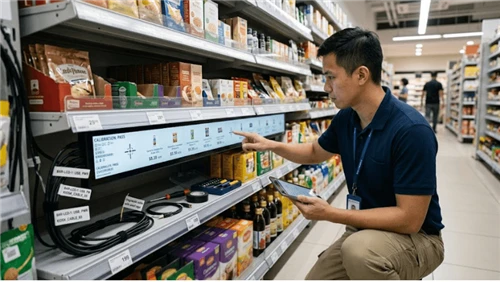
Transparent screens weigh 3-12 kg/m² and run about 10mm thick. Traditional screens with cabinets weigh 30-50 kg/m² and measure 50-150mm deep. A heritage building with original windows often cannot support traditional LED weight without steel reinforcement that would destroy heritage listings. Transparent screens mount directly onto interior glass surfaces with no structural work. Installation takes days rather than months.
A retail chain with 500 glass storefronts rolled out transparent screens across the entire network without touching building structures. Attempting the same with traditional screens would require custom structural engineering at every location-a project scope that kills most proposals before they reach final budget approval.
What We're Actually Comparing
For decades, traditional LED screens were everywhere-stadium scoreboards, retail signage. They worked well: bright, accurate colors, reliable. But they came with a tradeoff nobody could engineer around: every screen was basically a wall. Blocked light, blocked views, took up space.
Transparent LED flips that equation. Different category of product altogether.
The retail application is what's driving most of the growth right now. Shop windows have always been prime real estate. You want to show products and run promotions simultaneously. Traditional LED forces a choice-screen or window. Transparent LED removes that choice entirely. Customers see promotional content and merchandise at the same time. Nike and Zara flagship locations figured this out early. This single use case explains why transparent LED moved from niche curiosity to serious commercial consideration within five years.
How They're Built
Traditional screens prioritize one thing: cramming as many pixels as possible into a given area. LED chips-whether SMD (Surface Mount Device), COB (Chip on Board), or the older DIP (Dual In-line Package) format-get packed tightly onto PCB substrates. A black mask or epoxy coating covers everything to soak up ambient light and boost contrast.
The results speak for themselves. COB panels hit contrast ratios above 20,000:1. Pixel pitches go as fine as P0.6mm for 4K and 8K displays. Outdoor units push 10,000 nits.
But traditional LED screens block 100% of light passing through them. They're digital walls. Great for impact, terrible for anything where you need to see through.
Transparent screens start from the opposite end. Instead of maximizing pixel count, they're designed around letting light through while keeping image quality acceptable. Three main approaches exist. Strip-based designs put LED chips onto narrow aluminum or PCB strips with gaps between them-light passes through the gaps, hitting 60-90% transparency depending on spacing. Film-based versions embed micro-LEDs into ultra-thin transparent substrates (around 4mm thick, weighing 3-6 kg/m²) that stick directly onto existing glass. Glass-integrated designs sandwich LED elements between dual glass layers, turning architectural glass into a display surface.
More gaps between strips means more light gets through, but fewer pixels per square meter. Every transparent screen is a compromise between these two things.

LED Packaging Types
SMD-Surface Mount Device's been around for decades. Individual chips in tiny plastic housings, soldered onto PCBs. The technology is straightforward, which is precisely its advantage. Supply chains are mature, technicians know how to work with it, and when a single LED dies it can be swapped out without replacing the whole module. This is the most proven and reliable LED technology: not cutting-edge, consistently functional, cost-effective to maintain. Contrast sits around 1,200-1,800:1. Most units last about 50,000 hours before brightness drops noticeably. For anything P1.2 or coarser, SMD remains the default choice for good reason.

COB is where things get interesting-and expensive. Chip on Board skips the individual plastic housings entirely. Multiple LED chips get mounted straight onto the substrate, then covered with a single resin layer. The engineering benefits cascade from there: heat dissipates roughly 3x better (no plastic housings trapping warmth), contrast jumps past 20,000:1 (that unified surface absorbs ambient light more effectively), and lifespan extends beyond 100,000 hours. It's the only viable option for ultra-fine pitches below P1.0. The tradeoff: when something fails, the entire module requires replacement at $200-300 per incident. And the upfront cost runs significantly higher. The technology suits broadcast studios and high-end corporate environments. It represents excessive investment for a hotel lobby.

Then there's GOB-SMD with a protective coating. Glue on Board. Same underlying tech, but with a layer of optical glue covering the LED surface. This provides better durability against physical contact and humidity while keeping the repair economics of SMD. Some integrators recommend it strongly for high-traffic retail environments. Others consider it unnecessary for most applications. Results vary depending on specific use cases.
Most transparent screens use modified strip-based SMD mounting or specialized transparent substrates. Some premium models use COB-transparent hybrid approaches.
The Specs That Actually Matter (And the Ones That Don't)
Not all specs deserve equal attention.
Transparency
Transparency ranges from 50% to 95% on transparent screens depending on configuration. Traditional sits at 0%-that's fundamental to how they work. Coarser pixel pitches mean more gaps between LED strips, more light passes through. Push to P9.26 and you'll get past 80% transparency, but at that point you're only suitable for large-scale viewing-building facades seen from across the street.
Resolution
Resolution is traditional LED's clear win. COB goes as fine as P0.4. Standard SMD traditional screens bottom out around P1.0-P1.2. Transparent screens currently max out around P2.6. Most AV integrators use a quick calculation: divide pixel pitch (in mm) by 0.3 to get minimum comfortable viewing distance in meters. So a P3.9 transparent screen needs about 13 meters before pixelation disappears. A P1.2 traditional screen looks sharp from just 4 meters out.
Brightness
For indoor use, transparent LED typically outputs 800-2,500 nits. Traditional indoor screens run 600-1,500 nits-so transparent actually has an edge in many setups. Storefronts need more punch: transparent screens usually run 4,000-5,500 nits. Direct sunlight is where traditional still dominates-they push 5,000-10,000 nits while transparent screens behind glass struggle below 6,000 nits.
Contrast and Color
Contrast and color-traditional LED dominates here, and this won't change. The black mask design absorbs ambient light, producing deeper blacks. COB technology posts lab-measured contrast ratios above 20,000:1. Where traditional screens show black, transparent screens show whatever's behind them. A conference room, a parking lot, daylight. No amount of engineering fixes this-it's inherent to letting light through.
What You'll Actually Pay
These are FOB Shenzhen prices-landed cost in North America or Europe typically adds 15-25%. Prices fluctuate; LED chip costs dropped roughly 12% between Q1 and Q3 2024.
Transparent LED
Entry-level side-emitting panels run $580-950/m². Mid-range front-emitting-where most commercial installations land-sits at $1,100-2,400/m². Transparent film LED goes for $1,150-2,800/m². Holographic transparent displays push $1,400-3,200/m².
Traditional LED
Outdoor SMD (P4-P10) is the cheapest at $150-400/m². Indoor SMD (P1.5-P3) runs $300-800/m². Fine-pitch COB (P0.9-P1.2) hits $1,000-2,500/m². Ultra-fine COB (P0.6 and below) starts at $3,000+/m².
Installation for transparent LED typically runs $200-500/m²-straightforward mounting onto existing glass. Traditional LED installation runs $500-2,000/m² once you factor in structural requirements. This is where the weight differential mentioned at the beginning shows up in the budget.
Annual energy costs on a 100m² installation running 12 hours daily: roughly $3,000-4,500 for transparent, $5,000-7,500 for traditional. Transparent screens pull 30-40% less power-fewer LED chips per square meter, passive cooling instead of active ventilation.
Content creation adds another variable people forget. Transparent displays need content designed for transparent backgrounds-black areas show through as transparent.

Installation and Maintenance Reality
Transparent LED screens mount directly on glass surfaces using adhesive, magnetic systems, or mechanical clips. No steel structure for most applications. Timeline: days to weeks.
Traditional LED screens need dedicated support structures, weight loading calculations, wind load analysis for outdoor, building permits frequently. Timeline: weeks to months.
Maintenance works differently too. Transparent screens use modular strip/panel replacement. Components are light enough for single-technician service. Traditional SMD screens allow individual LED replacement but need skilled technicians with precision soldering-$10-15 per incident. Traditional COB screens require module-level replacement at $200-300+ per repair incident, though failures happen less often.
Where Each Belongs
Some projects fall obviously into one camp.
Transparent LED wins: Glass curtain wall buildings where facades become media surfaces while keeping architecture intact. Shopping mall atriums and glass partitions. Exhibition halls and museums layering digital content over physical displays. Automotive showrooms. Stage and event backgrounds where performers appear through screens.

Traditional LED wins: Outdoor advertising billboards needing maximum brightness under direct sun. Stadium displays at 50+ meters where fine pixel pitch is irrelevant. Broadcast studios and control rooms where color accuracy is non-negotiable. Concert main screens covering hundreds of square meters. Transportation hub information displays where transparency adds nothing.
Which One?
Is there glass involved that you want to preserve? Is natural light important to how the space functions? Can the structure handle 30-50 kg/m²? What's the typical viewing distance? Does the budget need to account for structural engineering?
For the growing category of projects involving glass architecture and natural lighting, transparent LED has shifted from interesting alternative to default consideration. For everything else-outdoor billboards, broadcast studios, stadium displays-traditional LED remains exactly what it's always been: proven, bright, cost-effective, and completely opaque.