Many people think digital signage is just buying a screen and plugging in a USB drive to play videos. Digital Signage Solutions is a complete system-hardware, software, content, and network all have to come together. They're everywhere: shopping malls, airports, retail stores. McDonald's ordering screens, Capital Airport flight information displays, supermarket price tags-all fall under this category.
Compared to traditional printed posters, the main difference is that content can be dynamically updated. A foam board sign takes a week at best, half a month at worst, from design to hanging-flash sales simply can't keep up. With digital signage, changes made in the backend sync to the front end in seconds. One person can manage thousands of screens nationwide without traveling. Nielsen did research showing digital screens get roughly four times the attention rate of static posters. It varies by scenario, but the order-of-magnitude difference is real.

(The global digital signage market size was estimated at USD 28.83 billion in 2024 and is projected to reach USD 45.94 billion by 2030, growing at a CAGR of 8.1% from 2025 to 2030.)Data research survey citation-https://www.grandviewresearch.com/industry-analysis/digital-signage-market
The Real Problem Nobody Talks About First
So many projects where screens get installed, content doesn't change for three months, and they become background walls nobody looks at. Equipment is just the starting point-if content operations don't keep up, it's all wasted. This point needs emphasis because it's where most projects go wrong.
An operations director at a convenience store chain did the math: previously, changing promotional materials across all 1,500 stores nationwide cost over 100,000 yuan in labor and logistics each time. Now one person handles it in half an hour. That single saving paid back the equipment investment within a year. Whether it's exactly accurate is uncertain, but directionally it makes sense.
So the question isn't just "what hardware should I buy"-it's whether you have the operational muscle to keep the thing alive after installation.
CMS: Start Here, Not With Screens
Without a CMS, every content update requires someone to physically visit each location with a USB drive. One store is manageable; a hundred stores is unmanageable.

What does CMS manage? Content creation (template editor), playlists (sequence, duration, transitions), scheduling (what content plays on which screen at what time), distribution (pushing content to players via network), monitoring (online status, playing content, hardware issues all visible in the backend). That's a lot of functions rolled into one system, which is why CMS selection matters so much.
Common practice in food service: play breakfast menu in the morning, automatically switch to lunch promotions at noon, change again in the evening. No one needs to watch it.
Deployment Options
Two deployment options: cloud and on-premises. Cloud is plug-and-play, maintenance-free, accessible from anywhere, and is now mainstream-Verified Market Research data says it's over 60% and growing. On-premises suits situations with strict data security requirements or poor network conditions.
Where People Get Burned
CMS selection is where it's easiest to step into pitfalls. Dozens of products on the market look similar in features but differ tenfold in price. It's genuinely confusing even for people in the industry.
A few key points. First, always do actual trials-run through the process with real content, don't just watch vendor PowerPoints. Second, clarify the billing model-per-screen or per-module, many traps where it's cheap upfront but storage and bandwidth cost extra. Third, check same-industry cases-retail needs differ from transportation needs, vendor experience matters.
Domestic vendors include Goodview, Touchwo, Anvo, and Sunmi. International ones include Scala, Four Winds, and Broadsign. For few locations and tight budgets, open-source Xibo works, but technical capability is required for self-maintenance.
Get proposals from 3-5 vendors for horizontal comparison. Require itemized quotes-hardware, software, implementation, and annual service fees listed separately. Bundled quotes easily hide tricks.
Now Let's Talk Hardware
Display Terminals
Display terminals-where users see content-are more complex to choose than most people think.
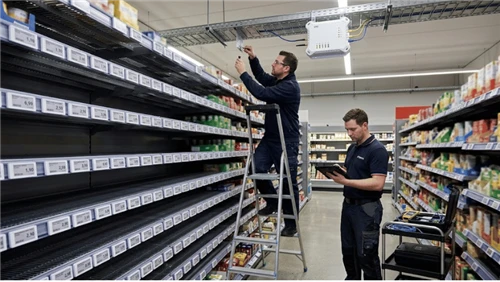
LCD is cheap, bright enough, and works fine indoors. LED has high brightness and enables seamless splicing; those giant screens in airports and malls are LED. OLED has stunning colors and can curve, often used for luxury displays, with luxury pricing to match. E-ink screens have extremely low power consumption and are clear in sunlight, suitable for static content like price tags-that's what Hema uses. There are other types too, but these four cover approximately 95% of field applications.


Screen selection depends on installation environment, viewing distance, brightness requirements, and operating hours. Generally, 10-12 inches of screen size per meter of viewing distance is comfortable. Indoors, 300-500 nits is enough; with direct natural light, 700+ is required; pure outdoor requires minimum 2,500 nits to compete with the sun, plus IP65 water and dust resistance, wide temperature range from -20°C to +50°C, anti-vandal and shatter-proof-costs multiply. The main takeaway is that outdoor deployment is significantly more expensive and complicated.
Commercial screens and consumer screens may have identical specs on paper, but actual performance is worlds apart. Heat dissipation, 24/7 operation capability, bezel width are all different. Some people use home TVs as store display screens to save money; three months later, burn-in, overheating crashes, and they switch back to commercial screens. This happens far more often than manufacturers want to admit. Samsung, LG, Hisense, and BOE all have dedicated commercial display product lines, 30%-50% more expensive than consumer grade, but the stability and lifespan difference is significant.
A Detour: The Extreme Case of Transportation
Speaking of hardware requirements, transportation scenarios are where things get brutal. Capital Airport T3 runs over 2,000 screens-flight dynamics, boarding gates, baggage carousels-must interface with flight systems in real-time with 99.9%+ accuracy. Delays or errors mean passengers missing flights. In these scenarios, stability is ten thousand times more important than fancy animations. Not something small integrators can touch.
Then there are county-level supermarkets, many still using standalone systems, copying content via USB drive for playback. Where network conditions are poor or scale is small, this approach still exists. Not every solution needs to be cutting-edge.
Media Players

Back to the typical setup. Media players are the bridge between software and display-receiving commands, decoding files, outputting signals. This is the part that tends to confuse people the most.
Two form factors. External players are standalone boxes connected to screens via HDMI, with controllable performance and easy upgrades; BrightSign, Advantech, and Giada are typical examples. Built-in SoC embeds chips inside the screen, simple to deploy and lower cost, but limited performance and difficult to upgrade; Samsung and LG push these.
How to choose? Follow content complexity. Basic image and video rotation-SoC or a 300-400 yuan Android box is enough. HTML5 animations, multi-zone layouts, 4K video-go for 1,500-4,000 yuan professional players. Complex interaction or edge computing-use industrial PCs.
Network Considerations
Use wired connections if possible; if not, WiFi or 4G. The key point is don't forget offline fallback-when the network goes down, the player should be able to continue playing from cache rather than showing a black screen with an error. This gets overlooked too often, then one day the network goes down, all stores go black, and then there's regret for not choosing a reliable solution.
Retail: Where Most of This Actually Gets Used
A regional manager oversees dozens of stores with new promotions every week. Rely on printing posters, logistics delivery, and manual posting? By the time materials arrive, the moment has passed. Digital signage can achieve "a decision made at headquarters ten minutes ago appears on screens in stores nationwide ten minutes later."

(A study conducted across four prominent retail locations in the Netherlands gathered over 24,000 shopper observations and 1,562 interviews. The findings revealed that 85% of customers believed digital video content displayed on window screens improved each store's brand image. Recall of promotional content was notably strong as well: as many as 64% of shoppers spontaneously remembered at least one themed message, and 57% reported gaining new information from the displays.)Reference Case Data-https://www.retailcustomerexperience.com/news/popai-research-digital-window-signage-increases-footfall/
McDonald's: The Benchmark
McDonald's is a benchmark of doing it well. In 2019, they spent $300 million to acquire Dynamic Yield and rolled out AI-driven digital menus across 38,000 stores globally, dynamically adjusting recommendations based on weather, time of day, inventory, and queue length. Their financial reports say drive-thru average ticket size increased 5-6%. But they have dedicated teams watching this-most companies can't replicate that. The resources McDonald's can allocate to this problem are significantly different from typical enterprises.
Actually Doing a Project
Requirements First, Equipment Later
First, clarify requirements-don't rush to select equipment.
Where will screens be installed? Indoor or outdoor? Wall-mounted, pillar, window, or ceiling? Different locations have completely different requirements for size, brightness, and installation methods. What content will be played? Pure image/video rotation or real-time data integration? Touch capability needed? Who creates content and how often is it updated? How many locations? One store and a hundred stores require two different approaches. What's the budget? 55-inch commercial screens range from 3,000-4,000 yuan to 30,000-40,000 yuan; CMS ranges from free to annual fees of hundreds of thousands. Without a budget framework, selection can't begin.
This phase should output a requirements document-location list, installation environment, content type, functional requirements, and budget range all clearly written. Bidding, price comparison, and vendor communication all rely on this document.
Site Surveys

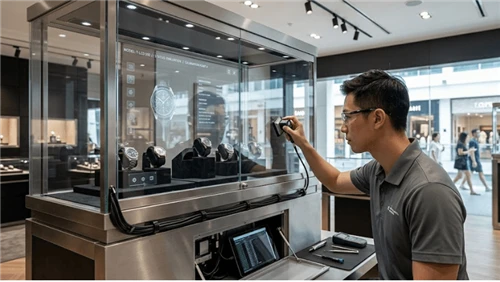
Then comes site surveys. What looks fine on drawings has all kinds of surprises on-site. Power outlets in wrong positions, network cables not pre-installed, load-bearing walls that can't be drilled. Every integrator can tell a basketful of such stories.
Installation, Acceptance, Training
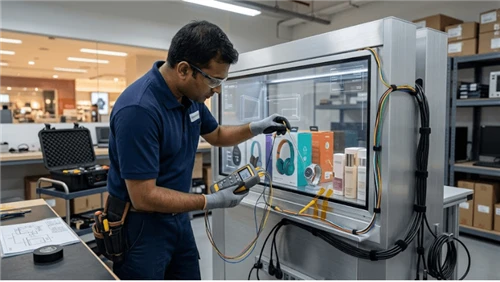
Installation and commissioning includes mounting screens, connecting players, configuring network, deploying software, importing content, and joint testing. A smooth standard location takes half a day; complex ones take two to three days. Large projects typically run a few pilot sites to iron out issues before mass rollout.
Acceptance and training are easily overlooked. Equipment installation is just the beginning; someone needs to manage it afterward. CMS operation, content publishing, offline troubleshooting-operations staff need to be trained properly. Vendors should provide operation manuals and FAQs; otherwise, every small issue waits for after-sales support, extremely inefficient.
After Go-Live
What about after going live? This is where the real work begins.
Content operations require ongoing investment. Establishing an update rhythm helps-promotional content changed weekly, brand visuals changed monthly. CMS data integration features can enable partial automatic updates to reduce manual work.
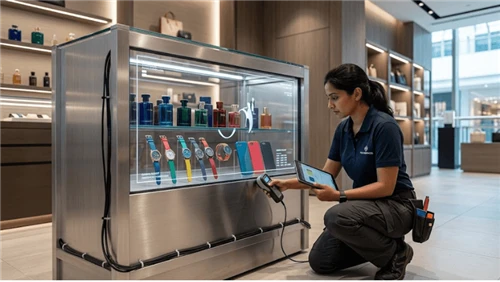
Equipment inspection must keep up. Regularly check for dead pixels, player lag, network stability. CMS backend usually has monitoring-scan the alert list daily to catch problems before customers complain "the screen has been black for three days."
Effectiveness evaluation is the only way to prove whether the investment was worthwhile. Trackable metrics: playback completion rate, audience dwell time, changes in associated sales. Some operations do A/B testing-two promotional designs to see which drives more sales.