Written by the warehouse technology team at Kiosk Etag Screen. Technically reviewed by Daniel Kottke, Senior Warehouse Automation Engineer (18 years in distribution center design, 40+ pick-to-light deployments across pharmaceutical, e-commerce, and 3PL operations). Last updated March 2026.
Pick to light warehouse operations use LED-mounted display modules at storage locations to visually guide workers through each pick, delivering order accuracy rates above 99.5% and throughput gains of 30–50% over paper-based methods. Those benchmarks come from the MHI Annual Industry Report, which has tracked light-directed picking performance across hundreds of North American facilities since 2016. The system connects directly to your warehouse management software and lights up the exact bin, shelf, or carton an operator needs-eliminating guesswork and slashing training time for new hires. Below, we break down how these systems actually work on the floor, where they pay off fastest, and what you should evaluate before committing capital.
Quick Answers: Pick to Light in 60 Seconds
What is pick to light? A light-directed picking system that mounts LED display modules at each storage location in a warehouse. When an order enters the warehouse management system (WMS), the module at the correct bin lights up, shows the quantity needed, and waits for the operator to press a confirmation button after pulling the item.
Who benefits most? Operations running 1,000+ order lines per day with fewer than 20,000 active SKUs-especially e-commerce fulfillment, pharmaceutical distribution, and subscription-box kitting. Facilities with strict accuracy requirements (medical devices, aerospace parts) also see outsized returns because of the built-in digital audit trail.
When does ROI make sense? Most mid-volume warehouses recover their investment within 12–18 months. High-volume sites processing 5,000+ lines daily often hit payback in 6–9 months. Those timelines are drawn from ROI modeling published by Bastian Solutions and project case summaries from Dematic.
How Does a Pick to Light System Work, Step by Step?
A pick to light system assigns an alphanumeric display module and one or more LED indicators to every pick location-each slot on a shelf, each bin in a flow rack, each compartment in a carton. When an order drops into the WMS, the software maps required SKUs to physical positions and fires signals to the corresponding modules. The operator walks up to a zone, sees which lights are active, reads the quantity shown on the display, pulls the items, and presses a confirm button. That confirmation feeds back into the WMS in real time, decrementing inventory and moving the order to the next stage.
There is no scanning a barcode, no reading a pick list, no toggling between a screen and a shelf. The cognitive load on the worker drops dramatically. In high-volume distribution centers running 800 or more order lines per shift, that reduction in mental overhead compounds into measurable labor savings within the first quarter of deployment-a pattern noted consistently across the MHI Annual Industry Reports from 2020 through 2024, which surveyed over 1,000 supply chain professionals each year.
Core Hardware and Software Components of a Pick to Light System
Understanding the hardware stack helps you evaluate vendors with sharper questions. A standard pick to light installation involves several integrated layers working in concert.
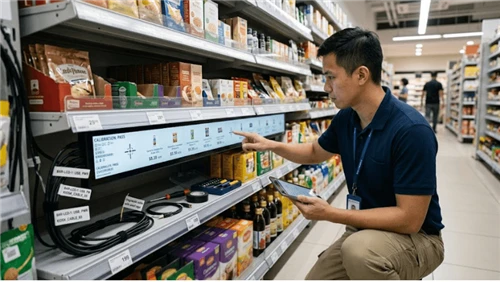
The pick to light display modules are the visible front end. Each unit typically includes a multi-digit numeric or alphanumeric screen, an LED indicator light (often multi-color to encode priority or zone), and a tactile confirmation button. Some newer modules incorporate e-ink display technology-a low-power screen type that holds an image without continuous electricity-reducing energy consumption across installations with thousands of positions.
Behind those modules sits a zone controller: a small industrial-grade circuit board that manages communication between a cluster of modules (usually 24 to 128 per controller) and the central server. Those capacity figures come from published specifications by Lightning Pick and Voodoo Robotics, two of the more widely deployed vendors in North America. Wiring in older installations runs on RS-485 or CAN bus, both standard serial communication protocols used widely in industrial automation. Current-generation systems increasingly rely on wireless protocols to cut installation cost and allow easier reconfiguration when slotting changes.
At the software layer, the system integrates bidirectionally with the WMS or ERP. Pick instructions flow down; confirmations, exceptions, and timestamps flow back. The depth of that integration matters more than most spec sheets suggest-if your WMS can push wave-planned batches to the light system rather than single orders, you unlock batch picking and cluster picking modes that multiply throughput further.
Where Pick to Light Earns Its ROI Fastest: Best-Fit Scenarios
Not every warehouse picking automation project benefits equally from light-directed picking. The technology delivers its strongest returns in specific operational profiles, and recognizing those patterns early saves you from over-investing-or under-investing.
High-velocity, low-SKU-count environments see the fastest payback. Think e-commerce fulfillment centers handling 2,000 to 20,000 SKUs where a relatively small portion of those SKUs drives the majority of picks. In Pareto-heavy operations-a common distribution pattern where roughly 20% of SKUs account for 80% of pick volume-equipping just those A-velocity slots with pick to light modules captures most of the benefit at a fraction of full deployment cost.
Pharmaceutical distribution and medical device warehouses represent another strong use case, not primarily because of speed but because of traceability. Every confirmation event in a pick to light system creates a timestamped, location-stamped, operator-stamped record. For operations subject to FDA 21 CFR Part 211 (the U.S. federal regulation governing pharmaceutical manufacturing controls) or EU Good Distribution Practice (GDP) requirements, that audit trail reduces compliance risk without bolting on a separate verification layer.
Multi-line, same-day fulfillment operations-subscription box companies, promotional kitting, retail store replenishment-also benefit heavily. These environments demand both speed and accuracy across dozens of unique items per order. Manual picking methods struggle to hold order fulfillment accuracy above 97% at pace; pick to light routinely holds 99.7% or higher. That figure aligns with accuracy benchmarks in the WERC DC Measures study, which annually surveys distribution center performance across multiple picking methodologies.
Pick to Light vs. RF Scanning vs. Voice Picking: Which Warehouse Picking Technology Fits?
Warehouse operators evaluating directed-picking systems usually weigh pick to light against voice picking and RF barcode scanning. Each technology occupies a different sweet spot, and in practice, many facilities run more than one.
Voice picking excels in large-footprint, full-case picking environments-think grocery distribution where an operator traverses long aisles pulling cases from deep pallet racking. The hands-free nature of voice suits those workflows. But voice systems slow down in high-density, multi-SKU zones where operators need to distinguish between adjacent bins holding similar products. The verbal confirmation loop ("pick three from Baker-Seven... three from Baker-Seven, confirmed") introduces latency that light-directed systems eliminate with a glance and a button press.
RF scanning with handheld terminals offers flexibility and relatively low per-position cost. For warehouses with very broad SKU profiles-50,000+ items-RF scanning avoids the cost of mounting modules across every location. But RF-based picking requires the operator to repeatedly shift attention between the screen and the shelf. Research from Georgia Tech's Supply Chain & Logistics Institute has documented that this context-switching penalty produces error rates approximately 3–5 times higher than light-directed methods in side-by-side warehouse trials.
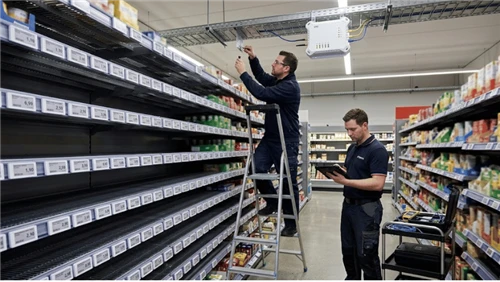
Advanced warehouse operations sometimes deploy electronic shelf label hardware in tandem with pick to light to create a dual-purpose system: the same display modules serve as dynamic location labels during non-picking hours and switch to active pick guidance during order fulfillment windows.
Is Pick to Light Right for Your Warehouse? A Decision Checklist
| Evaluation Factor | Strong Fit for Pick to Light | Consider Alternatives |
|---|---|---|
| Daily order lines | 1,000+ lines/day | Under 300 lines/day |
| Active SKU count | 500–20,000 SKUs | 50,000+ SKUs (RF scanning may be more cost-effective) |
| Accuracy requirement | 99.5%+ (pharma, medical, aerospace) | 95–97% acceptable (bulk, low-value goods) |
| Pick type | Eaches and inner packs | Full-case or full-pallet (voice or RF often better) |
| Labor turnover | High turnover; need fast training ramp | Stable long-tenured workforce |
| WMS maturity | WMS supports real-time pick-release and wave planning | No WMS or basic spreadsheet-driven inventory |
| Slotting discipline | Enforced single-SKU-per-slot rules | Chaotic slotting with frequent ad hoc changes |
| Budget per position | $250–$500 total installed cost acceptable | Under $50/position target (paper or basic RF) |
If your operation checks five or more boxes in the "Strong Fit" column, pick to light likely warrants a formal vendor evaluation. Fewer than three suggests the capital may be better allocated to other warehouse picking automation improvements first.
Implementation Realities: What the Sales Brochures Don't Mention
Deploying pick to light in a working warehouse involves more operational nuance than vendors typically surface during the evaluation phase. Several factors consistently determine whether an installation hits its projected ROI or falls short.
Slotting discipline becomes non-negotiable. A pick to light system hardwires the relationship between a SKU and a physical position. If your slotting is chaotic-items migrating between locations, overstock spilling into neighboring slots, new products shoved wherever space exists-the light system will direct operators to wrong locations. Before commissioning the hardware, invest in a slotting optimization pass. Recalculate velocity-based positioning and enforce single-SKU-per-slot rules in your WMS.
Ergonomic zone design deserves more attention than it typically gets. The ideal pick to light zone keeps an operator within a 10–15 foot lateral travel path, with pick faces between knee and shoulder height. Stretching zones wider increases non-productive walk time; compressing them vertically into positions that require bending or reaching overhead drives fatigue and injury risk. Facilities using put to light configurations for sorting operations face the same ergonomic considerations, with the added variable of outbound container positioning.
Training time, often cited as a major advantage, is real but requires context. Operators can learn the basic pick-confirm-advance cycle in under 30 minutes. However, handling exceptions-short picks, damaged inventory, location discrepancies-requires additional training and clearly defined escalation workflows in the WMS. Without that, operators freeze when the lights don't match reality, and throughput drops until a supervisor intervenes.
Measuring Pick to Light Performance: Essential Warehouse KPIs
- Lines per operator per hour: The primary throughput metric. Baseline your current paper or RF-based rate before go-live. Well-tuned pick to light zones typically produce 250–450 lines per hour per operator, depending on zone density and order profile-a range consistent with data reported in the MHI Annual Industry Report.
- First-pass accuracy rate: Measure picks confirmed without exception intervention. Target 99.5% minimum; investigate root cause for any zone consistently below 99%. The WERC DC Measures study classifies 99.5%+ as "best-in-class" for piece-level picking operations.
- Average pick cycle time: Time from light activation to confirmation press. This isolates operator speed from walk time and system latency. Under 4 seconds per pick is a reasonable benchmark for eaches picking.
- System uptime: Module failures, controller dropouts, and WMS communication interruptions all eat into throughput. Track mean time between failures at the zone level, not just the system level.
- Training ramp time: Days until a new operator reaches 90% of veteran throughput. Pick to light typically compresses this to 1–2 days versus 1–2 weeks for paper or RF methods, per deployment case studies from Lightning Pick and Matthews Automation.
The Technology Trajectory: Where Pick to Light Is Heading in 2026 and Beyond
Pick to light is not a static technology. Several developments are reshaping what these systems can do and how they integrate into broader warehouse automation strategies.
Integration with autonomous mobile robots (AMRs)-self-navigating warehouse vehicles that move shelving units without fixed conveyors-is one of the most significant shifts. In goods-to-person configurations, AMRs deliver portable shelving units to a pick station, and warehouse management display modules at the station light up to direct the operator's picks from that specific unit. This hybrid model combines the travel-time elimination of goods-to-person with the pick-accuracy advantage of light direction. Locus Robotics and 6 River Systems both published case studies in 2024 documenting this combined approach in live fulfillment environments.
Wireless mesh network architectures are replacing hardwired bus systems. Voodoo Robotics reports that wireless installation cuts deployment time by 40–60% compared to traditional wired setups, making seasonal reconfiguration viable. For operations that dramatically shift slotting between peak and off-peak seasons, wireless pick to light modules can be repositioned in hours rather than days.
Data analytics layers are getting richer. Modern pick to light platforms log every event with millisecond granularity, enabling heat-map analysis of pick zones, identification of bottleneck positions, and predictive maintenance alerts when a module's confirmation button response time degrades-an early indicator of mechanical wear.
Frequently Asked Questions About Pick to Light Systems
Q: How much does a pick to light system cost per position?
A: Hardware cost per pick position typically ranges from $150 to $350, depending on module complexity, display type, and whether the installation is wired or wireless. Total installed cost-including controllers, software integration, and labor-runs $250 to $500 per position for most mid-scale deployments. Those ranges reflect pricing published by Conveyco, Bastian Solutions, and Matthews Automation for North American projects. Operations with 500+ positions often negotiate volume pricing that brings per-position cost toward the lower end of that range.
Q: Can pick to light work alongside an existing WMS without a full software replacement?
A: Yes. Most pick to light vendors provide middleware or API layers that sit between the light system and your current WMS. The integration typically involves mapping your WMS pick-release transactions to the light system's instruction format. Complexity scales with how your WMS handles waving, batching, and exception processing. Budget 4–8 weeks for integration and testing in a moderately complex WMS environment.
Q: What is the difference between pick to light and put to light?
A: Pick to light directs an operator to remove items from illuminated locations-pulling inventory outward. Put to light reverses that flow: the operator scans or picks an item and then follows lit indicators to place it into the correct outbound order container or sorting position. Many facilities use both within the same operation-pick to light in the forward pick zone, put to light at the packing or sorting station. The underlying hardware is often identical; the software configuration and workflow direction differ.
Q: How long does it take to see ROI from a pick to light implementation?
A: Payback periods vary, but operations processing more than 1,000 order lines per day typically see ROI within 12–18 months through combined labor savings, error reduction, and faster training ramp. High-volume operations exceeding 5,000 lines daily often recover their investment in 6–9 months. The calculation hinges on your current cost per pick error-in pharmaceutical or aerospace parts distribution, a single mispick can cost hundreds of dollars in rework and compliance documentation, accelerating payback significantly. These timelines are consistent with ROI modeling frameworks published by the Material Handling Institute (MHI).
Q: Do pick to light systems require ongoing maintenance?
A: Maintenance requirements are low but not zero. LED modules have operational lifespans of 50,000–100,000 hours, per manufacturer specifications from Lightning Pick and Banner Engineering. Confirmation buttons are the most common wear component, typically requiring replacement after 1–2 million presses. Zone controllers need firmware updates as WMS integrations evolve. Budget 2–5% of initial hardware cost annually for replacement parts and preventive maintenance.
Q: What data should I prepare before meeting pick to light vendors?
A: Come with at least six months of order data showing daily line counts, SKU velocity distribution, average lines per order, current pick error rate, and current labor cost per line picked. If you have WMS data on zone-level travel time and pick cycle time, bring that too. Vendors who ask for this data upfront are typically the ones who design systems around your operation rather than selling a generic configuration.
Next Steps: Evaluate Whether Pick to Light Fits Your Operation
If the scenarios and benchmarks in this guide match what you're seeing on your warehouse floor, the next step is a fit assessment-not a sales call. A proper evaluation starts with your data: order profiles, SKU velocity curves, current error rates, and WMS capabilities. From there, a qualified integration team can model expected throughput gains, estimate installed cost per position, and identify which zones justify light-directed picking versus other methods.
Our engineering team at Kiosk Etag Screen has designed pick to light display hardware for distribution centers ranging from 500-position regional fulfillment operations to 8,000-position pharmaceutical DCs. If you want to start with a technical conversation about module specifications, wireless versus wired architecture, or WMS integration requirements, reach out to our warehouse display engineering team for a no-obligation technical consultation. We can also provide a sample hardware kit for bench testing before you commit to a full deployment.