This guide offers retail operations managers, procurement teams, and sustainability leads a supplier-neutral breakdown of the main sustainable retail display solution categories: what each involves, what it costs in real terms, and how to align your choices with growing compliance requirements.
What Counts as a Sustainable Retail Display Solution?
The term covers any customer-facing visual element in a store - shelf labels, promotional signage, end-cap displays, window graphics, and fixture systems - redesigned to reduce material waste, energy use, or both across the product's full service life.
Four categories account for most of the market:
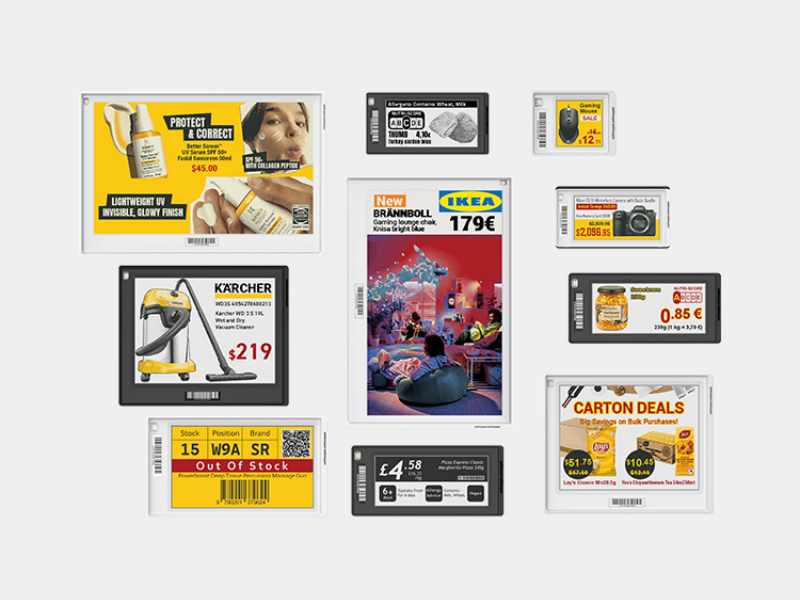
- Electronic shelf labels (ESL) and e-paper digital signage - wireless, updateable display units that eliminate paper consumption entirely
- Reusable and modular fixture systems - reconfigurable structures designed to serve multiple promotional cycles, replacing single-use cardboard
- Recycled and bio-based display materials - substrate and film alternatives to conventional PVC, compatible with existing fabrication processes
- Digital-physical hybrid displays - recyclable printed structures paired with a reusable electronic module for dynamic content
Most retailers end up combining two or more categories. The right starting point depends on store format, content update frequency, and capital budget.
Why 2026 Is a Decision Point, Not a Planning Horizon
Two factors have shifted the business calculus over the past 18 months.
The first is regulatory. The EU's Packaging and Packaging Waste Regulation (Regulation (EU) 2025/40) entered into force in February 2025 and becomes legally binding across all Member States on August 12, 2026. It sets recyclability thresholds for display and packaging materials, restricts several single-use plastic formats from 2030, and ties Extended Producer Responsibility (EPR) fees directly to material choices. Retailers operating in EU markets who have not yet audited their display inventory against PPWR criteria are behind the compliance cycle.
The second is operational. As wage floors have risen across the UK, US, and EU, staff hours committed to manual label management have become a measurable cost line. Electronic shelf label solutions are designed to eliminate that workload - and in high-labor-cost markets, that saving frequently carries the investment decision by itself.
The Four Solution Types: What Each Actually Involves
Electronic Shelf Labels and E-Paper Signage
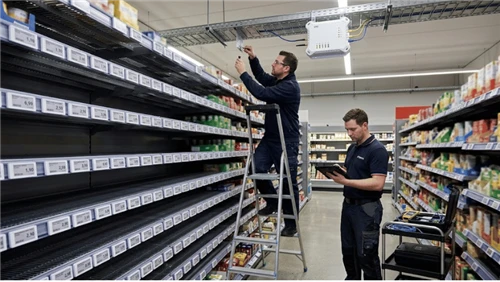
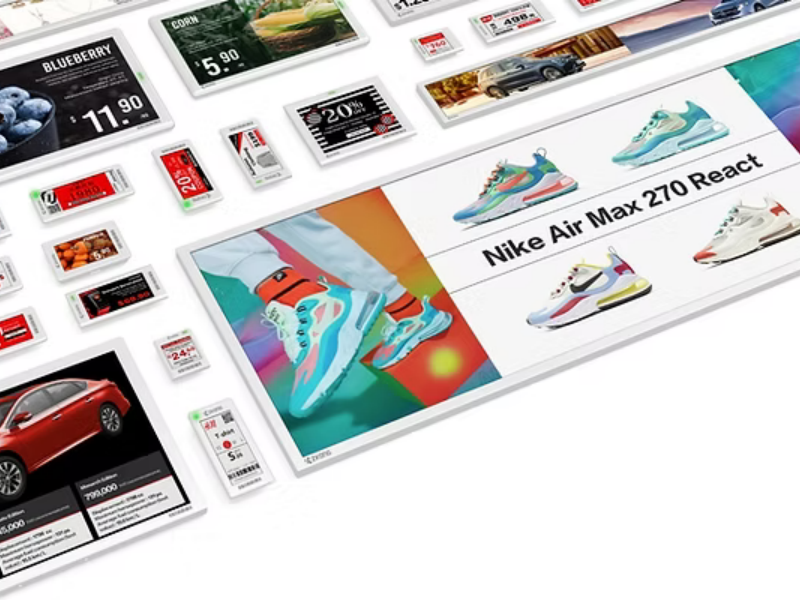
E-paper uses bi-stable display technology: the screen draws power only during a content refresh and holds the image indefinitely at zero energy draw. Compact tags at the shelf edge (typically 2–7 inches) replace paper price labels; larger panels handle category and promotional signage. All update wirelessly from a central platform - simultaneously across thousands of tags and multiple store locations.
How ESL systems work in practice varies by wireless protocol. A comparison of Bluetooth, Wi-Fi, and Sub-GHz ESL protocols is worth reviewing before specifying a system - each has different coverage patterns and gateway infrastructure requirements that affect total deployment cost.
Tag service life runs 5 to 10 years depending on update frequency. For high-SKU operations, the ESL versus paper label comparison shifts decisively once five-year labor costs are included. Beyond standard black-and-white e-paper, color e-paper ESL technology now supports three to seven display colors - relevant for branded shelf programs or formats where product imagery at the shelf edge matters.
Reusable and Modular Fixture Systems
Modular aluminum frame systems assemble tool-free and reconfigure between campaigns. The structural hardware is retained; only the graphic inserts are replaced each cycle. Pooling services extend this further: a third-party provider manages standardized display units on a pay-per-use basis, handling logistics and redistribution.
After three to four campaign cycles, per-campaign costs typically fall below the equivalent single-use cardboard display. For FMCG brands running seasonal promotions, this is where direct cost savings and waste reduction converge most clearly.
Recycled and Bio-Based Display Materials
This category requires no hardware investment and no IT integration - just a material switch at the next print order, making it the lowest-friction entry point for retailers not yet ready for a larger capital commitment.
Current commercial options include recycled-content display boards (post-consumer waste cores, compatible with standard fabrication), bio-based vinyl films (plant-derived, above 80% biodegradability under industrial composting, GREENGUARD GOLD certified for indoor VOC limits), and PVC-free graphic films that match conventional vinyl durability while remaining recyclable.
Per-unit pricing is broadly comparable to conventional materials. The practical value is compliance: materials meeting PPWR recyclability criteria reduce EPR exposure, and the waste diversion data is directly reportable in Scope 3 accounting. Key certifications to request: GREENGUARD GOLD, SCS Recycled Content, and FSC for paper-based substrates.
Digital-Physical Hybrid Displays
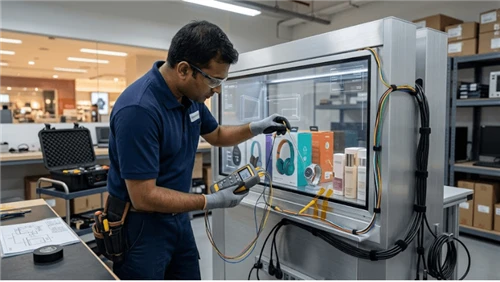
Hybrid displays pair a recyclable cardboard structure with a reusable compact electronic module - typically e-paper or LCD. The printed shell carries campaign-specific brand graphics; the module handles dynamic pricing or rotating promotional content. After each campaign, the cardboard is recycled and a new shell fabricated; the module is redeployed.
For brands running six or more promotional cycles annually, the module cost typically amortizes below the equivalent all-paper display within two years.
Solution Comparison at a Glance
| Solution Type | Typical Upfront Cost (per store) | Annual Running Cost | Service Life | Best Fit |
|---|---|---|---|---|
| ESL / e-paper system | $30K–$90K (tag count dependent) | $2K–$5K (software + support) | 5–10 years | High-SKU formats with frequent price changes |
| Reusable modular fixtures | $20K–$50K | Low (graphic refresh per campaign) | 3–5 years | FMCG seasonal and promotional campaigns |
| Recycled / bio-based materials | Modest premium over conventional | Comparable to conventional | Per campaign | Incremental compliance entry point |
| Digital-physical hybrid | $15K–$40K (module cost) | Low (recyclable shell per campaign) | 2+ years (module) | Dynamic promos without fixed digital infrastructure |
These ranges are benchmarks based on publicly available industry data. Actual costs vary by tag count, store format, and supplier. Always request full-system TCO modelling - including software, gateway, and integration - before budgeting.
What Sustainable Retail Displays Actually Cost - and Where the ROI Comes From
The unit price of an ESL tag is the wrong starting point. What matters is total cost of ownership across five years.
A regional chain with 50 stores, each managing 8,000 SKUs with price changes twice a week on 20% of labels, commits approximately 45 to 60 staff hours per store per week to manual label management. At $18/hour loaded labor cost, that is $900K to $1.1M annually across the chain - before paper and printing. An ESL deployment at that scale typically runs $1.5M to $4.5M upfront, with $100K to $250K in annual software costs. On a five-year horizon, the TCO comparison tends to favor ESL by a meaningful margin.
Pricing errors add another dimension. Manual label changes carry an industry-estimated 1–3% error rate, rising during promotional peaks. The compliance and margin consequences of incorrect price displays are frequently underestimated. ESL systems reduce that error rate to near-zero by syncing shelf display directly with the central price database. For initial cost modelling, an ESL ROI calculator provides a faster baseline than vendor spreadsheets. A breakdown of ESL costs by deployment size is also worth reviewing early in the process.
Compliance by Region: Where the Rules Stand in 2026
For EU retailers, PPWR is the immediate deadline. The August 2026 binding date covers recyclability thresholds, EPR fees that penalize non-recyclable display materials, and the groundwork for single-use plastic bans from 2030. Request third-party recyclability documentation from suppliers - not self-certified assurances.
In the US, California SB 54 (signed 2022) sets the most significant packaging reform timeline, with milestones in 2028 and 2032. Similar legislation has passed in Oregon, Maine, and Colorado. For multi-state retailers, procurement decisions made today need to account for where these standards land by the late 2020s.
For retailers with SBTi commitments or subject to CSRD disclosure requirements, display material choices fall within Scope 3, Category 1 under the GHG Protocol's Scope 3 guidance. ESL and reusable fixture programs both generate quantifiable reductions - request ISO 14040/14044-compliant lifecycle analysis documentation from any supplier you shortlist.
How to Choose: Format Matching and Supplier Due Diligence
| Retail Format | Recommended Starting Point |
|---|---|
| Supermarket / hypermarket | ESL system - labor savings drive the strongest ROI |
| Pharmacy / convenience chain | ESL - medium scale, fast payback cycle |
| FMCG brand / seasonal promotions | Reusable modular fixtures |
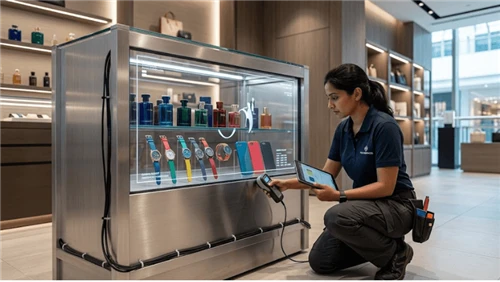
| Premium boutique / department store | Recycled/bio-based materials + e-paper window displays |
| Small independent retailer | NFC-based ESL or material substitution to start |
| Warehouse / logistics retail | ESL for inventory labelling and pick-to-light integration |
Four questions to ask any supplier before signing:
- Can you provide ISO 14040/14044-compliant lifecycle analysis documentation, independently reviewed?
- What wireless protocols does your ESL system support, and do your base stations expose open APIs (MQTT or REST) for POS integration?
- What are the end-of-life disposal or take-back options for hardware and display materials?
- Can you provide direct reference contacts at retailers operating at a comparable format and scale?
Two mistakes worth avoiding: evaluating on hardware price alone (software, gateway, and integration costs frequently exceed hardware cost in year one), and skipping a controlled pilot before chain-wide rollout. A 2–3 store pilot over 8–12 weeks identifies integration issues at a fraction of the cost of a full deployment. For a deeper evaluation framework, see how to choose a retail ESL solution.
Frequently Asked Questions
What is the difference between ESL and digital shelf labels?
"Electronic shelf label" (ESL) is the technical term used in procurement and operations; "digital shelf label" is used more broadly in supplier marketing. Both describe wireless display units at the shelf edge that update from a central management platform using e-paper or LCD technology.
How long do ESL tags last in a working retail environment?
Service life runs 5 to 10 years depending on update frequency and operating temperature. When comparing supplier specifications, check the assumed daily update frequency behind the headline figure - a "10-year" rating based on minimal updates may not reflect your store's actual pricing cadence.
Does EU PPWR apply to retail display materials?
It can. Shelf-ready display structures that function as packaging fall within PPWR scope. Recyclability thresholds apply from 2030, but EPR fee structures that reward reusable and recyclable materials take effect from August 2026. Request formal compliance documentation from suppliers now - after the deadline, procurement options narrow and timelines compress.
Can smaller retailers access ESL without gateway infrastructure?
Yes. NFC-based systems update tags via smartphone, removing the gateway cost entirely. The tradeoff is update speed: each tag requires individual scanning rather than a simultaneous broadcast update. ESL deployment in grocery and small-format stores covers scale considerations in more detail.
How do sustainable display choices factor into Scope 3 reporting?
Display materials fall under Scope 3, Category 1 (Purchased Goods and Services). To quantify the reduction, request lifecycle analysis documentation showing the embodied carbon difference between current materials and the proposed alternative. This data can be used directly in CDP disclosures, CSRD reports, and SBTi progress submissions.
For more background on how electronic shelf labelling works and what to evaluate, or an overview of the main reasons retailers switch to ESL, both are useful next reads depending on where you are in the decision process.