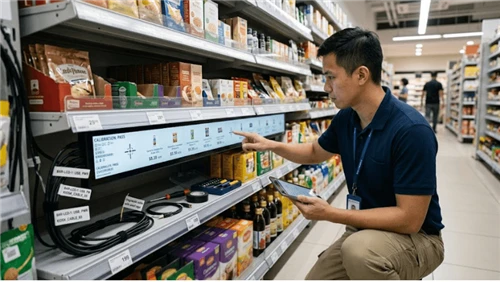
Here's what most people don't understand about ESL: a standalone screen is nothing. Literally useless. You need a network to deliver data to it, software to tell it what to display, and people to deploy this entire system into real stores-that's what constitutes a "solution." The terminal itself, without the network, is a brick. And without the platform feeding it data, what's the point?
In one project, a client insisted on putting base stations inside the ceiling panels because they thought it looked cleaner. They were told the signal wouldn't penetrate well. They didn't listen. Three weeks after launch, half the labels in the frozen section were showing stale prices. Had to rip everything out and redo it. Cost them triple. RF planning matters.

The Labels Themselves
Why E-ink?

ESL terminals are bindend to e-ink screens (E-ink), and this choice is not accidental. The way a hardware engineer once explained it: imagine tiny capsules filled with black and white particles floating in oil. Zap them with electricity, particles move around, image appears. Once the image forms, it just stays there. Cut the power, doesn't matter. The image remains. The technical term is bistable display or something like that.
Power consumption during static display is virtually nothing. Test data shows a 2.13-inch black-and-white label running on a CR2450 button battery, refreshing twice daily, lasted 6 to 8 years. Even with refresh frequency cranked up to more than 5 times daily, that's still about 4 years.
Then there's the fact that it doesn't emit light-it works by reflecting ambient light, same as paper does. You know how LCD screens become completely unreadable in direct sunlight? E-ink stays perfectly clear. And viewing angles are basically a non-issue. Customers aren't always standing directly in front of the label, right? Doesn't matter with e-ink.
Here's something many people don't know: the core technology for e-ink screens globally is almost monopolized by one company-Taiwan's E Ink Corporation. Almost all ESL manufacturers' screens come from E Ink or its authorized partners. This structural factor profoundly affects the cost and competitive landscape of the entire industry.
Size Options
Size-wise, there's a pretty wide range:
1.5 inches - regular shelf edges for everyday products
2.9, 4.2 inches - items that need a bit more info
6 inches - fresh produce, room for origin, grade, maybe a QR code
7.5 inches and up - end caps and category headers, sometimes all the way to 13 inches
Some 13.3-inch ones are used as mini digital signs, though at that point the line with signage starts to blur.

Color Tradeoffs
Now, e-ink has its limitations. The early versions were black and white only. Then manufacturers figured out how to add a third color-usually red or yellow-which was a big deal for promotional callouts. More recently there's been a push toward full-color displays.
Here's the tradeoff, and it's significant:
| Type | Refresh Time | Cost (2.9-inch) |
|---|---|---|
| Black-and-white | 1-2 seconds | Baseline |
| Three-color | 10-15 seconds | ~2x |
| Full-color | 20+ seconds | 3-4x |
Watching a three-color screen update is kind of painful. So most retailers stick with black-and-white or three-color. Full-color tends to show up in cosmetics sections, wine displays-places where the visual presentation is worth the premium.

Why This Even Matters-The Actual Problem
A regional chain supermarket in Zhejiang did a calculation: for one of their stores with 42,000 SKUs, a promotional price change involving 15% of products required 8 employees working nearly 6 hours to complete all the label changes. Before the label changes were complete, a considerable portion of customers saw prices inconsistent with checkout prices. Their internal audit data showed error rate for paper price tags was around 3.2%-about 3 out of every 100 products priced incorrectly.
Incorrect pricing leads to a series of problems:
Customers discover at checkout that the price differs from the shelf price-very bad experience
In many places, violations may face fines
Promotional strategies can't be executed as planned
Clearance items miss their optimal sales window
ESL is essentially a bridge. In traditional retail, "the price in the system" and "the price on the shelf" exist as two independent things. When the system changes a price, the shelf doesn't automatically update-someone has to go change it. That "someone" is the bottleneck in information transmission-bringing delays, errors, and costs. What ESL does is use technology to eliminate this bottleneck, allowing data to flow directly to shelf terminals without manual relay.

Since human labor is the bottleneck, use technology to replace it. The moment data changes in the system, it pushes to labels through the network, labels automatically refresh. No walking to shelves, no paper, no printing. Delay compressed from hours to minutes, error rate drops from several percent to near zero, labor costs significantly decrease.
When price updates are no longer a bottleneck, new possibilities open up. Dynamic pricing becomes possible. Online and offline prices can sync in real-time. Promotional activities can take effect precisely to the second. That's the real value.
The Communication Piece
Labels are hands, base stations are nerves, responsible for transmitting instructions from the brain (platform) to every hand.
Base stations are usually flat box-shaped, similar in size to home routers, installed on ceilings, shelf tops, or walls. Each base station covers a range of 10 to 50 meters, depending on communication protocol, transmission power, and environmental interference. A standard 3,000 square meter supermarket typically deploys 45 to 60 base stations, with the fresh refrigerated area requiring denser deployment due to signal shielding issues.
Communication Protocols
This is where manufacturers differentiate themselves-the communication protocols. Here's what different vendors have shared over the years:
2.4GHz Proprietary (SES-imagotag, Hanshow)

The big guys went with 2.4GHz proprietary stuff. Their engineers explain that they wanted full control over how the protocol behaves for ESL specifically. Makes sense. The downside-once in their ecosystem, switching is a nightmare. Their labels won't talk to anyone else's base stations. One client wanted to mix and match. Couldn't be done.
Sub-GHz (433MHz, 868MHz)
Some vendors prefer the lower frequencies. A Pricer rep explained that lower frequencies punch through obstacles better, which tracks with what was observed in a warehouse project with lots of concrete. But the regulations are different in every country, and the antennas end up bigger. It's a tradeoff.
Bluetooth Low Energy
Getting popular, especially with the newer players. Chips are dirt cheap now, and there's this appeal of letting customers tap their phones on labels for product info. It demos well. In actual dense deployments though, the range limitations start showing, and there's channel congestion. In one project, update schedules had to be spaced out because too many labels were trying to talk at once.
Infrared
Pricer uses this in some of their systems. Works great where there are electromagnetic interference issues. But there's a need for clear line of sight, which, in a real store with people walking around and stuff getting moved, isn't always realistic.
The Power Paradox
Here's what makes ESL communication really tricky to get right: labels need to barely sip power-batteries lasting 5 to 10 years-but they still have to catch updates when sent. The way they solve this is through synchronized sleep-wake cycles. Labels are basically in a coma most of the time, only waking up for a split second during preset windows to check if there's anything new. Power profiles show these things are in microampere-level sleep more than 99% of the time.
Why RF Planning Makes or Breaks Projects
Here's where more time should be spent, because quite a few ESL projects have success or failure largely depending on the quality of communication network planning.
Metal shelving reflects and blocks signals, so base station positions must be carefully designed
Refrigerated cases are basically Faraday cages-metal cabinets, compressor interference, glass doors all affect signals. Usually separate relay devices inside are needed
Peak update periods and dual coverage for key areas to prevent single points of failure
So What is ESL, Anyway-A Definition
Electronic Shelf Label Solution, broken down:
Electronic - distinguishes it from paper
Shelf Label - it's a shelf tag, not an advertising screen
Solution - it's a complete solution, not a single product

Why must it be called "solution"? A standalone electronic label is truly meaningless-it can't obtain prices by itself, can't know what to display by itself, can't refresh by itself. It must rely on a communication network to receive instructions, rely on a software platform to obtain data. That's kind of the first thing to wrap your head around with ESL.
The Software Side
Basically there needs to be some platform that pulls price data from the ERP or POS, figures out what goes on which label, and pushes it out. There's template editors for designing label layouts, and some logic for when to push updates.
The integration part with existing systems-that's where projects get stuck for months. Legacy ERP, weird data formats, IT departments that won't give access.
Getting This Thing Into a Store
An ESL system from nothing to completion requires going through a complete engineering implementation process. The complexity of this process often exceeds the expectations of first-time users. Many projects go sideways here, so this section deserves real attention.
The RF Survey-Where Projects Die
But the thing that kills most projects? RF survey. Or rather, the lack of a proper one.
ESL relies on wireless communication, and real retail environments are full of obstacles and interference:
Metal shelving reflects signals
Refrigerated cabinets are natural Faraday cages
Concrete walls block penetration
Other wireless devices cause interference
During peak traffic, human bodies themselves absorb signals
A proper RF survey is actually a lot of work. It starts with mapping out the physical environment-where the walls are, where the metal shelves are, what's generating interference. Then signal propagation tests show how frequencies actually behave in that specific space. Test the boundary conditions, the weird corners, the areas near the loading dock. The output isn't just "put base stations here"-it should be precise positioning, like down to the centimeter, along with coverage maps showing where the signal is strong, where it's weak, and what to do about the problem spots. It's tedious, but it saves from the nightmare scenario mentioned earlier.

A lot of vendors skip this or do it half-assed to save costs. Then they wonder why 15% of labels keep going offline.
Site Assessment
First step is understanding the store situation:
Physical environment - store area, ceiling height, floor layout, shelf types
Product requirements - total SKUs determine label quantity, category distribution determines size ratios
IT environment - what ERP/POS versions are running, what's the network infrastructure like
Base Station Installation
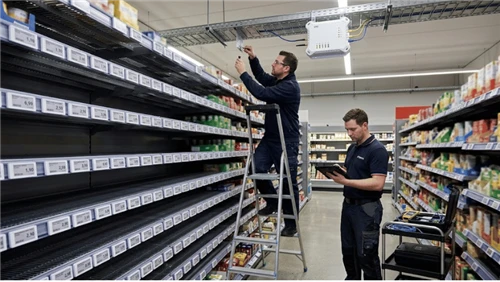
Ceiling mounting is the most common approach-there's clear line of sight to the shelves and it's out of the way. But if the ceiling is too low or there's no good mounting point, they can go on top of the shelving units instead. Wall mounting works as a supplement for certain areas.
Power is usually delivered through PoE, which is convenient because only one cable needs to run. That means PoE switches to power everything, and depending on the setup, maybe a local server or gateway.
Don't forget UPS-if the power goes out and the system crashes ungracefully, it can corrupt the database.
Label Deployment
Receive the shipment, inspect them, run activation tests to make sure they actually work
Scan each label and bind it to the corresponding product in the system
Physical installation depends on what kind of shelving is in place
Some labels hook onto the shelf edge, some slide into a rail slot. There are magnetic ones for metal surfaces, adhesive ones for smooth surfaces, and little stands for display cases. Nothing complicated, just time-consuming when doing thousands of them.
Testing & Validation
Functional testing - does everything work as expected?
Coverage testing - every single label
Stress testing - under peak load for at least 72 hours
System integration already mentioned-this is where projects die. The joint debugging phase alone can take weeks if the legacy systems are messy enough.