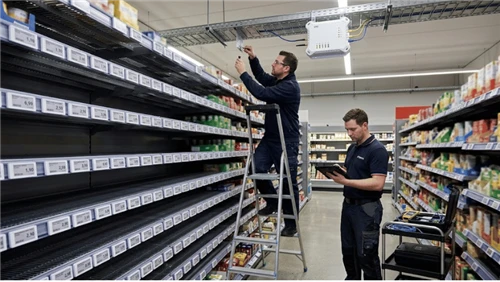
Electronic shelf labels have moved from pilot curiosity to operational standard. Walmart's ongoing U.S. rollout of SES-imagotag labels, Amazon's use of e-ink tags in Fresh stores, and steady adoption across European grocery chains have shifted the conversation from "should we deploy ESL?" to "which system should we buy?"
This guide compares the 10 best electronic shelf labels available in 2026, breaks down the technology and cost differences that matter, and walks through the selection process by store type.

Best Electronic Shelf Labels to Buy in 2026: Top 3 Picks
| Pick | Product | Price (MOQ 500+) | Battery | Best For | Rating |
| Best Overall | LEGOYO 4.2" E-ink | $15–18/unit | 5+ years | Supermarkets, general retail | 9.4/10 |
| Best Budget | LEGOYO 2.66" Compact | $10–12/unit | 5 years | Small stores, high-density shelving | 8.8/10 |
| Best Large Format | LEGOYO 7.3" Premium | $25–30/unit | 5–7 years | Warehouses, wholesale clubs | 9.2/10 |
The 4.2" model hits the sweet spot between screen area, unit cost, and battery life for the broadest range of retail applications. For high-density shelving where budgets are tight, the 2.66" handles core pricing without excess. In warehouse environments where readability at 3–5 meters determines picking speed, the 7.3" with LED indicators pays for itself fastest.

How to Choose the Right Electronic Shelf Label System
Picking an ESL system comes down to six factors. Get any one wrong and you'll either overspend or end up replacing hardware within a year.
Electronic Shelf Label Display Technology: E-ink vs LCD vs Segmented
E-ink (electrophoretic) uses the same principle as Kindle readers - charged particles in microcapsules rearrange to form text and images. The display draws power only during updates, not while holding an image. That's why battery life reaches 5–7 years at moderate update frequencies. E-ink reads well under bright store lighting with roughly 180° viewing angles. The trade-off: no video, limited color (most models offer black/white with one accent color), and refresh takes 5–20 seconds.
LCD shelf-edge displays are small screens requiring continuous power. They support full video, unlimited color, and instant refresh. Unit cost runs $80–200+, they need electrical wiring or frequent charging, and heat output makes them impractical for refrigerated zones. According to the Digital Signage Federation's 2024 retail survey, LCD shelf displays account for less than 8% of total shelf-edge digital deployments.
Segmented displays work like calculator screens - predefined character positions, no graphics. Battery life is the longest (7–10 years) and cost the lowest ($5–12), but they can't render barcodes, images, or flexible layouts.
For roughly 90% of shelf positions in a typical retail store, e-ink delivers the best balance of functionality, cost, and longevity.

Electronic Shelf Label Size Guide: Matching Screen to Viewing Distance
| Screen Size | Reading Distance | Typical Use |
| 1.54"–2.13" | Under 1 meter | Pharmacy, cosmetics, small packaged goods |
| 2.66"–2.9" | 1–1.5 meters | Grocery aisles, convenience stores |
| 4.2"–4.4" | 1.5–2.5 meters | Supermarkets, electronics, general retail |
| 5.8"–7.3" | 3–5 meters | Warehouses, bulk storage, wholesale clubs |
The common mistake: choosing the smallest (cheapest) label for every position. A pharmacy aisle with 20+ SKUs per shelf meter can work with 2.13" labels. A produce section where staff stand 2 meters back cannot. Mismatched sizing leads to read errors and defeats the purpose of the system.
ESL Battery Life vs. Price Update Frequency
Advertised battery life - usually "5+ years" - assumes 2 updates per day. Actual service life depends on how often you push changes:
| Update Frequency | Realistic Battery Life |
| 1–2x / day | 5–7 years |
| 4–6x / day | 3–4 years |
| Hourly | 2–3 years |
| Every 15 minutes | 1–2 years |
Before purchasing, ask the vendor for battery life at your actual update cadence. If hourly updates are required for part of the store, budget $3–5 per label for battery replacement every 2–3 years in those zones.
ESL Wireless Protocol: BLE vs Zigbee vs WiFi
BLE (Bluetooth Low Energy) 5.0+ is the industry standard. Range is 50–100 meters in theory, 30–70 meters once metal shelving absorbs signal. Power draw is minimal and BLE silicon is mature - the Bluetooth SIG reports over 5 billion BLE devices shipped in 2024.
Zigbee uses a mesh topology where labels relay signals to neighbors. Useful in very large facilities, but adds setup complexity. WiFi ESLs drain batteries roughly 3× faster than BLE and can interfere with store WiFi networks. Unless a specific integration demands it, BLE is the default choice.
Temperature Ratings for Refrigerated and Freezer Electronic Shelf Labels
Standard ESLs operate between 0°C and 40°C (32–104°F) - fine for regular store floors and standard refrigerated sections (2–8°C). Freezer aisles below −10°C require cold-rated labels (−25°C to 40°C), which carry a 30–50% price premium and refresh more slowly at extreme cold.
Map your store's temperature zones before ordering. Most retailers need cold-rated labels for 5–10% of total positions. Buying them for the entire store wastes money; skipping them in the freezer section means replacing failed labels within months.

ESL System Integration: POS, Inventory, and ERP Compatibility
At minimum, the ESL system must pull pricing data from your POS. Verify before purchasing: Can your POS export product/price data via API, webhook, or scheduled file (CSV/XML)? Does the ESL vendor provide pre-built connectors for your POS platform? If your POS is legacy or custom-built, does the vendor offer a REST API or database connector?
Additional integrations - inventory management (stock alerts on labels), ERP (product master data, lot tracking), promotion engines (automated discount displays) - add value but aren't prerequisites for basic deployment.
Typical integration timelines: 1–2 weeks for modern POS with API support, 4–8 weeks for enterprise ERP, 8–16 weeks for legacy systems requiring custom middleware.
Top 10 Best Electronic Shelf Labels Compared: Specs, Pricing, and Use Cases
The ESL market has consolidated around a handful of established players. Below is how they compare on hardware, price, and fit. Pricing reflects MOQ-based quotes as of late 2025; actual costs vary by volume and configuration.
1. VusionGroup SES-imagotag 4.2" - Enterprise Electronic Shelf Label

Market-share leader in enterprise ESL. Walmart's large-scale U.S. rollout runs on SES-imagotag infrastructure. The software platform includes analytics and audit tools. NFC tap-to-verify confirms label-product binding by phone tap. Battery: 5 years. Trade-off: 40–60% price premium over comparable hardware, plus annual software licensing fees of $2–5 per label that compound over multi-year deployments. $22–28/unit.
2. Pricer Plaza 3.7" - European Market Leader in Shelf Labels

Strong presence in European grocery (ICA, Carrefour). The optical flash function - the screen flashes to guide staff to a specific product - supports click-and-collect order fulfillment. Battery: 5 years. Less common in U.S. deployments; North American lead times tend to be longer than Asian-manufactured alternatives. $20–25/unit.
3. Hanshow Nebular 4.2" - Mid-Range E-ink Shelf Label

Competitive mid-market option. Tri-color e-ink. Solar charging accessory extends battery life in stores with strong overhead lighting. Battery: 5 years. Software interface is functional but less polished than SES-imagotag or LEGOYO platforms. Fewer pre-built POS integrations - custom API work may be required. $16–20/unit.
4. LEGOYO 4.2" E-ink Electronic Shelf Label - Best Overall Value

The 4.2" size covers the broadest range of retail scenarios. Resolution (400 × 300 px) renders barcodes and multi-line product info cleanly at 2+ meters. The tri-color option (black/white/red) supports promotional highlights without significant cost increase. BLE 5.0 protocol, 5+ year battery at 2–3 updates/day, with standard (0–40°C) and cold-rated (−25–40°C) versions available. Mounting options include rail clip, magnetic, screw, and adhesive. REST API, database connector, and CSV import for integration. CE, FCC, RoHS certified. $15–18/unit at MOQ 500+.
5. LEGOYO 2.66" Compact ESL - Best Budget Electronic Shelf Label

Same wireless platform and battery chemistry as the 4.2", in a smaller form factor. Resolution: 296 × 152 px. Battery: 5 years. Practical for high-density deployments - pharmacies with 20+ items per shelf, or as supplemental labels alongside larger displays on main facings. Content capacity is limited to price, SKU, and a short product name; it won't fit detailed promotional text. $10–12/unit at MOQ 500+.
6. LEGOYO 7.3" Large Format ESL - Best Electronic Shelf Label for Warehouses

Readable from 5+ meters - critical for warehouse bin locations and bulk storage aisles. Resolution: 800 × 480 px. Battery: 5–7 years. Integrated red/green/blue LED indicators support pick-to-light workflows. According to a 2024 Logistics Management survey, pick-to-light systems reduce new-hire training time by 60–80% compared to paper-based picking. $25–30/unit at MOQ 200+.
7. SoluM Newton 4.2" - Zigbee Mesh Electronic Shelf Label

Zigbee mesh networking performs well in large, multi-aisle grocery stores where BLE range hits limits. Optional 7-color e-ink produces richer displays but refreshes slower (15–20 seconds) and shortens battery life. Battery: 5+ years (standard mode). Gateway hardware costs more than BLE-based systems. $17–22/unit.
8. E Ink Spectra 6 2.9" - Full-Color Electronic Shelf Label

Best color reproduction in the e-ink ESL category - 6-color ACeP display. Useful for fashion retail, cosmetics, or premium brand displays where visual appeal on the label influences shopper perception. Battery: 4–5 years. Trade-off: slower refresh, shorter battery life, higher unit cost than standard bi-color or tri-color labels. $18–24/unit.
9. Displaydata Chroma 3.1" - Budget Electronic Shelf Label

Budget-friendly with faster-than-average refresh cycle (Photon architecture). Battery: 5 years. Limited size options and fewer enterprise integration connectors. Serves small and mid-size retailers needing basic price display without complex promotional templates. $12–16/unit.
10. Opticon ESL 2.13" - Ultra-Compact Shelf Label for High-Density Retail

The smallest mainstream ESL. Fits jewelry cases, cosmetics fixtures, pharmacy blister-pack aisles where nothing else will. Content limited to price, short product name, and small barcode. No tri-color option. Battery: 5–7 years. $9–13/unit.
E-ink vs LCD Electronic Shelf Labels: Which Display Technology to Buy
This is a ratio question for most retailers, not an either/or.
E-ink handles price integrity across the store - the job that runs 24/7/365 with minimal intervention. No wiring, no heat, no glare, 5–7 year battery, $10–30 per label.
LCD shelf-edge displays handle promotional impact in targeted zones. Full video, animation, unlimited color. But they require power infrastructure, generate heat (unsuitable for refrigeration), cost $80–200+ per unit, and last 3–5 years before backlight degradation.
The pattern that works: e-ink for 90% of shelf positions (price accuracy, low maintenance), LCD for the remaining 10% of high-margin or promotional zones (endcaps, feature displays, wine sections, demo stations). A 2023 Path to Purchase Institute study found that digital shelf-edge displays in promotional zones increased category sales lift by 18–24% - but only when deployed selectively at decision points, not across entire aisles.
LEGOYO manufactures both: e-ink labels from 2.66" to 7.3", and LCD bar-type displays from 28" to 49.5" - simplifying procurement for hybrid deployments.
Electronic Shelf Label Buying Guide by Store Type

| Store Type | Recommended Labels | Approx. Count | Est. Total Cost | Typical ROI |
| Supermarket (15k sq ft) | 4.2" main aisles, 2.9" cold-rated freezers, 2.66" pharmacy | 2,500–4,000 | $73k–$84k | 10–14 months |
| Convenience Store | 2.66" primary, 2.9" standard coolers | 600–1,200 | $11k–$13k | 12–18 months |
| Warehouse / DC | 7.3" with LED bulk, 4.2" small parts bins | 1,500–5,000 | $60k–$75k | 4–8 months |
| Pharmacy | 2.66" OTC shelves, 4.2" prescription area | 1,400–2,400 | $20k–$25k | 14–20 months |
| Fashion / Apparel | 2.9" with clothing clip, 4.2" shelves | 1,100–2,100 | $16k–$22k | 14–18 months |
| Hardware Store | 4.2" standard aisles, 7.3" lumber, 2.66" small parts | 2,100–4,200 | $25k–$45k | 12–16 months |
Cost estimates include labels, gateways, installation, and basic software integration. Enterprise ERP integration or custom middleware adds $5,000–$25,000 depending on system complexity. Figures reflect 2025–2026 market pricing at volume MOQs.
Warehouse deployments consistently show the fastest payback because labor efficiency gains - faster picking, shorter training cycles - translate directly into measurable cost reduction. Retail ROI depends more on pricing error reduction and labor reallocation, which are real savings but harder to quantify without baseline measurement.
Electronic Shelf Label Cost vs. Paper Labels: 5-Year ROI Analysis
Below is a comparison for a mid-size store with 2,000 shelf positions and 500 weekly price changes. Labor at $18/hour. Pricing error cost uses the National Retail Federation's estimated average of $50–$100 per incident ($75 midpoint).
Paper Label System: 5-Year Cost
| Category | Annual | 5-Year Total |
| Printing (500/week × $0.05) | $1,300 | $6,500 |
| Labor (10 hrs/week × $18/hr) | $9,360 | $46,800 |
| Pricing errors (15/week × $75) | $58,500 | $292,500 |
| Printer maintenance + supplies | $1,400 | $7,000 |
| Total | $70,560 | $352,800 |
ESL System: 5-Year Cost
| Category | One-Time | Annual | 5-Year Total |
| 2,000 labels × $16 avg | $32,000 | - | $32,000 |
| 8 gateways × $500 | $4,000 | - | $4,000 |
| Installation + integration | $14,000 | - | $14,000 |
| Software licensing | - | $2,000 | $10,000 |
| Battery replacement + maintenance | - | $2,800 | $14,000 |
| Total | $50,000 | $4,800 | $74,000 |
5-year net savings: ~$279,000. Payback lands around 10–11 months under these assumptions. The single largest driver is pricing error reduction - identified by the NRF as one of the top operational pain points in physical retail. Even if actual error rates are half the estimate above, the system still pays for itself within 18 months.
These are model figures. Actual results vary by store size, price volatility, labor market, and existing error rate. Run the numbers with your own inputs before committing.
ESL System Integration: Technical Requirements Before You Buy
Pre-Purchase Integration Checklist for Electronic Shelf Labels
POS integration (required): Confirm your POS can export product and price data via API, webhook, or file export. Identify update frequency capability (real-time push vs. scheduled batch). Verify multi-location pricing support if applicable.
Inventory management (recommended): Enables out-of-stock and low-stock alerts on labels. API connection preferred; scheduled file export as fallback.
ERP (nice-to-have): Product master data, lot/batch tracking, compliance data. Relevant for pharmacy (expiration dates) and food retail (traceability).
Network and Gateway Infrastructure for ESL Deployment
BLE gateways need AC power (110V or PoE) and internet (WiFi or Ethernet) for cloud sync. Plan for 30–40 meter effective radius in stores with metal shelving - budget 30% more gateways than theoretical coverage. ESL labels are battery-powered and communicate via BLE; no store-wide electrical work needed for labels.
ESL Deployment Timeline
Standard deployment - site survey through full go-live - takes 6–8 weeks: 2 weeks planning and survey, 2 weeks hardware installation and label binding, 2 weeks system integration and template configuration, 1 week parallel operation and cutover.
5 Electronic Shelf Label Buying Mistakes That Cost Retailers Thousands
1. Choosing ESL size by price instead of viewing distance. A pharmacy chain deployed 2.13" labels across all 12,000 positions. Picking errors nearly tripled before 40% were replaced with 4.2" models. Match size to reading distance first, then optimize cost within that constraint.
2. Underestimating gateway count. Theoretical BLE range (100m) drops to 40–50m with metal shelving. A 15,000 sq ft supermarket that installed 5 gateways based on spec-sheet coverage ended up with 30% of labels in dead zones. Always conduct a site survey and budget 30–50% more gateways than calculations suggest.
3. Skipping the pilot phase. A retail chain ordered 25,000 ESLs across 12 stores without testing integration. Their legacy POS only supported nightly batch exports, meaning prices lagged 24 hours. The middleware fix cost $40,000. Pilot 500–1,000 labels in one store first.
4. Ignoring total cost of ownership. One retailer chose $8/unit labels over $16 alternatives. Hidden costs: $3/year per label software licensing (undisclosed), proprietary gateways at $1,200 each (vs. $500 standard), $5,000 for API access included free elsewhere. Five-year TCO was 40% higher than the "expensive" option.
5. Deploying standard labels in freezers. Standard ESLs (rated 0–40°C) fail within weeks at −18°C. Cold-rated labels cost 30–50% more but are necessary below −10°C. Map temperature zones before ordering.
Frequently Asked Questions About Buying Electronic Shelf Labels
How much do electronic shelf labels cost per unit?
Per-unit pricing at MOQ 500+: $8–12 for 1.54"–2.13" labels, $10–14 for 2.66"–2.9", $15–20 for 4.2"–4.4", and $22–35 for 5.8"–7.3". A complete system for 2,000 shelf positions - labels, gateways, installation, and software - typically runs $45,000–$62,000. Ongoing costs average $3–5 per label annually for software licensing and battery replacement.
What is the best electronic shelf label brand to buy?
For price-to-performance across the broadest retail formats, LEGOYO's e-ink line is the value leader. For enterprise-scale deployments with analytics and audit tools, VusionGroup (SES-imagotag) is the established choice - at a 40–60% premium. Pricer leads in European grocery. SoluM's Zigbee mesh suits very large stores where BLE range is a constraint.
How long do ESL batteries really last?
At 1–2 updates per day, 5–7 years. At 4–6 updates per day, 3–4 years. Hourly updates bring it down to 2–3 years. Always ask vendors for battery life at your expected update cadence, not the marketing figure.
Do electronic shelf labels work in freezer sections?
Standard models (rated 0–40°C) handle normal refrigerated sections (2–8°C) but fail below −10°C. Cold-rated models (−25°C to 40°C) handle deep-freeze environments at a 30–50% price premium with slower screen refresh. Most stores need cold-rated labels for only 5–10% of total positions.
Can electronic shelf labels integrate with my existing POS system?
Modern cloud-based POS systems (Square, Shopify, Lightspeed, Microsoft Dynamics) support API or webhook integration with minimal development. Older systems can often export data via CSV or XML on a schedule. Verify export capability with your POS provider before purchasing ESL hardware.
What happens to electronic shelf labels during a power outage?
E-ink is bistable - the display holds its image without power. Labels continue showing current prices indefinitely. Gateways go offline until power returns, so new updates can't push. Queued changes sync automatically when gateways reconnect.
Can I use the same ESL system across multiple store locations?
Yes - multi-location management is a core ESL capability. Cloud platforms push pricing to all stores simultaneously or allow per-location overrides. Each store needs its own gateways, but labels and software are managed centrally. This is one of the strongest arguments for ESL in franchise and chain operations.
Are electronic shelf labels vulnerable to hacking or tampering?
ESL communication uses AES-128 encryption over BLE. Only authenticated gateways can push updates. Labels don't connect to public networks, and all changes are logged with timestamps and user IDs. In practical terms, your POS and store network are far more exposed than ESL hardware.
Next Steps: How to Start Buying Electronic Shelf Labels
Start with three steps: count your shelf positions and map temperature zones, confirm POS integration capability with your IT team, and request quotes from 2–3 vendors. A pilot of 500–1,000 labels in one location - measured over 90 days - gives you real ROI data before a full rollout.
For pricing on LEGOYO e-ink and LCD shelf-edge displays, visit kiosketagscreen.com.
Related Resources: