A practical guide from a manufacturer who's shipped labels into 300+ facilities across retail, logistics, and industrial warehousing.
A warehouse manager in Shenzhen once told us something that stuck: "We spent ¥2 million on a new WMS, but our pickers were still squinting at faded paper stickers to figure out which bin to pull from." He wasn't wrong. Warehouse management software gets the headlines and the budgets. Labels - the part your workers actually look at fifty times an hour - get ignored until something goes wrong.
We build electronic shelf labels and LCD display systems at LEGOYO. We've been in the store fixture business since 2002 and pivoted into digital display technology in 2019. So we've seen the full spectrum: warehouses running on handwritten masking tape, operations that tried RFID and gave up, and facilities that went all-in on pick-to-light and cut their error rates by an order of magnitude. This guide is what we've learned from those conversations and deployments, not a product pitch.

The paper label problem is worse than most managers think
There's a common misconception that labels are a rounding error in warehouse operating costs. They're not. They're just invisible - spread across labor hours, error correction, and compliance risk in ways that don't show up on a single line item.
The labor math. A distribution center with 10,000 bin locations typically updates 500–1,000 labels per week. Product changes, promotions, replenishment rotations, seasonal swaps. Each change means printing, walking to the right aisle, peeling off the old label, sticking the new one, and double-checking the information. We've timed this across multiple client sites: it averages 2–3 minutes per label. At the high end, that's 50 hours of labor per week - essentially a full-time employee who does nothing but swap stickers.
The error cascade. A wrong label on a bin doesn't cause one mispick. It causes a chain reaction. The picker grabs the wrong item. The packer doesn't catch it (they're moving fast, too). The customer gets the wrong product. Now you're paying for customer service time, return shipping, reprocessing, and a replacement order. Industry data puts the fully loaded cost of a single picking error at $50–$100 (NetSuite and FCBCO both cite this range), and warehouses without barcode verification typically run error rates of 1–2% (per FCBCO's 2024 analysis). For a facility shipping 1,500 orders a day, that's 15 wrong orders daily, costing $750–$1,500 - over $195,000 a year from picking errors alone. And that doesn't count the customer trust you can't invoice for.
The compliance angle. If you're in pharmaceuticals, food distribution, or electronics, regulatory labeling isn't optional. A paper label that's fallen off in a humid cooler or become illegible under warehouse lighting isn't just inefficient - it's a compliance violation waiting to happen. We've had pharmaceutical warehouse clients tell us their paper label audit findings alone justified the switch to digital.
Four labeling technologies - and when each one actually makes sense
There's no single "best" warehouse label. Each technology fits a different operational profile. Here's an honest comparison, including the downsides:
Warehouse Labeling Technologies Compared
An honest look at the four mainstream options - including what each one can't do.
|
Paper Labels
|
Barcode / QR
|
RFID Tags
|
ESL (E-ink or LCD)
|
|
| How you update it | Print and manually replace | Print and replace; scan to read | Wireless batch read/write | Remote wireless push; seconds |
| Can workers read it visually? | Yes - if it hasn't degraded | No - needs a scanner | No - no display at all | Yes - full graphic screen + LED |
| Holds up in a warehouse? | Poorly. Humidity, cold, and forklifts kill them | OK if undamaged | Very well. Waterproof, no line-of-sight needed | Well. 5+ year battery; 0–40°C standard |
| Connects to your WMS? | No | Scanner → WMS | Reader + middleware → WMS | Direct API to WMS / ERP / MES |
| Cost per label | ~$0.01 | ~$0.02–$0.10 | $0.10–$2.00 | $5–$30+ (depends on screen size) |
| Biggest weakness | Everything degrades; zero automation | Still requires manual scanning per item | No visual display; higher infrastructure cost | Higher upfront investment; needs wireless infrastructure |
| Where it shines | Temporary storage; very small operations | Standard scan-based workflows | Bulk identification at dock doors and pallet level | Bin-level display; pick-to-light; live inventory dashboards |
One thing we tell clients upfront: RFID and ESL are not competitors - they're complements. RFID is invisible identification (think: "did this pallet pass through the dock door?"). ESL is visible information (think: "what's in this bin, how many, and which order needs it next?"). The warehouses getting the most out of their tech stack use both.
How ESLs actually work in a warehouse - not just in a supermarket
Most people associate electronic shelf labels with supermarket price tags. Fair enough - that's where the market started. But the underlying technology maps directly onto warehouse problems. Here's how.
E-ink labels: the workhorse (2.66″ to 7.3″)
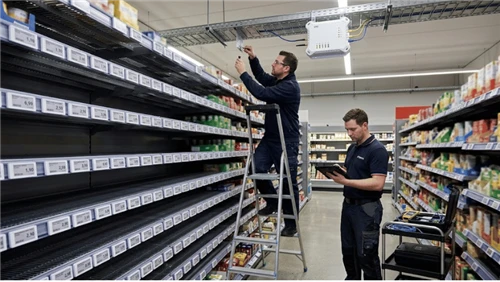
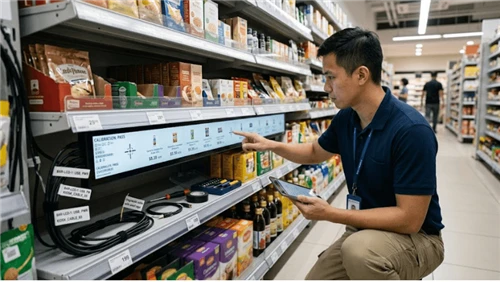
These use electrophoretic displays - the same tech as a Kindle. Power consumption is near zero except during screen refreshes, which gives you 5+ years of battery life at typical update rates (a few times per day). In a warehouse, they sit on bin locations, rack slots, or staging areas showing SKU details, current quantity, lot/batch codes, barcodes for scanner verification, and active pick instructions.
We supply e-ink labels from 2.66″ up to 7.3″. The smaller sizes (2.66″–4.2″) work well for dense bin areas where space is tight - think e-commerce fulfillment with thousands of small-item SKUs packed together. The larger formats (5.8″–7.3″) are better for bulk storage, where workers are standing further back and need to read information from a couple meters away, or where you need to display more detailed specs (automotive parts, electronics components).

What e-ink can't do: Video. Color (most models are black/white/red). Fast animation. If you need any of those, you need LCD.
LCD digital signage: the visual powerhouse (10.1″ to 15.6″)
LCD screens support full-color display, video playback, and dynamic content rotation. In warehouse settings, they earn their keep at specific high-value locations rather than on every bin: packing stations showing order details, shipping label previews, and QC checklists; zone entry points displaying real-time throughput dashboards and shift KPIs; staging areas cycling through outbound load assignments with truck numbers and dock doors; and quality inspection points presenting reference images, defect catalogs, and pass/fail criteria.
We manufacture both single-sided and double-sided LCD screens from 10.1″ to 15.6″. The double-sided versions work particularly well on aisle-end fixtures where workers approach from either direction.
The trade-off nobody likes hearing: LCD screens need constant power. You're running cable or using a nearby outlet. In a warehouse where most racking is far from power drops, this limits where you can deploy them. Plan LCD for fixed workstations and high-traffic decision points, not for every shelf position.
Pick-to-light: where labels become workflow tools
This is where electronic labels stop being passive displays and start actively directing work. And honestly, it's where the biggest ROI comes from.
A pick-to-light system works like this: a WMS order comes in. The system identifies which bin locations contain the needed items. Those bins' ESL labels light up - with LED indicators and, on button-equipped models, a confirmation button. The picker follows the lights, presses the button to confirm each pick, and the system updates inventory and moves to the next item. No paper pick list. No scanning. No guessing.
A Walmart associate described the impact of their VusionGroup deployment this way: price changes that previously took two days now take minutes, and features like "Stock to Light" and "Pick to Light" guide workers directly to the right location. Walmart's initial rollout covered nearly 500 stores, and they liked the results enough to sign a contract extension worth roughly €1 billion to expand across all 4,600 U.S. stores. That's a retail example, but the pick-to-light mechanics are identical in a warehouse - and the efficiency gains are often even larger because warehouse pick volumes are higher.
What we've seen in the field: Picking speed improvements of 30–50% versus paper pick lists. Error rates dropping from the 1–2% range to under 0.1% (consistent with barcode-verified automation benchmarks cited by fulfillment industry analysts). New hire training time collapsing from 3–5 days to under one day - people follow the lights on their first shift. Multi-order parallel picking using color-coded LEDs (red for Order A, green for Order B, blue for Order C running simultaneously).
That last point is underappreciated. In a paper-based system, parallel picking is a logistics headache - workers juggle multiple sheets, mix up orders, and error rates spike. With color-coded light guidance, running three or four orders at once becomes routine.
The money question: what does this actually cost, and when does it pay back?
Let's not dance around it. ESL hardware isn't cheap. A facility with 5,000 bin locations might spend $50,000–$150,000 on labels, gateways, and integration work. For a warehouse manager already fighting for capital budget, that number requires justification.
ESL ROI Framework: Paper vs. Digital
The cost comparison we walk clients through before every deployment.
| Cost Factor |
Paper / Manual Baseline
|
After ESL Deployment
|
| Label maintenance labor | 20–50 hrs/week | < 2 hrs/week (system admin only) |
| Picking error rate | 1–2% without barcode scanning | < 0.1% with pick-to-light |
| Cost per picking error | $50–$100 per incident (NetSuite, FCBCO data) | Near-zero error-related rework |
| New employee ramp-up | 3–5 days to independent picking | < 1 day with light-guided workflow |
| Inventory accuracy | ~63% for manual-only systems (SME benchmark) | 95%+ with real-time WMS sync |
| Paper & printing consumables | $2,000–$8,000/year for mid-size facility | $0 (display is reusable) |
A worked example. Take a mid-size 3PL shipping 2,000 orders per day. At a 1.5% error rate, that's 30 wrong orders daily. At $75 per error (a moderate estimate including return handling, reshipping, and customer service), that's $2,250/day - roughly $585,000 per year. If a pick-to-light ESL system cuts errors by 80%, you're saving $468,000 annually. A $120,000 hardware investment pays for itself in about three months. Even if you're more conservative - say a 50% error reduction - payback still comes within the first year.
The less quantifiable gains matter too. Faster picking means more orders per shift without adding headcount. Real-time inventory visibility cuts stockouts. And in operations serving both B2B and DTC channels, the ability to dynamically reassign bin labels and pick priorities across channels creates flexibility that paper can't touch.
Deploying ESLs: a four-phase approach (with the pitfalls we've seen)
We won't pretend this is plug-and-play. ESL deployment touches your WMS, wireless infrastructure, physical layout, and daily workflows. Here's how to structure it - and where things commonly go sideways.
Four Phases to a Successful ESL Deployment
From integration scoping to scaled rollout - and the pitfalls at each stage.
Figure Out What You're Connecting To (Weeks 1–4)
Map your integration pathway before buying hardware. ESL systems pull data from WMS, ERP, or MES via API, database views, or file exports. Major platforms may have pre-built connectors; legacy systems need development. Pitfall: Teams buy hardware first and figure out integration later - labels sit in boxes while IT builds the data bridge, and the project loses momentum.
01
Walk the Floor With Your Vendor (Weeks 3–6)
Wireless gateway placement can't be planned from a floor diagram alone. Metal racking, cold-room walls, and RF interference affect BLE signal coverage (typically 20–30 m per gateway). This step also determines label sizing by zone. Pitfall: Skipping the survey and discovering dead zones after installation - operators lose trust fast when a label shows yesterday's data.
02
Pilot One Zone, Measure Everything (Weeks 5–10)
Deploy 200–500 labels in a high-volume, high-churn zone. Run for 4–6 weeks. Measure picks per hour, error rate, and worker satisfaction. Pitfall: Piloting in an easy, low-traffic zone to "minimize risk" gives unimpressive data and makes the business case harder. Pilot where the pain is greatest.
03
Scale and Optimize (Weeks 10–20+)
Roll out zone by zone. Train staff in waves. After deployment, keep refining: adjust label templates based on picker feedback, tune update frequencies (more updates drain batteries faster), and introduce advanced features like color-coded multi-order picking.
04
Choosing hardware: which label for which warehouse?
Not every facility needs the same mix. Here's how we think about it:
Recommended Hardware by Warehouse Type
Match label technology and size to your operational profile.
| Warehouse Type |
Primary Label
|
Secondary / Accent
|
Why This Mix
|
| 3PL / E-commerce Fulfillment | 2.66″–4.2″ e-ink with LED + buttons | 10.1″ LCD at packing stations | High SKU density; pick-to-light for speed; LCD for visual order verification at pack-out |
| Cold Chain / Food Distribution | 4.2″–5.8″ e-ink (0–40°C rated) | 7.3″ e-ink at dock doors | No power cables in wet areas; larger labels for gloved handling |
| Automotive / Electronics Parts | 5.8″–7.3″ e-ink | 15.6″ LCD at assembly staging | Big labels for part numbers; LCD loops assembly instructions with images |
| Retail Backroom / Stockroom | 2.66″ e-ink | Match to sales floor ESL system | One system, unified inventory data front-to-back |
| Pharmaceutical / Medical | 4.2″–5.8″ e-ink | NFC-enabled models for access logging | Regulatory info display; NFC tap for lot tracking; audit trail |
Five specs that actually matter when you're comparing vendors
1. Display readability under real warehouse lighting. Showroom demos look great. But warehouses have uneven lighting - bright loading docks, dim interior aisles, fluorescent flicker. E-ink's paper-like contrast is a real advantage here. Ask for samples and test them in your actual facility, not in a conference room.
2. Gateway capacity under load. A single gateway updating 10 labels is easy. A gateway updating 500 labels simultaneously during a batch price change is where systems choke. Ask vendors for throughput specs under realistic load - how many labels can one gateway refresh within five minutes?
3. Battery life at your update frequency. "5+ year battery life" is a marketing number based on 1–2 updates per day. If your operation needs hourly updates (fast-moving FMCG, for example), battery life drops to 2–3 years. Ask for the depletion curve at your expected frequency.
4. Mounting versatility. Magnetic mount, rail clip, screw-in bracket, adhesive - your racking system determines which options work. If you have a mix of metal and non-metal shelving (common in older facilities), you need labels that support multiple mount types.
5. API openness. This is the one we feel strongest about. If the label system only works with the vendor's proprietary software, you're locked in. Open APIs that integrate with your existing WMS, ERP, or MES are non-negotiable for any serious deployment.
What's coming: AI slotting, IoT sensors, and transparent displays
A few trends worth watching, because they'll change how warehouse labels work within the next 2–3 years:
AI-driven dynamic slotting. Today, most warehouses assign bin locations semi-statically - you reorganize maybe once a quarter. AI analytics tools integrated into WMS platforms are starting to optimize bin assignments continuously based on pick frequency, order correlation, and seasonal patterns. ESLs make this practical because relabeling a bin is instant and costs nothing. With paper, dynamic slotting is operationally impossible at scale.
Sensor-embedded labels. Next-generation ESL hardware is beginning to integrate temperature and humidity sensors directly into the label housing. For cold-chain and pharma warehouses, the bin label itself becomes a monitoring device - showing real-time storage conditions and flagging excursions without separate sensor infrastructure. This is still emerging, but the trajectory is clear.
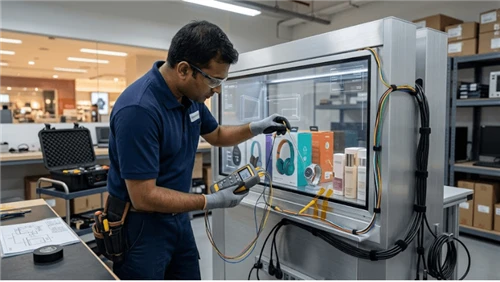
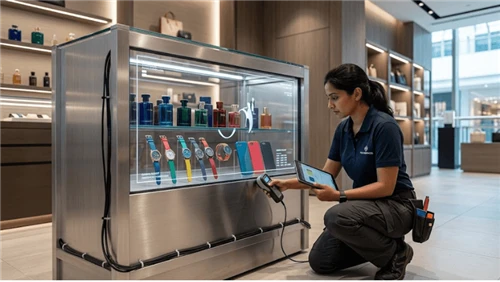
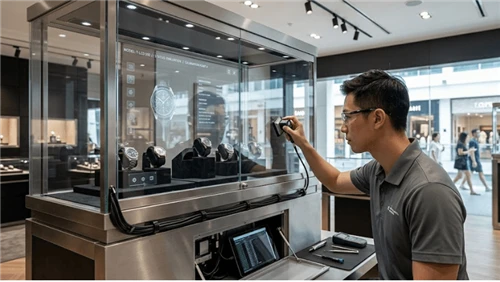
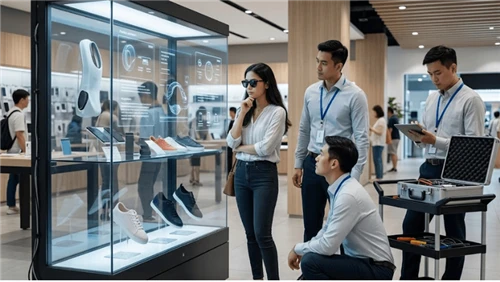
Transparent LCD displays. This one's closer to our heart because we manufacture these. Transparent screens overlay digital information on top of a physical product view - specifications, pricing, availability data - while the product remains visible behind the glass. In showroom-style warehouses, parts counters, and hybrid retail-warehouse formats, they bridge the gap between "I need to see the part" and "I need to see the data about the part."

Scale driving cost down. The global ESL market is growing fast - from about $2.34 billion in 2024 to a projected $6+ billion by 2031 (ResearchAndMarkets, January 2026). Walmart alone signed a ~€1 billion contract extension with VusionGroup to deploy across all 4,600 U.S. stores. As manufacturing volumes climb, per-unit costs for e-ink labels keep falling. We're already seeing mid-size warehouse operators deploy ESLs at price points that would have been viable only for large retailers three years ago.
Conclusion
Labels are infrastructure, not office supplies. The warehouses that figure this out - the ones that connect their bin labels to their WMS, push live data to every shelf position, and use light-guided workflows to direct their pickers - operate at a fundamentally different level of speed and accuracy than those still printing and sticking paper.
Start by calculating what your current labeling process actually costs, including the labor hours, the error rework, and the compliance exposure you're carrying. Run a focused pilot in your highest-pain zone. Measure the results honestly. And if the numbers work - they usually do - scale from there.
Ready to scope a pilot? Talk to our team - we'll model the ROI for your specific floor plan.
FAQ
Q: My warehouse already uses barcodes and scanners. Why would I add ESLs on top of that?
A: Barcodes tell your system what an item is. ESLs tell your workers where to go and what to do - without pulling out a scanner first. A barcode on a bin is passive; it sits there until someone scans it. An ESL with a lit-up LED is actively saying "pick from here, 3 units, for Order #4471." That's a workflow difference, not just a display difference. Most of our warehouse clients keep their barcodes for receiving and shipping verification, and add ESLs for the picking and put-away workflow layer.
Q: How do ESLs hold up in cold storage? We keep our coolers at 2–4°C.
A: Standard e-ink labels operate in 0°C to 40°C, so refrigerated environments are fine - displays actually look sharper in cool, dry conditions. Where you run into trouble is true freezer environments below -18°C: the e-ink fluid response slows and refresh times increase. For deep-freeze operations, you need specialty low-temperature variants, and the honest truth is the selection is more limited and more expensive. We recommend standard-temp ESLs for cooler zones and RFID or ruggedized barcode plates inside the blast freezer.
Q: What happens when a label goes offline or a battery dies?
A: The management platform monitors every label in real time. If one drops off - dead battery, physical damage, connectivity issue - the dashboard flags it. Replacing a label takes about 30 seconds: pull the dead unit, bind a new one to the bin location in software, mount it. The real question is whether you have spares on-site. We recommend keeping 3–5% spare labels in stock so replacements aren't waiting on a purchase order.
Q: We have 15,000 bin locations. Can the system handle a full refresh at once?
A: It can, but not instantly. Gateways communicate sequentially with labels in their coverage zone, so a mass update across 15,000 labels takes 15–45 minutes depending on gateway density. For most operations this is fine - you're rarely changing everything simultaneously. Seasonal resets or price-change events can be scheduled off-peak. If instant full-floor updates are critical, you'll need higher gateway density, which means more infrastructure cost. Ask us to model refresh time for your specific floor plan before committing.
Q: How long does integration with our WMS actually take?
A: Depends on your system. Modern cloud WMS with a REST API: 1–2 weeks. Older on-premise system with flat file or ODBC exports: 3–6 weeks including testing. The longest integrations we've seen were heavily customized legacy ERPs where getting a clean data export required development on the ERP side. Our advice: involve your IT team in the vendor conversation from day one, not after the purchase order is signed.
Q: Do ESLs make sense for a small warehouse with only 500–1,000 bins?
A: Honestly? Maybe not yet. If your pick volume is low and product mix is stable, the ROI takes longer. Where smaller facilities see faster payback: high label churn (lots of product rotation), accuracy-critical operations (medical, pharma), or labor constraints where every minute of saved walk time matters. We won't sell you a system that doesn't pay for itself. Run the labor and error-cost math for your facility before deciding.
Q: What's the difference between e-ink ESLs and LCD shelf screens? Which do I need?
A: E-ink for every bin, LCD for key locations. E-ink labels are battery-powered, paper-like, and designed for mass deployment - no cables. LCD screens are powered, full-color, and designed for high-impact spots needing video or dynamic dashboards. Most warehouse deployments are 90%+ e-ink by label count, with a handful of LCD screens at packing stations, zone entry points, and inspection areas. You probably need both, in very different quantities.
Q: Can we use ESLs for both our warehouse and retail store?
A: Yes - and this is one of the stronger arguments for ESL adoption if you operate both. Same hardware, same software platform, one data source, one training program. When a product arrives at the back dock, the receiving label and the sales floor price tag pull from the same database. No manual re-entry, no mismatch between what the back says you have and what the floor says it costs.
Related reading: Walmart's Historic Digital Shelf Label Rollout | Best Buy Electronic Shelf Labels Buying 2026 Guide | ESL Refresh Rates and Display Performance