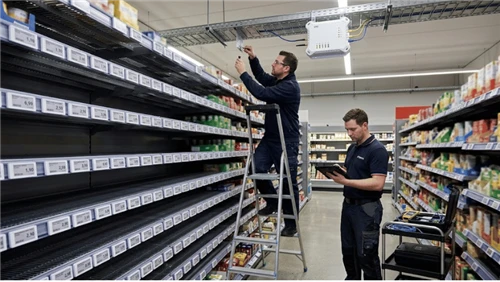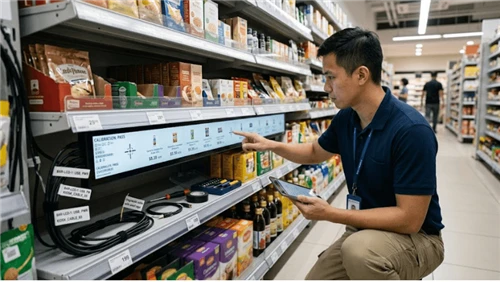
An electronic shelf label rollout does not end when the last label is installed. Once ESL becomes part of daily pricing and merchandising, the support model becomes an operational dependency. A retailer therefore needs more than a general promise of "technical support." It needs a service framework that defines what is covered, who responds, how incidents are classified, what information must be available for diagnosis, and how replacement or escalation works.
This guide focuses on the service-level agreement and support-contract questions that matter after an electronic shelf label solution moves from pilot to production. It is not a legal template. Instead, it is a procurement and operations checklist that helps retail, IT, and vendor teams turn vague service expectations into measurable working procedures.

Why ESL Support Needs Its Own Operating Model
ESL touches several systems at once: product and price data, store networks, gateways or access infrastructure, label binding, templates, management software, and physical shelf hardware. A problem that appears as "the label did not update" may originate in data, integration, communications, device status, template logic, or an operational mistake.
That cross-system nature is why support should not be reduced to a device warranty. A hardware warranty answers whether a defective unit can be repaired or replaced under defined conditions. An SLA addresses how incidents are received and handled. A managed service can go further by covering monitoring, maintenance, software operations, or field work. Buyers should keep these concepts separate in the contract.
Retailers still evaluating the technology can begin with the site's overview of electronic shelf labels, then translate the planned deployment architecture into support responsibilities.
Start by Defining the Service Scope
The most common source of dispute is an undefined boundary. The retailer assumes the supplier supports the entire solution; the supplier assumes it supports only the hardware or software it provided. A useful support schedule should list every component and identify whether it is included, excluded, or supported only through coordination with another party.
| Support area | Questions to define |
|---|---|
| ESL hardware | Diagnosis, replacement process, return conditions, spare stock, physical damage exclusions |
| Gateways / communications | Configuration support, connectivity diagnosis, replacement, firmware ownership |
| Management platform | Availability, account support, logging, upgrade path, incident escalation |
| Templates | Who corrects rendering or data-mapping issues? Who approves changes? |
| Integration | Which APIs, middleware, POS/ERP interfaces, and data flows are inside the support boundary? |
| Store network | What information must the retailer provide before the supplier investigates connectivity? |
| Mounting | Are rails, clips, holders, or damaged fixtures supported or treated as consumables? |
| Field service | Remote only, onsite options, geographic coverage, dispatch process, working hours |
The contract should match the actual architecture. A retailer using retail electronic shelf labels across a large chain will normally need a different operating model from a single-site proof of concept.
Define Incident Severity With Business Examples
Severity levels work only when people classify incidents the same way. Avoid labels such as "critical" or "high" without examples. Define severity using business impact, affected scope, workaround availability, and time sensitivity.
- Critical: a widespread condition that prevents a major portion of stores or labels from receiving required pricing data and has no acceptable workaround.
- High: a significant store, region, integration, or device-group problem that affects operations but does not stop the entire estate.
- Medium: a limited issue with a workaround, such as a subset of labels, template rendering, or non-urgent administrative function.
- Low: information requests, planned configuration questions, cosmetic issues, or enhancement requests.
These are examples, not universal definitions. A retailer should adapt them to its pricing operations and compliance obligations. The key is to remove ambiguity before an outage occurs.
Separate Response Time From Resolution Time
A response target describes how quickly the support team acknowledges and begins handling an incident. A resolution target describes when service should be restored or the issue corrected. They are not the same. Some technical incidents depend on diagnosis, replacement logistics, network access, or third-party systems, so an unconditional resolution promise may be unrealistic.
A stronger contract can define response time, target update frequency, escalation checkpoints, workaround expectations, and the conditions that pause the service clock. For example, if the support team needs logs or remote access and the retailer has not provided them, the contract should state how that dependency is handled.
For buyers comparing electronic shelf label companies, ask each bidder to show the workflow behind its SLA rather than simply quote a faster number.
Specify the Support Hours and Geographic Coverage
Retail pricing operations can span evenings, weekends, holidays, and multiple time zones. "Business hours support" is meaningless unless the timezone and working calendar are defined. International deployments should identify which language, region, and escalation team covers each store group.
Decide whether critical incidents require 24/7 intake or only extended business coverage. Also distinguish between remote technical support and onsite field service. An organization may offer continuous remote incident intake while onsite dispatch remains subject to local partner availability, travel conditions, site access, or spare inventory.
For multi-store projects, build the escalation map before rollout: store staff, regional support, retailer IT, integrator, ESL supplier, software owner, and any network or POS provider. A contact tree that exists only in email threads is difficult to use under pressure.
Make Monitoring and Alert Ownership Explicit
An SLA is much easier to operate when the system can identify exceptions. Ask what health information is available for gateways, labels, communication status, synchronization, failed tasks, or other relevant components. Then define who watches those indicators.
If the retailer owns monitoring, the contract should explain what evidence to include with a ticket. If the supplier provides managed monitoring, the contract should specify which conditions trigger action, how the retailer is notified, and what remains outside the monitored scope.
This is also where operational maturity matters. A retailer should not expect support teams to infer a store-level issue from a shopper complaint if the system already exposes useful device or synchronization status. The support process should use the management information available in the chosen electronic shelf label system configuration, where applicable.
Define the Replacement and Spare-Stock Process
Hardware incidents create logistical questions: who confirms a device is defective, who removes it, who binds the replacement, where spares are stored, who pays shipping, and how returned hardware is handled? Those steps should be designed before stores depend on ESL for daily operations.
For large estates, central spare stock may not be enough if shipping time is long. Regional or store-level spares can reduce operational delay, but they require inventory control. The contract can define minimum recommended spare holdings as a planning discussion without inventing a universal percentage. The right quantity depends on the installed base, geography, service model, failure history, lead time, and the retailer's tolerance for temporary fallback.
Mounting components deserve similar attention. A label may be functional while a broken clip or rail prevents it from being used. Buyers should ask whether accessories are covered, stocked, or treated as consumables.
Include Software, Firmware, and Change Management
Support contracts should explain how software and firmware changes enter production. "Updates included" is not enough. Retailers need to know who schedules the change, whether release notes are provided, whether staging or pilot validation is available, how compatibility is assessed, and what rollback options exist if the change causes a problem.
Template changes should follow a similar process. A small content edit can affect thousands of devices if centrally published. Define permissions, review, versioning, approval, and rollback. The support team should know whether it is authorized to change a production template during an incident or must wait for a retailer approver.
This is particularly important for organizations using ESL as part of a larger electronic shelf label technology stack with POS, ERP, or middleware integrations.

Clarify Data and Integration Responsibilities
If the shelf price is wrong, the physical display may be operating correctly. Support teams need a shared method for tracing data from the source system through integration and into the label platform. The contract should identify the system of record for product and price data and the point at which each party becomes responsible.
Ask what logs are retained, what transaction or update identifiers can be traced, and what evidence is needed to prove whether an update was received, processed, and sent. Avoid a support model in which every integration incident becomes a circular referral between vendors.
For complex deployments, a responsibility matrix is often more useful than a paragraph of legal language. List each operating task and assign who is responsible, accountable, consulted, and informed. The table can cover price feed, template mapping, API credentials, store network, gateway installation, label binding, incident triage, software updates, and replacement.
Set Reporting and Review Requirements
An SLA should create information that improves the service, not just metrics for a quarterly slide. Useful reports can include incident volume by category, recurring root causes, response performance, aging tickets, replacement activity, software changes, and unresolved risks. The exact measures should follow the deployment scope.
Schedule service reviews at a cadence appropriate to the project stage. Early rollout may require more frequent review than a stable mature estate. Use the meeting to identify repeated incidents, training gaps, documentation problems, network weaknesses, or change-control issues. The best support contract becomes a feedback loop into deployment quality.
Plan the Store-Level Escalation Path
Store staff need a simple first-line procedure. They should know what they are allowed to check, what they must not change, what information to capture, and where to report the issue. A ticket that says "ESL broken" provides little diagnostic value. A stronger report includes store, aisle or location, label identifier, product, observed state, expected state, time of last known good update, and a photograph if useful.
Retailers can connect this support process to deployment documentation for electronic shelf labeling. The goal is to keep first-line actions safe and repeatable without turning store associates into network engineers.
Use a Support Contract Scorecard During Procurement
| Area | Strong evidence to request |
|---|---|
| Scope | Component-by-component support boundary |
| Severity | Business-impact definitions with examples |
| Response | Targets by severity and support window |
| Escalation | Named tiers, handoff process, management escalation |
| Monitoring | Available health indicators and owner |
| Replacement | Diagnosis, RMA, spare, shipping, rebinding workflow |
| Change control | Release, validation, approval, rollback procedure |
| Reporting | Incident and service-review outputs |
| Field service | Coverage, dispatch conditions, access dependencies |
This scorecard helps buyers compare operational capability instead of treating support as a single line item. It can be included with an RFQ alongside hardware and integration requirements.
Common SLA Mistakes
One mistake is buying the lowest headline response time without understanding what happens after acknowledgment. Another is assuming the hardware warranty covers installation, software, integration, or field support. A third is failing to define who owns store-network troubleshooting. The fourth is neglecting change management until the first major software update.
Retailers should also avoid service credits as the only measure of quality. Commercial remedies may matter, but they do not restore shelf operations. A better SLA combines clear responsibilities, usable escalation, diagnostic evidence, trained participants, and continuous review.
FAQ
Q: Is an ESL warranty the same as an SLA?
A: No. A warranty primarily addresses product defects and repair or replacement conditions. An SLA describes how service incidents are handled. A project may need both, plus integration and field-service terms.
Q: Should every ESL incident have a guaranteed resolution time?
A: Not necessarily. Some incidents depend on third-party networks, retailer access, spare logistics, or root-cause investigation. Response, update cadence, escalation, workaround, and target restoration can often be defined more realistically than an unconditional resolution guarantee.
Q: Who should own the first support ticket?
A: The retailer should define a single intake path even when multiple vendors participate. The support model can then route the issue based on evidence instead of requiring store staff to guess which supplier is responsible.
Q: What should a retailer ask for before signing?
A: Request the full support scope, severity definitions, hours, response workflow, escalation contacts, replacement procedure, monitoring capability, change-control process, and sample service reporting. Ask how the process works in a realistic incident, not only what the contract promises.
Conclusion
An ESL service SLA is an operating agreement between retail, IT, integration, and support teams. It should define scope, severity, response, evidence, escalation, replacements, software changes, reporting, and store-level procedures in language that people can actually use during an incident.
When requesting a proposal, combine the support scorecard with the retailer's store count, geography, operating hours, integration architecture, and planned label types. That gives suppliers enough context to propose a support model that fits the deployment. Retailers can use the LEGOYO inquiry page to discuss project requirements without relying on unsupported generic SLA assumptions.