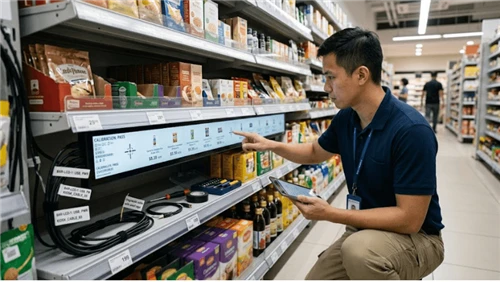
We've deployed smart LCD screen display systems across convenience chains, supermarket groups, and QSR franchises since 2016. The pattern we see most often: buyers focus on hardware specs, underestimate operational costs, then call us 18 months later when their consumer-grade TVs start failing and their "simple" content management turns into a full-time job. This piece covers what we've learned about making retail display investments actually pay back-with the specific numbers and failure patterns from our own project files.
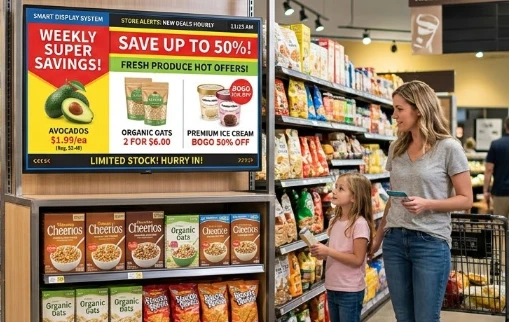
What 66% Sales Lift Actually Requires
A Walmart Super Centers test showed 66% unit sales increase with motion-enabled digital displays versus printed signage (motiondisplay.com). That number is real-but the deployment ran for 11 months on a single battery set, giving shoppers repeated exposure across multiple buying cycles. One-time campaign bursts don't produce these results.
The 2025 RFID-tracked study covering 30 million shopper visits found 8.1% higher purchase likelihood for advertised SKUs. Here's what the headline doesn't tell you: that 87.7% attribution rate assumed proper content rotation and correct screen placement. In roughly 80% of the installations we've audited for clients switching providers, at least one of these conditions was broken-wrong brightness for the ambient light, content loops too long, or screens placed where foot traffic doesn't pause.
Mood Media's 2024 survey adds another variable: Gen Z notices screens at 79%, baby boomers at 29%. If your customer base skews older, entrance displays underperform compared to aisle-level placement where dwell time is longer. We spec placement differently for grocery versus electronics versus pharmacy sections within the same store-there's no universal "optimal position."
The 70% You Don't Budget For-And How We Cut It
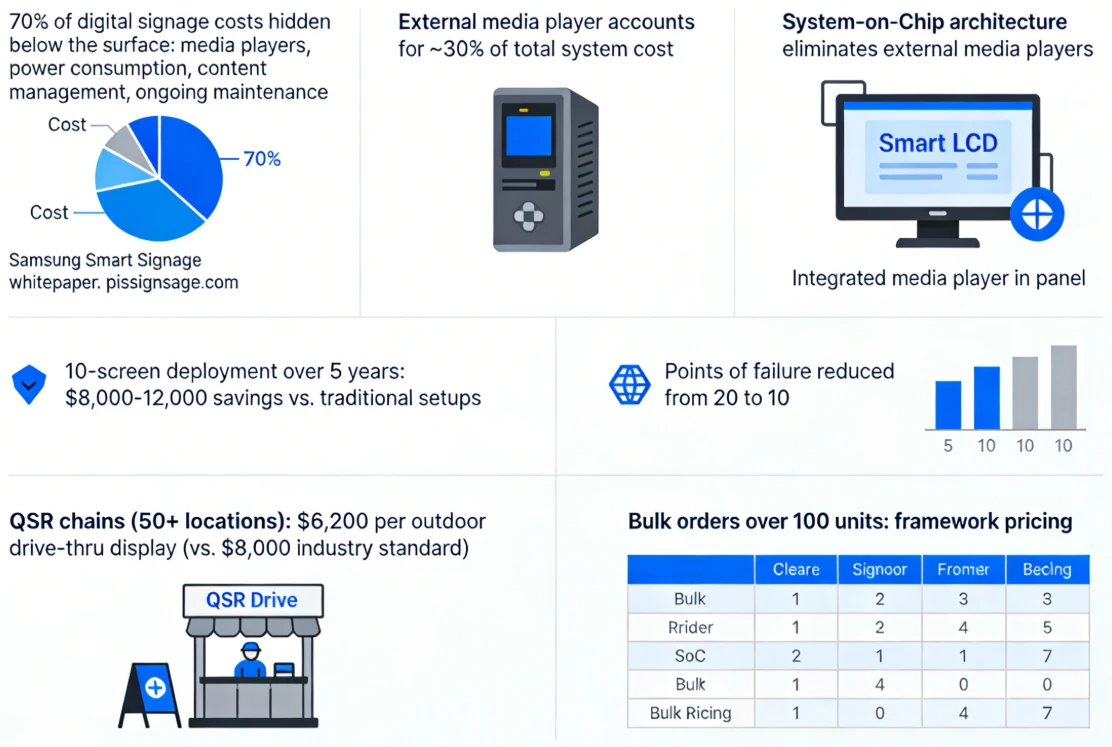
Industry TCO models show up to 70% of digital signage costs sitting below the surface: media players, power consumption, content management, ongoing maintenance (Samsung Smart Signage whitepaper via pisignage.com). The external media player alone accounts for roughly 30% of total system cost.
Here's where our approach differs. The smart LCD screen display units we supply integrate the media player directly into the panel-System-on-Chip architecture running commercial-grade signage software. That eliminates the external player, its cabling, its separate power draw, and its failure point. On a 10-screen deployment over 5 years, this architecture typically saves $8,000-12,000 compared to traditional two-box setups, while reducing points of failure from 20 to 10.
For QSR chains running 50+ locations, we model TCO differently. Our outdoor drive-thru displays with integrated players and remote diagnostics run $6,200 per unit versus the $8,000 industry standard for equivalent brightness-because we're not marking up third-party media players. Bulk orders over 100 units get framework pricing that changes the math further.
Why 80% of Deployments Miss Targets-And What We Do Differently
Industry surveys indicate 80% of digital signage rollouts miss performance targets due to visibility issues, technology mismatches, or systems that fail under load (crowntv-us.com). That number aligns with what we see when clients bring us in to fix someone else's installation.
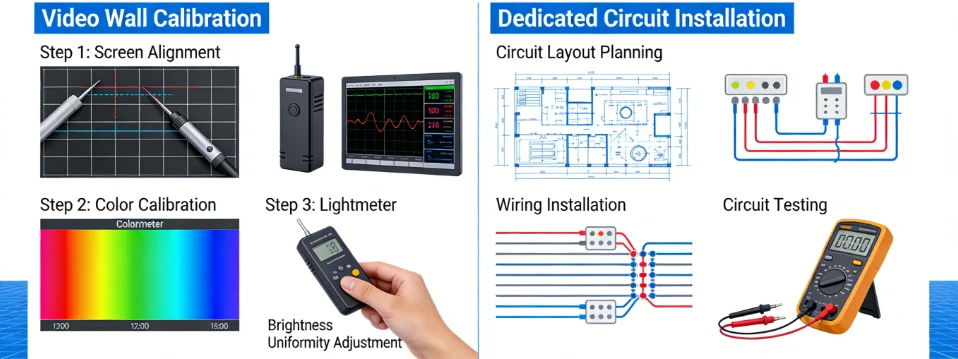
The most common failure we diagnose: electrical overload. Each commercial panel pulls 2.5-4.5 amps at full brightness. Chain multiple screens onto a single 15A circuit and you get intermittent flickering, random reboots, slow component degradation. Our pre-installation site survey includes circuit mapping-we spec dedicated circuits per screen zone before any hardware ships.
Second most common: cloud CMS pairing errors. AVIXA's 2024 report found 38% of early-stage content display failures trace to improper app linking, not hardware faults. The screen shows blank because nobody verified the device-to-dashboard pairing during setup. Our installation team runs a 47-point commissioning checklist that catches this before handover-we don't leave site until every screen shows live content from your dashboard.
Third: video wall color mismatch. LCD panels ship with varying color temperatures, brightness levels, contrast ratios. A Canadian retailer's 4x2 checkout video wall went viral for displaying eight visibly different color profiles. We budget 2-3 hours specifically for multi-screen calibration on every video wall project, and our post-install support includes remote color adjustment if store lighting changes seasonally.
Our Supply Chain: Why Lead Times Matter for Rollouts
We hold framework agreements with BOE and AUO for commercial-grade LCD panels, with pre-negotiated allocation during supply crunches. Standard lead time from order confirmation to ready-to-ship is 3-4 weeks for stock configurations, 6-8 weeks for custom brightness or enclosure specs. For multi-location rollouts, we stage inventory regionally so store installations can run in parallel rather than sequentially.
Why this matters: the display supply chain consolidated significantly post-2022, with three manufacturers controlling 75%+ of panel production. Buyers going direct to trading companies often discover their "confirmed" orders get bumped when larger customers claim allocation. Our volume commitments mean your 50-screen order doesn't get deprioritized behind a 500-screen enterprise deal.
Brightness Specs: What We Actually Recommend by Placement
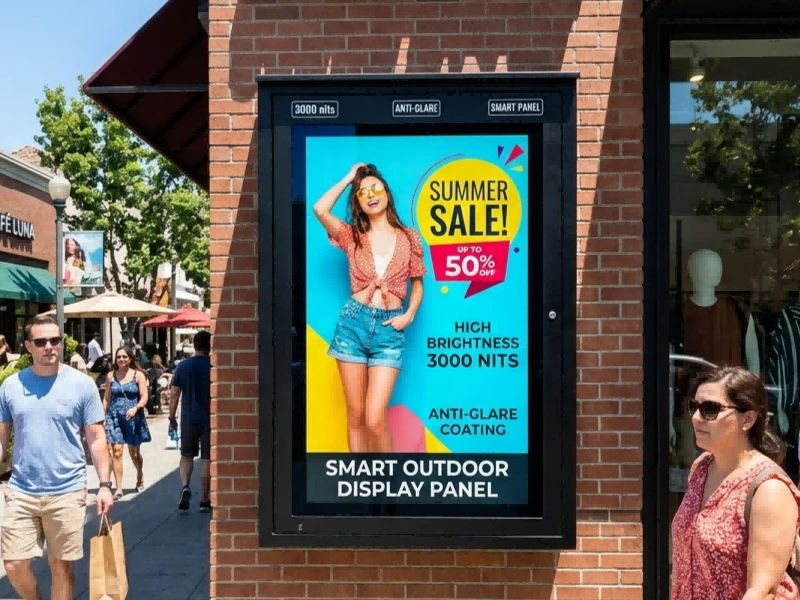
Standard indoor retail with controlled lighting: 500-700 nits, IPS panel for viewing angle. Window-facing with afternoon sun exposure: minimum 1,500 nits, ideally 2,500 with anti-glare coating. Full outdoor under direct sunlight: 3,000 nits minimum, 5,000 recommended-and at this brightness, thermal management becomes the limiting factor for lifespan.
One spec most buyers overlook: a 4K panel at the same brightness draws 1.7x the power of equivalent FHD, because pixel aperture ratio drops from 60% to 35% with the denser wiring (displaymodule.com). For 24/7 retail operation, that's an extra $200-300 per screen annually in electricity. We default to FHD for most retail signage unless viewing distance under 4 feet makes 4K worthwhile.
Ready to Scope a Deployment?
We run 90-day pilot programs starting with 1-3 representative store locations and 20-50 screens-enough to establish baseline metrics and identify operational requirements before full rollout. Every pilot includes pre-installation site survey, dedicated circuit verification, full CMS commissioning, and 30-day post-install optimization support.
Contact now with specific configurations for your retail format. We'll send a TCO comparison model within 48 hours showing your total 5-year cost against industry benchmarks.