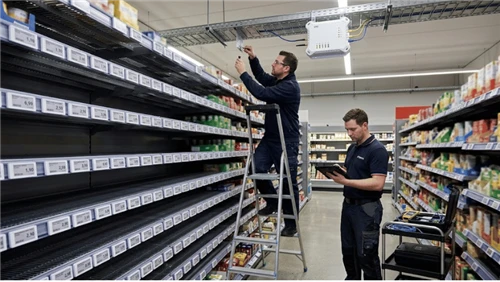
If ranked by revenue, VusionGroup is number one. But does highest revenue mean best? Not necessarily. SOLUM has been on a tear this year, Hanshow basically owns the Chinese market, and Pricer-even though they've fallen behind-has been doing this since the early 90s, longer than anyone else.
This is a rundown of the companies you're likely to encounter if you're in this industry.
VusionGroup
Used to be called SES-imagotag. French company. Last year Walmart gave them the contract for 4,600 stores, and that cemented their position as the top player.
Their products are good, but also expensive.

Their strategy is clear-they want to shift from selling hardware to selling platforms. VUSION Cloud, Captana visual recognition, Memory analytics, Engage retail media... they're building out the whole ecosystem. The logic tracks-SaaS margins are better than hardware margins, and Wall Street loves that story. Problem is, retailers aren't stupid. Everyone knows once you're on VusionGroup's full stack, you're locked in. Your data's with them, your systems run on their platform, all the interfaces are defined by them. Migration costs are brutal.
VusionGroup's major shareholders include BOE-the Chinese display panel company. E Ink and Qualcomm also have stakes. Nothing wrong with that structure per se, but some American clients bring it up during procurement reviews. There was a project last year where VusionGroup scored highest on technical evaluation but got dropped in the final round because of this.
SOLUM

Korean. Spun off from Samsung Electro-Mechanics.
Back then the imported brands available were limited.
The Samsung heritage means strong supply chain integration. Crack open an ESL and what do you have? Screen, chip, battery, communication module. Samsung's ecosystem has suppliers for all of that, and internal coordination costs less than sourcing externally. The Newton series has solid build quality. Their test reports show they can handle temperature cycles from -30°C to +60°C.
SOLUM built a new factory in Monterrey, Mexico. Full capacity next year. This is obviously a play on US-China trade tensions. If the US imposes tariffs on Chinese ESL products or puts up trade barriers, SOLUM has a supply chain that doesn't touch China at all. For some clients that's a hard requirement.
Their weakness is software. SOLUM is more of a hardware company. Their software platform isn't on VusionGroup's level. If all you want is to swap paper tags for electronic ones and push price updates, SOLUM works fine. If you want dynamic pricing, AI recommendations, and advanced features-either build the integration yourself or look elsewhere.
Pricer
Swedish.
Founded 1991, a year before VusionGroup. They basically invented this industry. Now they're third or fourth.
Pricer's trajectory is notable. They picked a unique technology path-infrared communication, completely different from everyone else's RF approach.
What's good about infrared? Positioning accuracy. RF signals spread out-you only know a tag is somewhere in a general area. Infrared is line-of-sight, point and shoot, centimeter-level precision. During picking, the system lights up one specific tag, no mistakes. In high-density warehouse environments or scenarios where positioning accuracy matters, Pricer has an edge nobody else can match.

But that's also the limitation. Infrared needs line of sight, can't have anything blocking the path. In a big store with endcaps everywhere and customers walking around, setting up infrared base stations is extremely difficult. That's why Pricer couldn't keep up with VusionGroup-their tech is great for specific scenarios but can't scale to mass market.
This year they partnered with a company called PaperShell to make a 100% bio-based electronic label. Playing the sustainability angle. Might work in Scandinavia where some retailers are into that. Elsewhere, unlikely. Ask a procurement manager if they'll pay 20% more for "biodegradable" and most will decline.
Hanshow

Chinese. Biggest domestic player.
Product line is comprehensive. IP68 protection rating matters for fresh food and cold chain. Cheaper than European vendors-how much cheaper depends on your volume, ranging from 10-something percent to 30 percent, varies by project.
Hanshow has been expanding overseas aggressively-European headquarters, US office, contracts with Leroy Merlin, Albert Heijn, and others. But they still hit walls with premium clients.
A big Western European retailer was doing vendor selection. Hanshow's specs were better across the board, price was lower. Last round of evaluation, someone on the client side said "we don't consider Chinese suppliers." No reason given. Project dead.
Is that fair? No. But it's reality. "Made in China" still means "cheap" in many places, not "technically superior." Changing that perception takes time and flagship wins.
In 2024 VusionGroup sued Hanshow for patent infringement in European court, asked for an injunction. It didn't get granted, but the lawsuit itself is a signal. If you're planning to use Hanshow, add an IP indemnification clause to your procurement contract, make them take liability. If the lawsuit outcome changes, you don't want tens of thousands of tags on your shelves turning into scrap metal.
E Ink

Yuan Tai. Taiwanese.
Technically E Ink isn't an ESL company-they don't sell finished products. But they control the chokepoint of this entire industry. E-paper displays? Almost all from E Ink. VusionGroup uses them, SOLUM uses them, Hanshow uses them. No exceptions.
Monopoly business is good business. E Ink's operating margin in 2024 was over 23%. Very high for hardware. They have zero incentive to cut prices.
What does this mean for ESL vendors? Screens are the biggest chunk of their cost structure, and screen prices are whatever E Ink says they are. Downstream clients want to squeeze you on price, upstream supplier won't give you room-you're getting squeezed from both ends. There was a project last year where an ESL vendor had already signed the contract, then E Ink raised prices, cost structure went sideways, and they ended up losing money on the whole deal.
There's also capacity. E-paper production can't expand overnight. When Walmart drops a mega-order, can supply keep up? Second half of last year there were lead time extensions across the industry, some projects got pushed back.
For procurement people, remember one thing: don't expect ESL prices to drop dramatically. E Ink's monopoly position is right there, costs aren't coming down. This isn't like TV panels falling 10% every year. Budget high.
ZKONG
Hangzhou.
If you've been to Hema (Freshippo), the electronic tags on the shelves are almost certainly ZKONG. Exclusive supplier, covers approximately 95% of their stores.
The interesting thing about ZKONG is their identity situation. They grew up in the Alibaba ecosystem, and Hema gave them an excellent training ground-every new retail scenario, they've run it. But because of that, outsiders see them as "Alibaba's people."

When they pitch other retailers, the first reaction is often: "What's your relationship with Alibaba? Is my data going to end up with Alibaba?" Especially as Alibaba's retail expansion has hit resistance, some retailers are instinctively wary of Alibaba-affiliated suppliers.
ZKONG is trying to break out of this. Overseas teams, independent branding, emphasizing data security-they're doing all the right things. But that label isn't easy to remove.
On the product side, two things worth noting. One is 32,640 tags per network-that's industry-leading capacity. In big stores, number of base stations directly affects deployment cost. ZKONG's high-capacity gateway has an edge there. The other is last year's Sparkle dual-sided screen-center-aisle shelving can display on both sides, one tag does the work of two. Looks like a small innovation but it has real impact on quantity needed and cost.
Displaydata
Samsung owns them now.
Samsung's system has two ESL brands-SOLUM and Displaydata. What's the relationship? Some say it's by market segment, SOLUM for volume and Displaydata for premium. Some say it's by geography, one for Asia-Pacific and Americas, one for Europe.
If you're considering Samsung products, figure out the relationship between these two brands upfront. Don't end up buying from A and finding it's not compatible with B, then both sides deflecting when something goes wrong.
Displaydata's full-color e-ink tags look good. They claim 29% improvement in promotional conversion rates. Directionally it makes sense-color catches the eye more than black and white. Good fit for image-conscious scenarios-luxury goods, high-end cosmetics, premium grocers.

Teraoka Seiko
Japanese.
Almost no presence outside Japan, but very strong domestically. Why? One-stop shop.
They have scales. They have barcode printers. They have POS. They have ESL. Japanese retailers are notoriously picky-a project involving four or five vendors, just coordinating interfaces and schedules is extremely difficult. Teraoka's pitch is "come to us for everything, one party responsible when things go wrong."
Japanese government mandated convenience stores deploy ESL or RFID by 2025, and Teraoka captured a good chunk of that demand. But going overseas to compete head-to-head with VusionGroup and SOLUM is not realistic. Their advantages are all Japan-specific and don't translate elsewhere.

Others
M2Communication. Some clients in Asia-Pacific, their focus is communication stability. Big stores have messy wireless environments, all kinds of devices fighting for spectrum, they apparently have solutions for interference resistance.

Opticon. Partnered with a Swedish company on solar-powered ESL. Interesting tech path. Perovskite solar cells that can charge from indoor lighting, theoretically never need battery replacement. They showed it at NRF, but mass production is still far off. Cost and stability are both issues. If this works out, it's a game changer-the most annoying part of ESL maintenance is replacing batteries, eliminating that changes the whole TCO calculation. Too early to call it a winner.
There are others. In China there's also New Beiyang, Siwco, doing ESL-smaller scale but growing fast. Europe has some regional players.
Ranking
VusionGroup first. SOLUM second, Hanshow third. After that it gets less clear-Pricer, ZKONG, Displaydata are in the same tier with their own territories. E Ink doesn't get ranked, they're upstream, different level entirely.
But ranking doesn't matter that much. This industry is still in high-growth mode. The pie is getting bigger. Being third in a growing market might be worth more than being first in a stagnant one. What matters is whether the supplier you pick will still be around in five years and can keep supporting your business. Small vendors getting acquired or going under is a real risk.
For Procurement People
Don't just look at hardware unit price on the quote. This industry isn't that deep but there are plenty of pitfalls. Hidden costs everywhere-system integration fees, software subscription fees, base station equipment, installation and commissioning, staff training, ongoing maintenance... Five-year TCO can be two to three times your initial purchase cost. Budget for the long term.
Ask about lock-in risk. Is the communication protocol proprietary? Can you export your data? What does it cost to switch suppliers later? There's no unified standard in this industry. Once you pick someone you're basically committed to them. Be prepared.
If you have cold chain scenarios, look at low-temperature test data. An electronic tag working at -20°C is not the same as working at room temperature. Get the vendor's test reports. Better yet, visit their actual deployed cold storage cases.
System integration is harder than buying hardware. ESL needs to connect to your ERP, POS, promotion systems. Even if you outsource this work, stay on top of it. There are projects where hardware was installed and system integration took another six months and still wasn't working right.