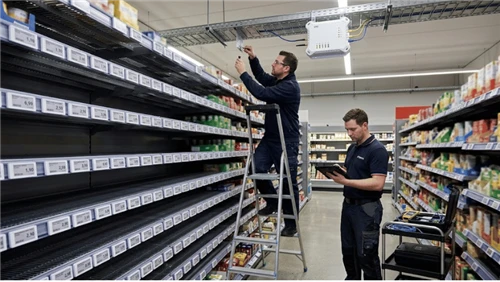
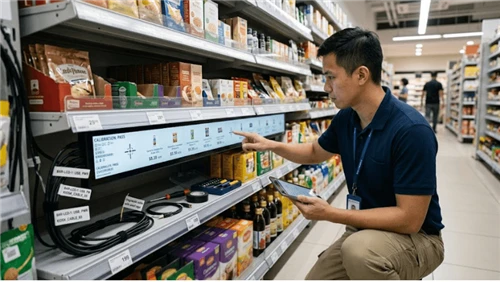
A distribution center with 10,000 bin locations typically updates 500 to 1,000 labels every week. Product changes, seasonal swaps, replenishment rotations-each update means printing, walking, peeling, sticking, and double-checking. We've timed this across client sites: it averages 2–3 minutes per label. At the high end, that's 50 hours of labor per week-a full-time employee who does nothing but swap stickers. And that's before you count the mispicks caused by labels that are faded, fallen off, or just plain wrong.

We build electronic shelf labels and LCD display systems at LEGOYO. We've been in the display business since 2002, shipping into 300+ facilities across retail, logistics, and industrial warehousing. This guide is what we've learned from those deployments about what actually works when you label warehouse racks-and what quietly bleeds money when you get it wrong.
What Is Warehouse Rack Labeling and Why Does It Matter?
Warehouse rack labeling is the system of marking every storage location-aisles, racks, shelves, and bins-with unique identifiers so workers can locate, pick, and put away inventory accurately. It sounds basic. It is basic. And it's one of the highest-ROI operational improvements you can make, because every other warehouse process downstream depends on it.
Industry data puts the fully loaded cost of a single picking error at $50–$100, accounting for customer service, return shipping, reprocessing, and replacement orders. Warehouses without barcode verification typically run error rates of 1–2%. For a facility shipping 1,500 orders a day, that translates to roughly $195,000 a year in picking errors alone. A well-designed labeling system cuts that number dramatically-not by making workers try harder, but by making the right location obvious.
Standard vs. Serpentine Labeling: How to Number Your Racks
Before choosing labels, you need a numbering scheme. There are two dominant approaches, and the right one depends on your warehouse layout and picking method.

Standard (parallel) labeling numbers racks sequentially in the same direction on every aisle-left to right, repeating on each row. It's intuitive, easy for new workers to learn, and ideal for smaller warehouses or facilities with high employee turnover. Think of it as reading a book: row 1 goes left to right, row 2 goes left to right, and so on.
Serpentine labeling alternates direction with each aisle-row 1 goes left to right, row 2 goes right to left, row 3 goes left to right again. This "S" pattern mirrors the path a picker actually walks, reducing backtracking and cutting travel distance by 15–30% in large facilities. One 3PL client of ours in Guangzhou switched from standard to serpentine and shaved 12 minutes off their average pick cycle per shift-across 3 shifts, that was a full additional hour of productive picking daily.
The numbering format itself typically follows a hierarchy: zone → aisle → rack → shelf → bin. Something like D-04-BC-17-03 (Zone D, Aisle 04, Rack BC, Shelf 17, Bin 03). Encode this into your WMS from day one; retroactively renumbering a running warehouse is painful.
Warehouse Rack Labeling Ideas: 5 Approaches That Actually Work

1. Color-coded aisle zones. Assign a color to each warehouse zone-green for bulk storage, yellow for pick-and-pack, red for hazmat. Workers learn the visual shorthand fast, and it dramatically reduces the "wrong aisle" problem for new hires and temporary staff. Use floor labels and overhead signage to reinforce zone boundaries.
2. Barcode + human-readable dual labels. Every rack label should carry both a barcode (for scanner verification) and a human-readable location code (for visual confirmation). This dual-format approach gives you scan-based accuracy when using RF guns while keeping the location findable even when a scanner battery dies at 2 AM.
3. Multi-level vertical labeling. In warehouses with tall racking (4+ levels), label every shelf level distinctly. Use increasing font sizes for higher levels (since workers read them from greater distances) and consider angled label placement so forklift operators can read shelf IDs from below.
4. Magnetic labels for dynamic inventory. If your product mix changes frequently-seasonal retail, short-run promotions, rotating SKUs-magnetic rack labels let you reconfigure without adhesive residue or reprinting. They're durable, reusable, and swap in seconds. The trade-off: they only work on steel racking.
5. Electronic shelf labels for real-time updates. This is where traditional labeling hits its ceiling. E-ink electronic shelf labels update wirelessly from your WMS-no printing, no walking, no peeling. When a bin assignment changes, the label refreshes in seconds. LED indicators on the label can even flash to guide pickers to the right location (pick-to-light). For operations running 5,000+ SKUs with frequent location changes, ESLs typically pay for themselves within 12–18 months through labor savings alone.
Warehouse Labeling Technologies Compared
| Technology | Update Method | Cost per Label | Best For | Biggest Weakness |
|---|---|---|---|---|
| Paper / adhesive | Print & manually replace | ~$0.01 | Temporary storage, small ops | Degrades fast; zero automation |
| Barcode / QR | Print & replace; scan to read | $0.02–$0.10 | Standard scan-based workflows | Manual replacement still needed |
| Magnetic | Swap by hand; reusable | $0.50–$3.00 | Dynamic inventory, frequent reconfig | Steel racking only; no WMS link |
| RFID tags | Wireless batch read/write | $0.10–$2.00 | Bulk pallet-level identification | No visual display for workers |
| ESL (e-ink) | Remote wireless push; seconds | $5–$30+ | Live bin display; pick-to-light | Higher upfront; needs wireless infra |
One thing worth noting: RFID and ESL are complements, not competitors. RFID handles invisible identification (did this pallet pass through the dock door?). ESL handles visible information (what's in this bin, how many, and which order needs it next?). The best-performing warehouses we've deployed into use both.
How to Choose the Right Label Size for Warehouse Racks
Label size matters more than most people think-primarily because of reading distance. Workers on foot in narrow pick aisles need something different from forklift operators scanning labels at height.
For dense bin areas with thousands of small-item SKUs, compact labels in the 2.66-inch to 4.2-inch range work well-they fit tight bin slots without overlapping. For bulk storage or pallet-level racking where workers stand further back, larger formats like 5.8-inch to 7.3-inch e-ink displays deliver legibility from 2+ meters away.

For high-traffic workstations-packing benches, staging areas, dock doors-LCD digital signage screens in the 10–15 inch range provide full-color, video-capable displays for order details, QC checklists, and shift KPIs.
Warehouse Rack Labeling Best Practices
Label at eye level for each shelf tier. This sounds obvious, but we've seen warehouses put all labels at the bottom of the rack-forcing workers to crouch for upper-shelf reads. Each level should have its own label, positioned where the worker's eyes naturally fall during that task.
Place labels at both ends of every aisle. A picker entering from either direction should be able to confirm they're in the right aisle before walking its length. Overhead hanging signs work best for this; kiosk-style displays at aisle entries are the digital equivalent.
Use durable materials matched to your environment. A standard adhesive label lasts 6–12 months in a climate-controlled DC. In a cold-storage facility, humidity and temperature cycles will peel it off in weeks. For cold chain, use polycarbonate or retro-reflective labels-or e-ink ESLs rated for 0–40°C operation.
Integrate labels with your WMS from day one. Your location code format (zone-aisle-rack-shelf-bin) should mirror your WMS structure exactly. Any mismatch creates a second source of truth-and second sources of truth always drift apart.
When to Upgrade from Paper Labels to Digital
Paper labels work. For a small warehouse with stable inventory and low order volume, they're fine. But three signals tell you it's time to look at electronic shelf label solutions:
Your label change volume exceeds 200 per week. Below that, manual replacement is tolerable. Above it, you're burning meaningful labor hours on a task that adds zero value.
Your mispick rate exceeds 0.5%. If quality audits show picking errors creeping up-especially after label changes or new product introductions-the labeling system is a likely contributor.
You're running pick-to-light or put-to-light operations. Paper can't flash. If your workflow depends on visual guidance to the right bin, you need active display technology.
Bottom Line
Warehouse rack labeling isn't glamorous work. But it's the foundation everything else depends on-WMS accuracy, pick speed, error rates, and new-hire ramp time. Start with a consistent numbering scheme, choose a labeling method that matches your layout, pick materials that survive your environment, and upgrade to digital when the labor math stops making sense for paper.
If you're evaluating electronic shelf labels for warehouse use, LEGOYO's technical team can help you match label sizes and display types to your racking layout. We offer e-ink ESLs from 2.66" to 7.3", LCD display screens, and transparent display cases-all with ERP/WMS integration.
Frequently Asked Questions
How do you label racks in a warehouse?
Assign each location a unique code following a hierarchy: zone, aisle, rack, shelf, and bin (e.g., A-03-R2-S4-B01). Use barcode labels with human-readable text so workers can visually confirm and scanners can verify. Place labels at eye level on each shelf tier, and install aisle markers at both entry points. Match your label codes exactly to your WMS location structure.
What is the difference between standard and serpentine rack labeling?
Standard labeling numbers every aisle in the same direction (left to right). Serpentine labeling alternates direction each aisle, forming an "S" pattern that follows the natural walking path of a picker. Serpentine reduces backtracking and can cut travel distance by 15–30% in large warehouses, but it's less intuitive for new workers to learn.
Are electronic shelf labels worth it for warehouse use?
For warehouses changing 200+ labels per week or running 5,000+ SKUs, ESLs typically pay for themselves in 12–18 months through labor savings. They eliminate manual label printing and replacement, integrate directly with WMS for real-time updates, and can function as pick-to-light guides. They're not cost-effective for small, stable-inventory operations where paper labels change infrequently.
What label material lasts longest in cold storage warehouses?
Standard adhesive labels fail quickly in cold storage due to moisture and temperature cycling. Polycarbonate labels and retro-reflective barcode labels are the most durable physical options. E-ink electronic shelf labels rated for 0–40°C provide the longest lifespan (5+ years with battery) while eliminating the adhesive failure problem entirely.
How much does a warehouse labeling system cost?
Paper and adhesive barcode labels cost under $0.10 each. Magnetic reusable labels run $0.50–$3.00 per unit. Electronic shelf labels range from $5–$30+ per label depending on screen size, plus wireless infrastructure costs. The total system cost depends on facility size-a 5,000-bin warehouse might spend $2,000–$5,000 on paper labeling or $25,000–$80,000 for a full ESL deployment, with the digital system paying back through reduced labor and error costs over 12–24 months.