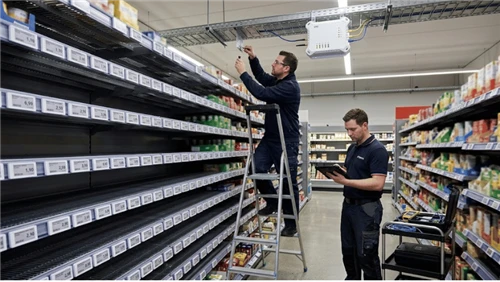
Last December we finished a picking station retrofit for a cold chain distributor outside Guangzhou. Forty-eight nodes, three facilities, eight weeks from PO to go-live. The project went fine. What stuck with me was the conversation that started it.
Their operations director had just scrapped a TFT touchscreen deployment after five months. Twenty-three units failed during the coldest week of the year-condensation got into the panel assemblies and shorted the driver boards. The vendor blamed "installation environment," which is the polite way of saying "not our problem." The real cost wasn't the hardware. It was 340,000 RMB in delayed shipments while they scrambled to patch together a manual workaround.
"Just give me something that works," he said. "I don't need animations. I need bin codes and quantities that don't disappear when the dock doors open."
We quoted 16x2 character LCDs. He thought we were joking. Fourteen months later, his maintenance team still hasn't had to touch them.

Temperature Tolerance Is the Specification That Actually Matters
Most RFQs I see for logistics displays focus on resolution, brightness, viewing angle. For customer-facing applications, sure. For a picking station that sits twenty meters from a loading dock in Harbin? Resolution is irrelevant. What matters is whether the display still works when ambient temperature drops to -15°C and then swings back to +25°C three times a day.
Character LCDs handle this better than alternatives for a boring reason: simpler construction means fewer failure modes. An industrial-rated 16x2 module has maybe 40 components total. A comparable TFT assembly has 200+. Every additional component is another potential point of failure under thermal stress.

The practical implication for procurement: don't buy consumer-grade modules for industrial environments. The savings aren't worth it. We've tested this extensively and the failure rate differential is roughly 4:1 over a two-year period. Consumer modules cost $2.10-2.80 at volume; industrial grade runs $3.40-4.50. Spending an extra $1.30 per unit to avoid a 4x failure rate should be an obvious decision, but we still see teams get this wrong because the datasheet electrical specs look identical.
Extended temperature range (down to -30°C) adds another $1.50-2.00 per unit. Worth it for cold storage applications. Probably overkill for climate-controlled facilities, though we've had clients in the northern US and Canada choose this grade anyway as insurance against HVAC failures.
Realistic Cost Breakdown
I'm not going to give you exact pricing because it changes every quarter and varies by supplier relationship. What I can give you is structure.
The LCD module represents about 8-12% of your total node cost for a picking confirmation station. The obsession with saving $0.40 per display while ignoring the other 90% of system cost makes no sense, yet I see it constantly in RFQ evaluation matrices.
Controller hardware is where specifications diverge from reality. A proper industrial MCU module with power management, I/O protection, and watchdog functionality costs $28-45 depending on feature set. If someone quotes you $12, they're either cutting corners on protection circuits or planning to surprise you with "required accessories" later.
Integration is where budgets actually blow up. If your WMS is SAP EWM or Manhattan or Blue Yonder, expect the integration scope to be measured in weeks and dollars to be five figures. Anyone who quotes a flat fee without understanding your software environment is either planning change orders or planning to underdeliver.
| Cost Category | Typical Range | What Drives Variance |
|---|---|---|
| LCD module (industrial) | $3.20-4.80 | Temperature rating, backlight type, supplier tier |
| Controller assembly | $28-52 | Protection level, communication interfaces, certification |
| Enclosure + mounting | $25-65 | IP rating, material, custom vs. off-shelf |
| Integration labor | $4,500-18,000+ | WMS platform, network architecture, client IT involvement |
That integration number looks wide because it is. A facility running a modern cloud-based WMS with open APIs might be on the low end. Legacy on-premise systems with custom middleware? Budget high and hope for the best.
Where Character Displays Don't Work
We turn down projects that don't fit the technology. Easier to say no upfront than deal with an unhappy client six months later.
Chinese language display kills the option.
The HD44780 controller architecture dates to 1987 and doesn't support CJK characters natively. You can program eight custom characters into CGRAM, which is enough for a few icons but not a Chinese interface. For mainland China operations with local staff, we recommend 128x64 OLED graphic displays instead-they support bitmap font rendering and cost $8-14 per unit at volume.
Anything customer-facing needs better aesthetics.
Character LCDs look industrial. That's fine for backend operations. For a self-checkout terminal or product information kiosk, invest in proper graphics capability.
Real-time animation or rapid updates create visible flicker. Character LCD refresh rates work fine for status information that changes a few times per minute. Progress bars, counting displays, anything updating multiple times per second-use something else.
If your application hits any of these, stop evaluating character LCDs. The technology doesn't fit. We can discuss alternatives, but the conversation changes significantly.
Supplier Qualification Reality

The character LCD supply chain has a quality spectrum that's wider than most procurement teams realize. At the top: manufacturers like Winstar (Taiwan) and Newhaven Display (US) with automotive-grade certifications, lot traceability, and actual engineering support. In the middle: regional suppliers with decent quality but inconsistent documentation. At the bottom: trading companies reselling whatever they can source cheaply.
The price spread across this spectrum is 300%+. A module that costs $4.80 from DigiKey might have equivalents available at $1.60 from Alibaba suppliers. They are not the same product, regardless of what the datasheets claim.
We maintain an approved vendor list based on our own qualification testing. I'm not going to publish it here because it changes based on our ongoing reliability monitoring and because it represents significant testing investment. What I will say: we've rejected modules from well-known brands that failed our temperature cycling protocol, and we've qualified modules from smaller suppliers that most procurement teams would overlook.
The testing protocol matters more than the brand name. If you're doing your own qualification, focus on thermal cycling (not just static temperature), vibration under power, and accelerated backlight aging. These predict field failures better than incoming inspection electrical tests.
Integration Notes from Actual Deployments
Power supply filtering is mandatory, not optional. Distribution centers have terrible electrical environments-VFDs on conveyor motors, forklift chargers, welding equipment in maintenance areas. We specify 60dB minimum common-mode rejection on power supplies. Cheaper units pick up interference and create character corruption that looks like hardware failure.
Condensation management in cold storage transition zones. If your kiosk sits at the boundary between ambient and refrigerated space, standard IP54 enclosures aren't enough. The seals breathe with thermal expansion. Water gets in. Optical bonding-laminating the LCD directly to the cover glass-eliminates the internal air gap where condensation forms. Adds $15-25 per display but extends service life from 18-24 months to 60+ in these environments.
The HD44780 initialization sequence has a known failure mode. If power glitches during communication, the controller enters an undefined state and the display locks up. Standard driver libraries don't always handle this correctly. The fix is documented in old Hitachi application notes-you send the function set command three times during initialization to force synchronization regardless of prior state. Not complicated once you know about it, but this catches a lot of teams doing their first deployment.
There are other integration patterns we've developed over the years. Some of them we document in reference designs for clients. Others we don't write down at all.
What Walmart's ESL Deployment Means for This Market
Walmart announced in June 2024 that they're rolling electronic shelf labels into 2,300 US stores by 2026. Price updates that used to take two days of associate labor now complete in minutes (corporate.walmart.com).
The detail that matters for our discussion: this deployment is entirely e-ink technology for customer-facing price display. Backend systems-picking stations, receiving docks, warehouse management interfaces-aren't part of the initiative.
Development resources and vendor attention are flowing toward customer-visible display technologies. Character LCD, being "mature" (read: boring), continues serving backend applications without the churn that comes with heavy competition. Supply remains stable with multiple qualified sources. For procurement, this is actually favorable-less obsolescence risk, less supplier consolidation, more negotiating leverage.
Engagement Structure for Qualified Projects
If your project involves 50+ display nodes, industrial temperature requirements, and WMS integration, we can provide technical guidance and commercial options that go beyond this article. Below that threshold, standard distribution channels probably serve you better.
For initial contact, include: deployment volume and timeline, operating temperature range (actual worst-case, not theoretical), WMS platform and version, mounting constraints, and any certification requirements. This lets us respond with relevant information instead of generic brochures.
What we provide to projects that qualify: supplier options from our approved list with internal qualification data, integration reference designs for common WMS platforms, TCO modeling templates customized to your labor rates, second-source recommendations for obsolescence management.
What we don't publish: volume-specific pricing (genuinely changes quarterly), detailed integration architecture (competitive sensitivity), supplier audit methodology (proprietary process).
The commercial reality of B2B display solutions is that meaningful pricing requires understanding your specific requirements. Fifteen minutes on a qualification call saves weeks of email back-and-forth.
LEGOYO Smart Display - industrial display solutions for logistics and retail automation. Inquiry form response time: 48 hours for projects meeting qualification criteria.