| Key Takeaway | What It Means in Practice |
|---|---|
| Smart labels are going mainstream | NFC and RFID now appear across retail, pharma, and food supply chains - not just high-value logistics |
| AI is automating compliance and quality control | Label errors that trigger product recalls are increasingly caught before printing, not after |
| Sustainability is legally required, not optional | EU and UK packaging regulations are pushing brands toward recyclable and linerless label materials |
| Variable data printing levels the playing field | Short-run digital printing makes serialised and personalised labels accessible to mid-size manufacturers |
| The EU Digital Product Passport is coming | From 2026 onward, select product categories must carry scannable labels linking to full lifecycle data |
A barcode used to be enough. A strip of black lines told the checkout scanner what to charge and told the warehouse what to restock. Today, that same physical space on a product can verify its journey from raw material to retail shelf, alert a pharmacist if cold-chain conditions were breached, or prompt a consumer's phone to display sourcing information.
The future of labeling technology is not a distant concept. It is already being implemented across manufacturing, food production, healthcare, and retail - driven by three forces arriving at once: consumers demanding greater product transparency, supply chains growing more complex and regulated, and governments introducing hard compliance requirements that directly affect what labels must contain and how that information must be accessible.
This guide covers seven key technologies defining where labelling is headed, how they apply by industry, and what to consider before investing.

Why Labeling Technology Is at an Inflection Point
The most useful way to understand labelling's evolution is a simple three-stage shift:
- Inform: the traditional label tells you what the product is and what it costs.
- Connect: the modern label links the physical product to a digital record - a supply chain database, a compliance document, a product authentication system.
- Interact: the emerging label engages the consumer or operator directly - triggering an experience, enabling real-time data capture, or feeding information back into an enterprise system.
Most operations sit somewhere in the transition between the first two stages. The technologies below describe what the third stage looks like - and how to get there without overinvesting.
7 Key Technologies Shaping the Future of Labelling
1. Smart Labels: NFC and RFID
Smart labels embed a microchip and antenna directly into the label substrate. Two technologies dominate this space: Near Field Communication (NFC) and Radio-Frequency Identification (RFID). They are often mentioned together but serve fundamentally different purposes.
| Feature | NFC | RFID (UHF) |
|---|---|---|
| Read distance | Up to 10 cm | Up to 10 m+ |
| Reader required? | No - any modern smartphone | Yes - dedicated scanner or gate |
| Primary use cases | Consumer authentication, loyalty triggers, brand interaction | Warehouse tracking, inventory counting, supply chain visibility |
| Best suited for | Consumer-facing interactions | Operations-facing workflows |
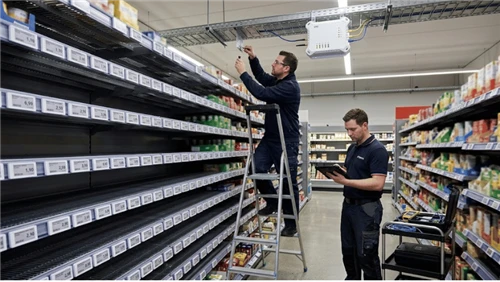
For a premium consumer goods brand, NFC lets a shopper tap their phone on-pack to verify authenticity or access product content - no app download required. For a retailer managing thousands of SKUs, UHF RFID enables inventory counts that take minutes rather than hours, with no line-of-sight scanning required. Electronic shelf labels increasingly combine with RFID infrastructure to create fully connected shelf-to-system workflows.
The practical rule: choose NFC when the intended interaction is consumer-facing; choose RFID when the priority is operational throughput. The two are not interchangeable, and conflating them leads to mismatched investment decisions. Learn more about retail electronic shelf labels and how they fit into smart label deployments.
2. AI-Powered Label Design and Compliance Automation
Artificial intelligence is entering the labelling workflow at multiple points. The most impactful application right now is not faster design - it is compliance automation, which directly reduces the risk of costly product recalls.
AI-powered labelling systems cross-reference label text against current regulatory databases in real time, flagging missing allergen declarations, non-compliant font sizes for mandatory nutritional information, or incorrect country-of-origin formats before a single label is printed. In regulated categories, a single labelling error can trigger a recall costing hundreds of thousands of pounds in product withdrawal, logistics, and brand damage - a cost that dwarfs the investment in compliance automation.
Beyond compliance, machine-learning vision systems inspect print quality at production line speeds - catching barcode readability failures, misalignments, and ink defects that manual inspection cannot reliably catch at volume. For operations managers without in-house design expertise, AI design tools now generate compliant label layouts from product data inputs, compressing artwork creation from days to hours.
One important caveat: no AI compliance system removes the need for qualified regulatory review, particularly in pharmaceutical or food manufacturing. These tools reduce error rates; they do not replace human accountability. Explore how electronic shelf label technology is incorporating AI-driven update and compliance features.
3. Sustainable Label Materials and Linerless Technology
The shift toward sustainable label materials is no longer driven by brand preference alone. Extended producer responsibility (EPR) legislation in the UK and the EU's packaging regulations create hard compliance requirements around material recyclability and waste reduction - which directly affect label specification decisions.
Key materials gaining traction include plant-based label films derived from sugarcane or corn starch, compostable adhesives that break down without leaving chemical residue, post-consumer recycled (PCR) content substrates, and water-soluble labels used where container reuse requires residue-free removal.
Within this trend, linerless labels deserve specific attention. Traditional labels are produced on a silicone-coated backing paper - the liner - which is discarded after application. Linerless labels eliminate this waste stream entirely, significantly reducing per-roll material consumption and increasing label yield per roll. For high-volume operations, the efficiency gains compound quickly. The trade-off: linerless labels require compatible applicators and printers, so adoption makes most sense as part of a planned equipment refresh rather than a standalone material swap. Read more about electronic shelf labelling approaches that pair linerless formats with digital display systems.

4. Variable Data Printing and On-Demand Customisation
Variable data printing (VDP) allows each label in a production run to carry different information - a unique serial number, a region-specific regulatory text, a different language, or a personalised message - without stopping the press or changing plates.
Three use cases drive most of the commercial interest:
- Pharmaceutical serialisation: regulatory mandates in the US and EU require every individual medicine pack to carry a unique identifier. VDP is how manufacturers meet this requirement at production speed.
- Multi-market product launches: a single production run can serve multiple destination markets, each label carrying the correct regulatory text for its jurisdiction.
- Direct-to-consumer differentiation: personalised packaging labels at scale, which research consistently shows increases perceived product value in competitive consumer categories.
Digital printing - which requires no plate setup - is the enabling technology. It makes short runs economically viable, removes the pressure to order large label quantities to justify setup costs, and allows label content to be updated when formulations or regulations change without obsolete stock write-offs. Electronic price screen digital signage extends this on-demand logic to the shelf edge, where pricing and promotional content updates in real time alongside label changes.
5. IoT Integration and Real-Time Supply Chain Visibility
Labels embedded with sensors or connected identifiers serve as data-collection nodes within an IoT supply chain network - going beyond tracking to active environmental monitoring.
Time-temperature indicators (TTIs) are among the most commercially mature examples. A TTI label changes colour irreversibly if a product has been exposed to temperatures outside its safe range, providing an immediate visual signal to handlers and inspectors at any point in the chain. More sophisticated versions log the full temperature profile throughout transit and transmit it wirelessly when scanned at checkpoints.
Consider a practical scenario: a chilled ready-meal producer shipping across multiple distribution centres uses temperature-logging labels on every pallet. When a cold-chain breach occurs at a third-party logistics facility, the label data pinpoints the exact transit leg - enabling a targeted recall affecting dozens of packs rather than a precautionary withdrawal covering thousands. That specificity is the difference between a manageable quality event and a significant brand incident.
The integration requirement is real: IoT labels generate data that only creates value if it flows into systems capable of acting on it - inventory platforms, quality dashboards, ERP systems. Assess data infrastructure readiness before investing in IoT-enabled label technology.
6. QR Codes, AR, and the GS1 Sunrise 2027 Transition
QR codes have moved well beyond "scan to visit website." On a food product today, a QR code can link directly to the farm where the primary ingredient was sourced, display full allergen declarations in multiple languages, or surface sustainability certifications that physically cannot fit on the label.
Augmented reality labels - where scanning through a camera overlays digital content onto the product - remain a niche application, used primarily in premium beverages, cosmetics, and luxury goods where the interactive experience supports the brand story. For most B2B labelling operations, AR is not a near-term priority.
What is a near-term priority is the GS1 Sunrise 2027 initiative, under which traditional linear barcodes are scheduled to be replaced by 2D codes - including QR codes and Data Matrix codes - as the primary retail point-of-sale scanning standard across major markets. Label designs created or significantly refreshed before 2027 should incorporate 2D code compatibility. This is not a discretionary upgrade; it is a planned transition with a defined industry timeline. Learn more about electronic shelf label ESL systems that are already built around 2D code infrastructure.
7. Regulatory Compliance Technology and Digital Product Passports
Regulatory requirements are not typically framed as a technology trend, but the scale of incoming compliance obligations is directly driving labelling technology investment - and this is the area most under-discussed in general industry coverage.
EU Digital Product Passport (DPP). The European Union's Ecodesign for Sustainable Products Regulation (ESPR) requires a growing range of product categories to carry a Digital Product Passport - a scannable label linking to a structured dataset containing the product's materials, repairability, carbon footprint, and end-of-life instructions. Phase-in begins with batteries, textiles, and electronics from 2026, with additional categories following through 2030. Companies exporting to the EU need to begin planning DPP infrastructure now, not when the first deadline arrives.
UK Extended Producer Responsibility (EPR). UK EPR legislation requires businesses placing packaged goods on the UK market to report on and fund the recycling cost of their packaging. Labels that are incompatible with the recyclability of their host packaging affect a brand's EPR compliance calculation - making label material specification a regulatory decision, not just an operational one.
Pharmaceutical serialisation. The EU Falsified Medicines Directive (FMD) and the US Drug Supply Chain Security Act (DSCSA) require prescription medicines to carry unique identifiers that can be verified at the point of dispensing. Label printing systems operating in this environment must be validated for the accuracy and production-speed requirements these mandates impose.

How These Trends Apply by Industry
Food and Beverage: The Future of Food Labelling Technology in Practice
Research consistently shows that a majority of consumers check food product labels before purchasing - and their expectations have expanded well beyond price and basic ingredients. They want origin information, allergen clarity, and environmental credentials. For food producers, this consumer shift intersects with incoming regulatory requirements for more detailed allergen declarations and cross-contamination risk disclosure.
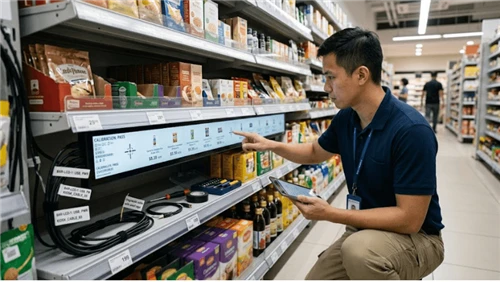
Smart labels with QR codes are well-positioned here, enabling brands to surface extended product information digitally without cluttering on-pack space. IoT cold-chain labels provide the traceability infrastructure that both regulators and major retailers increasingly require as a condition of supply. Electronic shelf labels in grocery stores are increasingly part of this connected labelling ecosystem, linking shelf-edge pricing to real-time inventory and promotional data.
Pharmaceutical and Healthcare: Serialisation, Authentication, and Cold-Chain Integrity
Pharmaceutical labelling operates under some of the tightest regulatory constraints of any product category. The FMD in Europe and DSCSA in the US both require that every individual saleable medicine pack carries a unique identifier, printed with sufficient accuracy to permit reliable scanning at line speeds across the full distribution chain. Any label printing system in this environment must be formally validated - regulatory compliance is not inferred from general capability claims.
Anti-counterfeiting is a parallel concern. NFC authentication labels, where tapping with a smartphone confirms product integrity, are increasingly standard for high-value medications and medical devices. The combination of serialisation, NFC authentication, and temperature-logging creates a multi-layer verification system that addresses the most serious supply chain risks in this sector. For pricing and information display at the pharmacy shelf level, ESL dynamic pricing systems allow product information to stay current without manual relabelling.
Retail and E-Commerce: Inventory Accuracy and Smarter Returns
RFID adoption in retail accelerated sharply when major retailers began mandating RFID tags on products supplied to their stores. The operational case is straightforward: RFID-enabled inventory counting requires no line-of-sight scanning, reducing full stock-count time from several hours to under thirty minutes in most formats, while delivering inventory accuracy levels that manual counting cannot match. How electronic shelf labels work alongside RFID infrastructure is increasingly part of the standard retail technology stack.
In e-commerce fulfilment, the priority shifts to speed and accuracy at the point of packing. Dynamic label printing integrated with order management systems generates the correct label at the moment of packing - eliminating errors from pre-printed label misapplication and enabling faster returns processing. For procurement teams evaluating the full cost picture, the comparison between electronic shelf labels vs paper labels typically shifts significantly once labour cost and error frequency are included in the calculation.

Building Your Labelling Strategy: 4 Questions Before You Invest
Understanding these trends is useful. Translating them into a coherent investment plan requires a different kind of thinking. Before evaluating specific technologies or vendors, work through these four questions:
- What is your primary pain point? Compliance risk, operational inefficiency, material cost, or consumer engagement? Different technologies address different problems - conflating them leads to investment in features that do not solve the core issue.
- What is your current system's integration capability? IoT labels and smart label platforms generate data. If your ERP, WMS, or quality management system cannot receive and act on that data, the value is lost at the integration boundary.
- What is your production volume and variability? Variable data printing and digital printing are most cost-effective for operations with short runs, frequent SKU changes, or complex regulatory requirements. High-volume, stable-SKU operations may still find conventional printing more economical for base label production.
- What regulatory requirements are scheduled for the next 24 months? If you supply the EU market, the Digital Product Passport timeline is not optional planning. If you operate in pharmaceutical distribution, serialisation compliance is a current operational requirement. Map incoming label compliance obligations before allocating budget to discretionary technology enhancements.
Use an ESL ROI calculator to model the financial case for specific upgrades before committing to a vendor selection process.
| Business Size | Near-Term Priorities | Longer-Term Considerations |
|---|---|---|
| Small / Growing | Digital printing for short runs; QR codes for consumer engagement; linerless labels on next printer refresh | NFC authentication; AI design tools for compliance support |
| Mid-Size Manufacturer | Variable data printing; linerless materials; compliance automation for key regulated markets | RFID if supplying to major retailers; IoT labels for cold-chain products |
| Large / Enterprise | Full RFID infrastructure; AI-assisted compliance management; DPP readiness planning | IoT sensor labels at scale; integrated digital label management platforms |
For teams ready to move beyond the planning stage, explore options to buy electronic shelf labels suited to your production environment and scale.
FAQ: Common Questions About the Future of Labeling Technology
What is the future of labeling technology?
Labelling technology is moving in three simultaneous directions: smarter (embedding NFC, RFID, and sensor capability), more sustainable (shifting to bio-based, recyclable, and linerless materials), and more connected (integrating with enterprise systems, regulatory databases, and consumer-facing digital platforms). By the end of this decade, the majority of commercially produced labels will carry some form of digital component - whether a 2D code, an embedded chip, or a linked digital identity.
What are smart labels and how do they work?
Smart labels incorporate a microchip, antenna, or sensor within the label itself. RFID labels transmit data wirelessly when within range of a compatible reader - no line-of-sight required. NFC labels work over very short distances and can be read by standard smartphones. The chip stores a unique identifier that links to a product record, an authentication system, or a consumer-facing content platform.
How is AI changing the labelling industry?
AI is primarily used in labelling for three functions: compliance verification, vision-based print inspection, and design automation. The most commercially significant application is compliance verification - automatically checking label content against regulatory requirements before production, reducing the risk of recalls that can cost far more than the technology investment itself.
What are linerless labels and why are they growing in use?
Linerless labels are produced without the silicone-coated backing paper that traditional labels use. Eliminating the liner reduces material waste and increases label yield per roll. They align with EPR packaging obligations in the UK and EU and lower consumable costs for high-volume operations. The trade-off is compatibility: linerless labels require specific applicators and printers, so adoption typically aligns with equipment refresh cycles. See how electronic shelf label solutions are integrating sustainable label formats into wider retail display systems.
What is the EU Digital Product Passport and how does it affect labelling?
The EU Digital Product Passport is a requirement under the Ecodesign for Sustainable Products Regulation (ESPR). Products in specified categories must carry a label - typically a 2D code or NFC tag - linking to a standardised dataset covering materials, environmental impact, repairability, and end-of-life instructions. Phase-in begins with batteries, textiles, and electronics from 2026, with more categories following through 2030. Companies exporting to the EU should begin DPP infrastructure planning now.
Will QR codes replace traditional barcodes?
In retail scanning, yes - on a defined timeline. GS1's Sunrise 2027 initiative targets the transition from linear barcodes to 2D codes (including QR codes and Data Matrix codes) as the primary retail point-of-sale scanning standard across major markets. For brands, label designs created or significantly refreshed before 2027 should incorporate 2D code compatibility. This is a scheduled industry transition, not a speculative trend. See how digital price tags are already being built around 2D code and connected label standards.
The Label as a Strategic Asset
Labels used to be the last item on the product development checklist - a functional necessity finalised after all the important decisions had been made. That position is no longer defensible.
The seven technologies covered here - smart labels, AI-driven compliance, sustainable materials, variable data printing, IoT integration, QR and AR interaction, and regulatory compliance systems - collectively represent a shift in what a label is capable of and what it is legally required to do. In the most advanced implementations, the label is the primary interface between a physical product and the digital world.
For most operations, the practical starting point is not a wholesale technology overhaul. It is a structured audit of current labelling infrastructure against incoming label compliance requirements and operational gaps, followed by a prioritised roadmap that addresses the most urgent needs first. The businesses that treat labelling as a strategic capability - rather than a production cost - will be better positioned to meet compliance obligations, respond to consumer expectations, and adapt to the regulatory changes already scheduled for the next five years.