Picking is the most labor-intensive step in most warehouse operations, typically accounting for 50 to 65 percent of total labor hours, according to the MHI Annual Industry Report. It is also where most fulfillment errors originate. If your team is falling behind on orders, making frequent mis-picks, or spending too much time walking between locations, the issue usually traces back to one decision: which picking system you are using, and whether it matches your actual operation.
This guide covers nine warehouse picking methods, from basic paper lists to electronic shelf label systems and AI-assisted robotics. For each one, you will find an honest summary of where it works well and where it does not, along with a practical framework for choosing the right approach for your specific situation.

What Is a Warehouse Picking System?
A warehouse picking system is the method or combination of tools a warehouse uses to guide workers to the correct items, confirm each pick, and record inventory changes in real time. It covers everything from how a picker receives instructions to how completion of each pick is verified.
Choosing the wrong system does not just slow things down. It compounds. Higher error rates mean more returns, more customer complaints, and more labor hours spent on corrections. The right system, properly implemented, compresses all three.
Strategy and Technology: Two Layers, Not One
Before evaluating individual technologies, it helps to understand that a picking system actually has two distinct components.
The first is picking strategy - how orders are organized and assigned. The four main strategies are discrete picking (one picker per order, start to finish), batch picking (one picker collects for multiple orders in a single trip), zone picking (pickers stay within assigned areas of the warehouse), and wave picking (orders are released in scheduled batches timed to carrier pickups). These strategies can be combined: a large distribution center might run zone-batch picking simultaneously.
The second is picking technology - the tools that guide pickers and confirm results. The rest of this guide covers the main technology options. Most operations benefit from thinking through both layers together rather than selecting a technology first and working backward.
9 Types of Warehouse Picking Systems
1. Paper-Based Picking
Pickers follow printed lists that specify item locations and quantities. No digital infrastructure is required, which makes it the lowest-cost entry point. The problems are equally straightforward: paper lists go out of date the moment inventory moves, errors are easy to make and hard to catch, and there is no real-time visibility for managers.
Paper picking is only practical for very small warehouses processing fewer than 100 orders per day with a stable, limited product range. For any operation with growth ambitions, the cost of mis-picks and manual corrections will eventually outweigh the cost of switching. A useful starting comparison is electronic shelf labels versus paper labels, which illustrates why most growing operations move away from paper-based systems.
2. Barcode Scanning (RF Scanning)
Pickers carry handheld scanners connected to a warehouse management system (WMS) via Wi-Fi. The WMS pushes pick instructions to the device; the picker scans the item to confirm. This is the most widely deployed picking technology globally, and for good reason: it delivers a significant accuracy improvement over paper at relatively modest cost, integrates with virtually every WMS platform, and works across almost any product type or SKU range.
The main constraint is speed. Pickers must handle the device throughout the process, which adds friction in high-velocity environments or wherever workers wear gloves. It is an excellent first step into digital picking for small to mid-size operations, and a reliable fallback in larger ones.

3. Electronic Shelf Labels (ESL) for Picking Guidance
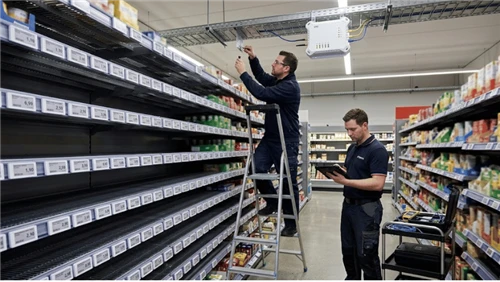
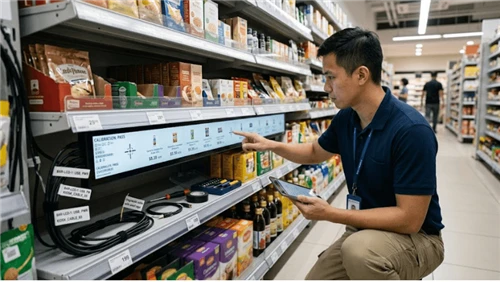
Electronic shelf labels are wireless digital displays mounted at shelf locations that update pricing, product information, and now increasingly, pick instructions. When integrated with a WMS, the correct label can flash or change color to direct a picker to the right bin - functioning as a form of light-directed picking that updates dynamically without fixed-installation costs per slot.
Electronic shelf labels improve warehouse picking by combining location guidance with real-time inventory accuracy. Because ESL systems update wirelessly across the entire label network simultaneously, the moment inventory is moved or a pick is confirmed, every label reflects the change. For warehouses that need picking guidance without the rigidity of traditional pick-to-light infrastructure, ESL-based solutions offer meaningful flexibility.
Understanding how electronic shelf labels work is worth doing before evaluating any system in this category, since the communication protocol - whether Bluetooth, Wi-Fi, or Sub-GHz - affects range, response time, and infrastructure cost significantly.
4. Pick-to-Light and Put-to-Light Systems
These two are regularly confused but serve different steps in the fulfillment process. Pick-to-light in warehouse operations uses LED indicators mounted at pick locations to illuminate the correct slot and display a quantity. The picker confirms by pressing a button on the light module. No handheld device is involved, which makes it fast and accurate in high-velocity, fixed-SKU environments. The hardware - typically a bar-shaped LCD display per pick location - must be installed across every active slot, which drives up the upfront cost and reduces layout flexibility.
Put-to-light works the same way but applies to the sorting step rather than the picking step. After a batch of items has been collected, put-to-light indicates which order tote each item belongs to. If you are evaluating light-directed systems, confirm which function you are actually buying: vendors sometimes use "light-directed picking" to mean either, or both.
Both systems perform best where the SKU mix is stable and pick locations are fixed. For frequently changing product ranges or seasonal operations, the reconfiguration cost can offset the efficiency gains.
5. Voice-Directed Picking
Pickers wear a headset connected to a voice-enabled WMS. Instructions are spoken aloud; the picker confirms each pick verbally. Both hands remain free throughout. Voice picking delivers accuracy rates consistently above 99 percent in well-implemented systems, according to benchmarks published by the Warehousing Education and Research Council (WERC). The verbal confirmation step creates a natural error check that most other systems lack.
Cold-chain and food and beverage operations are a natural fit. Heavy gloves and protective gear make handheld devices awkward; voice removes that friction entirely. Consider a hypothetical scenario: a frozen goods distributor running operations in minus 20 degrees Celsius environments where pickers wear full cold-weather gear. In that context, scanning a barcode accurately becomes genuinely difficult, and voice picking is often the obvious solution.
The main limitations are noisy environments (where voice recognition degrades) and multilingual workforces (where calibration adds time and complexity). Extended voice use also causes fatigue for some workers.
6. Pick-by-Vision (AR Smart Glasses)
Augmented reality glasses overlay pick instructions and item images directly onto the picker's field of view. The visual confirmation of item appearance is the key differentiator - for operations handling products that look similar (medical devices, electronic components, apparel variants), AR picking reduces identification errors that other systems cannot catch. Hardware cost is high, battery life in industrial environments is a genuine constraint, and the technology is still maturing. For high-value goods warehouses where a single mis-pick carries significant downstream cost, it may be justified. For most operations today, it is worth monitoring rather than deploying.
7. Mobile and Tablet-Based Picking
Consumer tablets or ruggedized mobile devices loaded with a picking app serve as a low-cost bridge between paper and dedicated warehouse hardware. The interface is familiar, devices are easy to replace, and most cloud-based WMS platforms support this format natively. The tradeoffs are durability and scan speed compared to purpose-built industrial scanners. This is a reasonable starting point for small operations moving off paper without committing to enterprise hardware investment.
8. Goods-to-Person (GTP) Automation
Rather than sending pickers to inventory, GTP systems bring inventory to the picker. Autonomous mobile robots, automated storage and retrieval systems, or shuttle systems retrieve the correct tote and deliver it to a stationary workstation. Walking between locations can consume 50 to 70 percent of a picker's time in a conventional warehouse; GTP eliminates most of it. The capital requirement - typically starting in the high six figures - makes it a long-horizon investment for most operations, but the ROI case at high volume is clear. Good warehouse rack labeling remains essential even in GTP environments, since accurate location data is what makes automated retrieval work correctly.
9. AI-Powered and Robotic Picking
Start with the honest limitation: fully autonomous robotic picking works reliably today only for a relatively narrow range of product types - standardized shapes, predictable dimensions, sufficient contrast for computer vision to read. Soft goods, irregular items, and very small components still present meaningful challenges. Commercial deployments are concentrated in large e-commerce and retail distribution operations with the engineering resources to manage ongoing system development.
That said, the technology is advancing quickly, and the cost curve is moving in the right direction. For operations planning infrastructure investments with a ten-year horizon, understanding the trajectory is worth the time even if deployment is not imminent.
How to Choose: Three Questions That Actually Matter
Most picking system evaluation processes go wrong by starting with the technology. A more useful starting point is the operation itself.
What is your actual bottleneck? High error rate and low throughput have different solutions. Accuracy problems usually respond to guided picking (voice, light-directed, ESL). Throughput problems are typically about travel time - batch picking strategies and GTP automation address this. Diagnosing the right problem before selecting technology prevents the most common expensive mistake.
What does your environment require? Cold storage points toward voice picking. A fixed, fast-moving SKU core points toward pick-to-light or ESL-guided picking. A constantly rotating product mix argues against any fixed-infrastructure system. Multilingual workforces complicate voice implementations. These constraints narrow the realistic options before any cost comparison begins.
What does the ROI actually look like? A useful framework: add annual labor savings to annual error cost reduction, then divide by total implementation cost. The result is the payback period in years. Most operations teams treat anything under three years as a strong case. Before evaluating any system, use an ESL ROI calculator or equivalent tool to build a rough baseline - the numbers often clarify the decision faster than a vendor demonstration.
For operations evaluating electronic shelf label systems specifically, how ESL optimizes warehouse workflows is a useful read on what the efficiency gains actually look like in practice.
Matching the System to Your Operation
Small warehouse, under 500 orders per day: Barcode scanning combined with batch picking delivers an immediate, measurable accuracy improvement over paper at manageable cost. Avoid over-investing at this stage. The right system for your current scale is the one that solves today's bottleneck without locking you into infrastructure you have not yet grown into.
Growing e-commerce operation, 500 to 2,000 orders per day: Pick-to-light or ESL-directed picking for the high-velocity core; voice for broader floor coverage and cold-storage areas. Zone picking as the strategy layer to reduce congestion as the team grows.
Large distribution center, 2,000-plus orders per day: GTP automation for core picking, conveyor and sortation for throughput, guided picking as a secondary layer. Pilot in one zone before committing facility-wide.
Cold chain or food and beverage: Voice-directed picking. Hands-free, eyes-free operation was partly developed for exactly this environment.
High-value or complex product warehouse: AR-guided picking for highest-risk picks; RF scanning or ESL-directed picking for the broader range. When a single mis-pick triggers a costly compliance event, visual item confirmation justifies the hardware cost.
Three Mistakes That Derail Implementations
Automating a broken process. Technology amplifies whatever process it is applied to. If items are stored in the wrong locations, a faster picking system will find the wrong items faster. Fix the underlying process first.
Switching the entire warehouse at once. A failed pilot in one zone is a learning experience with limited operational impact. A failed facility-wide rollout is a crisis. Always pilot in one zone first, measure the results, refine, then expand.
Treating technology and strategy as separate decisions. Deploying a voice picking system without changing how orders are batched or released is like replacing a vehicle without addressing the route. Technology and strategy need to be designed together, not sequentially.
Frequently Asked Questions
What is the most accurate warehouse picking method?
Voice-directed and pick-to-light systems consistently achieve accuracy rates above 99 percent in well-implemented deployments. ESL-guided picking, which functions similarly to pick-to-light but with dynamic label updates rather than fixed hardware, shows comparable results in modern implementations. The jump from paper to almost any digital method produces an immediate and significant accuracy improvement for most operations.
What is the difference between pick-to-light and ESL-guided picking?
Pick-to-light uses dedicated LED modules physically installed at each pick location. ESL systems use wireless digital labels that update across the warehouse simultaneously via the WMS and can display pick instructions with a flashing or color-change mode. ESL offers more layout flexibility; pick-to-light tends to be faster in very high-velocity fixed-location environments. The refresh rate and display performance of the ESL system is a key spec to evaluate when using labels for pick guidance.
Can small warehouses benefit from automated picking?
Yes, but the relevant question is which level of automation. For most small warehouses, the practical entry point is barcode scanning or ESL-guided picking - neither requires major infrastructure investment. Full automation only makes financial sense at significantly higher order volumes. The common mistake is over-investing in a system sized for a scale the operation has not yet reached. ESL capabilities in warehouse environments show how smaller operations are extending digital label technology practically and affordably.
The Right System Is the One That Fits Your Operation
There is no single best warehouse picking system. RF scanning remains the right answer for a large proportion of growing operations that have outgrown paper but do not yet need the throughput of light-directed or GTP systems. ESL-guided picking is closing the gap between traditional pick-to-light and flexible digital systems. Voice picking solves a specific and genuine problem in cold and hands-free environments. GTP automation changes the economics entirely at scale.
The decision that matters is not which technology is most impressive. It is which system solves the bottleneck you actually have, fits the environment your team works in, and delivers a payback period that makes sense given your order volume today and your growth trajectory over the next three years. Start there, and the technology selection follows naturally.