Questions to Settle Before Any Vendor Demo
- How often do your prices change? Daily markdowns require fast, reliable updates across the full store. Weekly planogram cycles give you more flexibility on this criterion.
- What wireless infrastructure is in your buildings? BLE, IR, and sub-GHz radio behave differently in RF-dense environments. Concrete construction increases gateway requirements and cost.
- Do any areas need specialized hardware? Freezer sections and produce areas require IP65+ or IP68-rated labels. Confirm whether a vendor's standard line covers this before comparing prices.
- What POS and ERP systems are you running? Integration compatibility is the most common ESL deployment blocker. Get written confirmation from any vendor before signing a contract.
- What is your store count in three years? Platform scalability decisions made now affect your options later. Migrating mid-rollout is expensive.
Six Electronic Shelf Label Manufacturers, Honestly Compared
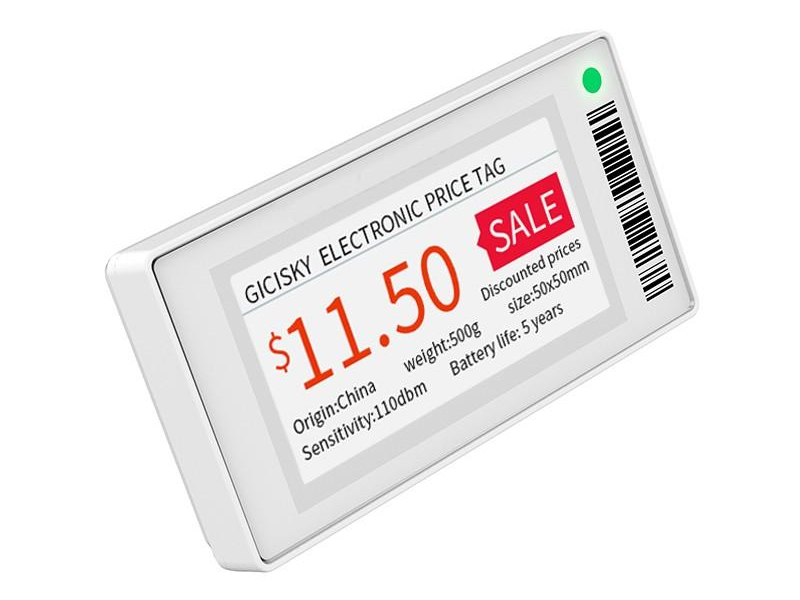
The electronic shelf label manufacturer market is concentrated around a handful of players that account for the majority of commercial deployments worldwide. Here is an honest look at six of them.
Vusion (Formerly SES-imagotag) - The Platform Play
450 million connected devices. 45,000 stores. More than 60 countries. No other ESL provider operates at that footprint, and the scale reflects a deliberate strategy to build something broader than a labeling system.
Vusion's cloud platform, VusionCloud, manages pricing, promotions, and label health across all locations from a single dashboard. It connects to inventory intelligence, in-store retail media, and computer vision analytics. For a large retailer that wants one vendor covering pricing, stock visibility, and digital campaigns under a unified platform, Vusion is currently the only option operating at that scope.
The tradeoff is predictable: enterprise platform, enterprise pricing, and an onboarding process to match. Regional chains often find the feature set well beyond what their operation needs or can absorb.
Best fit: Large grocery chains, enterprise multi-format retailers, and operators that need pricing, inventory, and retail media managed from a single platform at global scale.
LEGOYO Smart Display - Factory-Direct, Flexible by Design
Founded in 2002 as SINTOP - supplying customized store fixtures to retailers including Walmart, Target, and Home Depot - LEGOYO Smart Display pivoted into ESL manufacturing in 2019, bringing two decades of precision retail manufacturing into a category that rewards it.
LEGOYO's e-ink ESL line spans 1.53 to 9.7 inches, covering more size options than most competitors offer as standard. ERP and POS integration is built in, with both API and file-based connectivity for retailers on varied technology stacks. Five or more mounting configurations are supported out of the box. The factory-direct supply model removes distributor margins from the pricing equation, making it a competitive option for mid-size to large retailers sourcing at volume. Custom configuration and branding options are available for larger deployments.
Where the platform is still developing: as a newer entrant to ESL technology compared to the legacy market leaders, the analytics ecosystem and third-party software integrations are less mature. Retailers with complex multi-system environments should confirm platform depth before committing.
Best fit: Retailers prioritizing factory-direct ESL procurement, flexible sizing, and competitive bulk pricing - particularly where custom configuration is part of the requirement.
Pricer - Speed, Reliability, and Three Decades of Grocery Data
Founded in Stockholm in 1991 and listed on Nasdaq Stockholm, Pricer has delivered over 350 million electronic shelf labels across more than 28,000 stores in 70+ countries. That grocery retail track record - particularly across Northern and Western Europe - gives it reference deployments few competitors can match in that format.
Pricer's technical differentiator is its use of infrared (IR) communication rather than the radio frequency approach used by most competitors. IR transmits updates from base station to label without return traffic competing for bandwidth alongside BLE handhelds, payment terminals, and other wireless devices. In RF-dense store environments, this produces more consistent, faster update cycles.
At NRF 2026, Pricer launched Pricer Avenue, a powered-rail shelf-edge communication platform for high-value store zones, integrated with its Pricer Plaza cloud ecosystem. IR has one physical constraint: clear line-of-sight between transmitters and labels is required, which complex shelf configurations can disrupt.
Best fit: European grocery and supermarket chains where consistent, fast updates across dense store floors are the primary requirement.
Hanshow Technology - Where Volume Meets Full-Color Value
When Jumbo Supermarkten committed to digitizing 700+ stores across the Netherlands and Belgium with over 11 million labels, they chose Hanshow. That rollout - among the largest single ESL deployments on record - captures the Chinese manufacturer's core positioning: supply chain scale that enables competitive pricing on high-volume contracts, including four-color e-ink displays that most competitors only offer at premium tiers.
Hanshow's cloud platform, launched in 2024, supports centralized management across large networks. The company is active across Asia, Europe, and North America. One due-diligence check worth making: Hanshow's local support infrastructure in Western markets is still developing, and field response capacity varies by region.
Best fit: Mid-to-large retailers prioritizing cost-effective, full-color ESL deployment at scale, particularly those with significant Asia-Pacific operations.
SoluM - When Battery Life Is the Deciding Factor
SoluM, a spinoff from Samsung's semiconductor business, rates its Newton line at over 10 operational years on standard e-ink labels - meaningfully higher than most competitors' catalog averages. For a retailer deploying 20,000 labels, the difference between a 7-year and 10-year battery rating accumulates into real maintenance labor and replacement cost over the system's life. NFC is built into SoluM's hardware as standard, enabling shoppers to tap labels for product pages or loyalty pricing without additional per-unit hardware cost.
SoluM is primarily a hardware and connectivity specialist. Advanced analytics and broad cloud platform capabilities are less developed than Vusion's.
Best fit: Large-format retailers where hardware longevity, durability, and NFC shopper interaction are the primary evaluation criteria.
Displaydata - Display Precision for Compliance-Sensitive Retail
EU unit pricing regulations, pharmacy labeling requirements, and premium electronics displays all create retail contexts where a label's rendering accuracy matters as much as its update speed. Displaydata, the UK-based provider, has positioned itself specifically for those environments, with cloud-managed integration focused on pricing compliance, promotional accuracy, and display fidelity. Fashion, pharmacy, and electronics retailers have chosen Displaydata where shelf presentation quality is itself a brand requirement.
Displaydata's global deployment footprint is smaller than the top three providers. For specialty retail formats with precise display requirements, that focused positioning is a genuine fit.
Best fit: Specialty retail, pharmacy, electronics, and markets with strict unit pricing compliance display requirements.
Brand Comparison at a Glance
| Brand | Communication Tech | Color Options | Key Strength | Tier | Best Fit |
|---|---|---|---|---|---|
| Vusion | RF + BLE | B/W, BWR, Full-color | Full platform ecosystem | $$$ | Enterprise, multi-format |
| LEGOYO | BLE | B/W, BWR | Factory-direct, flexible sizing | $$ | Mid-market, custom deployments |
| Pricer | Infrared (IR) | B/W, BWR | Update speed, reliability | $$–$$$ | European grocery |
| Hanshow | BLE | B/W, BWR, 4-color | Volume pricing, full-color | $$ | High-volume deployments |
| SoluM | BLE 5.0 + NFC | B/W, BWR | Battery longevity, NFC | $$ | Durability-critical |
| Displaydata | BLE | B/W, BWR, Full-color | Display precision | $$–$$$ | Specialty, compliance |
Pricing tiers are relative indicators. Actual costs vary by deployment scale and contract terms.
What ESL Deployment Actually Costs
The per-label price is what vendors quote first. It is not what you spend. According to Global Market Insights, the ESL market exceeded $2.2 billion in 2025 - a range wide enough that cost comparison only makes sense across the full deployment budget:
- Label hardware: Standard e-ink labels run $5–$15 per unit. Full-color and larger formats reach $20–$50+. A store deploying 10,000–15,000 labels can expect hardware costs of $75,000–$200,000 depending on display mix.
- Gateway access points: Each covers roughly 1,500–2,000 labels at $150–$300 per unit. Older buildings with poor RF penetration require more of them.
- Software subscription: Enterprise platforms typically run $150–$400 per store per month.
- Integration services: Connecting to POS and ERP is usually $2,000–$15,000 depending on system age and complexity.
- Annual support: Generally 12–18% of hardware cost per year.
For a full cost model by store format, see our electronic shelf label cost breakdown, or use the ESL ROI calculator to model your payback timeline. Most mid-market retailers reach ROI in 18–30 months. Budget an additional 20–30% above initial vendor quotes - older buildings consistently surface infrastructure requirements that desk-based site surveys miss.
Matching the System to Your Store Scale
Small retailers (1–5 stores): ESL economics require honest evaluation first. Stores with stable pricing and low change frequency may face payback timelines beyond three years. Cloud-native platforms without on-site server requirements reduce complexity for single-location deployments.
Regional chains (5–100 stores): This is where the business case becomes consistently strong - especially for grocery store ESL deployments with high promotional frequency. Multi-store dashboard capability, confirmed POS integration, and phased rollout support are non-negotiable. Ask vendors for references from retailers at your store count, not just their largest enterprise clients.
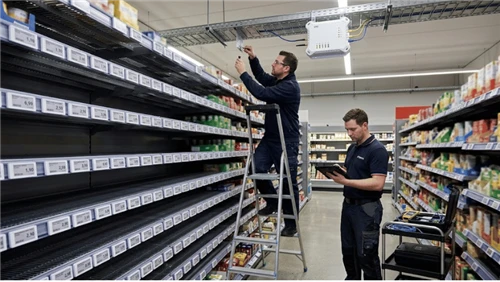
Enterprise retailers (100+ stores): At this scale you are choosing a connected retail management layer. Require documented uptime SLAs, full API documentation, and a formal site survey per location. Understanding how electronic shelf label installation works at each stage surfaces infrastructure requirements that otherwise become budget surprises.
Three Buying Mistakes Worth Knowing
Comparing per-unit price without modeling total cost. Two systems with similar label pricing can have substantially different three-year costs once gateways, software, integration, and support are included. Always request a full TCO model alongside hardware pricing.
Skipping the pilot phase. A two-to-eight-week pilot in one or two stores reveals wireless coverage gaps, POS edge cases, and workflow issues that no demo shows. Retailers who skip pilots consistently report higher actual deployment costs.
Accepting "compatible" as a complete answer. If your POS or ERP is more than five years old, integration will likely require additional work. Get written confirmation of what compatibility means for your specific stack before contracts are signed.
Quick Picks by Scenario
| Your Priority | Start With |
|---|---|
| One platform: pricing, inventory, and retail media at enterprise scale | Vusion |
| Factory-direct sourcing with flexible sizing and bulk pricing | LEGOYO |
| Fastest, most consistent updates in European grocery | Pricer |
| Full-color ESLs at competitive high-volume pricing | Hanshow |
| Maximum hardware longevity with NFC as standard | SoluM |
| Display precision for specialty or compliance-sensitive retail | Displaydata |
Frequently Asked Questions
How much do electronic shelf labels cost per unit?
Standard e-ink labels run approximately $5–$15 per unit. Full-color and large-format models reach $20–$50+. Hardware is only part of the budget - gateways, software, integration, and support add substantially to total deployment cost. For a realistic full picture, see what electronic shelf labels cost in real deployments.
What is the difference between e-ink and LCD shelf labels?
E-ink displays only draw power when their content changes, enabling battery lives of 7–15 years. LCD displays refresh continuously - useful for dynamic content but significantly more power-intensive. For most retail shelf applications, e-ink is the practical default. For a direct comparison, see LCD vs e-ink shelf labels.
Can ESLs support dynamic or time-based pricing?
Yes. Platforms connected to a pricing engine can push updates across a full store in minutes, enabling markdown automation, competitive repricing, and time-of-day pricing. For how this works in practice, see how ESL dynamic pricing works.
How long does ESL deployment take?
A single-store pilot typically takes two to eight weeks. Chain-wide rollouts are measured in quarters, not weeks. Stores with legacy infrastructure or concrete construction consistently take longer than initial estimates - build that into your project plan before committing to a go-live date.
The Bottom Line
The six brands covered here represent the realistic shortlist for most commercial ESL evaluations. The right match depends on your retail format, region, integration complexity, and what you need ESLs to do beyond displaying a price.
Before your first vendor call, know your weekly price-change volume, your POS and ERP stack, your store count in three years, and your first-year capital ceiling. Those four answers eliminate most mismatches before a demo is scheduled.
For a broader view of electronic shelf label companies across the market, or to compare specific ESL technology options by display type and communication protocol, those resources continue the comparison in more technical depth.