LCD vs E-Ink Shelf Labels: Which Technology Fits Your Retail Store?

May 07, 2026

Leave a message

e-ink is the right default for most of your store. It draws almost no power between updates, batteries last three to five years, and the display stays readable under any retail lighting condition. LCD earns its place at endcaps, feature bays, and brand-led zones where full color, video, and instant refresh justify the higher hardware and energy cost.

The real question is not which technology is better in the abstract. It is how much of each belongs in your store, and where. If you are still in the early stages of this evaluation, our guide on what digital price tags actually are and how retailers decide on them is a better starting point. This article assumes you are past that question and ready to compare technologies side by side.

info-858-572

LCD vs E-Ink Shelf Labels: Side-by-Side Comparison

Dimension E-Ink Shelf Labels LCD Shelf Labels
Power consumption Only during content updates; essentially zero when idle Continuous backlight draw, typically 1–3 W active
Battery life 3–5 years on a standard coin cell 6–12 months rechargeable, or wired power required
Color capability Black/white, 3-color, or 4-color (red + yellow options) Full RGB; video supported
Refresh speed 1–3 seconds per update Real-time, 30–60 fps
Sunlight readability Excellent - reflective display, no glare Poor without high brightness, which increases power draw
Cold environment performance Rated to −25°C; no additional cost or variant needed Standard panels fail below 0°C; freezer-rated variants cost more
Unit price at volume $5–$25 depending on display size and color configuration $80–$400+ per bar-type display
Ideal deployment density Every SKU position across the full store floor 1–5% of shelf positions: endcaps and feature zones
Strongest retail fit Grocery, pharmacy, warehouse, all baseline pricing positions Electronics retail, beauty, brand zones, promotional walls


How E-Ink Shelf Labels Work - and Why Batteries Last So Long

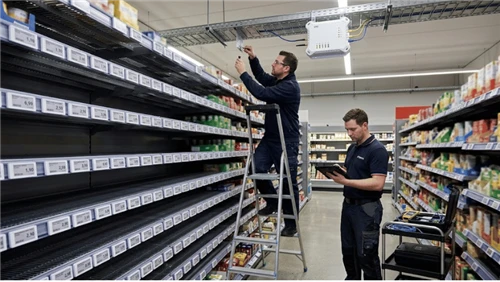
E-ink, formally called electronic paper display or EPD, uses microscopic capsules filled with charged white and black pigment particles suspended in a clear fluid. An electrical pulse pulls the pigments into position to form text or images. Once the image is set, the display holds it indefinitely with no further power. That bistable property is the entire reason e-ink works at retail scale. E Ink Corporation, which originated and commercialized the technology and supplies the panels used in most ESL hardware sold today, describes it as image retention without power - the screen holds its last state even if the battery is removed entirely.

In production deployments, e-ink shelf labels run from about 1.5 inches to 7.5 inches diagonal. Monochrome black and white remains the volume standard for plain pricing. Three-color variants adding red and four-color variants adding both red and yellow are now widely available for stores that need promotional differentiation at the shelf edge. Color e-ink has improved considerably in the last three years - red sale prices, yellow clearance flags, and promotional borders have become standard features. The e-ink shelf labels Legoyo produces range from 1.53 to 9.5 inches and integrate directly with major ERP and POS platforms through wireless update cycles.

Battery life is not a fixed number. A label updating once or twice a day on a stable price file typically lasts four to five years on a CR2450 coin cell. Push that to six to eight updates daily - common for fresh produce and perishable pricing - and you are looking at two to three years. Your actual update cadence is what drives replacement cost, not the figure on the data sheet. For a deeper look at how the full system connects from label to gateway to software back-end, our breakdown of how electronic shelf labels work from a retailer's perspective covers the architecture end to end.

info-858-572

How LCD Shelf-Edge Displays Work - and Where the Higher Cost Pays Off

LCD shelf labels use liquid crystals sandwiched between polarizing filters. Electrical voltage shifts crystal orientation to modulate a constant backlight, producing color and brightness. The key word is constant. The backlight is always on when the screen is active. That is the fundamental engineering difference that puts LCD in a separate cost and maintenance category from e-ink.

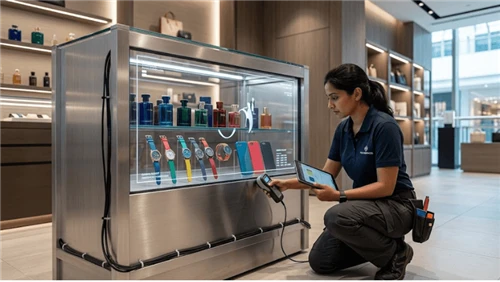
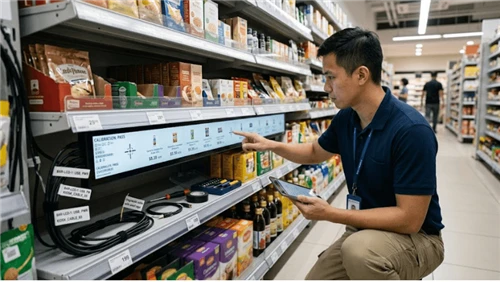
What LCD gives up in efficiency, it recovers in versatility. Full RGB color, smooth video at 60 frames per second, and pixel densities that support QR codes and detailed product graphics make bar-type LCD shelf-edge displays a genuinely different communication tool from a price tag. An endcap running LCD can cycle brand video, show a promotional countdown, surface a recipe, and display a scannable loyalty QR code - content types e-ink simply cannot support.

That versatility comes with infrastructure requirements. LCD shelf displays typically need either low-voltage DC power running through the gondola rail or a high-capacity rechargeable battery on a six-to-twelve month swap cycle. In a 40,000-SKU grocery store, deploying LCD at every shelf position would be operationally and financially unworkable. At a carefully selected ten to fifteen positions per store - the highest-conversion endcaps and brand feature bays - it can earn a measurable return on the promotional investment.

Before specifying bar LCD displays, the hardware questions go deeper than most buyers expect. Panel brand, operating temperature rating, resolution, brightness specification, and bracket compatibility vary significantly between suppliers. Our bar LCD display buying guide for retail shelf signage walks through the specification decisions worth pressing on before you commit to a vendor.

info-858-572

ESL Cost Breakdown: E-Ink vs LCD Across a Five-Year Budget

Hardware unit cost is where most comparisons start and stop. That gets you about 30 percent of the real picture.

For e-ink, the five-year budget includes hardware per label, wireless gateway infrastructure, software licensing, installation labor, and battery replacement cycles. At 10,000 labels across a grocery chain, volume pricing typically brings unit hardware cost into the $5–$15 range depending on display size and color configuration. Gateway infrastructure adds cost on top of that - roughly one gateway per 250 to 500 labels depending on the wireless protocol and store geometry. Installation labor is often the largest single variable, especially in stores with legacy shelving that requires rail adapters or custom mounting solutions.

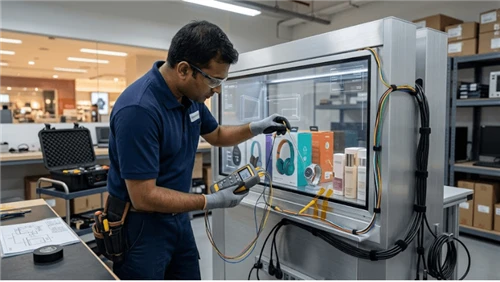
For LCD shelf displays, infrastructure dominates. If your gondola rails do not already include low-voltage power channels, retrofit costs and construction lead times add significant budget and calendar. In new builds and full remodels, LCD power infrastructure can be designed in from the start at lower marginal cost. This is one reason many retailers end up specifying LCD in new store openings while running e-ink across their existing estate.

The comparison against paper labels - the baseline most stores are still operating from - is a separate calculation that most buyers underestimate. Our breakdown of electronic shelf labels versus paper labels covers the labor cost math in detail. The short version: labor elimination is typically the primary payback driver, not hardware cost reduction alone. According to Grand View Research, the global ESL market reached approximately USD 1.95 billion in 2024 and is projected to grow above 11 percent annually through the decade - most of that driven by grocery and large-format retail moving off paper-based pricing systems.

For a full view of how an ESL system fits within your pricing infrastructure, including POS, ERP, and promotion scheduling integration, our guide on electronic shelf labelling: how it works and what it costs covers the system-level picture.


Installation, Wireless Protocols, and Maintenance: The Questions Most Guides Skip

Unit price comparisons are incomplete without the infrastructure picture. These are the procurement questions that determine whether a rollout succeeds or stalls at implementation.

Wireless protocol matters more than most buyers realize. E-ink shelf labels communicate using one of three approaches: proprietary RF, infrared (IR), or Bluetooth Low Energy (BLE). RF dominates large-format retail because it handles long range, penetrates shelving fixtures reliably, and scales to thousands of labels per gateway. BLE is gaining ground in newer deployments because it works within existing Wi-Fi infrastructure and supports two-way communication for more advanced features. IR is older, increasingly legacy, and being phased out of most new product lines. The protocol you select affects gateway density, software compatibility, and your ability to integrate with future hardware generations - it is not a detail to finalize after the hardware order.

LCD shelf displays typically run on Wi-Fi or Ethernet, with content delivered through Android-based media players built into the unit. For wired power, that means coordinating with your facilities or electrical team before a single display is mounted.

Maintenance cycles diverge sharply. E-ink requires battery replacement on a multi-year schedule - typically five to ten percent of the installed label count per year in a mature deployment. LCD displays need more frequent attention: firmware updates, cleaning cycles, and battery rotation on portable units every six to twelve months. Neither maintenance program is unmanageable, but they have different staffing and logistics footprints that should be modeled before you commit to a technology mix.

Our electronic shelf label solutions page outlines what a full deployment engagement covers, from initial site survey through ERP integration. For a store-operations view of how ESL changes day-to-day workflow once it is live, how electronic shelf labels streamline retail operations walks through the staffing and process shifts retailers typically experience in the first quarter post-rollout.


Readability Across Real Store Lighting Conditions

This variable matters more than the spec sheets suggest, and it is routinely underweighted in technology selection.

Retail lighting varies widely. High-lux LED overhead grids in grocery, warm halogen in specialty apparel, fluorescent tubes in pharmacy, and the enclosed cooler lighting inside refrigerated cases each create distinct readability conditions. E-ink performs reliably across all of them because it is a reflective display - it uses ambient light the way a printed page does, rather than emitting its own. Viewing angles run to approximately 170 degrees, which means a label mounted on the bottom shelf is still legible from a standing shopper's eye level without the customer crouching down.

LCD is more situational. Strong ambient light washes out the image unless brightness is pushed high, which increases power draw and heat. That is a problem for battery-powered units and an operating cost issue for wired installations. Standard LCD panels also degrade or fail below 0°C, requiring freezer-rated variants at additional cost and often with a reduced feature set. For stores with significant refrigerated or frozen floor space, this is not a footnote - it is a budget line item.

For warehouse and racking environments where pick-aisle visibility across long distances and in variable lighting matters more than promotional impact, e-ink's combination of wide viewing angle, glare-free surface, and broad temperature tolerance is the cleaner operational choice. Our breakdown of how electronic shelf labels are used in warehouse racking and picking operations covers that deployment context specifically.

info-858-572

Which Retail Format Should Use Which ESL Technology?

The clearest guidance comes from matching technology characteristics to actual merchandising requirements rather than looking for a universal winner.

Grocery and supermarkets (15,000–50,000 SKUs, high promotional frequency, significant labor cost exposure): e-ink across the full store floor, with LCD reserved for endcaps, fresh department signage, and seasonal feature bays. In high-labor-cost markets with active weekly promotional calendars, labor savings on price-change management typically recover full hardware cost within 18 to 30 months.

Pharmacy and drug chains sit closest to grocery in their operational profile. High SKU counts, pricing accuracy requirements driven by regulation, and frequent promotional cycling make e-ink the natural default across most of the floor. LCD earns its place at front-of-store promotional walls and beauty endcaps where customer dwell time is longer and visual presentation has measurable sales impact.

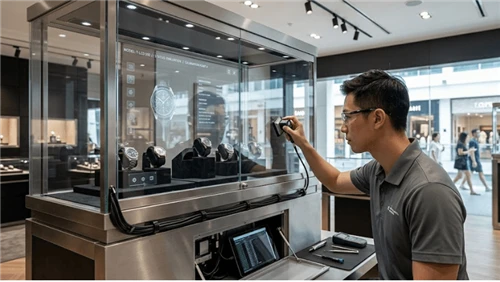
Specialty electronics retailers lean LCD-heavy. Lower SKU counts, extended customer dwell time, and a merchandising emphasis on product specification and comparison align with what LCD does well. Our electronic price screen and digital signage hardware is designed specifically for this category, pairing real-time pricing with the visual weight electronics shoppers expect from a modern store environment.

Apparel and soft goods sit in the middle. Moderate SKU counts, lower price-change frequency, and brand visual identity matter more than real-time pricing flexibility. Color e-ink handles most of the use case cleanly; LCD shows up at premium display zones in flagship locations where brand spend justifies the infrastructure investment.

Warehouse and distribution operations: e-ink almost always. Wide viewing angles, no glare, long battery life, and operating temperature range make it the practical choice for racking, pick lanes, and inventory zones where legibility across distances matters more than visual richness.


A Real Deployment Example: How Hybrid Configurations Work in Practice

Across the rollouts Legoyo has supported, the strongest outcomes consistently come from hybrid configurations - not a pure e-ink or pure LCD approach.

One example from 2023: a regional grocery operator deploying across 47 stores, averaging approximately 18,000 SKUs per location. The configuration that produced their best measured return looked like this:

  • E-ink labels at all 18,000 SKU positions per store - 1.6-inch monochrome for shelf-stable goods, 2.9-inch three-color for produce and fresh categories running dynamic pricing on a six-times-daily update cycle
  • 14 LCD bar displays per store positioned at endcaps, the deli counter, and the bakery zone for promotional video content and daypart-driven messaging
  • One transparent display case at front-of-store entry for seasonal campaign rotation
  • Centralized management software handling both display types from a single operator dashboard, with pricing rules and content templates applied by zone

Their measured outcome after the first full quarter post-rollout: weekly staff hours spent on price changes dropped from approximately 14 hours per store to under two hours. Pricing errors flagged at checkout fell to near zero. Full hardware payback landed at 22 months, calculated on labor savings alone and before any promotional conversion uplift from the LCD endcap network was factored in.

The pattern holds because e-ink and LCD are not competing technologies. They are complementary tools doing different jobs on the same shelf.


E-Ink vs LCD Shelf Labels: What Is Changing in 2025 and 2026

Both technologies are evolving, though at different rates and in different directions.

On the e-ink side, color options have expanded beyond the standard red and yellow accent palette. Full-color e-ink panels - supporting thousands of colors - are entering commercial availability for premium applications, though still at lower resolution and higher unit cost than monochrome. Refresh speeds continue to improve incrementally. Not LCD-fast, but noticeably better than three years ago, which expands the use cases where e-ink can plausibly replace LCD.

On the LCD side, micro-LED backlighting is gradually replacing older architectures in newer product generations, reducing power consumption while improving brightness uniformity. Thinner rail-mount form factors are making LCD easier to retrofit into existing gondola systems without structural modification. Touchscreen LCD ESL variants - allowing customers to interact at the shelf edge - are appearing in early premium deployments, though mass-market adoption is still several years out.

Walmart's ongoing digital shelf label rollout across more than 2,300 U.S. store locations is the most consequential real-world deployment currently shaping supplier roadmaps and software platform development across the industry. Their technology choices are setting a direction that smaller retailers and regional chains are watching closely.

For most mid-to-large retailers, the technology has matured past the question of whether to adopt. The conversation has shifted to configuration mix, integration architecture, and deployment sequencing. If you want to talk through what makes sense for your specific store profile, you can request a configuration assessment from our team and we will walk through the options.


Frequently Asked Questions

Can e-ink shelf labels display color, or are they only black and white?

Modern e-ink shelf labels support up to four colors in a single display - typically black, white, red, and yellow. Full RGB color e-ink panels exist but remain higher cost and lower resolution than LCD. For most retail pricing and promotional applications, three- or four-color e-ink covers the practical display requirements without the continuous power draw that LCD requires.

How often do e-ink shelf label batteries actually need to be replaced?

In typical grocery retail use with one to three price updates per day, batteries last three to five years. Push that to six or more daily updates - common for fresh and perishable pricing - and you are looking at two to three years. The spec sheet number assumes average update frequency. Your actual cadence is the figure that matters when you are building a five-year maintenance budget.

Is LCD or e-ink better for refrigerated and freezer environments?

E-ink wins clearly here. Standard e-ink panels operate to approximately −25°C without modification or added cost. Standard LCD panels degrade or fail below 0°C and require freezer-rated variants at higher unit price. For any refrigerated display or cold chain application, e-ink is the lower-risk and lower-cost default.

Can one software platform manage both e-ink and LCD labels in the same store?

Yes - and verifying this capability is a standard due-diligence step before selecting a vendor. Mature ESL software platforms support mixed-technology deployments with both display types managed from a single admin interface. Content templates, pricing rules, and update scheduling can be applied selectively by display type and store zone. Confirm multi-display support and ask for a live demonstration before you sign a contract.

What is a realistic payback period for moving from paper labels to electronic shelf labels?

In high-labor-cost markets with active promotional calendars - the profile that describes most grocery operations in Western Europe and major U.S. metro areas - full hardware payback typically lands within 18 to 30 months on labor savings alone. Smaller stores with stable pricing and lower local wage rates may see a three-to-four-year window. Labor cost elimination is the primary driver; hardware cost reduction is secondary. The ratio of update-related labor to total store labor cost is the number worth modeling before you make the business case internally.

Send Inquiry