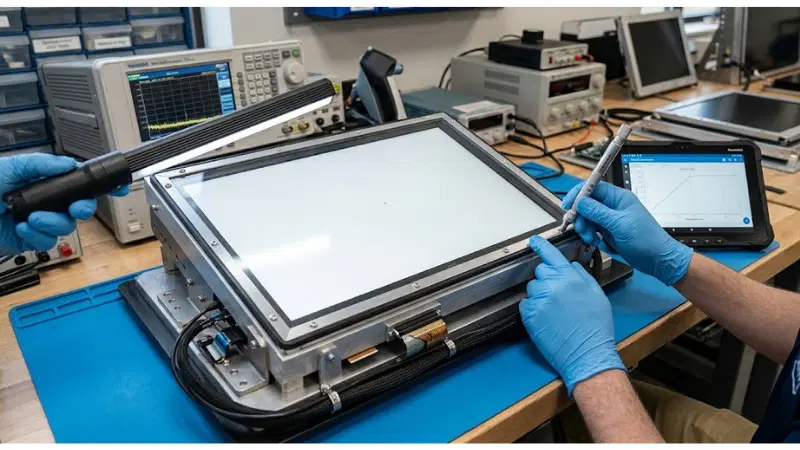
An air gap can simplify service and cost, but if the protective glass locally touches or approaches the panel, pressure and interference patterns can appear; if the gap is too open or poorly sealed, dust becomes visible against bright content. That is the practical reason to treat commercial LCD cover glass air gap Newton rings as a system problem rather than a specification-line feature. This guide is for Display enclosure engineers, kiosk/signage OEMs, optical designers, manufacturing teams, and buyers and answers one narrow question: How should an air-gapped cover glass be spaced and supported over a commercial LCD to avoid Newton-ring contact, moiré, dust shadows, and pressure transfer? The focus is unbonded cover-window spacing + optical artifacts + cleanliness, distinct from optical-bonding QA.

Do not let a single bench demo carry the whole decision. Begin with model-specific documentation, connect it to drawings and configuration for the finished display/fixture assembly, then inspect the difficult interactions on production-equivalent hardware. Capture the exact revision and the condition under which it passed. After rollout, compare incidents with that baseline so old evidence is not reused after a field modification. The important interfaces include panel mechanics, video source, display settings, optical condition, mounting, and service replacement. When a numerical limit matters, source it from the applicable standard, the exact model, or an approved project requirement instead of turning a convenient example into a universal specification.
Useful neighboring LEGOYO resources are Bar-Shaped LCD Screen, Bar LCD CMS Integration, Bar LCD Thermal Management. They establish adjacent product and integration context; this article keeps its own keyword owner and engineering boundary.
The topic-lock research reviewed public category/technical material from Samsung Business Displays, LG Commercial Display, and Sharp/NEC Display Solutions. The purpose was to identify common buyer language and gaps in implementation detail. Competitor claims are not used as LEGOYO facts, and competing commercial pages are not linked from the final article.
Set the boundary before selecting a fix
Optical-bonding QA owns bonded stacks; this page owns intentionally air-gapped protective windows and the spacing/cleanliness issues unique to them. The controlling object is the finished display/fixture assembly, not a loose component on a laboratory table. The supplier-quality team should set the supported condition around minimum functional separation under tolerance stack, cover-glass flatness and bow, and spacer/gasket placement outside sensitive viewing zones; name the owner of each interface; and state what the user or technician sees when it falls outside the approved state. That approach separates a real component defect from a fixture, configuration, content, environment, or service problem.
Write exclusions next to the scope. This article focuses on unbonded cover-window spacing + optical artifacts + cleanliness, distinct from optical-bonding QA and should not absorb every adjacent topic merely because the same hardware is involved. The first adverse case to place in the plan is "Cover glass bows inward and locally contacts the LCD surface." If the project cannot explain how that condition is detected, contained, and retested, the boundary is still too vague for procurement or acceptance.
Scope-to-evidence map
| Control point | Review action | Adjacent dependency | Output |
|---|---|---|---|
| minimum functional separation under tolerance stack | challenge a tolerance edge | Interaction with spacer/gasket placement outside sensitive viewing zones | reviewable evidence tied to production revision |
| cover-glass flatness and bow | reproduce a service state | Interaction with frame deflection under assembly and user pressure | reviewable evidence tied to production revision |
| spacer/gasket placement outside sensitive viewing zones | confirm recovery after disturbance | Interaction with anti-glare/anti-reflective surface interaction | reviewable evidence tied to production revision |
| frame deflection under assembly and user pressure | establish the reference condition | Interaction with dust ingress and cleaning access | reviewable evidence tied to production revision |
| anti-glare/anti-reflective surface interaction | expose the dependency | Interaction with moiré risk with printed meshes or patterned films | reviewable evidence tied to production revision |
| dust ingress and cleaning access | make the state observable | Interaction with touch sensor placement and gap stability where applicable | reviewable evidence tied to production revision |
Engineering controls to specify explicitly
The controls below come directly from the failure boundary for commercial LCD cover glass air gap Newton rings. They are intentionally more specific than generic product features. For each one, define the reference state, the interaction that can change it, the production/service check, and the change that invalidates the old result.
Minimum functional separation under tolerance stack
Put minimum functional separation under tolerance stack into the requirement set before tooling and quotations are frozen. Set the variable that controls it, which part or configuration establishes the reference, and how a technician can confirm it without relying on tribal knowledge. Pair the check with cover-glass flatness and bow, because those two conditions can move together after a revision. The negative case "Cover glass bows inward and locally contacts the LCD surface" is useful because it forces the review away from nominal geometry or default settings. The expected outcome should say what remains functional, what becomes unavailable, and what evidence distinguishes this condition from an unrelated latent defect.
Cover-glass flatness and bow
Cover-glass flatness and bow is an installation condition, not a drawing label. Bound the variable that controls it, which part or configuration establishes the reference, and how a technician can validate it without relying on tribal knowledge. Pair the check with spacer/gasket placement outside sensitive viewing zones, because those two conditions can move together after a service intervention. The negative case "A gasket compresses unevenly and creates a narrow interference zone" is useful because it forces the review away from nominal geometry or default settings. The expected outcome should say what remains functional, what becomes unavailable, and what evidence distinguishes this condition from an unrelated configuration fault.
Spacer/gasket placement outside sensitive viewing zones
The design review for spacer/gasket placement outside sensitive viewing zones needs a reference that survives production and field service. Document the variable that controls it, which part or configuration establishes the reference, and how a technician can verify it without relying on tribal knowledge. Pair the check with frame deflection under assembly and user pressure, because those two conditions can move together after a replacement. The negative case "Dust in the air gap becomes sharply visible on white content" is useful because it forces the review away from nominal geometry or default settings. The expected outcome should say what remains functional, what becomes unavailable, and what evidence distinguishes this condition from an unrelated drift.
Frame deflection under assembly and user pressure
For frame deflection under assembly and user pressure, the key issue is whether the final assembly keeps the intended state after tolerance, service and environment are added. Frame the variable that controls it, which part or configuration establishes the reference, and how a technician can prove it without relying on tribal knowledge. Pair the check with anti-glare/anti-reflective surface interaction, because those two conditions can move together after a change. The negative case "A decorative mesh or printed pattern creates moiré with the pixel structure" is useful because it forces the review away from nominal geometry or default settings. The expected outcome should say what remains functional, what becomes unavailable, and what evidence distinguishes this condition from an unrelated integration error.
Anti-glare/anti-reflective surface interaction
Put anti-glare/anti-reflective surface interaction into the requirement set before tooling and quotations are frozen. Pin down the variable that controls it, which part or configuration establishes the reference, and how a technician can exercise it without relying on tribal knowledge. Pair the check with dust ingress and cleaning access, because those two conditions can move together after a configuration edit. The negative case "User pressure transfers through a flexible window and produces temporary LCD pressure marks" is useful because it forces the review away from nominal geometry or default settings. The expected outcome should say what remains functional, what becomes unavailable, and what evidence distinguishes this condition from an unrelated edge-case breakdown.
Dust ingress and cleaning access
Dust ingress and cleaning access is an installation condition, not a drawing label. Establish the variable that controls it, which part or configuration establishes the reference, and how a technician can demonstrate it without relying on tribal knowledge. Pair the check with moiré risk with printed meshes or patterned films, because those two conditions can move together after a site alteration. The negative case "Service cleaning leaves lint inside the gap before resealing" is useful because it forces the review away from nominal geometry or default settings. The expected outcome should say what remains functional, what becomes unavailable, and what evidence distinguishes this condition from an unrelated mismatch.
Moiré risk with printed meshes or patterned films
The design review for moiré risk with printed meshes or patterned films needs a reference that survives production and field service. Define the variable that controls it, which part or configuration establishes the reference, and how a technician can check it without relying on tribal knowledge. Pair the check with touch sensor placement and gap stability where applicable, because those two conditions can move together after a substitution. The negative case "Cover glass bows inward and locally contacts the LCD surface" is useful because it forces the review away from nominal geometry or default settings. The expected outcome should say what remains functional, what becomes unavailable, and what evidence distinguishes this condition from an unrelated service escape.
Touch sensor placement and gap stability where applicable
For touch sensor placement and gap stability where applicable, the key issue is whether the final assembly keeps the intended state after tolerance, service and environment are added. Describe the variable that controls it, which part or configuration establishes the reference, and how a technician can inspect it without relying on tribal knowledge. Pair the check with minimum functional separation under tolerance stack, because those two conditions can move together after a field modification. The negative case "A gasket compresses unevenly and creates a narrow interference zone" is useful because it forces the review away from nominal geometry or default settings. The expected outcome should say what remains functional, what becomes unavailable, and what evidence distinguishes this condition from an unrelated failure.

Trace the interfaces that can move the result
Commercial lcd cover glass air gap newton rings sits inside the finished display/fixture assembly and can be changed indirectly by panel mechanics, video source, display settings, optical condition, mounting, and service replacement. Build the interface map before troubleshooting. That prevents the first visible symptom from becoming the assumed root cause and gives service teams a sequence for checking recent changes before parts are swapped.
| Interface layer | Variables to connect | Practical challenge | Traceability |
|---|---|---|---|
| Mechanical/fixture | minimum functional separation under tolerance stack; frame deflection under assembly and user pressure | Exercise representative and difficult site conditions rather than laboratory defaults | retain unit/revision and result |
| Electrical or device state | cover-glass flatness and bow; anti-glare/anti-reflective surface interaction | Repeat the task with service access, cleaning, replenishment or replacement steps included | retain unit/revision and result |
| Configuration/software | spacer/gasket placement outside sensitive viewing zones; dust ingress and cleaning access | Compare a substitute part or revision with the approved evidence before release | retain unit/revision and result |
| Environment/content | frame deflection under assembly and user pressure; moiré risk with printed meshes or patterned films | Hold the approved baseline and move one physical variable at a time | retain unit/revision and result |
| Service/operations | anti-glare/anti-reflective surface interaction; touch sensor placement and gap stability where applicable | Observe power/device state while the linked mechanical or optical condition is changed | retain unit/revision and result |
| Supplier/lifecycle | dust ingress and cleaning access; minimum functional separation under tolerance stack | Read back the configured state before and after restart, reset or replacement | retain unit/revision and result |
The map should be useful during a real incident. A technician should be able to answer: what changed last, which of minimum functional separation under tolerance stack or cover-glass flatness and bow could explain the symptom, and what quick observation preserves evidence before recovery is attempted? If the answer requires unwritten knowledge from the original designer, the handover is incomplete.
Failure modes worth provoking on purpose
Use the fault table as a troubleshooting rehearsal. It is cheaper to discover an ambiguous alarm or inaccessible recovery step in qualification than during store hours. For commercial LCD cover glass air gap Newton rings, the following cases are high-value because they exercise the actual integration boundary rather than an isolated feature.
| Failure condition | Controlled investigation | Likely checkpoints | Evidence / closure |
|---|---|---|---|
| Cover glass bows inward and locally contacts the LCD surface | repeat after the normal service or reset procedure | Check minimum functional separation under tolerance stack and spacer/gasket placement outside sensitive viewing zones | configuration-backed proof; corrective action; targeted retest |
| A gasket compresses unevenly and creates a narrow interference zone | compare a known-good unit or reference condition | Check cover-glass flatness and bow and frame deflection under assembly and user pressure | configuration-backed proof; corrective action; targeted retest |
| Dust in the air gap becomes sharply visible on white content | verify the following transaction/content cycle, not just the immediate reset | Check spacer/gasket placement outside sensitive viewing zones and anti-glare/anti-reflective surface interaction | configuration-backed proof; corrective action; targeted retest |
| A decorative mesh or printed pattern creates moiré with the pixel structure | reproduce it on a production-equivalent assembly | Check frame deflection under assembly and user pressure and dust ingress and cleaning access | configuration-backed proof; corrective action; targeted retest |
| User pressure transfers through a flexible window and produces temporary LCD pressure marks | change only the suspected variable while holding the baseline | Check anti-glare/anti-reflective surface interaction and moiré risk with printed meshes or patterned films | configuration-backed proof; corrective action; targeted retest |
| Service cleaning leaves lint inside the gap before resealing | capture the system state before applying the recovery action | Check dust ingress and cleaning access and touch sensor placement and gap stability where applicable | configuration-backed proof; corrective action; targeted retest |
Keep symptom, cause and consequence separate
When "Cover glass bows inward and locally contacts the LCD surface" occurs, record the user-visible symptom first, then the device/configuration state, recent substitution, diagnostic finding, and final correction. Do the same for "A gasket compresses unevenly and creates a narrow interference zone." This makes incidents comparable across sites. A reboot, reseat or adjustment can be an approved recovery step, but it should not erase the clues needed to determine whether the same service escape is recurring.
Turn the risk into an acceptance plan
The acceptance method should be reproducible by a second team. A pass based on "looks okay" is weak if the viewing condition, fixture, configuration or service state is not recorded. Exact numerical limits remain tied to model documentation, standards or buyer-approved requirements; the table below describes method and evidence rather than inventing a universal number.
| Test ID | Primary focus | Method | Adverse condition | Evidence |
|---|---|---|---|---|
| A15-1 | minimum functional separation under tolerance stack | Baseline minimum functional separation under tolerance stack; then challenge spacer/gasket placement outside sensitive viewing zones | Include adverse case: Cover glass bows inward and locally contacts the LCD surface | attach setup, observation, disposition and retest |
| A15-2 | cover-glass flatness and bow | Baseline cover-glass flatness and bow; then challenge frame deflection under assembly and user pressure | Include adverse case: A gasket compresses unevenly and creates a narrow interference zone | attach setup, observation, disposition and retest |
| A15-3 | spacer/gasket placement outside sensitive viewing zones | Baseline spacer/gasket placement outside sensitive viewing zones; then challenge anti-glare/anti-reflective surface interaction | Include adverse case: Dust in the air gap becomes sharply visible on white content | attach setup, observation, disposition and retest |
| A15-4 | frame deflection under assembly and user pressure | Baseline frame deflection under assembly and user pressure; then challenge dust ingress and cleaning access | Include adverse case: A decorative mesh or printed pattern creates moiré with the pixel structure | attach setup, observation, disposition and retest |
| A15-5 | anti-glare/anti-reflective surface interaction | Baseline anti-glare/anti-reflective surface interaction; then challenge moiré risk with printed meshes or patterned films | Include adverse case: User pressure transfers through a flexible window and produces temporary LCD pressure marks | attach setup, observation, disposition and retest |
| A15-6 | dust ingress and cleaning access | Baseline dust ingress and cleaning access; then challenge touch sensor placement and gap stability where applicable | Include adverse case: Service cleaning leaves lint inside the gap before resealing | attach setup, observation, disposition and retest |
What the evidence package should contain
- Production model/revision and the parts that establish minimum functional separation under tolerance stack
- Fixture, enclosure, content or configuration needed to reproduce cover-glass flatness and bow
- Method and tool used to inspect or measure spacer/gasket placement outside sensitive viewing zones, including tool status where relevant
- Expected behavior for the difficult case "Cover glass bows inward and locally contacts the LCD surface" and the observed behavior
- Defect disposition and corrective action if frame deflection under assembly and user pressure does not meet the project boundary
- Explicit retest triggers covering anti-glare/anti-reflective surface interaction, supplier substitution and field service
A useful reviewable evidence lets a reviewer reconstruct why the unit passed months later. Photographs without configuration context, measurements without the test condition, or logs without unit identity are easy to collect and difficult to use. Store the evidence with the requirement and defect disposition rather than in an unrelated project folder.
RFQ questions that reveal hidden scope
Before price comparison, normalize what is included, what is optional and what the buyer must engineer locally. For commercial LCD cover glass air gap Newton rings, require answers that name the exact model/revision, included elements, exclusions, and service method. The questions below are intended to reveal whether two quotations describe the same responsibility boundary.
- What air-gap and flatness tolerances are controlled in the complete enclosure stack?
- Where are spacers/gaskets located relative to the active area?
- How is cover-glass bow under its own weight or user pressure evaluated?
- What sealing/cleaning method controls dust inside the gap?
- Are patterned films, meshes, or touch layers checked for moiré with the selected panel?
- What assembly inspection detects local contact before shipment?
Before comparing price, normalize these five items
- Identify the exact quoted revision and every part/configuration that affects minimum functional separation under tolerance stack
- Ask for reviewable evidence around cover-glass flatness and bow and the exclusions around spacer/gasket placement outside sensitive viewing zones
- Name who owns integration and field verification of frame deflection under assembly and user pressure
- Record the service/replacement method that can change anti-glare/anti-reflective surface interaction
- Treat any workaround affecting dust ingress and cleaning access as a documented deviation with owner and retest
A different architecture is not automatically worse. If a supplier handles minimum functional separation under tolerance stack another way, check whether the method still serves the use case, can be verify on delivered hardware, and can be maintained after replacement. Keep the outcome and evidence requirement fixed; avoid mandating an implementation unless the project genuinely depends on it.
Keep the approved state alive after handover
Handover is where an engineering result becomes an operational control. For commercial LCD cover glass air gap Newton rings, give operations the baseline configuration, diagnostic or inspection cues, safe recovery method, replacement constraints, and retest triggers. This is especially important when the immediate service action can make the symptom disappear without proving its cause.
Metrics that can reveal drift
- Newton-ring/contact rework
- dust-in-gap complaints
- cover-glass bow deviations
- moire-related design changes
- service contamination after glass removal
Trend these signals by site, production revision, service action and time. For example, repeated movement in "Newton-ring/contact rework" after a particular replacement or configuration release is stronger evidence than isolated anecdotes. The goal is to connect field behavior back to minimum functional separation under tolerance stack, cover-glass flatness and bow, or another controlled variable while the evidence is still recoverable.
Write retest triggers into the service package
- A hardware or material configuration edit can alter minimum functional separation under tolerance stack or cover-glass flatness and bow
- Software, driver or configuration changes can alter spacer/gasket placement outside sensitive viewing zones where it participates in the result
- Fixture, mounting, lighting, cleaning, cable, power or site changes can move frame deflection under assembly and user pressure
- A replacement part or supplier lot changes the baseline for anti-glare/anti-reflective surface interaction
- A repeat of "Cover glass bows inward and locally contacts the LCD surface" challenges an assumption used during the original approval
- Relocation or reassembly disturbs dust ingress and cleaning access or another physical datum
For neighboring decisions, use Shelf-Edge LCD Content Design, LCD Image Retention Prevention, Commercial Display vs Consumer TV, LEGOYO Products, Supermarket Solutions. Those pages should remain separate owners for their broader subjects; use them to understand dependencies rather than copying their acceptance result into this one.
Final decision gate: approve, revise, or stop
- Boundary: can another team reproduce the configuration and exclusions around minimum functional separation under tolerance stack?
- Interface: is ownership clear where cover-glass flatness and bow interacts with spacer/gasket placement outside sensitive viewing zones?
- Acceptance: did the evidence include the adverse condition "Cover glass bows inward and locally contacts the LCD surface"?
- Recovery: can "A gasket compresses unevenly and creates a narrow interference zone" be contained without erasing diagnostic context?
- Lifecycle: will a future substitution affecting frame deflection under assembly and user pressure trigger a comparison with the baseline?
Close commercial LCD cover glass air gap Newton rings as approve, revise, or stop rather than "looks fine." If an unresolved item must move into pilot operation, state the temporary control, evidence owner, and the exact event that closes the gap. That keeps a pilot assumption from quietly becoming the fleet standard.
FAQ
Q: What is the first thing to verify when cover glass bows inward and locally contacts the lcd surface?
A: Confirm the approved baseline for minimum functional separation under tolerance stack and cover-glass flatness and bow before changing parts or settings. Capture the state and recent service/configuration changes, then reproduce the symptom if it is safe to do so.
Q: How should minimum functional separation under tolerance stack be documented?
A: Use a model/revision-specific datum, drawing, configuration readback, inspection method or test record. The document should tell production and service how to recognize the approved state and when a retest is required.
Q: Can supplier documentation replace project testing for commercial LCD cover glass air gap Newton rings?
A: No. Supplier documentation defines product capability and limits. Project testing verifies the chosen fixture, software, environment, content, workflow and service method in the final integrated configuration.
Q: How can a team distinguish "A gasket compresses unevenly and creates a narrow interference zone" from another fault?
A: Compare the symptom with the controlled variables most likely to affect it-especially spacer/gasket placement outside sensitive viewing zones and frame deflection under assembly and user pressure. Change one suspected variable at a time and keep logs, measurements or photos tied to the exact unit.
Q: What changes should force a retest of anti-glare/anti-reflective surface interaction?
A: Retest after substitutions or service changes that can alter the same load path, optical path, electrical state, configuration or environment. A recurring field incident is also a valid trigger even when no planned engineering change is known.
Q: How should two supplier solutions be compared?
A: Normalize exact configuration, included accessories, evidence, integration responsibility, deviations, service access and replacement strategy. Initial price is not comparable until those boundaries are aligned.
Final recommendation
A reliable rollout comes from preserving the conditions that made the approved sample work. For commercial LCD cover glass air gap Newton rings, keep minimum functional separation under tolerance stack, cover-glass flatness and bow, and spacer/gasket placement outside sensitive viewing zones inside the same evidence chain. Test at least one difficult condition, preserve the result, and make future substitution trigger an explicit comparison rather than an assumption.
For broader context, return to LEGOYO products and the technical blog. When a project is ready for configuration review, prepare site conditions, interfaces, intended workflow and acceptance evidence before using Request a Quote.