How to Use Digital Endcap Displays to Engage Shoppers (and Actually Boost Sales)
Walk into any Walmart, Target, or Kroger today and you'll notice something different at the end of the aisles. The cardboard standees and printed posters that once dominated endcap real estate are quietly being replaced by bright, dynamic screens. It's not a coincidence-it's a calculated shift backed by hard numbers.
According to Oracle's retail research, products featured on endcap displays see up to a 93% lift in customer exposure and a 32% increase in sales compared to standard shelf placement. Now layer digital content on top of that prime retail location, and you start to understand why the U.S. retail digital signage market surpassed $2.2 billion in 2024 and keeps climbing.
But here's the thing most articles won't tell you: simply slapping a screen at the end of an aisle doesn't guarantee results. The retailers seeing real ROI are the ones who think carefully about hardware selection, content strategy, and data-driven optimization. This guide walks you through all of it.
What Exactly Is a Digital Endcap Display?
An endcap display sits at the end of a store aisle-that high-traffic zone where nearly every shopper passes by, whether they planned to or not. Traditionally, these were physical shelving units with printed signage, product stacks, and promotional posters.
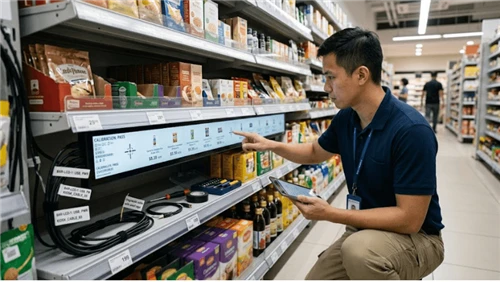
A digital endcap replaces (or augments) the static signage with one or more screens that can show video, animations, real-time pricing, interactive product information, or targeted promotions. Some setups use a single stretched bar display mounted above the shelving. Others incorporate larger format screens or even interactive touch displays that let shoppers browse recipes, compare products, or scan loyalty cards.
The key difference isn't just the screen-it's the flexibility. A printed endcap takes days to design, print, ship, and install. A digital endcap can be updated in seconds from a laptop anywhere in the world.
Digital Endcap Displays vs. Traditional Printed Endcaps
Retailers often ask whether digital endcaps justify the higher upfront cost. Here's a side-by-side breakdown to help frame that decision:
| Factor | Traditional Printed Endcap | Digital Endcap Display |
|---|---|---|
| Upfront cost | Low ($50–$300 per display) | Moderate to high ($500–$3,000+ per screen) |
| Ongoing cost | Recurring printing, shipping, labor for each campaign refresh | Minimal-content updates are remote and near-instant |
| Content flexibility | Static; one message per display cycle | Dynamic; rotate multiple promotions, daypart content, A/B test |
| Time to deploy new campaign | 5–14 days (design → print → ship → install) | Minutes to hours (upload → schedule → publish) |
| Engagement level | Passive | Active; video and motion draw 400% more views than static (Intel, 2024) |
| Data collection | None | Dwell time, impression counts, integration with POS data |
| Environmental impact | Paper waste, shipping emissions per campaign cycle | One-time hardware; no recurring waste |
| Lifespan | Single campaign use | 50,000+ hours (5–7 years) with commercial-grade panels |
The math becomes clearer over time. A grocery chain running 12 endcap campaigns per year spends roughly $600–$3,600 per location on printed materials alone. A commercial-grade digital display pays for itself within 12–18 months in most scenarios-and that's before factoring in the sales lift from better content.
Why Digital Endcaps Work: The Psychology and the Data
There's a reason endcaps account for less than 5% of a store's selling space but disproportionately influence what ends up in shopping carts.
The National Retail Hardware Association reports that endcap displays can move products up to 8× faster than the same item placed elsewhere in the store. Combine that with the fact that roughly 62% of grocery purchases are impulse buys, and you see why this aisle-end real estate is so valuable.
Digital screens amplify this effect in measurable ways:
- 58% of shoppers actively notice in-store digital displays, and nearly half say these screens influence their purchase decisions (Mood Media, 2025 survey of 1,000 U.S. consumers).
- Among Gen Z, that number jumps to 79%. For millennials, it's 75%.
- Checkout areas draw the highest display engagement (54%), followed by store entrances (44%) and shelf/aisle displays at 42%-exactly where endcaps sit.
- Retailers using digital signage for promoted items report a 24% to 38% lift in sales versus non-digital promotions.
A peer-reviewed study published in the Journal of Marketing Research (2022) found something especially interesting: moderately vivid digital endcap projections outperformed both traditional endcaps and highly vivid ones. The researchers concluded that attention and mental involvement peak at a moderate level of visual stimulation-too flashy, and shoppers mentally tune out. Adding audio to the digital endcap increased sales further, while adding scent had no measurable effect.
The takeaway? Content quality matters more than screen brightness.
Hardware Selection: Choosing the Right Screen for Your Endcap
Not every screen belongs at the end of an aisle. Retail environments are demanding-bright overhead lighting, narrow mounting spaces, long operating hours. Here's what to look for.
Display Type and Form Factor
Standard 16:9 screens work well for full-size endcap installations where you have a clean vertical or horizontal surface to work with. But many retailers find that ultra-wide stretched bar displays are a better fit for endcap environments. Their elongated form factor (ratios like 16:3 or wider) slides neatly above a product shelf or along a narrow header without dominating the physical merchandising space below.
A stretched bar LCD display in the 23" to 43" range is a popular choice for grocery and pharmacy endcaps. These screens mount horizontally above the top shelf, delivering video and promotional content at eye level while leaving the entire endcap face open for physical product display.
Key Specifications to Evaluate
When comparing display hardware for endcap applications, pay attention to these specs:
- Brightness (nits/cd/m²): Retail stores typically run at 500–1,000 lux overhead lighting. You'll want a screen rated at 500 cd/m² minimum for indoor retail. Anything below 350 nits will look washed out under fluorescent or LED store lighting.
- Panel type: IPS panels provide wider viewing angles (178°), which matters when shoppers approach from different directions down the aisle. TN panels are cheaper but lose color accuracy off-axis.
- Resolution: For stretched bar displays, look for Full HD (1920×540 or higher depending on aspect ratio). Shoppers read text at close range on endcaps, so pixel density matters more here than on a screen mounted 10 feet up on a wall.
- Operating hours: Retail displays run 12–16 hours a day, 365 days a year. Consumer-grade TVs are rated for 30,000 hours; commercial displays hit 50,000+ hours. The cost difference pays for itself in avoided replacements.
- Built-in media player: Many commercial digital signage screens now ship with an embedded Android System-on-Chip (SoC), so you can plug in power and manage content remotely-no external PC needed.
Mounting and Installation
Most endcap digital screens use VESA-standard wall mounts. For stretched displays, the slim profile (often under 30mm deep) means they sit flush against the shelf header. Some retailers opt for custom bracket solutions that integrate the screen directly into the shelving gondola.
One practical tip from installers we've worked with: always run power from above or behind the gondola, never across the floor. Trip hazards in high-traffic endcap areas are a liability issue, and exposed cables look unprofessional.
Content Strategy: What to Actually Put on the Screen
Hardware without a content plan is an expensive nightlight. Here's what works.
Dayparting: Match Content to the Audience in the Store
Shopper demographics shift throughout the day. A health and beauty retailer, for example, might see retired shoppers browsing in weekday mornings and working professionals stopping in after 5 PM. Digital endcaps let you schedule different content for each window.
This isn't theoretical. Retailers running dayparted campaigns on digital endcaps consistently report higher engagement than those running the same loop all day. The content doesn't need to be radically different-sometimes it's as simple as swapping a "Morning Wellness" promotion for a "Post-Work Self-Care" message with adjusted product callouts.
A cloud-based digital signage CMS makes this kind of scheduling practical even across hundreds of locations. You build the playlists once, set time triggers, and the system handles the rest.
Video Outperforms Static-But Keep It Short
Shoppers spend an average of 3–7 seconds looking at an endcap as they walk past. That's enough time for a short product demo, an animated price callout, or a quick recipe suggestion-but not a 60-second brand story.
Best practices from retailers who've tested extensively:
- 5–15 second loops with clear product focus and pricing
- Silent video with text overlays (most store environments are too noisy for audio to land consistently)
- High-contrast visuals that read well under mixed lighting
- Movement draws the eye, but avoid jarring flashing or rapid transitions-the Journal of Marketing Research study on vividness applies here
Cross-Merchandising and Bundling Prompts
One of the most effective digital endcap strategies is suggesting product pairings. A pasta sauce brand on the endcap? The screen shows a 10-second recipe with callouts for pasta, olive oil, and parmesan-all stocked nearby. This approach lifts basket size, not just single-SKU sales.
Walmart and Kroger have both expanded their in-store retail media networks with this exact tactic. Walmart's network places digital screens at endcaps and checkout zones, and the company's public data indicates a 7% product sales lift and a 4% brand halo effect when products are featured on in-store screens.
Seasonal and Event-Driven Content Rotation
The friction-free nature of digital content makes seasonal campaigns dramatically easier. Instead of shipping new printed materials for Valentine's Day, back-to-school, or Black Friday, you push updated creative to every endcap screen in your network from a single dashboard.
One grocery chain we've spoken with reduced their campaign turnaround from 10 days (print workflow) to under 4 hours (digital upload and scheduling)-a difference that matters when you need to react to a competitor's pricing or a sudden weather-driven demand spike.
Measuring ROI: How to Prove Digital Endcaps Are Working
This is where many digital signage projects stall. The screens look great, but leadership wants numbers. Here's how to build the case.
Metrics That Matter
- Sales lift: Compare week-over-week or year-over-year sales data for SKUs featured on digital endcaps versus the same SKUs on traditional endcaps or standard shelf positions. Use matched control stores when possible.
- Impression estimates: Camera-based people counters or infrared sensors at the endcap can estimate how many shoppers passed by and how many paused (dwell time > 2 seconds).
- Content engagement: If running interactive touch displays, track taps, session duration, and which product pages get the most views.
- Campaign attribution: Use unique promo codes or QR codes displayed on the digital endcap and tracked at checkout.
What the Numbers Typically Look Like
Based on published case studies across the industry:
- Retailers see an average 8–10% sales lift for targeted campaigns on digital endcaps, with some seeing 25%+ lift for well-optimized promotions.
- A/B testing (digital creative A vs. creative B on matched endcap locations) typically yields 15–20% performance variance, proving that content optimization drives real results.
- Payback period for endcap digital signage hardware averages 12–18 months when factoring in reduced print costs, faster campaign deployment, and incremental sales lift.
- NielsenIQ (2023) found that up to 40% of traditional displays are set up incorrectly or never installed at all-a waste that digital deployments eliminate entirely since compliance is verified remotely through the CMS dashboard.
Real-World Applications by Retail Category
Grocery and Supermarkets
Grocery endcaps are the original endcap battlefield. Digital screens here tend to focus on seasonal promotions, recipe inspiration, and new product launches. Stretched bar displays mounted above the top shelf are especially effective-they don't compete with the physical product for space but still catch the eye from 15–20 feet down the aisle.
Kroger's retail media network now includes in-store screens at endcaps and other high-traffic zones, monetizing these placements by selling ad slots to CPG brands. The retailer offers incremental sales measurement to directly connect campaign exposure with ROI.
Pharmacy and Health & Beauty
These categories benefit heavily from educational content. A digital endcap for a new skincare line can show before-and-after visuals, ingredient breakdowns, and usage tutorials-content that a printed card simply can't deliver with the same impact.
Interactive touch screen displays add another layer here. Shoppers can browse shade options, check ingredient lists for allergens, or scan a QR code to save a product to their mobile wishlist.
Electronics and Big Box
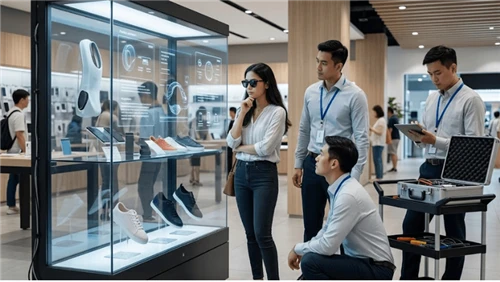
Electronics endcaps often need larger format screens or even multi-screen setups to showcase product demos and comparison specs. A large-format commercial display in the 43"–55" range works well here, positioned vertically to simulate a phone or tablet screen or horizontally for side-by-side product comparisons.
Convenience and Forecourt
Smaller format screens-compact digital signage panels in the 10"–16" range-fit the tighter footprint of convenience store endcaps. These are often used for beverage promotions, snack cross-sells, and loyalty program callouts.
Content Management: Running Your Endcap Network at Scale
Managing one screen is easy. Managing 200 screens across 50 locations requires a proper content management system (CMS). Here's what to look for:
- Cloud-based management: Update any screen from any browser, anywhere. No USB drives, no on-site visits.
- Scheduling and dayparting: Set time-based rules so content rotates automatically by hour, day, or season.
- Device grouping: Organize screens by location, region, department, or campaign so you can push updates selectively.
- Remote monitoring: Get alerts when a screen goes offline or loses internet connection. NielsenIQ's data on display compliance failures reinforces why this matters.
- Analytics dashboard: Track plays, scheduling accuracy, and device health from a single interface.
A well-built digital signage software platform handles all of this while integrating with external data sources-RSS feeds, Google Sheets for live pricing data, calendar integrations for event-driven content, and even sensor inputs for triggered content.
Common Mistakes to Avoid
After working with dozens of retail signage deployments, we see the same pitfalls repeatedly:
- Choosing consumer-grade hardware. That $200 TV from Amazon will look dim, overheat, and die within 8 months in a retail setting. Commercial-grade displays cost more upfront but are built for the job.
- Ignoring content after launch. The screen goes up, the launch video plays… and it's still playing six months later. Stale content is worse than no content-it trains shoppers to ignore your screens.
- Overcomplicating the creative. Remember: 3–7 seconds of attention. Your message needs to land fast. One product, one price, one call to action.
- Skipping the measurement plan. If you can't connect screen activity to sales data, you can't prove ROI, and you can't justify expansion.
- Poor placement. A screen mounted too high, angled away from foot traffic, or blocked by a product stack is wasted investment. Test sightlines before finalizing installation.
Frequently Asked Questions
How much does a digital endcap display cost?
Hardware costs vary based on size and specification. A commercial-grade stretched bar display suitable for endcap use typically ranges from $500 to $2,000 per unit. Larger format screens (43"+) with touch capability can run $1,500 to $4,000+. Factor in mounting hardware ($50–$200), potential network infrastructure ($100–$300 per location), and CMS software licensing (often $10–$30/month per screen).
What size screen works best for endcap displays?
For grocery and pharmacy endcaps where the screen mounts above shelving, 23"–37" stretched bar displays are the sweet spot. For electronics or big-box endcaps with more vertical space, 43"–55" standard or portrait-oriented displays work well. The key is matching the screen dimensions to the available space without covering the physical product.
Can digital endcaps integrate with my existing retail media network?
Yes. Most cloud-based CMS platforms support standard media formats and can integrate with programmatic ad platforms. Retailers like Walmart and Tesco are actively integrating in-store screens-including endcap displays-into their broader retail media networks, allowing CPG brands to buy ad placements alongside online inventory.
Do I need internet connectivity for each screen?
Ideally, yes-Wi-Fi or Ethernet connectivity enables remote content management, real-time updates, and device monitoring. However, most commercial signage displays with built-in media players can also operate offline using locally stored content, with updates pushed via USB when needed.
How often should I update endcap content?
At minimum, refresh your endcap creative with each promotional cycle (typically every 1–2 weeks in grocery). High-performing retailers update more frequently, using dayparting for daily variation and A/B testing to optimize creative performance weekly.
Are digital endcaps worth it for small retailers?
Even a single digital endcap in a high-traffic area can drive measurable results. The lower end of commercial stretched displays starts around $500, and free or low-cost CMS platforms exist for small deployments. Start with one screen, measure the impact, and scale from there.
Getting Started
Digital endcap displays represent one of the highest-ROI investments in modern retail merchandising. The combination of prime physical location, dynamic content capability, and measurable performance data makes them a natural upgrade from static print-for retailers of every size.
The key is approaching it as a system: the right hardware for your store environment, a content strategy that respects how shoppers actually behave, a CMS platform that makes management practical at scale, and a measurement framework that proves value to stakeholders.
If you're evaluating digital endcap solutions for your stores, browse our full range of commercial display hardware or reach out to discuss your project requirements. We've helped retailers across grocery, pharmacy, electronics, and convenience deploy endcap signage that delivers measurable results-and we're happy to share what we've learned.