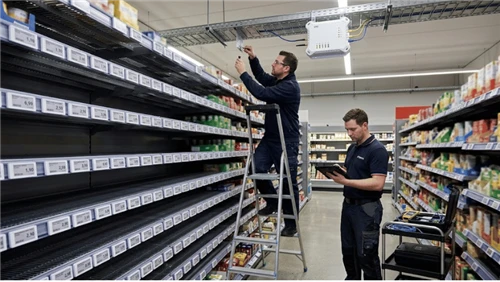
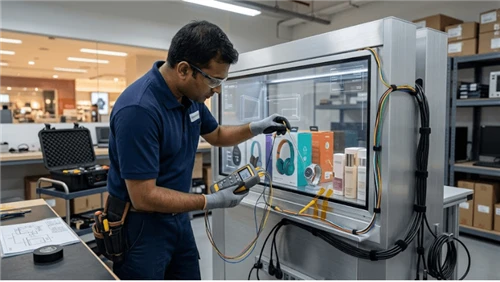
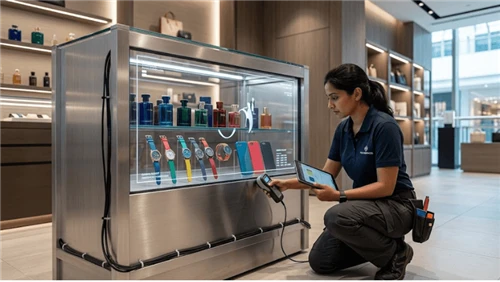
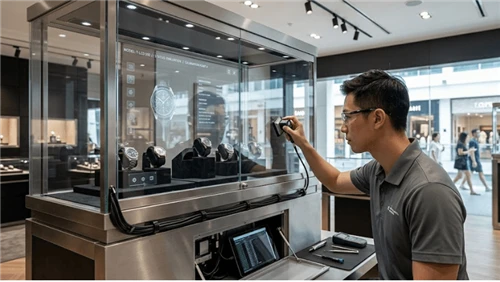
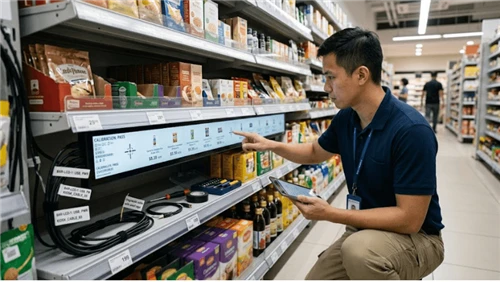
Adoption is accelerating past the early-adopter stage. Grand View Research puts the global ESL market at roughly $2 billion in 2025, growing at over 15 percent annually. Walmart is midway through a rollout targeting more than 2,300 U.S. stores, and independent grocers, pharmacy chains, and specialty retailers are following the same path - driven primarily by rising labor costs and a competitive pricing environment that makes weekly manual re-labeling increasingly unsustainable.
The five reasons below cover the real business case, not just the feature list. If you want a grounding in the technology before going further - how labels connect to your POS, what gateway architecture looks like, what display types are available - our guide on digital price tags and how to evaluate them for your specific store type is the right place to start.
1. Electronic Shelf Labels Eliminate Pricing Errors at the Source
A price mismatch between the shelf and the register isn't a training failure. It's a structural one. Every time a price changes in the system but hasn't yet reached the physical label, there's an open window - a customer sees one number, the register rings up another, and what follows is never a simple transaction. In a store with 20,000 SKUs receiving weekly supplier cost updates, that window stays open almost continuously.
The mechanics are simple enough: paper labels require a human to close the loop. Someone prints the tag, carries it to the aisle, and physically swaps it. That process has a lot of ways to stay incomplete - tags printed but not distributed, distributed but not swapped, swapped for the wrong slot. There's no automatic confirmation that the shelf matches the system. There can't be.
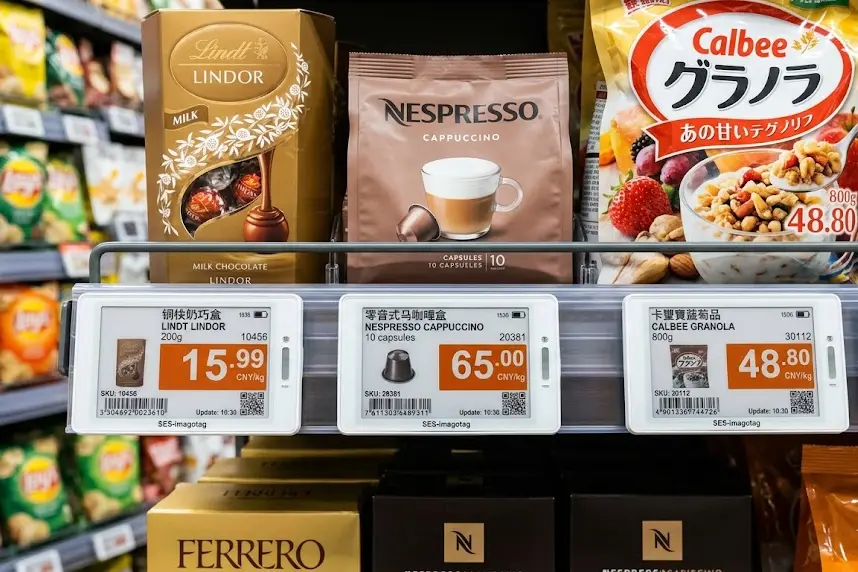
Electronic shelf labels close that loop structurally. Each label maintains a live connection to the central pricing database through a wireless gateway. When a price changes in the POS or ERP, the update pushes to the relevant labels - typically within seconds, depending on system configuration. No human step sits between the pricing decision and the shelf display. For retailers who want to understand the technical side of how that wireless sync works before they evaluate vendors, our article on how electronic shelf labels communicate with store systems covers the gateway architecture and update protocols in useful depth.
There's a legal dimension here too. Most U.S. states maintain pricing accuracy regulations that allow per-item fines when shelf prices don't match register prices. For grocery, pharmacy, and general merchandise retailers operating at scale, that exposure is real and measurable. ESLs don't reduce that risk through better compliance management - they remove the manual process that creates the risk in the first place.
2. Pricing Labor Is a Larger Cost Than Most Store Managers Can Easily See
Ask a store manager how much staff time goes into pricing, and the answer is almost always an underestimate. The visible part is straightforward: print the labels, sort by aisle, distribute, swap, done. But that's only the direct task. There's the verification walk afterward, the correction loop when errors surface at the register, the escalations when a customer dispute requires a manager, the overtime on price-change-heavy days when the volume runs past shift end. None of this shows up cleanly in most labor tracking systems. It gets absorbed into general floor time, which makes it functionally invisible until someone times it properly.
One independent grocer documented by the Independent Grocers Alliance handled 1,400 price changes in under 10 minutes after switching to electronic shelf labels. Before the switch, the same volume took four full days across multiple employees. That's not an exceptional result - it's the natural outcome for any store with large SKU counts and frequent pricing cycles when manual steps are removed from the process.
For a store with 20,000 SKUs, industry estimates put pricing-related labor at 60 to 100 or more hours per month when all related tasks are counted. As hourly wages in U.S. retail markets have moved from the $14–$16 range toward $18–$22 in many metro areas, the payback timeline on ESL hardware has shortened accordingly. The compounding effect matters too: hours recovered from label management flow directly into customer service, inventory accuracy, and the tasks that directly affect sales and shrink rather than simply maintaining price integrity.
The same efficiency logic extends beyond the store floor. Retailers applying digital label thinking to back-of-house operations have found comparable gains in warehouse racking environments, where manual location markers and bin labels create the same update-lag problems as retail shelf tags. For a complete picture of deployment costs - hardware per label, gateway infrastructure, software licensing, integration, and installation timeline - our guide on what electronic shelf labelling actually costs and involves at the store level lays out the full model across different configurations.
What Disappears From Store Operations the Day ESLs Go Live
The list is longer than most retailers expect before they go through it themselves: the printing station disappears, along with its consumables budget - paper roll orders, ink cartridges, printer maintenance contracts. The aisle-by-aisle label distribution run disappears, and with it the two to four staff members it ties up on heavy change days. The verification walk disappears - the manual pass to confirm every updated label actually made it to the right shelf slot. The correction workflow disappears - the reprint-and-re-walk triggered by a pricing error caught at the register. The escalation chain disappears - the manager call that happens when a customer disputes a price and the label no longer matches anything on record. What replaces all of it is a software dashboard, a wireless gateway network, and a timestamped update log that records every change pushed to every label, automatically.
3. Dynamic Pricing Becomes an Operational Tool, Not Just a Strategy Concept
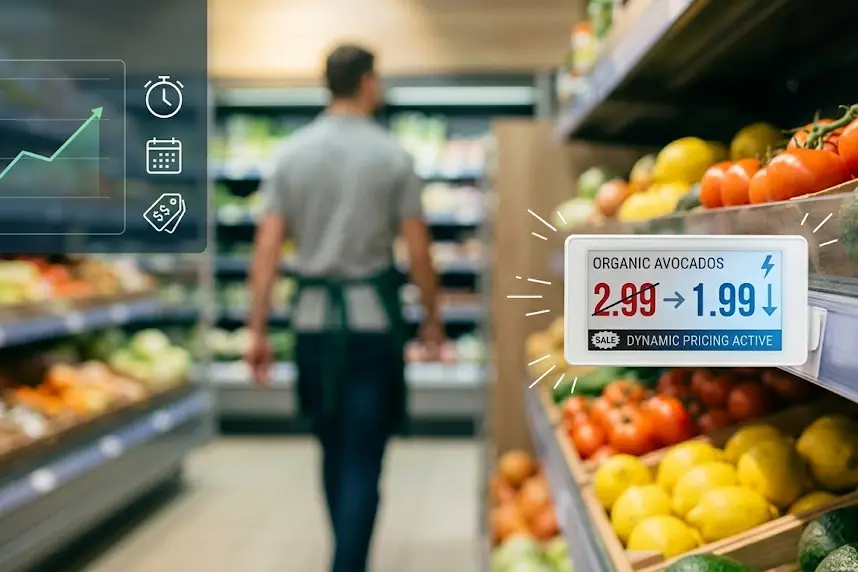
The case for dynamic pricing in physical retail has been understood for years. Adjust prices based on demand patterns, inventory levels, time of day, competitive signals, or approaching expiration dates - the same logic that airlines and hotels have run profitably for decades. The problem was never the concept. It was execution. Dynamic pricing doesn't work on paper tags. By the time a human responds to a market signal, changes a label, and gets it onto the shelf, the signal has moved.
Electronic shelf labels change what's operationally possible in that window. A retailer can configure rules directly within the ESL management platform - reduce prices on perishables eight hours before close, match a competitor's promotional price within minutes of detecting it, run a two-hour flash sale on a slow Wednesday afternoon in a single category - and the shelf reflects those decisions in real time. No print queue, no floor team, no lag between the pricing decision and the customer-facing label.
The revenue impact for stores that use dynamic pricing actively is measurable. Case data from DisplayData's enterprise retail deployments showed in-store sales increases averaging around 6 percent and margin improvements of 2 to 3 percent. A European grocery chain operating over 800 stores recovered its ESL investment in 16 months and projected more than 400 percent ROI across a five-year window. Those figures reflect operations that treated the dynamic pricing capability as a live daily tool rather than a feature they had access to in theory.
4. Electronic Shelf Labels Cut Paper Consumption in Ways That Show Up in Sustainability Reporting
A mid-size grocery store with 20,000 SKUs and weekly pricing cycles generates tens of thousands of discarded paper labels per year - and that's before accounting for reprints, damaged tags, and promotional cycle changeovers. At chain scale, the volume compounds into something that belongs in a sustainability report, and increasingly does, as major retailers face external pressure to quantify operational waste streams.
The ongoing footprint of an ESL system compares well to continuous paper consumption for a reason built into the display technology. E-ink labels are bistable - the display holds its image without drawing power until it's updated. A label can sit unchanged on a shelf for months and consume essentially no energy during that time. That's the same principle behind an e-reader holding a page for weeks without charging. For a detailed look at how e-ink technology achieves its ultra-low power draw and what it means for battery lifespan in practical deployments, that article covers the display physics and battery management in useful depth.
LEGOYO's e-ink shelf label range carries battery ratings of up to seven years depending on update frequency - which is notably longer than most general estimates in the category and materially affects the total cost of ownership calculation for high-SKU deployments. For retailers with public ESG targets, paper elimination is often reportable as a concrete metric. For operators focused on efficiency rather than sustainability disclosure, the same math produces a consumables budget line that drops to near zero after deployment.
5. The Shelf Edge Stops Being a Price Display and Starts Being a Sales Tool
A paper tag has one job: show a price. Sometimes a product name, occasionally a unit price. That's the ceiling - not because anyone chose to limit it, but because of what's physically possible in a small paper rectangle that has to be printed, sorted, and swapped by hand.
That ceiling doesn't exist with digital shelf labels. Depending on label size and format, the display can carry unit pricing, promotional flags, nutritional highlights, stock status, QR codes linked to extended product content, compatibility notes, sourcing and origin information, or customer review summaries - whatever the retailer chooses to push from the management platform. In a pharmacy, that might mean dosage guidance or therapeutic substitution alerts at the shelf edge. In specialty food retail, it might mean organic certification or local sourcing callouts that move purchase decisions at the moment of consideration. In consumer electronics, it might mean compatibility specs that help a customer confirm they're buying the right accessory without hunting down a staff member.
The QR code integration is particularly practical because it adds capability without adding hardware cost. A label linking to a product page, a spec sheet, or a review aggregator extends the depth of available information to whatever the retailer hosts online, using the shelf label as the access point. Retailers building toward this richer shelf experience will find digital signage-capable shelf labels particularly relevant - these models offer color e-ink or LCD displays with larger screen real estate, designed specifically for high-consideration product zones where information depth directly affects conversion.
For wider fixture runs - wine walls, electronics bays, specialty health aisles - bar-format LCD shelf displays give category managers significantly more canvas than standard ESL form factors. When those are part of a broader deployment that includes in-aisle touchscreen kiosks, the shelf edge becomes one node in a connected in-store information environment rather than an isolated price tag.
The Switch Is an Integration Project, Not a Hardware Upgrade
The five reasons above point consistently toward the same conclusion, but the retailers who extract the most value from electronic shelf labels treat the transition as a system integration project rather than a hardware swap. The label is the visible part. The operational value lives in what's behind it: the gateway network, the management software, the POS and ERP connections that ensure every pricing decision reaches the shelf automatically and accurately. A poorly integrated ESL deployment is an expensive screen. A well-integrated one changes how pricing decisions move from the back office to the shelf edge - and keeps that connection live in real time, at scale, without manual intervention.
For retailers ready to work through the numbers for their specific operation - SKU count, update frequency, current pricing labor costs, existing tech stack - our retail display solutions team has built this analysis across more than 10,000 store projects globally. The conversation typically starts with a scoping call; the ESL solutions page is the right place to reach us.
Frequently Asked Questions About Switching to Electronic Shelf Labels
How long does deployment take from decision to a live store?
Physical installation in a mid-size grocery store - 15,000 to 25,000 SKUs - typically runs two to five days for the in-store work. The work that takes longer happens before installation: cleaning item master data, testing the integration with the POS or ERP, and configuring label templates. A retailer with clean data and a well-scoped integration can realistically go from signed agreement to live store in two to three weeks. Chains running sequential multi-store rollouts often compress the per-store installation to a day and a half as the team builds operational rhythm across locations.
What does a realistic payback period look like?
Most retailers report payback between 18 months and three years. Stores with high SKU counts, above-average hourly wages, and active dynamic pricing programs land at the shorter end. The calculation should account for hardware, software licensing, installation, and integration costs on the investment side, against labor savings, consumables elimination, pricing error reduction, and margin gains from dynamic pricing on the return side. The Independent Grocers Alliance has documented independent grocery operators recovering their investment within two years, with roughly half of that recovery coming from labor reduction and the other half from improved pricing agility.
Will ESLs integrate with the POS and ERP system already in place?
Most enterprise-grade ESL platforms offer API-based integration with the major retail POS and ERP systems in wide use today. The integration complexity depends primarily on two things: the quality of the retailer's item master data, and whether the existing POS system can push real-time price event triggers. Cloud-based ESL management software has made this considerably more approachable than first-generation systems that required on-premise middleware. Before finalizing a vendor, verifying their documented integration experience with your specific POS or ERP stack - not just general compatibility claims - is one of the most valuable diligence steps in the evaluation process.
Do electronic shelf labels work in freezer and refrigerated aisles?
Yes, with the right product specification. E-ink ESLs built for cold-chain environments operate reliably down to around -20°C (-4°F) in specialized models. Standard commercial e-ink labels typically perform down to 0°C (32°F), which covers most refrigerated display cases. For deep-freeze zones, confirming the temperature rating of the specific label model before deployment is essential - general-purpose retail ESLs aren't always rated for freezer use. Battery performance degrades at sustained low temperatures, which affects expected update frequency and longevity estimates in those zones and should be factored into the total cost model for cold-chain environments.
Is there a minimum store size or SKU count where the economics make sense?
There's no universal threshold, but the unit economics generally support a reasonable payback for stores with at least 5,000 SKUs that receive weekly or more frequent pricing updates. Below that range, the labor savings may not outweigh hardware and integration investment within a practical window. Update frequency often matters more than raw SKU count - a specialty food retailer with 3,000 products running daily promotional changes typically builds a stronger financial case than a hardware store with 12,000 items that reprices once a quarter. Running a basic estimate of current pricing labor costs against projected ESL operating costs is usually sufficient to determine whether the numbers work for a given operation.