Quick answer: Yes - electronic shelf labels make dynamic pricing technically possible in physical stores. But current evidence shows U.S. grocery retailers are not using them for surge pricing. A 2025 UC San Diego study analyzing 180 million product observations found no real-time price spikes after ESL deployment. The primary applications today are markdown automation for perishables, pricing accuracy improvements, labor cost reduction, and omnichannel price consistency.
Electronic Shelf Labels and Dynamic Pricing: Why This Debate Matters Now
Grocery retailers across the United States are replacing paper price tags with electronic shelf labels at a pace nobody predicted five years ago. In June 2024, Walmart announced plans to deploy ESLs across 2,300 stores; by December that year, the company extended its VusionGroup contract past $1 billion to cover all 4,600 U.S. locations (Walmart Corporate, June 2024). Kroger, Whole Foods, and Amazon Fresh have installed them too. And the question that keeps surfacing - from legislators, consumer advocacy groups, and retailers evaluating their own deployments - is whether electronic shelf labels open the door to dynamic pricing in physical stores.
The short answer is yes, the technology removes the physical barrier. The longer answer is more useful: what kind of dynamic pricing, under what conditions, and whether it actually benefits the person buying yogurt on a Tuesday afternoon.

What Electronic Shelf Labels Actually Do - and Don't Do
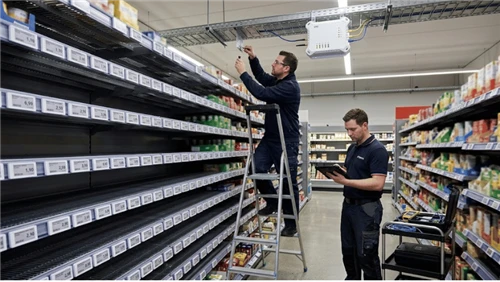
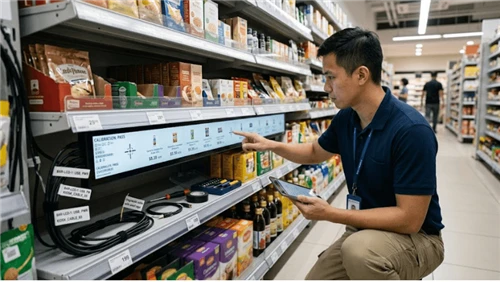
An electronic shelf label is a small digital display - most commonly using E-ink technology - mounted where a paper tag used to sit. These E-ink electronic shelf labels connect wirelessly to a centralized pricing system, typically through Bluetooth Low Energy 5.0 or proprietary RF protocols. When someone in the pricing team updates a price in the back-end system, the change pushes to the shelf automatically. No printing. No walking aisles with a label gun.
For a store carrying over 120,000 products - Walmart's average per location - that shift matters enormously. Manual price changes at that scale consume hundreds of labor hours weekly. The industry-standard estimate is that paper-based pricing carries a 5% to 10% error rate between shelf and register (ABI Research, 2024). ESLs bring that number close to zero.
But ESL hardware is neutral. It doesn't force a particular pricing strategy any more than a spreadsheet forces a particular budget. It removes the mechanical constraint that kept brick-and-mortar stores locked into weekly price cycles. What retailers choose to do with that flexibility - and what guardrails they build - is where the real conversation starts.
Dynamic Pricing in Grocery Is Not Surge Pricing - Here's the Evidence
When Senator Elizabeth Warren and then-Senator Bob Casey wrote to Kroger's CEO in August 2024, they warned that digital price tags could enable surge pricing on household essentials - prices spiking based on time of day, weather, or demand fluctuations. The Uber comparison was implicit and alarming.
A working paper published in 2025 by researchers at UC San Diego's Rady School of Management and UT Austin directly tested that claim. Robert Sanders, Ioannis Stamatopoulos, and Robert Bray (Northwestern Kellogg) analyzed over 180 million product-level price observations before and after ESL deployment in U.S. grocery stores. Their finding: no evidence of real-time pricing spikes - not during holidays, not during high-inflation months, not at any point in the dataset.
The reason is structural. Grocery operates on razor-thin margins across entire baskets, not individual items. A supermarket doesn't monetize one bottle of water the way a hotel prices a single room. Raising the price of bread during a snowstorm might generate a few extra cents today and permanently lose a household that spends $200 a week. Stamatopoulos put it plainly: grocery stores earn revenue through long-term loyalty and full-basket economics.
Kroger responded to the Warren-Casey letter by stating it does not and has never engaged in surge pricing, and that ESLs are used for operational data and faster markdowns. Amazon said it has no plans for dynamic pricing in physical stores. Walmart SVP Greg Cathey was explicit: the labels will not create hour-to-hour price fluctuations.
What ESL-Enabled Dynamic Pricing Actually Looks Like in Practice
Strip away the political rhetoric, and the pricing strategies ESLs support in grocery look nothing like the surge-pricing scenarios lawmakers described. They're operational improvements that e-commerce has used for years - now feasible in physical retail.
Perishable Markdown Automation
This is the least controversial and most immediately impactful use case. A department running 200 perishable SKUs under paper tags does markdowns once - usually the morning before expiration - and only if an associate notices and re-tags each item manually. With ESLs tied to inventory management, the pricing system triggers automatic step-down discounts at 48 hours, 24 hours, and 12 hours before expiration. No floor intervention needed. European chains like Carrefour and Auchan have operated this way for years; their data shows reduced food waste, not inflated prices.
Competitive Price Matching
In categories where price sensitivity runs high - bottled water, diapers, paper towels - retailers need to respond to competitor moves quickly. With paper tags, a response might take a week. With modern E-ink price tags tied to competitive intelligence feeds, a pricing team can adjust within hours. That's dynamic pricing, but it's dynamic downward - keeping prices competitive rather than inflating them.
Promotional Agility
Flash sales, time-limited offers, and event-driven promotions become operationally realistic when execution doesn't require two days of manual labor. A retailer launching a weekend grilling promotion can push it across every store Friday morning and pull it Monday with no leftover signage creating confusion at the register.
Omnichannel Price Consistency
One of the most persistent customer complaints in modern grocery retail is price mismatch - the app says $3.49, the shelf says $3.79. Walmart's ESL rollout was designed in part to solve exactly this problem: when in-store prices update through the same system driving online pricing, the discrepancy disappears. That's a trust-building move, not a gouging mechanism.
What Critics Fear vs. What Evidence Shows
| Concern | What critics fear | What current evidence indicates |
|---|---|---|
| Real-time price spikes | Surge pricing on essentials during high demand | UC San Diego study (2025): no evidence of surge pricing in 180M+ observations |
| Primary operational use | Frequent price hikes to extract margin | Faster markdowns on perishables, accuracy gains, promotional speed |
| Customer impact | Price gouging and reduced transparency | Fewer shelf-to-register discrepancies, better consistency across channels |
| Regulatory risk | Technology should be banned (proposed in AZ, RI, ME) | Researchers and retailers argue bans address a problem that hasn't materialized |
The Technology Behind Real-Time ESL Price Updates
E-ink displays - the same electrophoretic technology in Kindle readers - consume power only during screen refreshes. A typical tag runs five years on a coin-cell battery with one to three updates daily, making large-scale deployment feasible across tens of thousands of tags per store.
Communication flows through BLE 5.0 base stations positioned throughout the store. A pricing update propagates from the central server through these stations to individual tags, with full-store refresh times ranging from seconds to a few minutes. ESL infrastructure integrates with existing ERP and POS systems through APIs or database exports - the same layer where retailers build pricing rules, markdown triggers, and promotional calendars. The sophistication of any strategy depends on the retailer's data infrastructure, not the labels themselves.
What the European Market Tells U.S. Retailers
The U.S. lags Europe in ESL adoption by several years. Chains including Auchan, Carrefour, and Aldi have run electronic shelf labels across thousands of European locations, and the track record shows ESLs used primarily for waste reduction, operational efficiency, and faster promotions - not aggressive price increases.
Leading ESL manufacturers such as SES-imagotag, SoluM, and Pricer built their platforms around these use cases, with software emphasizing centralized control, compliance tracking, and multi-store consistency. Still, consumer perception remains a challenge. A Forbes survey found 52% of U.S. consumers associate dynamic pricing with gouging, while only 34% see potential benefits (Forbes, September 2024). Retailers deploying ESLs cannot afford to ignore that gap.
Deployment Checklist for Retailers Evaluating ESLs
For retailers weighing an electronic shelf label investment, dynamic pricing capability is actually secondary to the operational fundamentals. The technology pays for itself through labor savings and pricing accuracy long before any advanced strategy enters the picture. Here's a practical decision framework:
Start with a focused pilot. Pick a high-turnover category - perishables and dairy are natural fits. A single aisle in two or three stores gives enough data to validate integration and quantify labor savings without overcommitting.
Validate system integration early. ESL data flows from your ERP or POS. If your retail software has pre-built connectors, setup is straightforward. Custom systems may need four to eight weeks of development work.
Choose hardware by use case. LCD digital price screens suit endcaps and promotional hotspots where video and color matter. Standard E-ink labels - 2.66 inches to 7.3 inches - handle the majority of shelf-edge pricing.
Build pricing governance before you scale. Define which categories allow automated price changes and at what frequency. Set markdown floors and ceilings. Document the rules so pricing, store operations, and compliance teams share the same playbook.
Communicate proactively with customers. Explain that digital labels enable faster markdowns and more accurate prices. In-store signage, associate talking points, and website FAQ pages all help close the perception gap.
Key Takeaways
ESLs make dynamic pricing technically feasible - but feasible doesn't mean inevitable or harmful. The technology removes the physical constraint of paper tags; the pricing strategy is the retailer's choice.
No credible evidence supports the surge-pricing fear. The most rigorous study to date - 180 million observations across U.S. grocery stores - found no price spikes after ESL deployment.
The primary ROI comes from operations, not pricing aggression. Labor savings, pricing accuracy, markdown automation, and omnichannel consistency are the proven benefits.
Consumer perception matters. More than half of U.S. shoppers associate dynamic pricing with gouging. Transparency and communication are not optional.
Europe provides a useful preview. Years of large-scale ESL deployment across European grocery chains have not produced the outcomes U.S. critics predict.
For retailers building their electronic shelf label deployment strategy, the pattern from early adopters is consistent: lead with operational efficiency, build trust through transparency, and let pricing capabilities scale as your data infrastructure and governance mature.
Frequently Asked Questions
Q: Can electronic shelf labels change prices instantly?
A: Once a pricing update is pushed from the central system, tags refresh within seconds to a few minutes. However, most grocery retailers update prices on a daily or weekly cadence, not in real time.
Q: Do grocery stores use ESLs for surge pricing?
A: Current evidence says no. The 2025 UC San Diego study found no surge-pricing behavior in U.S. grocery stores with ESLs. Walmart, Kroger, and Amazon have publicly stated they do not use the technology this way.
Q: Are electronic shelf labels legal in the United States?
A: Yes. Legislation to restrict them has been introduced in Arizona, Rhode Island, and Maine, but as of early 2026, no state has enacted a ban.
Q: What are the main benefits of electronic shelf labels?
A: Pricing accuracy (eliminating the 5–10% error rate common with paper tags), labor savings, faster promotional execution, automated perishable markdowns, and online-to-in-store price consistency.
Q: How do ESLs integrate with existing retail systems?
A: Through APIs, database views, or file exports connecting to ERP and POS platforms. Major retail software typically offers pre-built connectors.
Sources
- Walmart Corporate Newsroom, "New Tech, Better Outcomes: Digital Shelf Labels Are a Win for Customers and Associates," June 2024
- Sanders, R., Stamatopoulos, I., Bray, R., "Electronic shelf labels have not led to surge pricing in US grocery retail, despite regulator concern," UC San Diego Rady School of Management working paper, 2025
- Warren, E. and Casey, B., Letter to Kroger CEO Rodney McMullen regarding electronic shelf labels and surge pricing, August 2024
- Forbes, "Walmart, Kroger and Whole Foods Use Digital Pricing - What Customers Should Know," September 2024
- ABI Research, "A Retailer's Guide to Electronic Shelf Labels," 2024
- Revionics / Aptos, "Dynamic Pricing with Electronic Shelf Labels and Price Optimization," citing 33% profit value potential from combined ESL + AI optimization