ESL Dimensions: What the Numbers Look Like in Practice
Electronic shelf edge labelsare sized by screen diagonal, the same convention used for monitors and phones. Legoyo's range runs from 1.53 inches at the compact end to 9.7 inches for larger promotional formats.
The figure most retailers want first is body depth - how far the label protrudes outward from the shelf face. Here are dimensions across the range, including Legoyo's verified spec for the 4.2" model:
| Screen Size | Label Width | Label Height | Body Depth | Typical Application |
|---|---|---|---|---|
| 1.53" | ~48 mm | ~33 mm | 8–10 mm | Pharmacy, cosmetics, narrow shelves |
| 2.13" | ~72 mm | ~38 mm | 8–10 mm | High-density grocery, spice aisles |
| 2.66" | ~84 mm | ~43 mm | 9–11 mm | Convenience stores, click & collect |
| 4.2" ✓ | 97.4 mm | 88.9 mm | 10–12 mm | Supermarket standard, warehouse |
| 5.8" | ~155 mm | ~73 mm | 11–13 mm | Mid-format grocery, promotional runs |
| 9.7" | ~235 mm | ~160 mm | 13–16 mm | Electronics, wine, specialty retail |
✓ = confirmed from Legoyo's 4.2-inch ESL spec sheet. Other figures are representative for e-ink ESL construction at each screen size; verify individual product pages before finalising orders.
A depth of 8–16 mm is roughly the thickness of a standard credit card laid flat - not a meaningful obstruction for any gondola shelf. The numbers that do create problems when they're wrong are label width and label height, not depth. More on that below.
How Do ESLs Compare to Your Current Paper Label Setup?
The standard answer from vendors is that ESLs take up "almost no space" - accurate but unhelpful if you're trying to figure out whether you'll gain or lose clearance relative to what you have today.
A typical paper label fixture includes a plastic snap-in channel (10–14 mm deep), the paper insert itself, and in many stores a promotional clip, shelf talker, or sign holder that adds another 5–20 mm on top. A fully populated paper label strip at the shelf edge commonly protrudes 12–28 mm, depending on how many accessories are attached.
Legoyo's 4.2" ESL at 10–12 mm clips directly into most standard shelf rails. The paper channel either stays in place and the ESL mounts over it, or it is removed entirely - either way, the resulting protrusion is equal to or shallower than what it replaced.
For a detailed side-by-side comparison of operational differences, The Shelby Report's retail technology coverage
offers useful perspective from stores that have completed the switch. Our own guide toESL vs. paper labelscovers the full operational comparison.
Three Things to Check Before Choosing Your Label Size
Most shelf-space issues in ESL projects trace back to skipping one of three checks before ordering.
1. Label Width vs. Your Product Facing Width
Body depth is rarely the problem. The dimension that causes real headaches is label body width relative to the product's assigned shelf slot. If a product sits in a 60 mm slot and you order a label with a 97.4 mm body, you either overlap the neighbouring slot or lose one facing position from your planogram. Neither is acceptable mid-deployment.
Before finalising size selection, measure the narrowest product category in your store and confirm your chosen label width falls within that slot. This takes 30 minutes with a tape measure and prevents the single most common sizing mistake in full-store ESL rollouts.
2. Label Height vs. the Product Face
Label height determines how much of the product's front face is obscured below the shelf edge. Legoyo's 2.13" label at 38 mm tall blocks a small fraction of a standard beverage bottle. The 9.7" label at 160 mm covers a more significant portion.
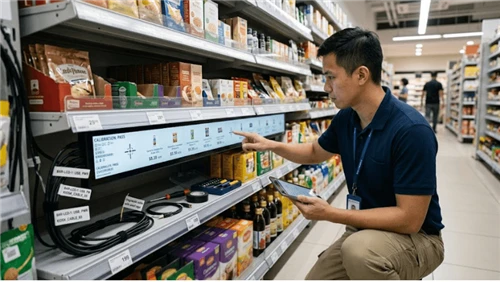
For bottom-shelf positions where customers crouch to read labels close-up, smaller tends to work better - not because of depth, but because a compact label with a clean layout is easier to parse from 30 cm than a large one packed with text. Match label size to how customers physically interact with that shelf height, not just to screen-size conventions.
3. What Happens to Your Existing Label Channel
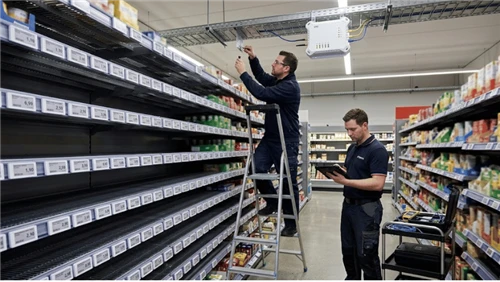
This is the question first-time buyers almost always have but rarely ask directly: do I need to remove my current paper label strips before installing ESLs?In most cases, no. Legoyo's ESLs are designed for drop-in installation with zero shelf modification - they use clip-in, magnetic, peg hook, and adhesive mounts that work on or alongside existing rail systems. Installation teams can typically fit 500+ labels in a single shift on standard gondola shelving. Where older or non-standard rail profiles are involved, an adapter clip resolves compatibility without structural work. Thestep-by-step ESL installation guidecovers both scenarios.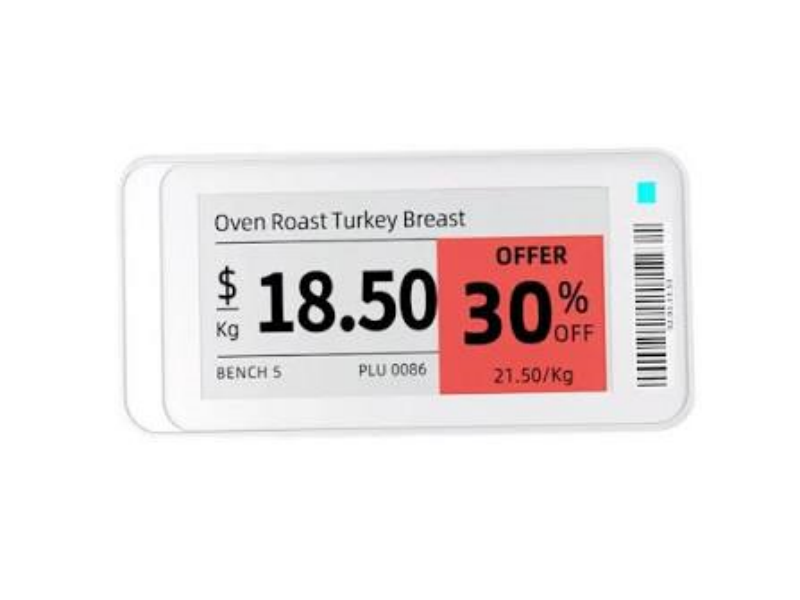
Size Recommendations by Store Environment
Grocery Supermarkets
The 2.13"–4.2" range covers the majority of standard grocery shelving. For high-SKU sections with narrow product facings - condiments, spices, snacks, sauces - 2.13" or 2.66" keeps label width comfortably within the available slot. For wider products like boxed goods or beverages, where displaying a QR code or promotional callout alongside the price matters, 4.2" is the global retail standard for good reason: it fits the widest range of gondola rail profiles and strikes the right balance between screen real estate and shelf density. See how this plays out across real store formats in Legoyo's overview of
grocery store ESL deployments.Convenience Stores
SKU density is lower than a supermarket, but shelf space per product is tighter. The 2.66" works well for most C-store gondola configurations. One thing that surprises first-time convenience store deployers: because the store footprint is small, a single wireless access point covers the entire sales floor in almost every case, so infrastructure planning is minimal. Ceiling mounting keeps all hardware off the shelves entirely. How that works depends on the ESL wireless standard you choose - our comparison of Bluetooth vs. Wi-Fi vs. Sub-GHz ESL systems explains the coverage and battery-life trade-offs.
Pharmacies
The critical variable in pharmacy environments is label width, not depth. Pharmacy shelves hold blister packs, tubes, and unit-dose boxes - most of them narrow. A label that's technically fine in depth will still create a visual mess if it bleeds into the neighbouring SKU's slot, which is particularly disruptive in planogram-controlled OTC sections. The 1.53"–2.13" range is standard for high-density pharmacy shelving; 2.66" works for broader-format OTC or medical device sections. Check body widths in Legoyo's retail ESL catalog before confirming your order.
Specialty and Electronics Retail
Wide shelves, fewer SKUs, and products where specification detail influences the decision. The 5.8"–9.7" range earns its larger footprint here by displaying warranty terms, product specs, and QR codes alongside the price - content that genuinely moves considered purchases. The wider product facings common in electronics and home goods retail mean label width is rarely a planogram conflict in these formats.
Refrigerated and Frozen Displays
Standard e-ink ESLs operate from 0°C to 40°C. Refrigerated and frozen cases need purpose-built low-temperature models rated to −20°C or lower. These are available across most of Legoyo's standard size range and use the same clip-in mounting approach - no modified shelving required. Always confirm the operating temperature specification before ordering for cold-chain sections.
Four Sizing Decisions That Create Real Space Problems
Ordering by screen size without checking label body width
Screen size is the diagonal measurement of the display, not the width of the label body. Different aspect ratios mean a 5.8" label (155 mm wide) and a 4.2" label (97.4 mm wide) have significantly different body widths despite both being standard sizes. Always compare the label body width against your narrowest product facing before placing a bulk order - not the screen diagonal.
Assuming all shelf rails accept standard ESL clips
Most gondola shelving installed in the last 15 years is compatible with standard snap-in ESL clips. The exceptions are older fixtures from before ESL adoption became widespread, refrigerated cabinet doors, and some warehouse pallet racking. Test a physical sample on your specific rail profile before a store-wide rollout. It is a 10-minute check that prevents a deployment-stopping problem on installation day - and it is the reason Legoyo recommends ordering samples before bulk commitments.
Using large-format labels on bottom-shelf positions
The issue on bottom shelves is not depth - it is readability. A customer crouching to look at a bottom-shelf product sees a label from 20–40 cm away. A large label dense with promotional text is harder to parse at that distance than a compact label with a clean, high-contrast price display. Smaller labels at the bottom, larger at eye level, is a layout principle that applies regardless of which technology you use.
No plan for endcaps and promotional fixtures
Straight gondola runs are straightforward. Endcaps, curved end fixtures, and freestanding promotional bays sometimes need angled brackets or custom mounting solutions that are not part of a standard gondola order. These are easy to overlook when planning from a floor plan. Identifying them during a pre-pilot site survey adds almost no time to planning and prevents a messy mid-deployment improvisation. If you want to understand
how ESL systems work end-to-endfrom hardware to software, that guide covers the full picture.Quick Reference: Recommended ESL Size by Shelf Type
| Shelf / Product Type | Recommended Size | Body Depth | Key Consideration |
|---|---|---|---|
| Small grocery (jars, sachets, spice) | 1.53"–2.13" | 8–10 mm | Label body width must stay within product slot |
| Standard grocery (packaged goods, drinks) | 2.66"–4.2" | 9–12 mm | 4.2" has widest gondola rail compatibility |
| Pharmacy / OTC (blister packs, tubes) | 1.53"–2.13" | 8–10 mm | Width is the critical variable, not depth |
| Convenience store (mixed goods) | 2.13"–2.66" | 9–11 mm | Verify rail compatibility; one AP usually covers full floor |
| Specialty / electronics / home goods | 5.8"–9.7" | 11–16 mm | Use extra screen area for specs and QR codes |
| Refrigerated / frozen display | 2.66"–4.2" (low-temp model) | 9–12 mm | Confirm min. operating temp spec before ordering |
Before You Order: A Five-Point Sizing Checklist
- Measure your narrowest product facing. Your label body width must fit within that slot without overlap.
- Test rail compatibility. Request a physical sample and clip it onto your specific shelf rail before placing a bulk order.
- Note which shelf heights are involved. Bottom-shelf positions favour smaller, cleaner labels; eye-level shelves can carry more information.
- Flag any refrigerated or frozen sections. These require dedicated low-temperature models - confirm temperature specifications before ordering.
- Identify endcaps and non-standard fixtures. These may need custom brackets; factor that scope into your pilot plan.
FAQ
Q: Will electronic shelf labels block the barcode on my products?
A: No. ESLs mount on the shelf edge - the front rail strip - not on the product itself. The barcode on the product packaging sits above and behind the label, fully visible. The only scenario where label height becomes an issue is if a large-format label is installed on a very short product, which is why matching label height to product size matters - and why smaller labels work better for compact items like sachets or blister packs.
Q: Do I need to remove my existing paper label strips to install ESLs?
A: Usually not. Legoyo's clip-in and magnetic mount designs work on or alongside existing label rail systems without tools or structural modification. For older or non-standard rail profiles - common in refrigerated cabinets or pre-2010 gondola fixtures - an adapter clip resolves compatibility in most cases. See the full process in Legoyo's ESL installation guide.
Q: How far do electronic shelf labels protrude from the shelf edge?
A: Legoyo's e-ink ESLs sit 8–16 mm deep depending on size. The 2.66" and 4.2" models - the most commonly deployed - protrude 9–12 mm. A standard plastic label channel with a paper insert is typically 10–14 mm, so ESLs are comparable and often shallower once the paper channel is removed.
Q: Does the wireless access point take up space on the shelves?
A: No. The access point mounts on the ceiling or high on a wall, not on merchandise shelves. For most small and mid-size stores, one or two access points cover the full sales floor. The wireless standard you choose affects coverage range and battery performance - our guide to Bluetooth vs. Wi-Fi vs. Sub-GHz ESL systems explains the trade-offs.
Q: Are there ESLs designed for refrigerated shelves?
A: Yes. Purpose-built low-temperature e-ink ESLs are available across most standard size ranges and rated to −20°C or lower. They use the same clip-in mounting as ambient-temperature models, so no shelf modification is needed. Confirm the minimum operating temperature specification when ordering for cold-chain sections - it varies by model.
Q: Which size should I request as a sample?
A: Start with the 4.2" - it is the most widely deployed size globally and compatible with the majority of standard gondola rail systems. If your store has significant sections of narrow-product shelving (pharmacy, cosmetics, spice aisle), also request a 2.13" or 2.66" sample. A side-by-side comparison on your actual shelf takes five minutes and will answer every question a spec sheet cannot. Request samples directly from Legoyo here.