Retail labeling covers every label in a store environment - product identifiers, shelf prices, regulatory disclosures, barcodes, and increasingly the digital screens that update pricing across an entire chain in minutes. For store managers and operators, understanding what each label type requires and where compliance obligations begin is the practical starting point for getting this right.
This guide covers the ten label types most retailers work with, the compliance requirements that most often catch operators off guard, and a set of best practices grounded in how labeling actually fails in practice.
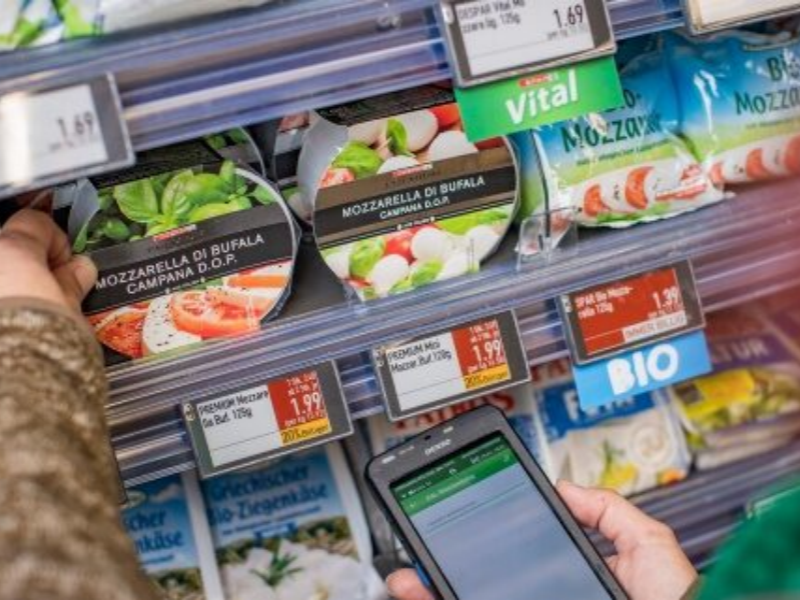
The 10 types of retail labels
1. Product labels
Attached directly to the item, product labels carry the core identifying information: name, brand, weight or volume, and relevant attributes such as ingredients, materials, or care instructions. For branded goods, the manufacturer produces the label. For private-label products, the retailer assumes full responsibility - including every legally required element. That distinction matters because private-label labeling errors cannot be passed back to a supplier.
2. Price labels
Price labels display the selling price and any active promotions. In many jurisdictions, consistently charging above a displayed price is a regulatory matter, not just a customer service issue. For retailers running frequent promotions, the labeling risk is usually at the end of a promotion - when the discounted label stays up after the price reverts to full.
3. Shelf edge labels
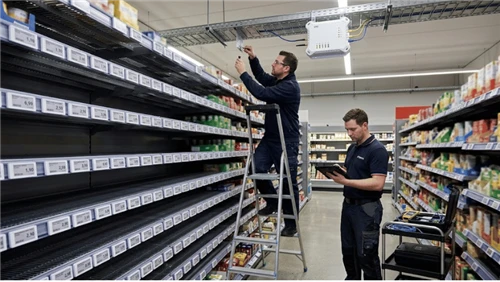
Shelf edge labels sit at the front of the shelf slot and serve two audiences simultaneously: customers browsing and staff restocking or running planogram checks. A mid-size supermarket may manage 20,000 or more individual shelf labels, making this the highest-volume and most labor-intensive label type in grocery retail.
4. Barcode labels
Barcode labels encode product information for scanning at checkout and throughout receiving and inventory workflows. The GS1 barcode system - EAN-13 used internationally and UPC-A in North America - is the globally recognized standard. Label quality matters here more than it appears: barcodes printed below the minimum quiet zone width, at insufficient resolution, or applied to curved or reflective surfaces fail to scan reliably. Each failed scan introduces inventory discrepancies and slows checkout.
5. QR code labels
Where a barcode stores a fixed identifier, a QR code links to dynamic content: full product pages, nutritional databases, recycling guidance, or NFC-enabled loyalty program entry. Retailers use QR codes to bridge physical shelf space with richer digital information, particularly when label space is tight. Operationally, QR codes on shelf locations also let staff pull up stock data without leaving the aisle.
6. Compliance and regulatory labels
This is the category most frequently underestimated and the one with the most serious consequences. Mandatory requirements vary by product category and market. Common examples include:
- Food and beverage: ingredient lists, allergen declarations, nutritional information, date marking, and country of origin - governed in the EU by Regulation (EU) No 1169/2011
- Chemical products: hazard symbols under GHS (Globally Harmonized System) or EU CLP standards
- Textiles: fiber content, country of manufacture, care symbols
- Electronics: CE marking (EEA), FCC marking (US), RoHS compliance
Retailers who sell private-label products carry the same compliance obligation as manufacturers - there is no passing that responsibility to a supplier. Failing to maintain compliant labels in food or chemical categories can result in product recalls and regulatory fines, not just complaints.
This section provides a general overview. Consult a legal or compliance specialist for guidance specific to your product categories and operating markets.
7. Packaging and logistics labels
Packaging labels appear on outer cartons and pallets rather than the product itself. In retail operations, they cover receiving, put-away, and handling instructions. In e-commerce fulfillment, carrier labels, return address labels, and picking labels all need to be accurate - errors here mean orders reach the wrong destination or returns sit unprocessed.
8. Electronic shelf labels (ESLs)
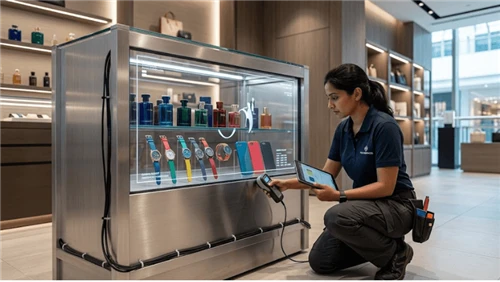
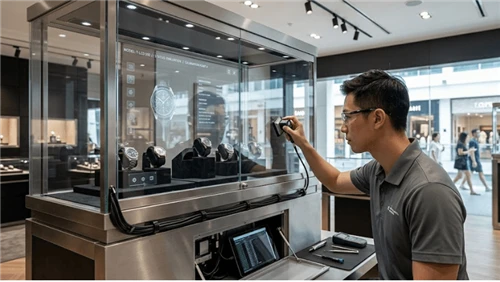
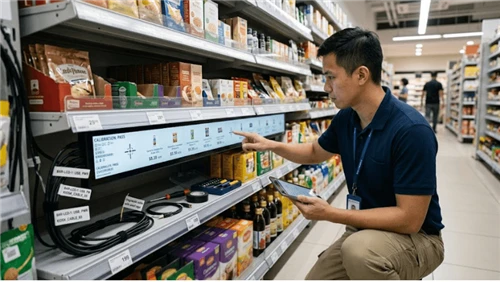
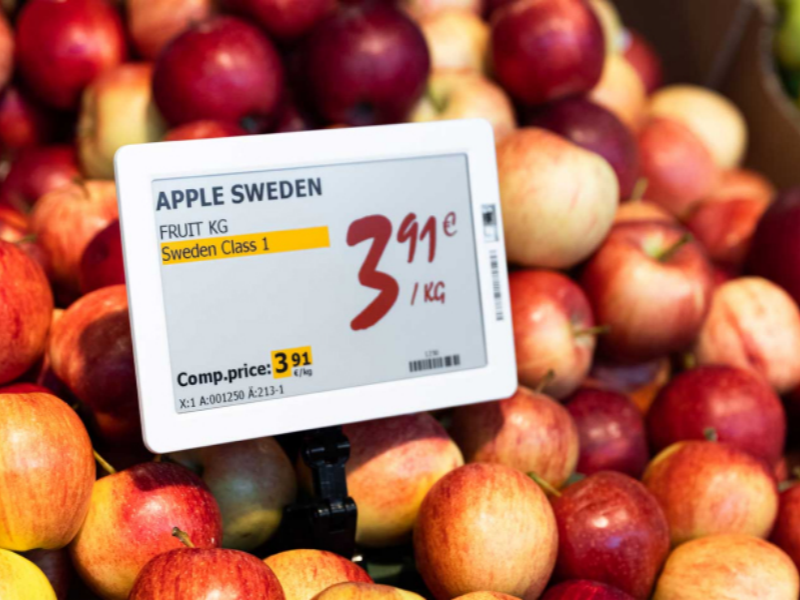
Electronic shelf labels replace paper shelf tags with small digital displays - most commonly e-ink - connected wirelessly to a central management system. When pricing or product information changes, the update is issued centrally and propagates to individual labels automatically, without manual replacement.
E-ink ESLs consume power only when the display changes. Most commercial models achieve battery life in the range of 3 to 7 years depending on update frequency, with some enterprise-grade units rated higher. Beyond battery life, the more significant operational advantage is time: a store-wide price change that takes hours with paper can be completed in minutes with ESLs.
Some ESL models also support NFC, which lets customers scan a tag for extended product information - a useful bridge between physical shelf space and digital content. For a closer look at how these systems function, see this overview of how electronic shelf labels work.
9. RFID labels
RFID (Radio Frequency Identification) tags encode product data that can be read wirelessly without line-of-sight scanning, which is the key operational difference from barcodes. In retail, RFID enables bulk inventory counting - a full stockroom pallet can be read in seconds rather than scanned item by item. Fashion retail has seen the most adoption, where SKU proliferation (multiple sizes and colors of the same item) makes accurate inventory tracking critical to reducing out-of-stocks. RFID does carry a higher per-label cost than barcodes, so the business case is strongest in high-turnover categories with significant inventory complexity.
10. Sustainability and eco-labels
Sustainability labels communicate environmental or ethical credentials: organic certification, recycled content, Fair Trade, B Corp, or cruelty-free status. Consumer demand for this information is growing, and regulatory scrutiny of how these claims are made is increasing alongside it. The EU's forthcoming Green Claims Directive - currently advancing through the legislative process - aims to require substantiation for environmental claims on products and labels. Vague or unverified sustainability claims are becoming legally risky in major markets. Retailers should treat eco-labels with the same documentation discipline as any other compliance label.

Compliance requirements by product category
The table below summarizes key mandatory labeling requirements across common retail categories. Requirements vary by market - verify local rules before launching in a new geography.
| Category | Key mandatory elements | Primary standards / regulations |
|---|---|---|
| Food and beverage | Ingredient list, allergens, nutrition facts, date marking ("best before" / "use by"), country of origin, net weight | EU Reg 1169/2011; FDA 21 CFR; FSANZ Standards |
| Chemicals / cleaning | Hazard pictograms, signal word, hazard statements, precautionary statements, supplier details | GHS; EU CLP Regulation |
| Textiles | Fiber content (%), country of manufacture, care symbols | EU Textile Regulation 1007/2011; US Textile Fiber Act |
| Electronics | CE / FCC / UKCA marking, RoHS compliance, WEEE symbol (EU), serial / model number | EU Radio Equipment Directive; FCC Part 15 |
| Food (unit pricing) | Price per standardized unit (per 100g, per liter) alongside selling price | EU Price Indication Directive; UK CPIR 2004; various US state laws |
A note on date labeling: "Best before," "use by," and "sell by" are not interchangeable. Most regulatory frameworks assign them distinct legal meanings with different food safety implications. Using the wrong term on a food product is a compliance error, not a stylistic choice.
Unit pricing is a frequently missed requirement. The obligation to display a price per standardized unit alongside the selling price applies in the EU, UK, Australia, and several US states for food and grocery products. It is often overlooked by retailers entering new geographies or launching e-commerce channels, where the shelf-equivalent label may not exist.
Paper labels vs. electronic shelf labels: how to choose
The choice between paper and electronic shelf labels is primarily a function of store size, pricing complexity, and operational capacity - not technology preference.
| Factor | Paper labels | Electronic shelf labels |
|---|---|---|
| Upfront cost | Low | Significant hardware investment |
| Ongoing labor cost | High (printing, applying, replacing) | Low once deployed |
| Store-wide update time | Hours to days | Minutes |
| Pricing accuracy at scale | Error-prone | High |
| Promotional pricing | Difficult to execute quickly | Readily achievable |
| Best suited for | Small stores; low price-change frequency | Large stores; grocery; pharmacy; FMCG |
For most independent retailers, paper labels are the practical starting point. The operational case for ESLs strengthens when price changes are frequent (grocery, pharmacy), when stores are large enough that manual label runs consume significant staff hours, or when pricing needs to integrate with a central inventory or ERP system.
Retailers evaluating the investment can work through the numbers using an ESL ROI calculator that factors in current labor costs, error rates, and update frequency. For a direct comparison of the two approaches across practical scenarios, see ESLs vs. paper labels.
If you're considering specific ESL hardware, retail electronic shelf label options range from small e-ink price tags to larger digital price screens depending on shelf format and display requirements.
Best practices for retail labeling
Standardize label templates before you scale
Define consistent formats for each label type - font sizes, required fields, and placement position - before expanding to new categories or locations. Inconsistent templates create a visually cluttered store and make retraining difficult. A useful rule: if two staff members produce the same label independently and they don't match, your template is ambiguous.
Build a defined update workflow with ownership
Every price change, promotion launch, and promotion end-date needs a corresponding label update process: who triggers it, who executes it, and how completion is verified. The most common and costly labeling failure in retail is promotional labels left in place after a promotion ends - a customer arrives expecting the promotional price and is charged full price at checkout. The fix is to attach label removal to the promotion's end date in the planning stage, not the morning after.
Match printing hardware to actual volume
Desktop thermal printers work for low-volume applications (fewer than a few hundred labels per day). High-volume environments - grocery, pharmacy, large general merchandise - benefit from industrial thermal transfer printers with faster throughput and higher resolution output. Using desktop hardware in a high-volume environment creates print quality inconsistencies that affect barcode scan reliability over time. If your barcode scan failure rate at receiving or checkout is above 1–2%, print quality is a likely contributor.
Schedule label audits after every promotion
A periodic label audit - checking that labels are present, legible, correctly placed, and current - catches issues before customers do. Audits are most valuable immediately after a promotion ends and after a planogram reset. A simple audit checklist should cover: all price labels present, promotional labels removed or updated, barcode scan test on 10% of new or reprinted labels, and compliance labels undamaged and unobscured.
Distribute labeling responsibility across functions
Labeling errors persist when ownership is fragmented. Purchasing needs to understand what labels incoming products are required to carry. Operations applies and maintains them. Marketing drives promotions that require price label changes. Compliance monitors regulatory updates. When these functions don't communicate, labels fall out of sync in ways that no single department catches. Assigning one person or team as the labeling system owner - with cross-functional visibility - is the structural fix.
Track label-related complaints as a system signal
Incorrect pricing disputes and missing information complaints are symptoms, not isolated incidents. If more than two or three complaints about the same label type appear in a month, that points to a process failure, not a staff error. Logging complaint type, location, and label category takes two minutes and makes patterns visible within weeks.
Common labeling mistakes - and what to do instead
Leaving promotional labels up after the promotion ends. Build label removal into the promotion planning workflow, tied to the end date - not handled the next morning as an afterthought.
Missing unit pricing. Before entering a new market or launching an e-commerce channel, verify local unit pricing requirements. They apply in more jurisdictions than most retailers expect, and they're frequently absent in online product listings where a physical shelf label equivalent doesn't exist. For context on what happens when displayed prices are wrong, see the regulatory and operational consequences of incorrect price displays.
Underestimating private-label compliance obligations. Retailers launching own-brand products sometimes focus on packaging design and miss the required labeling elements. For food products in particular, the list is extensive and varies by market. Compliance review before print sign-off is the only workable approach.
Allowing barcode quality to degrade. Labels printed at insufficient resolution, or applied on surfaces where they wrinkle or fade, create consistent scan failures. Barcode label quality should be part of regular supplier checks, not assumed to be correct.
Treating ESL as a plug-and-play solution. ESL systems require integration with your pricing and inventory management software to realize their operational benefit. Retailers who deploy ESL hardware without that integration end up updating labels manually through the ESL interface - which captures some of the accuracy benefit but none of the labor savings. Plan the software integration before hardware deployment, not after.
Frequently asked questions
What is the difference between a shelf label and a product label?
A product label is attached to the item and carries information about what it is - name, ingredients, care instructions. A shelf label sits at the front of the shelf slot and displays pricing and a barcode for staff scanning. Both are needed; they serve different purposes and different audiences.
How do electronic shelf labels work?
ESLs use e-ink or LCD displays connected wirelessly to a central management system. When pricing changes, the update is sent from the central system to individual labels via a wireless network - typically sub-GHz or Wi-Fi - without manual replacement. For a fuller technical explanation, see how ESLs work. For a breakdown of communication protocols, the comparison of Bluetooth vs. Wi-Fi vs. sub-GHz ESL networks covers the tradeoffs in practical terms.
Are there legal requirements for retail labels?
Yes, and they vary significantly by product category and market. Food, chemicals, textiles, and electronics all carry mandatory requirements. Allergen declarations, date labeling, unit pricing, and country-of-origin statements are among the most commonly required and most frequently missed. Retailers are responsible for ensuring products on their shelves carry all required labeling, including for branded goods where the manufacturer originally produced the label.
What should I look for when selecting an ESL system?
The key factors are: display type (e-ink for low update frequency, LCD for real-time or animated content), wireless protocol (sub-GHz for better range in large stores, Wi-Fi for simpler integration), integration capability with your existing pricing and inventory system, and total cost of ownership including infrastructure. The guide to choosing a retail ESL solution breaks down the decision criteria in more detail. For a comparison of leading suppliers, see ESL manufacturer comparisons.
Can ESLs support dynamic pricing?
Yes - this is one of the primary operational advantages. With ESLs integrated into a pricing system, time-of-day pricing, demand-based adjustments, or promotional triggers can be pushed automatically to shelf labels without staff intervention. See how ESLs enable dynamic pricing for a practical explanation of how this works in retail environments.
Where to start
A practical audit takes less time than most managers expect. Work through your current labeling against the ten types covered in this guide. Identify where you have gaps - missing shelf labels, absent compliance information, outdated promotional tags, or barcode quality issues. Then define or refine the workflow that keeps labels current.
For retailers considering a move to electronic shelf labels, the starting point is usually the labor cost calculation: how many staff hours per week are spent printing, replacing, and correcting labels? That number, compared against ESL system costs, typically frames the investment decision clearly. The five reasons retailers switch to ESLs covers the most common decision drivers. For those further along in evaluation, ESL technology options and direct inquiry are the logical next steps.