Retail has always been driven by what shoppers want - and the data on what they want right now is unambiguous. According to PwC's 2024 Voice of the Consumer Survey, 80% of consumers say they are willing to pay more for sustainably produced goods, with an average premium of 9.7%. Meanwhile, Blue Yonder's 2025 Consumer Sustainability Survey found that 78% of shoppers say sustainability considerations are important when choosing where to buy - a figure that climbs to 88% among Gen Z.
That shift isn't just a reputational opportunity. It's a cost management signal. Retailers that reduce waste, digitize manual processes, and tighten their supply chains consistently find that sustainability and profitability move together.
This guide covers 10 practical strategies for building a more sustainable retail environment - structured for both independent store owners and multi-site operations. Each strategy includes a quick win you can act on now and a longer-term option for teams ready to go further.

What Is Sustainable Retail?
Sustainable retail means running a retail business in ways that minimize environmental harm, support fair working practices, and remain financially viable over time. In practice, it spans decisions across packaging, energy use, supply chain logistics, waste management, and how you engage both customers and employees.
Three forces are making this a business-critical issue rather than an optional commitment:
- Consumer expectations: Shoppers - particularly millennials and Gen Z - are factoring environmental values into purchasing decisions and brand loyalty.
- Regulatory pressure: The EU's Corporate Sustainability Reporting Directive (CSRD) now requires large retailers to disclose ESG performance. Similar requirements are expanding in the US and Asia-Pacific.
- Operational economics: Waste is cost. Reducing it - whether through energy, packaging, or spoilage - goes directly to the bottom line.
The Business Case, Grounded in Numbers
Skeptical of whether sustainability investments pay off? Here's what the evidence shows:
- Revenue: PwC found consumers willing to pay a 9.7% premium for sustainably sourced goods. For everyday product categories like food and personal care, this premium is already influencing purchase decisions at the shelf.
- Energy costs: According to the International Energy Agency, LED lighting offers 50–80% energy savings compared to fluorescent and halogen alternatives. For a mid-size retailer, that often means payback within two to four years.
- Food waste losses: WRAP estimates UK retailers generate around 270,000 tonnes of food waste annually - all of it representing direct financial loss. Improved forecasting and stock rotation can cut that significantly.
- Compliance risk: Retailers that address environmental impact proactively are significantly better positioned ahead of mandatory reporting requirements.
10 Sustainable Retail Strategies
1. Conduct a Waste Audit Before You Invest in Anything
The single most common sustainability mistake retailers make is buying solutions before understanding their actual waste profile. A basic audit doesn't require expensive tools - it requires two weeks of disciplined observation.
Quick win: Assign a team member to categorize waste daily across five fields: waste type, source location, approximate volume, frequency, and current disposal route. Two weeks of data will almost always reveal one or two categories that account for the majority of your waste - and those are where you start.
Scale-up: IoT-enabled smart bins with sensors that log fill levels, material types, and disposal patterns in real time - feeding dashboards that make waste reduction measurable and manageable across multiple sites.
What most guides skip: The audit isn't just environmental - it's a financial diagnostic. Every category of unsorted or misdirected waste carries a disposal cost. Knowing your waste profile is what makes every other strategy in this list more targeted.
2. Rethink Packaging from the Category Level Down
Packaging is the most visible sustainability lever in retail - and the one shoppers notice first. Excessive single-use packaging now actively drives brand perception downward, particularly in food and personal care categories.
Quick win: Audit your own-brand packaging and switch to materials that are recyclable, compostable, or made from recycled content. Remove secondary packaging layers where they serve no structural purpose.
Scale-up: Closed-loop packaging systems - reusable containers for cleaning products, refill stations for personal care, or deposit-return schemes for beverages - create ongoing waste reduction and often become a visible customer engagement point in-store.

3. Tackle Food Waste Where the Numbers Are Biggest
For grocery, convenience, and food service retailers, food waste is typically the largest sustainability and cost problem simultaneously. WRAP data shows UK retailers alone discard around 270,000 tonnes of food annually - the vast majority of it edible.
The financial logic is straightforward: every product that spoils before it's sold was purchased, received, stored, and labeled - all that labor and cost goes with it to the bin.
Quick win: Enforce strict FIFO (first-in, first-out) rotation as a non-negotiable operational standard. Pair this with automated markdown pricing triggered by proximity to sell-by date - most modern EPOS systems support this. Establish a donation partnership with a local food bank or redistribution platform for surplus that is safe but unsellable.
Scale-up: Demand forecasting tools that integrate historical sales data with external variables - seasonality, weather, local events, promotional calendars - can dramatically reduce over-ordering. Some supermarket electronic price tag systems also support real-time markdown coordination directly from the shelf, reducing the lag between a product nearing expiry and a price change reaching customers.
4. Replace Paper Pricing and Signage with Digital Alternatives
Paper-based pricing tags and printed promotional materials represent a recurring waste stream that is almost entirely avoidable. In a 1,000 SKU store, even quarterly reprints generate significant paper consumption, printing costs, and staff time.
Quick win: Switch high-frequency promotional signage - weekly offers, seasonal pricing, limited-time events - to reusable display boards or digital screens. This eliminates the print-and-discard cycle for the highest-turnover signage immediately.
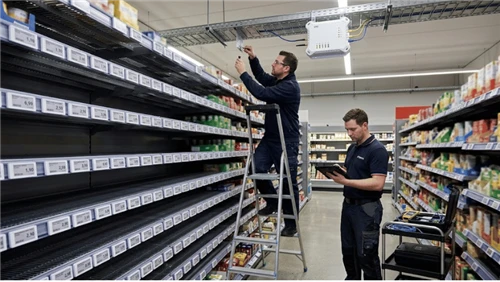
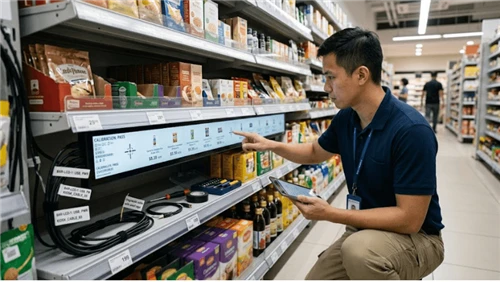
Scale-up: Electronic shelf labelling systems allow pricing and product information to be updated across an entire store network instantly, without paper or staff walking every aisle.
Electronic shelf labels eliminate label waste entirely while also enabling
dynamic pricing - including the automated end-of-life markdowns mentioned in Strategy 3.
This is one area where the sustainability benefit and the operational efficiency benefit are genuinely inseparable.
5. Build Supplier Accountability into Your Supply Chain
A retailer's environmental footprint doesn't begin at the loading dock - it begins with every supplier decision. Supply chain emissions typically represent the largest share of a retailer's total carbon impact, yet they're often the least visible.
Quick win: Introduce a supplier sustainability scorecard. It doesn't need to be elaborate to be effective. Start with five criteria: whether the supplier has a published environmental policy, whether they hold a relevant certification (FSC for paper/wood products, SA8000 for labor, ISO 14001 for environmental management), their approach to packaging, their delivery consolidation practices, and whether they can provide basic emissions data. Rank suppliers on these criteria and use the results to prioritize conversations and, over time, sourcing decisions.
Scale-up: Real-time inventory tracking and route optimization reduce unnecessary transportation miles, consolidate deliveries, and cut logistics-related emissions - often with direct cost savings from reduced fuel and fewer return trips.
6. Cut In-Store Energy Consumption Systematically
Lighting, refrigeration, and HVAC typically account for 70–80% of a retail store's total energy consumption. This is where the fastest and most measurable sustainability returns usually live.
Quick win: If you haven't already completed a full LED retrofit, that's the immediate priority. The IEA reports LED lamps offer 50–80% energy savings versus fluorescent and halogen equivalents. Add occupancy sensors in stockrooms, restrooms, and low-traffic zones, and align HVAC scheduling precisely with actual opening hours rather than leaving systems running during overnight and pre-opening periods.
Scale-up: Building energy management systems (BEMS) automate energy use across your store estate - monitoring consumption in real time, flagging anomalies, and optimizing based on occupancy patterns. Bar-shaped LCD screens and other low-power display technologies can also replace higher-draw signage formats in energy-conscious store fitouts.
Worth noting: Fix operational inefficiencies first. Advanced technology running on top of preventable waste is a poor investment. The correct order is: audit → behavior change → technology to scale what's working.
7. Move Toward a Circular Retail Model
The traditional retail model - manufacture, sell, dispose - generates waste at every stage. Circular approaches extend the useful life of products and materials, reducing waste at source rather than managing it downstream.
This strategy is most relevant for fashion, electronics, home goods, and sporting equipment retailers, where products have meaningful value after first use.
Quick win: Launch a product take-back collection for a single high-waste category - batteries, phone accessories, clothing, or small appliances. Partner with a recycling or refurbishment provider to process what's collected. Even a small-scale program signals intent to customers and creates a foundation for expansion.
Scale-up: Resale, repair, or rental services alongside primary product lines. In apparel and electronics, recommerce is growing faster than primary market sales - retailers that build these capabilities early are positioning for a structural shift rather than reacting to it. Creative retail display strategies can also help integrate take-back points and circular product sections into the store layout without disrupting the primary shopping experience.
8. Make In-Store Recycling Genuinely Easy
Customers frequently want to recycle - but only if the process is obvious and requires minimal effort. Poorly located bins, unclear labeling, and a lack of staff guidance result in recyclable materials ending up in general waste or, worse, contaminating existing recycling streams.
Quick win: Install clearly labeled, color-coded recycling stations at store entrances and near high-waste product categories (bottles, batteries, plastic bags). Brief frontline staff so they can answer basic questions confidently. Simple behavioral cues - placement, signage, and staff visibility - drive significant volume increases without any technology investment.
Scale-up: Sensor-equipped bins that identify material types and alert staff when they're approaching capacity - maintaining a clean store environment while ensuring recycling streams stay uncontaminated. Digital signage solutions placed near recycling stations can reinforce messaging about what to deposit, reducing contamination rates.
9. Make Sustainability Part of How Your Teams Work
Sustainability programs stall when they exist only on paper or in executive communications. The retailers with the strongest environmental results are those where frontline staff treat sustainability as part of normal operations - not a separate initiative.
Quick win: Identify two or three staff members in each location who are genuinely interested and give them a specific mandate: spot waste patterns, propose improvements, and track one metric (energy, food waste, or recycling volume) over a 90-day period. This 'green champion' model works better than broad awareness campaigns because it creates local ownership and specific accountability.
Scale-up: Embed sustainability metrics into team performance frameworks. Use interactive kiosk displays or digital dashboards in staff areas to show progress in real time - energy use versus last month, food waste tonnage, recycling rates. Making progress visible changes behavior more reliably than training alone.
10. Set Targets You Can Actually Measure
Sustainability without measurement is marketing. Public commitments without data to back them up - increasingly called out as greenwashing - expose retailers to regulatory scrutiny and reputational risk rather than building trust.
Quick win: Define two specific, measurable 12-month targets based on your waste audit findings. Examples: a 15% reduction in packaging waste by weight, or a 10% reduction in energy consumption per square meter of retail floor space. These are small enough to be achievable and specific enough to be verifiable.
Scale-up: Align with established reporting frameworks. The Science Based Targets initiative (SBTi) provides a methodology for setting emissions reduction targets consistent with climate science - and is increasingly expected by investors and major retail partners. The
Global Reporting Initiative (GRI) standards provide a comparable structure for broader ESG disclosures. Both have onboarding resources designed for businesses starting from scratch.
Quick-Win vs. Scale-Up: At a Glance
| Strategy | Quick Win | Scale-Up |
|---|---|---|
| 1. Waste Audit | 5-field manual audit over 2 weeks | IoT smart bins with real-time monitoring |
| 2. Packaging | Switch own-brand to recyclable materials | Refill stations / closed-loop schemes |
| 3. Food Waste | FIFO + automated markdown + donations | Demand forecasting software |
| 4. Digital Signage | Reusable boards for promotions | Electronic shelf label systems |
| 5. Supply Chain | 5-criteria supplier scorecard | Real-time tracking + route optimization |
| 6. Energy | LED + occupancy sensors + HVAC scheduling | BEMS + renewable procurement |
| 7. Circular Economy | Single-category take-back collection | Resale / repair / rental services |
| 8. Customer Recycling | Labeled stations + staff briefing | Sensor-equipped sorting bins |
| 9. Employee Engagement | Green champions per location | Sustainability KPIs + live dashboards |
| 10. Targets | Two measurable 12-month goals | SBTi / GRI alignment |
Where to Start: A 4-Step Plan for Any Retailer
- Run a two-week waste audit. Identify your top two or three waste categories before committing to any solutions.
- Set two specific 90-day targets. Small, measurable goals build internal momentum and create data you can report on.
- Pilot one strategy per category. Run a focused trial - a take-back collection, an LED retrofit, or an automated markdown rule - and document the outcome.
- Scale what works, drop what doesn't. Use results from the pilot to build the internal case for broader rollout and continued investment.
Three Mistakes That Stall Sustainability Programs
- Greenwashing without substance. Sustainability claims that aren't backed by data erode trust faster than saying nothing. Regulators in the EU and US are actively targeting misleading environmental marketing - the risk is real and growing.
- Technology before behavior. Expensive tools only work if the underlying processes are sound. Fix operational discipline first; use technology to scale and measure what's already working.
- Treating it as a communications project. Programs without operational ownership, clear targets, and staff accountability stall after the initial announcement. Sustainability needs a home in operations, not just in marketing.
FAQ
Q: What is sustainable retail?
A: Sustainable retail means operating a retail business in ways that minimize environmental impact, support fair practices across the supply chain, and remain financially viable long-term. In practice, this covers packaging, energy use, waste management, sourcing decisions, and how the business reports and communicates its environmental performance.
Q: Why does sustainability matter for retailers specifically?
A: Three reasons converge: consumer demand (80% of shoppers say they're willing to pay more for sustainable goods, per PwC), regulatory pressure (ESG disclosure requirements are expanding globally), and direct cost savings from reducing waste and energy consumption. All three make sustainability increasingly difficult to deprioritize.
Q: How can a small retailer become more sustainable without a big budget?
A: Start with the audit (Strategy 1) - it costs nothing but time and immediately identifies where money is being wasted. LED lighting, FIFO stock discipline, and a food donation partnership are all low-cost, high-impact starting points. The key is picking one specific action, measuring it, and building from there rather than trying to change everything simultaneously.
Q: What are the biggest sources of waste in retail?
A: Packaging materials, food spoilage (particularly for grocery and food service retailers), paper-based signage and receipts, returned merchandise, and energy waste from inefficient lighting and HVAC systems. For most retailers, one or two of these will dominate - which is why the audit comes first.
Q: How long does it take to see returns on sustainability investment?
A: It depends on the strategy. LED lighting retrofits often pay back within two to four years through energy savings. Food waste reduction via FIFO and markdown automation can show measurable results within weeks. More complex investments like demand forecasting software or supplier scorecard programs take longer to implement but deliver compounding returns. Starting with quick wins builds the financial and operational case for longer-term investment.
Q: What technology supports sustainable retail operations?
A: Electronic shelf label systems eliminate paper pricing waste and enable automated markdowns. Demand forecasting tools reduce food overstock. Building energy management systems (BEMS) automate energy optimization. IoT sensors monitor waste streams. If you're evaluating the financial case for ESL adoption specifically, the ESL ROI calculator provides a practical starting framework. Most of these technologies are now available across a broad price range - from SMB-accessible to enterprise-grade.
Q: What is greenwashing and how do retailers avoid it?
A: Greenwashing is making sustainability claims - in marketing, on packaging, or in corporate communications - that aren't backed by measurable action or verifiable data. Retailers avoid it by setting specific, time-bound targets; measuring and reporting progress against them; and ensuring that public claims match what's actually happening operationally.
The Bottom Line
Sustainable retail isn't one project - it's a set of operational decisions that compound over time. The retailers seeing the strongest results aren't necessarily those with the largest sustainability budgets. They're the ones who started with an honest audit, set one specific target, and built from there.
The strategies in this guide are designed to be sequenced, not tackled simultaneously. If you're deciding where to begin: the waste audit, an LED retrofit, and FIFO enforcement are the three actions with the fastest measurable return at the lowest cost. Everything else builds on the foundation those three create.
For retailers exploring how in-store display technology fits into a sustainability program - particularly around paper elimination and pricing efficiency - our electronic shelf label solutions page covers the full range of hardware and deployment options.