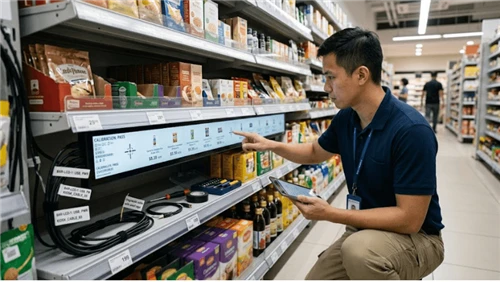
A transparent LCD showcase is usually approved while everything is working: the panel is powered, the interior lighting is on, the media player is rendering content, and the product is positioned for the intended visual effect. Real installations also spend time in abnormal states. A branch circuit can trip, the player can crash, the backlight or cabinet lighting can fail, a scheduled shutdown can occur, or a technician can open the enclosure during service. The customer experience in those states should be designed, not discovered after launch.
This guide explains power-off and blackout behavior for a transparent display case solution project. It does not assume every transparent LCD becomes clear, dark, or opaque when power is removed; the optical result depends on panel mode, polarizers, backlight/cabinet lighting, cover stack, content state, and enclosure geometry. Procurement should therefore specify the fail state as an observed system behavior on the proposed assembly.

Break "The Screen Went Black" Into Four Different Failures
A useful diagnosis separates display power, video content, illumination, and player state. A black video frame with a healthy panel is not the same as a panel with no power. A powered panel with failed interior lighting can make the product behind it disappear while digital content still exists. A player crash can leave the last frame, a blank frame, an input-loss OSD, or another behavior depending on configuration.
| Observed state | Possible layer | First evidence to collect |
|---|---|---|
| Digital content disappears but product remains lit | Player/input/content path | Player status, input lock, test source |
| Product behind screen becomes hard to see | Cabinet/backlight illumination | Interior-light power and lighting geometry |
| Panel appearance changes after mains loss | Panel/power sequence | Panel mode, power rails, controller state |
| Unexpected message or logo appears | Controller/OSD/player recovery | Boot sequence and no-signal settings |
| Display recovers but cabinet lighting does not | Separate power/control domains | Relay, driver, control output, wiring |
Define the Desired Fail State Before Choosing Recovery Logic
The preferred state depends on the use case. A museum or premium product showcase may prioritize uninterrupted physical-product visibility. A secure retail cabinet may prioritize a predictable dark/neutral digital state while keeping door security intact. A staffed demonstration may allow a service message. The requirement should say what a shopper should see and what the equipment should do, not only how quickly the player reboots.
Consider whether the product remains visible, whether stale promotional content could remain on screen, whether a black digital layer hides the merchandise, whether an error OSD is acceptable, and whether cabinet lighting should stay on during a player failure. These decisions determine power-domain separation and control logic.
Do Not Infer Unpowered Appearance From a Marketing Photo
Transparent LCD optical stacks vary. Polarizer orientation, panel mode, cover layers, lighting and background all influence the unpowered look. Some panels can appear substantially darker when unpowered; others may preserve more see-through appearance. Even within the same nominal size, a panel or polarizer revision can change visual behavior enough to matter to a premium showcase.
Treat the unpowered condition as a golden-sample photograph under controlled lighting. Capture front and oblique views with the representative product behind the panel. Repeat with cabinet lighting on and off if those power domains can fail independently. This evidence is more useful than a generic statement such as "transparent when off."
Separate Cabinet Lighting From Media-Player Power Where It Helps
A transparent LCD installation often depends on light behind or around the product. If the player and interior lighting share one uncontrolled switched outlet, a player reset may blank both the digital layer and the product illumination. Separating power/control domains can allow the product to remain presentable while the player or display controller recovers, but it adds wiring, controls, and failure states that must be documented.
The design should also decide what happens during scheduled shutdown. Keeping lighting on after the display is intentionally off may waste energy or produce an unwanted overnight appearance. Use a state table that covers trading hours, scheduled sleep, service, player restart, display restart, and full mains loss.
Design the No-Signal and Boot Sequence
No-signal behavior can be more visible than the failure itself. If the controller shows a bright vendor OSD, input label, blue screen, or boot logo during recovery, the showcase can flash through states that were never part of the creative design. Ask what no-signal screen, startup logo, input switching behavior, and boot timing are configurable on the proposed controller.
Test the sequence from cold power-on rather than only rebooting the application. Record the order in which cabinet lighting, panel power, player output, and content become stable. If content must never appear before product lighting, encode that dependency into the control sequence or content design.
Use a Neutral Fallback Asset for Player Failures
Where the player or CMS supports watchdog/fallback behavior, a neutral local asset can be safer than a blank or stale campaign frame. The asset might preserve brand color, a simple service message, or a dark mask designed not to obscure the product. Keep it locally cached if the failure mode includes network loss.
Avoid pretending that one fallback image solves panel-power failure. The player cannot render through an unpowered display path. The fallback asset is a content-layer control; power design, controller recovery, and lighting state need their own controls.
Decide Whether UPS Hold-Up Is Actually Needed
A UPS can bridge short interruptions or allow controlled shutdown, but it should be justified by the business consequence. Adding a battery introduces space, heat, maintenance, lifecycle, safety and service considerations. A showcase that can recover cleanly after a brief outage may not need hold-up power, while an installation where a restart creates a long unacceptable visual state may benefit from it.
If a UPS is used, define which loads it supports. Keeping the player alive while the display and lighting lose power may not improve the customer experience. Conversely, supporting every load can require a much larger system. Test the complete recovery path after the UPS reaches its cutoff, not only the first few seconds of backup.
Plan Maintenance Mode So Service Does Not Look Like a Failure
Technicians need a repeatable way to open the cabinet, disconnect a player, replace a panel, or inspect lighting without creating confusing public content. A maintenance mode can disable scheduled content, show a neutral message, or power down the digital layer in a controlled order. The mode should be easy to exit and should not bypass door security or other safety controls.
Coordinate this with the physical access design and the maintenance considerations in transparent LCD UV aging guide for the complete optical stack. Cleaning, film replacement, or cover work can change reflections and the apparent fail state even when the electronics are unchanged.
Build a Fail-State Test Matrix
| Fault injection | Expected customer-facing state | Evidence |
|---|---|---|
| Player process stopped | Defined fallback or controlled no-signal state | Photo/video plus player/controller log |
| Video cable disconnected | Approved input-loss behavior | Photo and controller setting |
| Display/controller power removed | Approved unpowered panel appearance | Golden-sample photo under fixed lighting |
| Cabinet lighting removed | Defined product visibility or safe shutdown | Photo from primary viewing positions |
| Full mains interruption | Predictable restart sequence without stale content | Timed video and recovery log |
| Network unavailable | Local content/fallback behavior as specified | Player log and visible state |
Questions for a Transparent LCD RFQ
- What does the proposed panel/controller assembly look like with display power removed under the specified cabinet lighting?
- Can the supplier provide a production-representative unpowered golden sample or video?
- What no-signal screen, boot logo, input label, and startup behavior are configurable?
- Can display, player and cabinet lighting be powered or controlled independently if the project needs it?
- What state follows a player crash, cable loss, controller reboot, and full mains recovery?
- Which settings are stored persistently after power loss?
- Will panel, polarizer, controller, or firmware changes trigger fail-state requalification?
- What service procedure prevents a maintenance event from leaving an uncontrolled public screen?
-

Turn the Design Into a Repeatable Acceptance Test
A good transparent LCD power-off and blackout behavior decision ends with a test another engineer can repeat. The test should identify the production-representative hardware, software or firmware revision, cables and accessories, environmental condition, input data, operator action, expected result, and evidence file. Avoid a pass rule such as "works normally." A pass rule should describe what state must be observed and what exceptions are allowed.
Keep the test evidence with the same revision record used for procurement. The most useful artifact is a fail-state and restart-sequence acceptance matrix: one sheet that connects requirement, setup, action, observed result, defect owner, and approval. This prevents a later supplier change from being judged against a memory of the pilot rather than the approved baseline.
- Freeze the test configuration and record model/revision identifiers.
- Create normal, boundary, and recoverable-failure cases.
- Run the sequence more than once, including after reboot or power cycling when relevant.
- Capture logs, photos, screenshots, or measured values that prove the result.
- Repeat on a second unit or production lot when variation can affect the conclusion.
- Record every exception and either close it or carry it as an approved residual risk.
Define regression triggers before rollout
Regression should be triggered by a change that can alter the mechanism being validated, not by an arbitrary calendar. Relevant triggers for this topic include panel or polarizer revision, controller firmware change, player change, cabinet-lighting change, power-supply/UPS change, no-signal setting change, or optical-stack change. A documented trigger list makes change control faster because the team knows which tests must be repeated and which evidence can remain valid.
FAQ
Q: Does a transparent LCD become fully transparent when power is off?
A: Do not assume that. The observed appearance depends on the exact panel mode and optical stack. Approve the real sample in the finished lighting geometry.
Q: Is a black screen the same as no power?
A: No. A rendered black image is an active display state. No power changes the electrical and optical state of the panel/controller and can look different.
Q: Should cabinet lighting stay on during a display failure?
A: Only if that supports the desired customer experience and safety/energy policy. Define the state deliberately and test it.
Q: Can a UPS guarantee a clean fail state?
A: No. It can provide temporary power, but the player, display, lighting and control logic still need a defined recovery sequence.
Design Store Opening and Closing as Controlled State Transitions
The most common "blackout" may be intentional: the store closes, a building-management system removes power, or a scheduler shuts down the display. Opening and closing deserve the same design attention as faults because they happen repeatedly. Define whether the player shuts down gracefully, whether cabinet lighting fades or switches immediately, whether the panel enters standby, and what sequence occurs the next morning.
Avoid creating a stale-content window during opening. If the player has not yet synchronized current content, it may display yesterday's promotion while the physical product is already illuminated. A safer sequence can hold a neutral local asset until the content service confirms the current campaign. This is a content-governance choice, not a universal requirement, but it should be decided before rollout.
Protect the Physical Product During Digital Failure
A transparent showcase has two simultaneous merchandising layers: the digital image and the physical item. Failure planning should protect the physical layer. Confirm that a dark digital state does not make the product effectively invisible, that interior lights do not overheat or discolor the item when the display is off, and that a service technician can access the cabinet without leaving loose cables or a bright diagnostic screen visible to shoppers.
High-value merchandise may also require the lock, alarm or door-sensor system to remain active when the display/player power is isolated. Keep security power and display power boundaries explicit. A clean entertainment/display shutdown must not unintentionally disable the cabinet protection system.
Approve a Golden Fail-State Sample and Photo Set
The golden sample should include more than the best hero photo. Capture at least normal operation, black content, no video input, player reboot, display power off with lighting on, lighting off with panel powered, full power off, and restart. Use the same camera position and exposure where possible so later comparisons reveal meaningful changes instead of photography differences.
Store these images with the panel, controller, cover, lighting and player revision. If a supplier changes the polarizer, controller, cover-glass treatment, LED lighting or no-signal firmware, compare the new sample against the approved set. This is especially valuable because "transparent" is a perceptual result influenced by several layers.
Plan Field Diagnostics Without Exposing Engineering Screens
Service tools should let a technician identify whether the fault is content, input, controller, panel power or cabinet lighting without requiring a public factory menu to remain on screen. A hidden service page, remote log, status LED inside the cabinet, or controlled test asset can reduce time to isolate the layer.
After service, the recovery checklist should confirm content version, player network state, display input, lighting mode, door/security state and the normal shopper-facing appearance. A repaired display is not ready merely because pixels are visible.
For adjacent integration context, review the LCD display screen category, LEGOYO homepage, about LEGOYO, contact LEGOYO, transparent LCD UV aging guide, and LEGOYO technical blog pages. These provide six additional site anchors while the article remains focused on failure-state behavior rather than repeating general transparent-LCD selection guidance.
Link Fail-State Approval to Signal and Power Configuration
The final blackout behavior also depends on source-loss and power-control settings. Compare the approved cabinet behavior with the commercial LCD input failover guide and commercial LCD scheduled power guide guidance when the transparent panel uses a commercial controller. Input auto-switching, standby behavior, RTC scheduling and recovery settings can change what the shopper sees before the player is ready.
Treat these controller settings as part of the golden configuration. Record them in the commissioning checklist, protect them from casual factory reset, and recheck them after board replacement. A fail-state design is only reproducible when the electronics configuration and the optical cabinet are controlled together.
Include the customer viewing zone in blackout approval
An unpowered panel can look acceptable from straight ahead and much darker from an oblique shopper angle. Photograph the fail state from the same primary and secondary viewing positions used for normal showcase approval. If a side view is important to the store layout, it belongs in the failure-state test as well as the hero-state test.
Commissioning should also confirm the exact operator action used after a blackout. If recovery requires a hidden button, remote command, door opening, or player restart, document it and test it with the service team. The desired fail state is only useful when staff can restore normal operation predictably.
Final Procurement Perspective
A transparent display case should have an approved normal state and an approved abnormal state. Photograph the unpowered sample, define lighting and no-signal behavior, test player and mains failures, and make the restart sequence repeatable. The product catalog, display solutions overview, and LEGOYO technical blog pages provide adjacent display context; use request a project quotation to define the fail-state matrix and production sample required before rollout.