This is not a minor inconvenience. In organizations where space is shared and schedules are tight, poor room management creates a daily drag on productivity - wasted time searching for available space, administrative staff manually updating paper signs, and rooms held captive by bookings that no longer exist.
Digital room management addresses this directly. By connecting real-time electronic displays to your existing booking systems, organizations can make the actual state of every room visible at a glance - and update it automatically whenever something changes.
This guide covers what digital room management is, how it works from hardware to daily use, where it makes the most operational difference, and what to evaluate before choosing a system.
What Is Digital Room Management?
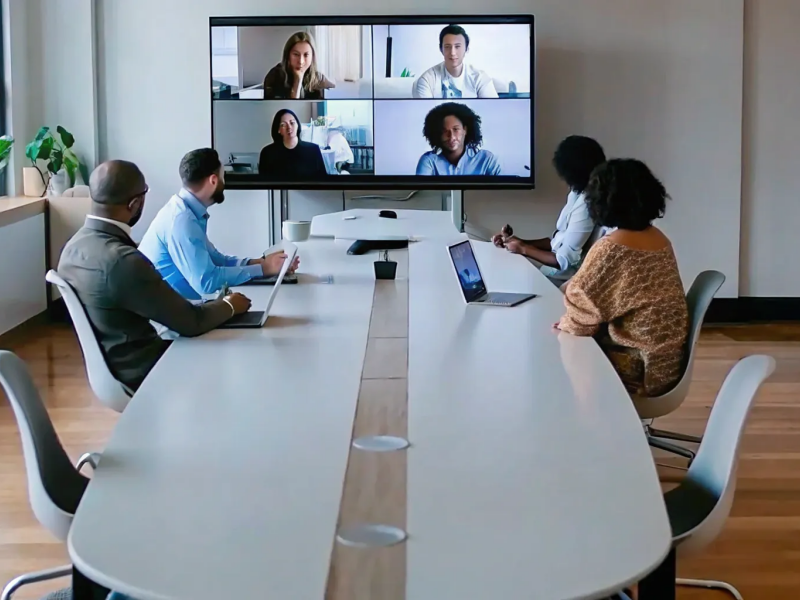
Digital room management is a system that uses networked electronic displays - mounted outside meeting rooms, offices, or other shared spaces - to show live booking status, upcoming schedules, and occupancy information. It connects directly to your calendar or reservation software, so every change is reflected automatically on every screen.
In practical terms, anyone walking past a room can see immediately whether it is occupied, when it becomes free, and who has booked it next - without checking a calendar app, asking a receptionist, or hunting for a printed schedule. It sits within the broader category of digital signage solutions but is purpose-built for the specific demands of shared space coordination.
From Paper Schedules to Connected Displays
The traditional approach - a printed weekly schedule slid into a wall-mounted frame, or a whiteboard updated by hand - has three persistent problems: it goes stale the moment a change is made, someone has to physically update it, and it tells you nothing about what is happening right now.
A connected display solves all three. When a meeting is cancelled in Google Calendar, the display clears immediately. When someone extends a booking by 30 minutes from their phone, the sign outside updates to match. No one has to do anything manually.
The Four Core Components
A functioning digital room management setup requires four things working together:
- Electronic displays mounted outside each bookable space. Most professional deployments use e-ink (electronic paper) technology, though LCD and tablet-based options exist for environments requiring touch interaction.
- A central software platform - a cloud dashboard or on-premise management system through which all rooms and displays are administered.
- Calendar or booking system integration - the bridge that connects bookings made in tools like Microsoft Outlook or Google Calendar to the physical displays on the wall.
- Optional occupancy sensors - hardware that detects whether a room is physically in use, independently of whether it has a booking recorded in the system.
Each component serves a distinct function. The displays make information visible. The software keeps everything synchronized. The integration means staff don't need to change how they book rooms. And the sensors close the gap between what the calendar says and what is actually happening.
The Real Cost of Poor Room Management
Ghost Meetings: When Bookings Don't Reflect Reality
A ghost meeting is a room booking that no longer reflects reality - the meeting was cancelled, cut short, or never started, but no one released the room. The calendar still marks it as occupied, so the space sits empty while other teams search for somewhere to meet.
Ghost meetings are a well-documented problem in shared office environments. They lock up bookable time, push employees to over-reserve as a workaround, and frustrate anyone trying to find a room at short notice. A digital room management system with occupancy sensors can automatically detect when a booked room has been empty past a defined threshold, release it, and update the display to show it as available - with no human intervention required.
Double Bookings and the Administrative Burden They Create
In organizations without a single, authoritative booking system, double bookings happen regularly. One team books through the shared calendar, another confirms a reservation by email, and neither checks whether the other has done the same until both arrive at the same door.
Digital systems resolve this by maintaining one authoritative record of room status - one that every connected display reflects in real time. Once a room is booked, it appears as unavailable on every screen and in every connected calendar simultaneously.
Space You're Paying For But Not Using
Underused meeting rooms are a real cost, not just an inconvenience. Facilities managers in organizations with reliable occupancy data consistently find that some rooms are heavily oversubscribed while others sit underused for much of the week - not because of a space shortage, but because visibility is poor and booking habits are uneven. Digital room management generates the occupancy data needed to understand those patterns and make evidence-based decisions about space allocation.
How It Works: From Installation to Daily Use
Step 1 - Choose and Mount Your Room Displays
Electronic displays are mounted beside or above the entrance to each bookable space. The most common choice for dedicated room sign applications is an e-ink display, for several practical reasons:
- Readable in all lighting conditions, including bright corridors and direct sunlight
- Low power consumption - battery-powered models avoid the need for wall cabling (battery life varies by model and how frequently the display updates; check manufacturer specifications)
- No backlight or glare, making them easy to read at a glance from several metres away
- Support for full graphic layouts, including logos, room names, and colour-coded availability indicators
For rooms where staff need to book on the spot, extend a session, or check in interactively, bar-shaped LCD displays and tablet-based systems offer the touchscreen interaction that e-ink panels generally do not provide. The right hardware depends on how your teams will actually use the display - passive information or active interaction.
A full overview of electronic display hardware formats is useful context when matching display type to deployment environment.
Step 2 - Connect to Your Calendar System
Integration with your existing calendar infrastructure is the most critical step in any deployment. Most enterprise-grade systems support three main platforms:
- Microsoft 365 / Teams Rooms - room resources configured through Exchange Online sync automatically with connected displays. Microsoft's Teams Rooms documentation covers the IT configuration in detail.
- Google Workspace Calendar - room resources managed through Google Workspace feed booking data to displays in real time once connected.
- Third-party booking platforms - for organizations using dedicated facility management or workplace tools, API or middleware connectors are typically available, though integration quality varies by vendor.
A display that shows only static information is little better than a printed sign. The value is in live synchronization: when a meeting is cancelled, the display clears automatically; when a room is booked, it marks as occupied with no manual steps required. If you are evaluating complete systems rather than display hardware alone, reviewing available room signage and display solutions alongside your IT requirements is a practical starting point.
Step 3 - Staff Book, Change, or Release Rooms
Once the system is live, most employees continue using exactly the tools they already use. Bookings made in Outlook or Google Calendar appear on the room display automatically. There is no new interface to learn for standard reservations.
Walk-up booking - where someone claims an available room directly at the display - requires a touchscreen panel rather than an e-ink screen. Whether you need this depends on your team's working style: organizations with a culture of spontaneous, same-day meetings will use it heavily; those who schedule in advance may find it unnecessary.
Early release is straightforward in most systems. Staff can free a room ahead of its scheduled end time through their calendar app or directly on the display, making it immediately available for others. Administrators retain full override capability from the central dashboard for urgent changes, closures, or large-event scheduling.
Step 4 - Occupancy Sensors Close the Loop
Sensors add a layer of accuracy that booking data alone cannot provide. Presence detection hardware - typically PIR (passive infrared), radar, or camera-based, depending on required accuracy and privacy constraints - monitors whether a room is physically occupied regardless of its booking status.
This is the mechanism behind ghost meeting detection. If a sensor registers an empty room past a defined timeout, the system can automatically:
- Notify the booking holder that the room is being released
- Clear the display and mark the space as available
- Log the event for occupancy reporting and utilization analysis
Sensor-equipped deployments produce significantly richer utilization data - increasingly valuable for organizations managing hybrid work schedules and making decisions about future space needs.
What Changes After You Deploy It
Less Coordination, More Available Rooms
Before digital room management, the administrative overhead in organizations with shared meeting space tends to be persistent and invisible: printing and updating paper signs, resolving double-booking disputes, fielding availability enquiries from staff who can't find a free room. After deployment, most of this disappears. Room status updates without any human involvement.
In a company managing 20 or more rooms across multiple floors, the time saved - for both administrative staff and employees searching for space - accumulates into a meaningful operational improvement. The advantages and trade-offs of electronic display systems are worth reviewing in detail against your specific operational context.
Actual Data on How Your Space Is Being Used
Occupancy reporting is one of the less obvious but more valuable outputs of a well-deployed digital room management system. Over time, it builds a detailed picture of actual space usage: which rooms are consistently overbooked, which are routinely empty, and at what times of day demand peaks versus drops off.
This data is directly useful for facilities managers making decisions about space reconfiguration, hybrid work policy, or future leasing requirements. It replaces assumption and anecdote with measurable evidence - something that is increasingly difficult to justify ignoring in organizations paying significant costs per square metre.
Hybrid Work and Desk Sharing
The growth of hybrid working has made space management less predictable. On any given day, office attendance varies, and so does demand for meeting rooms, quiet zones, and collaboration areas.
Desk-sharing environments - where employees don't have fixed workstations but find a free space when they arrive - face the same visibility problem as meeting rooms. Sensor-based systems can map available desks on a floor plan in real time, letting staff locate a workspace on arrival without a lengthy search or a conversation with reception.
Co-working operators managing bookable spaces for external members have a related challenge: members arrive at unpredictable times, book through different platforms, and expect clear, self-service availability information. Real-time digital displays reduce front-desk questions and improve the member experience at relatively low operational cost.
Where Digital Room Management Makes the Biggest Difference
Corporate Offices
The core use case. Multi-floor offices with a mix of large conference rooms, smaller meeting rooms, phone booths, and collaborative spaces are the environments where the scheduling conflicts described above happen most frequently and most expensively. The return on deployment here tends to be immediate and visible - most organizations notice a reduction in scheduling conflicts within the first few weeks.
Hospitals and Healthcare Facilities
In clinical environments, room management is a patient flow issue, not merely an administrative one. Treatment rooms, consultation rooms, and operating theatres need to turn over efficiently between appointments. A nurse checking a display outside a room to confirm whether a patient is still present - rather than knocking, interrupting, or consulting a paper board - is a small improvement with compound effects across a busy shift. Digital room signage in healthcare settings also reduces the coordination overhead between clinical and administrative staff managing room schedules.
Universities and Educational Campuses
Lecture halls, seminar rooms, and laboratories are shared across multiple departments and timetabled weeks in advance. When timetables change or a session is cancelled, paper schedules go out of date immediately and remain wrong until someone physically updates them. Digital room signage reflects the current state across all displays simultaneously, reducing student and faculty confusion and cutting down on availability enquiries to administrative offices.
Hotels, Event Venues, and Co-Working Spaces
In hospitality settings, room signage is also a guest experience issue. A digital sign outside a conference room can display the event name, the hosting company's branding, and the day's schedule - creating a professional impression that a paper notice in a plastic frame cannot replicate. For event venues hosting multiple clients on the same day, the ability to update all room signage from a central dashboard in minutes - rather than printing and distributing updated schedules - is a practical time-saver.
e-Ink vs. LCD: Choosing the Right Display Technology
The choice of display technology affects installation cost, power requirements, and how staff interact with the system day to day.
| Feature | Paper Signs | LCD / Tablet Displays | e-Ink Displays |
|---|---|---|---|
| Real-time updates | Manual only | Yes | Yes |
| Calendar integration | No | Yes | Yes |
| Touchscreen booking at door | No | Yes | Limited models |
| Power requirement | None | Mains power required | Battery option available |
| Readability in bright light | Good | Variable (glare) | Excellent |
| Installation complexity | None | Power cabling required | Low (wireless models) |
| Upfront hardware cost | Minimal | Higher | Mid-range |
| Long-term admin cost | High | Low | Low |
For a detailed look at how e-ink compares to other display technologies on readability, power draw, and total cost, see: e-ink vs. OLED display comparison.
Choose e-ink when: cabling to each door is difficult or expensive, power conservation matters, or a non-illuminated display is more appropriate for the environment (clinical settings, libraries, executive floors).
Choose LCD when: staff regularly need to book rooms on the spot or interact directly with the display. A range of commercial LCD display options is available for deployments of varying scale.
Choose an interactive kiosk-style display when: the installation point is a high-traffic lobby or reception area where visitors need to navigate the space or view multiple room schedules simultaneously. Touchscreen kiosk displays are well suited to this use case. For guidance on when interactive displays outperform passive ones, this overview of touchscreen display scenarios covers the practical decision points.
Four Questions to Ask Before You Buy
Does it integrate with your existing calendar?
This is non-negotiable. A room display that doesn't sync with your booking system still requires manual updates - which removes the entire operational benefit. Before evaluating hardware, confirm which calendar platform your organization uses (Microsoft 365, Google Workspace, or a dedicated room booking tool) and verify that any system you consider has a live, tested integration for that specific platform. API documentation is not the same as a working integration.
Do you need occupancy sensors?
If ghost meeting detection and accurate utilization data are priorities, sensors are worth including from the start. If your primary goal is to replace paper signs and give staff visibility of bookings, sensors may not be necessary in the initial deployment. They increase system cost but also significantly increase data value. Clarify which problem you are primarily trying to solve before committing.
How will staff interact with the display at the door?
If employees need to book rooms on the spot, check in, or extend sessions by touching the display, you need a touchscreen-capable panel. e-Ink displays are well suited to showing information passively; for active interaction at the door, an LCD-based display with booking system integration is the more practical choice.
Can it grow with your organization?
Ask whether the management dashboard handles multiple floors, buildings, or sites from a single interface. Ask how the system behaves if the network connection drops (most retain their last known state on the display). Ask how software updates are distributed to devices at scale. A system that works reliably for ten rooms needs to work just as reliably for two hundred, without requiring a full system replacement.
Frequently Asked Questions
- What is digital room management?
- A system combining networked electronic displays, central booking software, and calendar integration to show real-time room availability and automate room signage - replacing manual, paper-based processes entirely.
- How does a meeting room booking display work?
- The display connects to your calendar or booking platform via a software integration. When a room is booked, modified, or released, the screen outside updates automatically. In systems with touchscreen displays, staff can also book or release rooms directly at the door.
- Can digital room signs integrate with Microsoft Teams and Google Calendar?
- Most enterprise-grade systems support integration with both Microsoft 365 (Exchange Online, Outlook, Teams Rooms) and Google Workspace Calendar. Integration quality varies between vendors - always test with your specific IT configuration before committing to a full deployment.
- What is a ghost meeting?
- A calendar booking where the room is reserved but physically empty - because the meeting was cancelled, ended early, or never started. Systems with occupancy sensors can automatically detect and release these rooms after a set timeout, freeing them for other bookings.
- What is the difference between e-ink and LCD room displays?
- e-Ink displays are power-efficient, glare-free, and available in battery-powered models - well suited to passive information display in most office and clinical environments. LCD panels support touch interaction, full animation, and higher brightness, but require mains power. The right choice depends primarily on whether staff need to interact with the display at the door or simply read it in passing.
- How much does a digital room management system cost?
- Costs vary considerably depending on display technology, number of rooms, sensor inclusion, and vendor pricing model. Hardware for a single room can range from a few hundred to several thousand dollars. For current pricing context on e-ink display hardware, see this 2026 e-ink display cost guide. Software licensing models vary - some vendors charge monthly per-room fees, others use perpetual or site licences.
- Is digital room management suitable for small offices?
- Yes. A ten-person office sharing two or three meeting rooms still benefits from eliminating double bookings and removing the manual effort of maintaining paper signs. Entry-level systems exist for smaller deployments, and most scale without requiring a full system replacement as the organization grows.
- Does installation require significant IT work?
- Standard deployments are manageable for most IT teams. Battery-powered e-ink displays require no power cabling - physical mounting is the main task. Calendar integration is typically a one-time configuration step; complexity increases with larger rollouts, custom integrations, or on-premise rather than cloud-based infrastructure.
Summary
Digital room management solves a specific, common, and measurable problem: the gap between what a calendar shows and what is actually happening in your shared spaces. The technology - connected displays, calendar integration, and optional occupancy sensing - is mature, widely deployed, and available at a range of price points suitable for organizations of most sizes.
The systems that work best are those that fit into how your organization already operates: integrating cleanly with your existing calendar tools, matching the interaction model your staff will actually use at the door, and scaling without adding significant ongoing administration.
If you are beginning to evaluate options, a practical starting sequence is:
- Confirm which calendar platform your organization uses - integration compatibility narrows the field quickly.
- Decide whether occupancy sensors are a priority, or whether booking display alone solves the immediate problem.
- Choose display technology based on whether staff need to interact with it at the door (LCD) or simply read it in passing (e-ink).
- Run a pilot on one floor or department before committing to a full rollout - use that period to measure the metrics that matter to you.
- Use occupancy data from the pilot to build the business case for wider deployment.