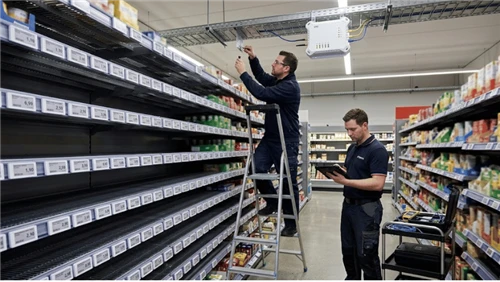
Electronic shelf label decommissioning is more than removing digital price tags from a shelf. A complete project must protect customer pricing, stop retired devices from receiving new events, end product bindings, remove gateway access, recover physical assets, separate reusable equipment from waste, and reconcile every device before closure.
Without those controls, a retailer may complete the physical removal while still leaving active registrations, missing labels, unresolved SKU associations, unrecorded batteries, or gateways connected to the store network.

Quick answer: Build an approved asset baseline, confirm ownership and contract duties, protect price continuity, unbind products, offboard gateways, inspect and classify the hardware, control batteries and reverse logistics, test every reusable label before rebinding, and close the project only when the digital and physical records agree.
An electronic shelf label solution includes more than the shelf device. Labels, gateways, cloud or local management services, product bindings, templates, user accounts, network permissions, mounting accessories, and asset records may all remain active after the display has been removed.
What Electronic Shelf Label Decommissioning Means
Electronic shelf label decommissioning is the controlled retirement or reassignment of ESL devices and their associated business, network, security, and asset records.
It differs from routine maintenance. Replacing one failed label is normally a repair task. Removing a storewide installation, changing suppliers, closing a location, or transferring thousands of labels to another store requires a formal lifecycle process.
Readers who need the underlying system context can first review how electronic shelf labels work. The important point for decommissioning is that the physical label, product association, platform registration, gateway connection, and asset record are related but separate objects.
A device should not be marked as retired merely because it has disappeared from the shelf.
When an ESL System Needs a Formal Decommissioning Plan
| Scenario | Primary Risk | Special Control |
|---|---|---|
| Store closure | Missing assets, incomplete price replacement, or active store access | Full-store inventory, temporary pricing, network offboarding, and final reconciliation |
| Store remodel or shelf reset | Loss of location history and incorrect rebinding | Zone-controlled removal and preserved fixture mapping |
| Vendor or platform migration | Old and new systems publishing at the same time | Controlled cutover, source ownership, compatibility testing, and credential retirement |
| Hardware refresh | Old and new device populations becoming mixed | Batch status, serial tracking, staged replacement, and separate exception reports |
| Damaged or recalled batch | Unsafe handling or repeated hardware failure | Quarantine, supplier investigation, and controlled evidence |
| Supplier or lease return | Contractual count, ownership, or condition disputes | Lease review, signed handover, and accepted condition grades |
Compatibility should be established from formal product and platform documentation. Two products using a similarly named frequency or protocol are not automatically interoperable. Supplier capabilities, contract terms, and ownership responsibilities should therefore be reviewed while choosing a retail ESL solution, not only when the contract ends.
Before the Ten Steps: Confirm Ownership and Contract Duties
The intended destination of every device may depend on who owns it. The retailer should distinguish:
- Retailer-owned labels and gateways
- Leased equipment
- Supplier-managed assets
- Warranty returns
- Take-back or recycling programs
- Devices held by a system integrator
- Equipment subject to an incident or evidence hold
Review the contract before deciding to reset, repair, sell, recycle, or transfer a device. A leased label may need to be returned in a specified condition, while a supplier-managed gateway may require the supplier to remove credentials or close the cloud registration.
The contract review should identify ownership, return deadline, approved packaging, condition standard, lost-device liability, data-retention requirements, warranty status, take-back responsibility, and the party authorized to approve disposal.
These obligations can materially affect the real costs of electronic shelf labels, especially when freight, temporary pricing, scanning, testing, repair, recycling, and missing-asset charges are included.
Define the Disposition of Every Asset
The following is a suggested starting framework. Actual grades and actions should follow the supplier, contract, safety process, and intended reuse environment.
| Disposition | Meaning | Approval Needed |
|---|---|---|
| Reuse | The device can be redeployed after inspection and testing | ESL operations or approved technical owner |
| Reprovision | The device is functional but requires new registration, configuration, or binding | Platform owner |
| Repair | The device needs an approved hardware repair | Supplier or repair owner |
| Battery service | An approved battery process is required before reuse | Qualified service owner |
| Return to supplier | The asset is covered by a lease, warranty, take-back, or contract return | Procurement or contract owner |
| Recycle | The device has reached end of life and enters an approved recycling route | Waste or sustainability owner |
| Quarantine | The device is damaged, unsafe, unidentified, or awaiting evaluation | Safety, supplier, or incident owner |
| Evidence hold | The device must be preserved for an incident, dispute, compliance review, or warranty claim | Authorized investigation owner |
A simple "working" or "broken" label is not enough. It does not confirm ownership, registration status, compatibility, battery condition, repairability, or approval for another store.

Step 1: Build an Asset Baseline
Before physical removal, export or create a device inventory. For each label, record:
- Device ID and serial number where available
- Model, size, firmware, and template group
- Store, zone, aisle, fixture, and current product binding
- Gateway association and last communication where supported
- Battery or device-health state
- Physical condition and installation date
- Ownership, lease, warranty, or supplier-return status
- Intended disposition and responsible owner
Gateways require a separate baseline containing the gateway ID, location, network address, power source, store or tenant, account or certificate, platform registration, monitoring rules, removal status, and final destination.
The baseline is the starting point for every later count. Without it, the project cannot prove whether an expected device was removed, returned, reused, recycled, lost, or left active in software.
Step 2: Protect Price Continuity Before Removal
Removing a customer-facing ESL creates an immediate pricing-control issue. Before the device is taken down, define what will display the approved price during the transition.
Possible controls include an approved paper replacement, a temporary shelf-edge sign, a tested replacement ESL, a closed fixture, or a controlled period outside trading hours. The selected method must follow the retailer's process and the rules that apply in the target market.
The replacement check should confirm the product, selling price, promotion condition, unit price where required, effective and expiration times, shelf position, and agreement with the POS or approved pricing source.
The consequences of an uncontrolled mismatch can extend beyond one missing tag. The guide to what happens when price displays are wrong explains why price continuity should be a release gate rather than a task completed after removal.
Temporary paper signs may be appropriate, but the retailer should understand the operational differences described in the comparison of electronic shelf labels versus paper labels.
Do not remove all customer-facing labels first and plan the replacement price display later.
Step 3: Unbind Products and Stop New Updates
The physical device and its product association should be retired as separate records.
- Record the last approved product and label state.
- End the product-to-label binding.
- Mark the device as unavailable for normal publication.
- Remove the label from scheduled price and promotion events.
- Stop or close pending retries where the platform supports that action.
- Preserve required binding and change history.
- Confirm that a later event cannot reactivate the retired association.
One product may have several facings. Unbinding one label should not remove valid labels at other shelf positions. Conversely, a discontinued SKU should not remain active because a secondary display was missed.
The exact platform statuses vary. The required outcome is that the device cannot continue to receive the wrong business event. The wider electronic shelf labelling workflow provides additional context for product data, update events, gateways, and endpoint confirmation.
Step 4: Offboard Gateways, Accounts, and Network Access
Gateways may contain or rely on registrations, network configuration, certificates, service accounts, local logs, monitoring rules, and remote-support access.
The offboarding record should consider:
- Management-platform deregistration
- Store or tenant removal
- Static address and network inventory removal
- Firewall and access-control entries
- Certificates, keys, or credentials
- API and integration service accounts
- Monitoring and alert rules
- Remote-support access
- Cloud asset inventory
- Approved configuration backup or destruction
- Power and Ethernet removal
NIST describes IoT decommissioning as including deregistration from controllers, smart hubs, or cloud services and removal from the network. It also notes that a factory reset can be part of the process, but the actual procedure should follow manufacturer instructions. See the official NIST IR 8349 IoT device lifecycle guidance.
Disconnecting an Ethernet cable does not prove that cloud registration, certificates, accounts, or remote access have been revoked.
Communication technology also affects association and confirmation behavior. Check supplier-specific assumptions against the comparison of Bluetooth, Wi-Fi, and Sub-GHz ESL communication.
Step 5: Remove Labels and Mounting Hardware by Zone
The approved removal method depends on the mounting system, which may include rails, snap-in adapters, magnets, adhesive mounts, peg hooks, freezer rails, counter stands, screws, or protective housings.
A rushed removal can damage the display, housing, clip, shelf rail, or reusable accessory. The team should therefore follow product-specific instructions and the principles in the electronic shelf label installation guide in reverse, where appropriate.
A practical zone-controlled sequence is:
- Close or control one defined zone.
- Confirm replacement pricing.
- Scan or record each label.
- End the digital binding.
- Remove the label and accessory with the approved tool.
- Inspect the display, housing, battery condition, and mount.
- Place the item in the correct disposition container.
- Reconcile the zone before moving to the next area.
Zone-level control makes a missing device easier to investigate than a storewide count performed after every aisle has been cleared.
Step 6: Inspect and Classify Returned Assets
Inspection should occur before equipment from several stores or projects is mixed.
| Grade | Typical Condition | Next Action |
|---|---|---|
| Grade A | Clean, intact, ownership and registration understood, no visible damage | Functional test and approval for reuse |
| Grade B | Potentially functional but needs cleaning, battery service, adapter replacement, or reprovisioning | Approved service workflow |
| Grade C | Faulty or incomplete but potentially repairable | Supplier or repair evaluation |
| Grade D | End of life or uneconomical to repair under the approved policy | Approved recycling route |
| Quarantine | Damaged battery, cracked housing, water or heat damage, unknown ownership, or incident evidence | Isolate and escalate |
E Ink explains that a bistable e-paper image can remain visible without continuous power. That means a retained price does not prove that the radio, battery, memory, housing, registration, or update path is healthy. See E Ink's explanation of bistable e-paper image retention.
Update and display behavior should be tested, not inferred from appearance. The article on ESL refresh rates and display performance explains why device state, display technology, image workload, and platform scheduling must be considered separately.
Step 7: Control Batteries and Electronic Waste
ESLs may use different battery chemistries, quantities, and service methods. The correct procedure must come from the specific product documentation, trained personnel, approved waste process, contract, and local requirements.
For the United States, the EPA advises that button-cell, coin, and lithium single-use batteries should not be placed in ordinary trash or municipal recycling bins. Its official used household battery guidance also directs users to identify the battery and use an appropriate collection route.
For EU operations, Regulation (EU) 2023/1542 concerning batteries and waste batteries provides the formal legal framework. The duties of a retailer, producer, distributor, supplier, recycler, or other party depend on the specific role and market.
The project record should identify battery chemistry, whether the battery remains in the device, who is authorized to handle it, the damaged-device procedure, temporary storage owner, quantity, collection or take-back provider, transfer date, and receipt or certificate where required.
Damaged, leaking, swollen, hot, or otherwise abnormal equipment should not enter the normal asset box. The article should not be used as a substitute for product-specific safety instructions or qualified transport advice.
Step 8: Reset, Reprovision, and Rebind Reusable Labels
A reusable label is not ready for another store simply because it passed a visual inspection. Its previous digital state must be closed, and the new state must be tested.
Rebinding Acceptance Checklist
| Acceptance Check | Evidence | Failure Action |
|---|---|---|
| Previous store assignment is closed | Platform export or status record | Return to reprovisioning queue |
| Previous product binding cannot publish again | Negative test or closed-binding record | Block redeployment |
| Device is registered to the approved new store or tenant | Registration record | Quarantine until corrected |
| New product and shelf position are assigned | Binding record and scan evidence | Do not install on the sales floor |
| Template is compatible with the label model | Rendered test image | Assign an approved template |
| Known price update completes | Platform and device status where supported | Technical investigation |
| Visible content matches the new product | Physical verification | Correct the binding or template |
| Asset register shows the new owner and location | Updated asset record | Hold shipment or installation |

A factory reset is not a universal substitute for platform deregistration. Some devices must be removed from the old management system before reset; others require an approved sequence after reset. Cross-platform use must be confirmed from formal compatibility documentation.
When a test update fails, separate binding, battery, gateway, network, template, and hardware causes. The guide to electronic shelf labels not updating provides a broader fault-isolation path.
Step 9: Control Reverse Logistics
Large projects involve many small, similar devices. Each shipment should preserve the origin store, project wave, container number, device and gateway quantity, accessory quantity, disposition category, sender, destination, receiver, count difference, observed damage, and final acceptance.
Sealed or numbered containers may be appropriate when the project requires controlled custody. The store should record the dispatch count, and the warehouse should reconcile receipt before devices are mixed with another store or project.
Store and batch identity may be needed for warranty, incidents, battery-age review, lease returns, supplier campaigns, and rebinding analysis. Do not erase the origin record before the destination confirms receipt.
Missing-Asset Escalation
- Compare the platform inventory with the pre-removal baseline.
- Check zone records, spare stock, damaged-device logs, and completed bindings.
- Review shipment containers and warehouse receipt records.
- Determine ownership, lease status, and any security or financial exposure.
- Assign an investigation owner and response deadline.
- Escalate unresolved devices according to the project, security, and contract process.
- Close the difference only with documented recovery or authorized acceptance.
Step 10: Reconcile, Apply Release Gates, and Sign Off
The project is complete only when physical and digital records agree and every unresolved issue has an approved status.
| Release Status | Typical Conditions |
|---|---|
| Stop Removal | Price continuity is not available, a critical binding error exists, or unsafe devices cannot be controlled |
| Quarantine | Ownership, battery condition, damage, registration, or destination is unknown |
| Conditional Close | Non-customer-facing exceptions have owners, deadlines, controls, and an authorized approver |
| Fully Closed | Required prices are protected, registrations and access are retired, assets are reconciled, dispositions are evidenced, and responsible owners approve the record |
No universal missing-device percentage can determine closure for every retailer. The acceptable result depends on ownership, security exposure, contract terms, device value, and whether the missing unit remains registered or associated with an active store.
Responsibility and Approval Matrix
| Activity | Responsible | Approver | Required Evidence |
|---|---|---|---|
| Temporary price replacement | Store operations | Pricing or trading owner | Shelf and POS verification |
| Label unbinding | ESL or application operations | Retail IT | Binding export and closed status |
| Gateway and credential offboarding | Network or platform team | Information security | Access-removal and deregistration record |
| Physical removal and zone count | Store or installation team | Project manager | Zone completion record |
| Battery and waste handling | Approved service or waste owner | Safety or sustainability owner | Transfer and receipt record |
| Rebinding and reuse approval | ESL operations | Technical product owner | Acceptance checklist |
| Final asset reconciliation | Asset management | Project sponsor | Signed final report |
The actual roles may differ, but every activity should have one accountable owner. A list of participating departments is not a substitute for assigned responsibility.
Audit Deliverables to Retain
- Approved asset and ownership baseline
- Device and gateway registration export
- Product-binding and scheduled-event records
- Price-continuity evidence
- Gateway, account, certificate, and remote-access offboarding record
- Zone removal counts
- Shipment manifest and warehouse receipt
- Condition grades and disposition report
- Rebinding acceptance results
- Supplier returns, warranty records, and recycling evidence
- Missing-asset and quarantine logs
- Conditional-close approvals and deadlines
- Final physical and digital reconciliation
- Business and technical sign-off
What to Include in the Decommissioning Budget
Do not estimate the project from hardware removal labor alone. The budget may need to include:
- Project planning and asset-data cleanup
- Temporary price labels and shelf verification
- Scanning, unbinding, and system administration
- Installation or removal tools
- Packaging, sealed containers, and freight
- Warehouse receiving and reconciliation
- Device testing, cleaning, repair, and reprovisioning
- Battery and electronic-waste handling
- Supplier or lease returns
- Credential and cloud-tenant offboarding
- Missing-asset investigation or contractual charges
In grocery and other high-promotion environments, the effort required to protect current prices and unit information may be significant. The guide to supermarket electronic price tags provides additional context for these operational demands.
Illustrative Store Closure Example
The following scenario is hypothetical and does not claim a customer result.
A retailer is closing a store with 4,000 installed labels, three gateways, 120 spares, freezer-grade models, and several mounting systems. The asset review finds that most labels are retailer-owned, 300 are leased under a supplier contract, and one gateway is managed by a third-party integrator.
The store will continue trading for four days during removal. A controlled plan would:
- Review ownership and return terms before resetting any leased device.
- Freeze non-essential template, binding, and campaign changes.
- Export device, binding, gateway, credential, and ownership records.
- Divide the store into removal zones.
- Install and verify temporary prices before each ESL is removed.
- Scan, unbind, inspect, and classify every device.
- Keep leased labels, retailer-owned labels, damaged devices, and freezer models in separate numbered containers.
- Retire store updates and deregister gateways after the final required event.
- Use the approved supplier workflow for the leased labels.
- Test retailer-owned Grade A labels before rebinding them to another store.
- Reconcile the warehouse receipt against the original 4,120-label inventory.
- Investigate each count difference and close credentials, support access, and platform registrations.
- Retain return, reuse, quarantine, recycling, and sign-off evidence.
The example demonstrates why physical removal, customer pricing, contract ownership, system offboarding, and final reconciliation must occur together.
Common Decommissioning Mistakes
| Mistake | Why It Fails | Better Control |
|---|---|---|
| Removing labels before preparing replacement prices | Customers may see no price or an outdated price | Verify the replacement before each removal wave |
| Deleting devices before exporting history | Asset, binding, and incident evidence may be lost | Export and approve records first |
| Treating a visible e-paper image as proof of health | The display can retain an image while the device is offline or faulty | Run an approved functional test |
| Mixing stores or ownership categories | Warranty, lease, and count investigations become difficult | Separate assets before shipment |
| Disconnecting gateways without revoking access | Cloud registrations, credentials, or support accounts may remain active | Use an offboarding checklist and evidence |
| Resetting leased equipment without contract approval | The retailer may breach return or evidence requirements | Confirm ownership and supplier instructions |
| Mixing reusable equipment and waste | Reuse evidence and safe handling become unreliable | Use separate disposition streams |
| Closing with unexplained count differences | Missing devices and active registrations remain unresolved | Assign, escalate, and formally approve every difference |
FAQ
Q: Can electronic shelf labels be reused in another store?
A: Possibly. The device must be owned or transferable, compatible with the target system, released from the old registration, inspected, tested, assigned to the new store, rebound to the correct product, and updated in the asset register.
Q: Can an ESL be reused with another supplier's platform?
A: Do not assume compatibility from the radio band or product appearance. Confirm device, gateway, firmware, security, registration, template, and licensing compatibility through formal documentation and controlled testing.
Q: Should an ESL be factory reset before recycling?
A: Follow the manufacturer, platform, contract, and approved waste process. The device may need to be deregistered or preserved for evidence before a reset. One reset sequence does not apply to every model.
Q: Who decides whether a missing label can be accepted?
A: The decision should involve the asset owner and any relevant security, finance, contract, or project approver. The record should state the device identity, last known assignment, registration status, exposure, investigation, and reason for acceptance.
Q: Can store staff remove ESL batteries?
A: Only when the product design, supplier instructions, training, safety process, and local rules permit it. Some devices should remain intact and be handled by an approved supplier, service provider, or recycler.
Q: When should the decommissioning process be repeated or reviewed?
A: Review the process after supplier changes, new label models, contract changes, store migrations, incidents, battery-policy changes, or any project that reveals missing assets, unsafe handling, failed rebinding, or incomplete access removal.
Final Takeaway
Electronic shelf label decommissioning is a lifecycle-control process, not a hardware-removal task.
A defensible project protects customer pricing, separates device retirement from product binding, removes gateway and platform access, respects ownership and contract terms, controls batteries and waste, tests every reusable label, and reconciles physical assets with digital records.
Before closing a store, replacing a platform, or refreshing the hardware fleet, make sure every label and gateway has a known owner, a known destination, a completed system status, and evidence accepted by the responsible teams.
Review the available electronic shelf labels and discuss device models, gateway architecture, ownership, rebinding, return, and end-of-life requirements with the LEGOYO team before finalizing a deployment or migration contract.